
Marriage therapy isn’t just for couples standing at the edge of divorce. Many partners who feel stuck in repetitive arguments, emotionally distant, or simply disconnected use it to rebuild closeness and communicate better. As couples therapy research shows, it’s a form of psychotherapy where both partners work with a licensed therapist to resolve conflicts, improve communication, and strengthen emotional bonds. This guide walks you through what marriage therapy is, how it works in California, what to expect in sessions, and how to find the right therapist for your relationship.
Table of Contents
- What is marriage therapy?
- How marriage therapy works in California
- Common issues addressed in marriage therapy
- What to expect in marriage therapy sessions
- How to find the right marriage therapist in California
- Next steps for California couples: Connect with expert marriage therapists
- Frequently asked questions
Key Takeaways
| Point | Details |
|---|---|
| Anyone can benefit | Marriage therapy serves couples in all stages, not just those in crisis. |
| California sessions explained | Therapists are licensed LMFTs; sessions are weekly, typically lasting several months. |
| Addresses real issues | Therapy tackles communication breakdowns, conflicts, and emotional distance. |
| Qualified therapist essential | Choose an LMFT with experience and evidence-based methods like EFT or Gottman. |
| Telehealth is an option | Many marriage therapists in California offer sessions online for convenience. |
What is marriage therapy?
Marriage therapy, also called couples therapy or marital therapy, is psychotherapy for couples who want to resolve relationship issues, improve how they communicate, and feel more connected. It’s not a last resort. It’s a proactive tool that works for couples at every stage, whether you’ve been together two years or twenty.
The core goals are straightforward:
- Improve communication so both partners feel heard
- Reduce conflict by identifying patterns that keep arguments stuck
- Rebuild emotional intimacy after distance has grown
- Strengthen trust following betrayal or repeated misunderstandings
- Navigate major transitions like parenthood, career changes, or loss
You don’t need to be in crisis to benefit. Couples who start therapy early, before small frustrations become deep resentments, often see faster and more lasting results. Explore the types of marriage therapy available to understand which approach might fit your relationship best.
“Marriage therapy helps couples resolve conflicts, improve communication, and strengthen emotional bonds, regardless of whether the relationship is in crisis.” — Harvard Health
How marriage therapy works in California
In California, marriage therapy is primarily delivered by Licensed Marriage and Family Therapists, commonly known as LMFTs. These professionals complete a master’s degree, accumulate 3,000 supervised clinical hours, and pass state licensing exams before they can practice independently. That’s a significant amount of training focused specifically on relationship dynamics.
Here’s a quick overview of what the therapy structure typically looks like:
| Element | Details |
|---|---|
| Session length | 45 to 60 minutes |
| Frequency | Weekly, especially early on |
| Average duration | 3 to 12 months |
| Format | Joint sessions, occasional individual check-ins |
| Setting | In-person or telehealth |
Understanding therapist qualifications in California helps you make a more confident choice when selecting someone to work with. Licensing isn’t just a formality. It signals that your therapist has been trained to handle the complexity of relationship dynamics without taking sides or causing harm.
On the financial side, many insurance plans offer partial coverage for marriage therapy, but full coverage is not guaranteed. Sliding-scale fees and HSA/FSA plans can make sessions more accessible. When choosing a marriage therapist, ask upfront about costs and payment options so there are no surprises.
Pro Tip: Call your insurance provider before your first session and ask specifically whether “couples therapy” or “marriage counseling” is covered. Some plans cover it under mental health benefits, but only if one partner has a documented diagnosis.
Common issues addressed in marriage therapy
Marriage therapy addresses a wide range of relationship struggles, from communication breakdowns and frequent conflicts to emotional disconnection and loss of intimacy. What makes therapy valuable is that it doesn’t just treat the symptom. It helps you understand the pattern underneath.

Here’s how common issues compare and what therapy targets in each case:
| Relationship issue | How therapy helps |
|---|---|
| Communication breakdown | Teaches active listening and assertive expression |
| Conflict escalation | Identifies triggers and de-escalation strategies |
| Emotional withdrawal | Rebuilds safety and vulnerability between partners |
| Loss of intimacy | Explores emotional and physical connection barriers |
| Trust issues | Structures accountability and rebuilds transparency |
| Parenting disagreements | Aligns values and creates shared approaches |
Left unaddressed, these issues tend to follow a predictable path:
- Small frustrations accumulate and partners stop bringing them up to avoid conflict.
- Emotional distance grows as both people feel unseen or unheard.
- Conflict becomes more intense because unresolved issues pile up.
- Withdrawal or escalation becomes the default response to disagreement.
- Disconnection deepens until partners feel more like roommates than partners.
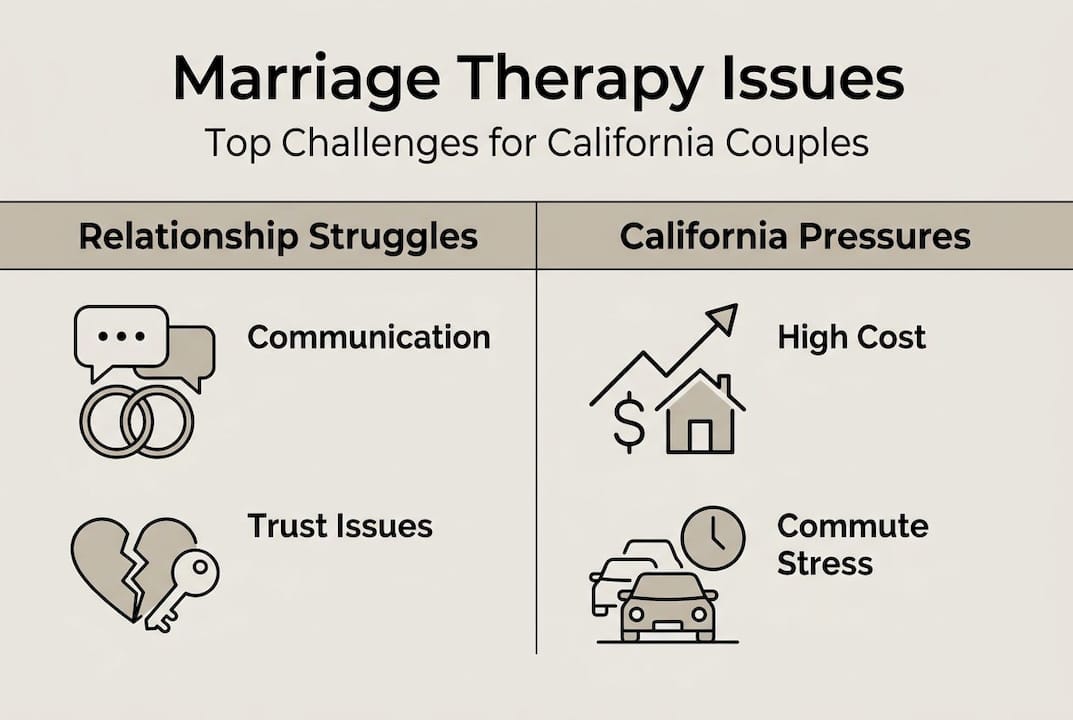
California couples face some unique pressures. High-cost living in the Bay Area, long commutes, blended families, and the state’s rich cultural diversity all add layers of complexity to relationships. A therapist familiar with these realities can help you navigate them more effectively. Learning about the benefits of couples counseling can also help you and your partner get aligned on why starting therapy is worth the investment. You can also explore different approaches to marriage therapy to find what resonates with your situation.
What to expect in marriage therapy sessions
Walking into a first session can feel intimidating. Knowing what actually happens inside the room makes it much less so. Most sessions follow a similar structure, though your therapist will adapt based on where you are in the process.
A typical session includes:
- Check-in: Both partners share how the week went and what’s on their mind.
- Goal focus: The therapist guides the session toward a specific issue or skill.
- Guided communication: Partners practice speaking and listening with the therapist’s support.
- Skills building: You learn tools like “I” statements, pausing during conflict, or identifying emotional needs.
- Wrap-up: The therapist summarizes key insights and may suggest something to practice before the next session.
Your therapist is a facilitator, not a referee. They won’t declare a winner or take sides. Their job is to create a space where both of you feel safe enough to be honest. That’s harder than it sounds, and it’s exactly why professional training matters.
Sessions typically run 45 to 60 minutes and progress builds over weeks and months, not overnight. Evidence-based techniques like Emotionally Focused Therapy (EFT) and the Gottman Method are commonly used because research supports their effectiveness with couples.
Pro Tip: The couples who get the most from therapy are the ones who practice between sessions. If your therapist suggests a communication exercise or a check-in ritual, try it. Real change happens outside the therapy room, not just inside it.
If getting to an office feels like a barrier, online marriage therapy options are widely available in California and just as effective for many couples. You can also read more about the therapist’s role in marriage therapy to set realistic expectations before your first appointment.
How to find the right marriage therapist in California
Finding the right therapist is one of the most important decisions you’ll make in this process. A good fit makes the work feel possible. A poor fit can make it feel pointless. Here’s a step-by-step approach that works:
- Identify your needs. Are you dealing with communication issues, infidelity, parenting conflict, or emotional distance? Knowing your primary concern helps you search more specifically.
- Search for licensed LMFTs. Use the California Association of Marriage and Family Therapists directory or your insurance provider’s portal to find licensed professionals near you.
- Verify their license. Check the California Board of Behavioral Sciences website to confirm the therapist’s license is active and in good standing.
- Ask about their approach. LMFTs trained in EFT or Gottman use evidence-based methods with strong track records for couples.
- Schedule a consultation. Most therapists offer a brief intro call. Use it to ask about their experience with couples, their style, and how they handle conflict in sessions.
- Trust your gut. Both partners should feel reasonably comfortable with the therapist. If one of you feels dismissed or judged after the first session, it’s okay to keep looking.
Red flags to watch for include therapists who seem to take sides, avoid structure, or rely entirely on venting without building skills. Therapy should feel productive, even when it’s uncomfortable.
For a more detailed walkthrough, read our guide on how to choose a marriage therapist or browse best marriage counseling services available in California.
Next steps for California couples: Connect with expert marriage therapists
If this article has helped clarify what marriage therapy is and whether it might be right for you, the next step is finding support that fits your life. At Revive Health Therapy, we offer evidence-based couples therapy for California residents, both in-person at our Walnut Creek and Oakland locations and through secure telehealth sessions statewide.
Our therapists are trained in proven methods like EFT, CBT, and trauma-informed care, and we accept insurance along with HSA/FSA plans. Sliding-scale fees are available to make therapy accessible regardless of your income. Whether you’re navigating a specific conflict or simply want to feel closer to your partner, we’re here to help. Learn more about why seek psychotherapy, explore our telehealth marriage therapy options, or contact a therapist today to take the first step.
Frequently asked questions
Is marriage therapy effective for couples not in crisis?
Yes. Therapy strengthens emotional bonds and improves communication at any stage, making it just as valuable for couples who want to grow as for those in serious conflict.
How do I know if a marriage therapist is qualified in California?
Look for an LMFT with an active California license. California therapists require a master’s degree, 3,000 supervised hours, and passing state exams, so licensure is a strong indicator of proper training.
What therapy approaches are evidence-based for couples?
Emotionally Focused Therapy (EFT) and the Gottman Method are the most well-researched options. Seek therapists trained in EFT or Gottman for approaches backed by decades of clinical research.
Can we do marriage therapy online in California?
Absolutely. Telehealth sessions are widely available across California, offering the same quality of care as in-person therapy with added flexibility for busy couples.