
Prioritizing mental wellness in marriage is one of the most direct things you can do for both your relationship and your own health. Couples who actively tend to their emotional and psychological wellbeing report stronger marital satisfaction, better communication, and lower rates of depression than those who let mental health slide. The research is clear: relationship confidence is the single strongest factor in improving mental health, sleep quality, and reducing substance use among married individuals. This isn’t about having a perfect marriage. It’s about building one where both partners feel safe, seen, and supported.
Here is what that looks like in practice:
- Stable marriages reduce depressive symptoms for both men and women, while divorce raises them, often for years afterward.
- Emotional safety within the relationship protects individual mental wellbeing, particularly during conflict or stress.
- Mutual support and open communication are the backbone of mental wellness in any partnership.
- Unaddressed mental health struggles in one partner tend to ripple outward, affecting the other and the relationship as a whole.
- Professional support, including couples therapy and counseling, produces measurably better outcomes than either partner managing alone.
Why mental wellness pays off for both partners and the marriage itself
Mental wellness in marriage isn’t a soft concept. It has concrete, measurable effects on individual health and relationship quality. Studies have found that better mental health indirectly boosts marital satisfaction by increasing personal happiness, meaning your own psychological state shapes how fulfilled you feel in your relationship. That’s a feedback loop worth paying attention to.
The benefits extend well beyond mood:
- Reduced depression. Longitudinal research confirms that getting married decreases depressive symptoms, while divorce raises them, with elevated symptoms persisting years after a breakup.
- Better sleep. Partner support and relationship confidence are directly linked to improved sleep quality.
- Lower substance use. Stable, emotionally healthy marriages correlate with reduced heavy drinking and other high-risk behaviors.
- Greater resilience. Couples with strong mental wellness foundations handle stress, illness, and life transitions with more flexibility.
- Healthier lifestyle choices. Spouses in mentally well partnerships tend to encourage each other’s physical health, from eating habits to exercise.
The protective effect of a stable, mentally healthy marriage compounds over time. Stably married adults generally show fewer depressive symptoms as they age compared to those who remain unmarried, even after accounting for baseline mental health differences. That’s not a small finding.
How mental wellness shapes communication, conflict, and closeness
Good mental health doesn’t just make you feel better individually. It changes how you show up in every conversation with your partner.

When both partners are in a mentally well place, open and nonjudgmental communication becomes the default rather than the exception. You listen more fully. You respond rather than react. The NHS notes that being able to speak openly about feelings, and genuinely listening in return, reduces relationship anxiety and protects mental wellbeing for both people. That’s not just good advice; it’s a documented mechanism.
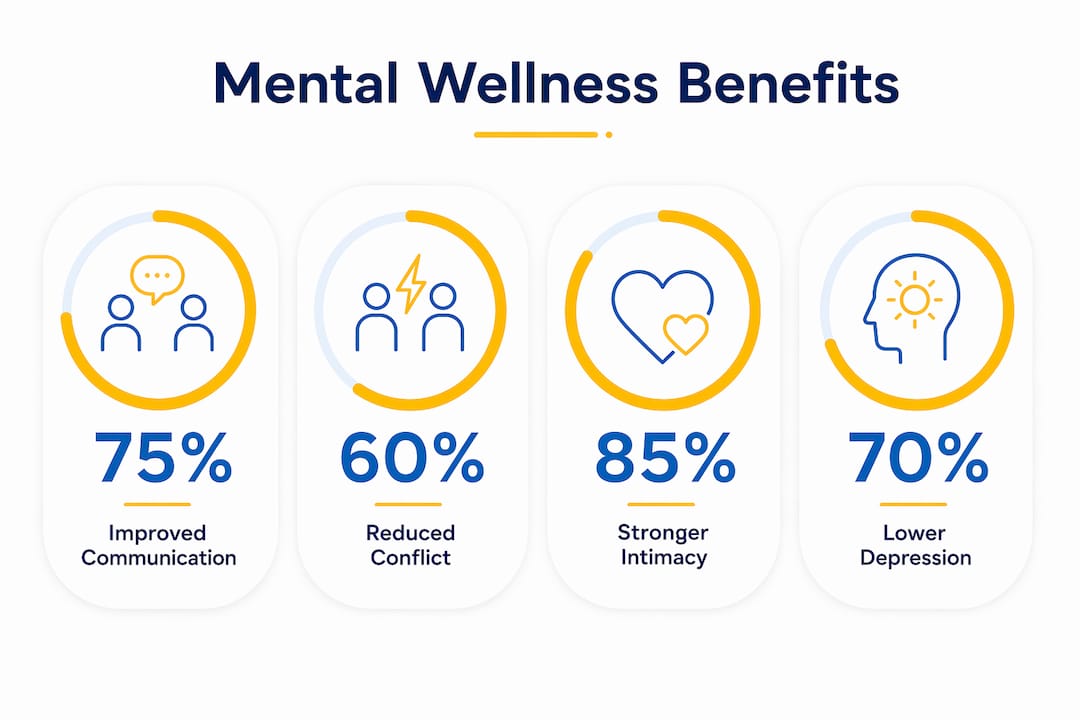
Conflict is where mental wellness really shows its hand. Constructive communication built on appreciation and non-blaming language predicts better marital stability. Negative patterns like criticism, contempt, and defensiveness do the opposite: they worsen both mental health and relationship quality over time. Emotional regulation is the skill underneath all of this. When you can manage your own distress during a disagreement, you don’t escalate. You stay in the conversation.

Intimacy deepens through the same mechanism. Research on self-expansion, the idea that partners grow each other’s traits, skills, and sense of self, shows it correlates with lower depression and greater wellbeing. A study with over 700 individuals and 100 couples confirmed this link. When you genuinely help each other grow, the emotional bond strengthens in ways that pure conflict management never achieves.
Unaddressed mental health issues work in the opposite direction. Anxiety, depression, or unresolved trauma in one partner creates distance, misreads, and tension that can quietly erode the relationship before either person names what’s happening. Checking in on each other’s emotional state isn’t a luxury. It’s maintenance.
Pro Tip: During disagreements, try the “soft startup” technique from Gottman-informed therapy: begin with “I feel” rather than “You always.” It shifts the frame from blame to vulnerability, which makes it far easier for your partner to actually hear you.
Practical ways couples can build mental wellness together
The couples who do this well don’t wait for a crisis. They build small, consistent habits that keep the emotional connection alive and catch problems early.
- Regular emotional check-ins. Set aside 10–15 minutes a few times a week to ask each other how you’re really doing. Not logistics. Not the to-do list. Emotional temperature.
- Seek professional support early. Couples therapy works best when it’s not a last resort. Treating relationship distress through couple-based interventions improves both individual and relationship mental health outcomes more than individual therapy alone.
- Practice empathy and validation. You don’t have to agree with your partner’s feelings to acknowledge them. “That sounds really hard” goes further than most people expect.
- Engage in shared activities that stretch you both. Self-expansion research points to activities that feel new or challenging together as particularly effective at reducing depressive symptoms and building closeness.
- Set boundaries that protect individual mental health. Healthy marriages make room for each partner’s separate needs, friendships, and downtime. Enmeshment isn’t closeness; it’s pressure.
- Use couple relationship education programs. Meta-analyses confirm that both online and in-person programs improve communication skills, increase satisfaction, and reduce anxiety and depression symptoms across diverse couples, including socially disadvantaged groups.
Pro Tip: If scheduling in-person therapy feels impossible, telehealth marriage therapy removes the commute barrier entirely. Consistency matters more than format, and most couples find it easier to keep appointments when sessions happen from home.
What the research actually says about mental wellness and marriage
The science here is more specific than most people realize, and it’s worth knowing the details.
Marriage as a mental health protective factor
ASPE research synthesizing recent longitudinal studies confirms that marriage reduces depressive symptoms for both men and women. Getting married decreases those symptoms; getting divorced raises them, with the elevation persisting long after the breakup. Stably married adults also show smaller increases in depressive symptoms as they age compared to those who remain unmarried, even after controlling for baseline mental health.
The mechanism matters. Marriage improves mental health partly through social connection and emotional fulfillment, satisfying the human need for intimacy in ways that reduce psychological distress. It’s not the legal status doing the work. It’s the quality of the emotional bond.
Couples therapy outperforms individual therapy for relationship-linked distress
When mental health symptoms are tied to relationship distress, treating only the individual is less effective. Couple-based interventions improve both individual mental health symptoms and relationship quality more than individual therapy alone. This is a finding that still surprises many people, but it makes intuitive sense: if the relationship is part of the problem, the relationship needs to be part of the treatment.
Self-expansion reduces depression within partnerships
Research with 700+ individuals and 100 couples found that self-expansion within a relationship, viewing your partner as a source of personal growth, correlates with lower depression and greater overall wellbeing. Couples who actively help each other learn new things, take on challenges, and expand their sense of identity show measurably better mental health outcomes.
Key findings at a glance
| Research area | Finding | Implication for couples |
|---|---|---|
| Depression and marital status | Stable marriage reduces depressive symptoms; divorce raises them long-term | Investing in marriage quality is a mental health strategy |
| Relationship confidence | Strongest single factor improving mental health, sleep, and reducing substance use | Build trust and emotional security deliberately |
| Couples therapy vs. individual therapy | Couple-based interventions outperform individual therapy when distress is relational | Seek couples therapy, not just personal therapy, for relationship-linked issues |
| Self-expansion | Correlates with lower depression in studies of 700+ individuals and 100 couples | Pursue growth together, not just side by side |
| Relationship education programs | Meta-analyses confirm improved communication and reduced anxiety/depression | Structured programs work, even online formats |
| Emotional safety during conflict | Open, supportive emotional contexts reduce anxiety and protect wellbeing | Prioritize how you fight, not just whether you fight |
Revivehealththerapy offers evidence-based therapy modalities including EMDR, CBT, and mindfulness-based approaches, all of which have documented effectiveness for the anxiety, depression, and relationship challenges that most commonly affect married couples. Both in-person sessions in Walnut Creek and Oakland and statewide telehealth options are available, with sliding-scale fees and insurance acceptance to keep access realistic.
Key Takeaways
Prioritizing mental wellness in marriage directly reduces depression, improves communication, and builds the emotional safety that keeps relationships stable and satisfying over time.
| Point | Details |
|---|---|
| Relationship confidence leads | It is the strongest single factor improving mental health, sleep, and reducing substance use in married individuals. |
| Stable marriage protects mental health | Longitudinal research confirms marriage reduces depressive symptoms, while divorce raises them, often for years. |
| Mental health drives marital satisfaction | A study found better mental health indirectly boosts marital satisfaction through increased personal happiness. |
| Couples therapy beats individual therapy alone | Couple-based interventions improve both individual and relationship mental health more than individual therapy when distress is relational. |
| Self-expansion lowers depression | Research with 700+ individuals and 100 couples links self-expansion in relationships to lower depression and greater wellbeing. |
Ready to take your marriage’s mental wellness seriously? Revivehealththerapy provides accessible, evidence-based psychotherapy for couples across California, in person in Walnut Creek and Oakland, and via secure telehealth statewide. Sliding-scale fees and insurance acceptance, including HSA/FSA plans, make consistent support realistic for most couples.
Start with psychotherapy built around your relationship’s actual needs, not a one-size-fits-all program.
Recommended
- Role of therapists in marriage health: California guide – ReviveHealthTherapy
- Marriage counseling modalities: Your guide to stronger bonds – Revive Health Therapy
- Telehealth Marriage Therapy: Improving Couples’ Connections – ReviveHealthTherapy
- What is premarital counseling: benefits and preparation – Revive Health Therapy