
TL;DR:
- Peer support therapy involves individuals with lived mental health experience providing emotional and practical help outside clinical treatment. It emphasizes mutuality, shared experience, and empowerment, offering evidence-backed benefits such as reduced depression and hospitalizations, especially with sustained engagement. When combined with professional therapy, peer support enhances recovery, reduces isolation, and fills gaps that clinical methods alone cannot address effectively.
Peer support therapy is a complementary mental health approach where individuals with lived experience of mental health challenges provide emotional, social, and practical support to others facing similar struggles, outside of formal clinical treatment. The industry term for this practice is peer support, and it operates on three foundational principles: mutuality, shared experience, and empowerment. Organizations like Mental Health America and SAMHSA have formalized this model, recognizing it as a distinct and evidence-backed layer of care for people managing anxiety, depression, and trauma recovery. Unlike clinical therapy, peer support does not diagnose or treat. It connects, sustains, and empowers. For anyone exploring complementary mental health approaches, understanding what peer support offers and where it fits in a recovery plan is genuinely useful.
What is peer support therapy and how does it work?
Peer support is defined by mutuality and shared experience as its core mechanism, not credentials or clinical training. A peer support worker is someone who has navigated a mental health challenge and now uses that experience to help others move forward. This is what separates peer support from counseling or psychotherapy: the helper’s authority comes from having been there, not from a license.

In practice, peer support involves a range of activities that go well beyond conversation. SAMHSA outlines peer worker roles as including emotional support based on lived experience, facilitating peer groups, advocacy within healthcare systems, connecting individuals to community resources, and helping with goal setting. These activities happen in community centers, hospitals, online platforms, and recovery programs across the country.
SAMHSA’s competency framework for peer workers emphasizes two non-negotiable skills: creating psychologically safe spaces and using recovery-oriented language. Recovery-oriented language avoids labels like “addict” or “chronic case” and instead centers possibility and progress. This matters because the words used in support conversations directly shape how someone understands their own capacity to recover.
Pro Tip: When evaluating a peer support program, ask whether peer workers receive ongoing supervision and training. Programs without structured oversight often dilute the very qualities that make peer support effective.
Peer support programs operate across settings that clinical therapy rarely reaches: late-night crisis text lines, community drop-in centers, and workplace wellness programs. This reach is one of peer support’s most underappreciated strengths.
What does research say about the effectiveness of peer support?
The evidence base for peer support has grown substantially over the past decade, and the findings are specific enough to guide real decisions. A systematic review of group-based peer support found statistically significant improvements in recovery outcomes, depression symptom reduction, empowerment scores, and fewer rehospitalization days. That last finding carries particular weight: fewer hospitalizations represent both better quality of life and lower healthcare costs.
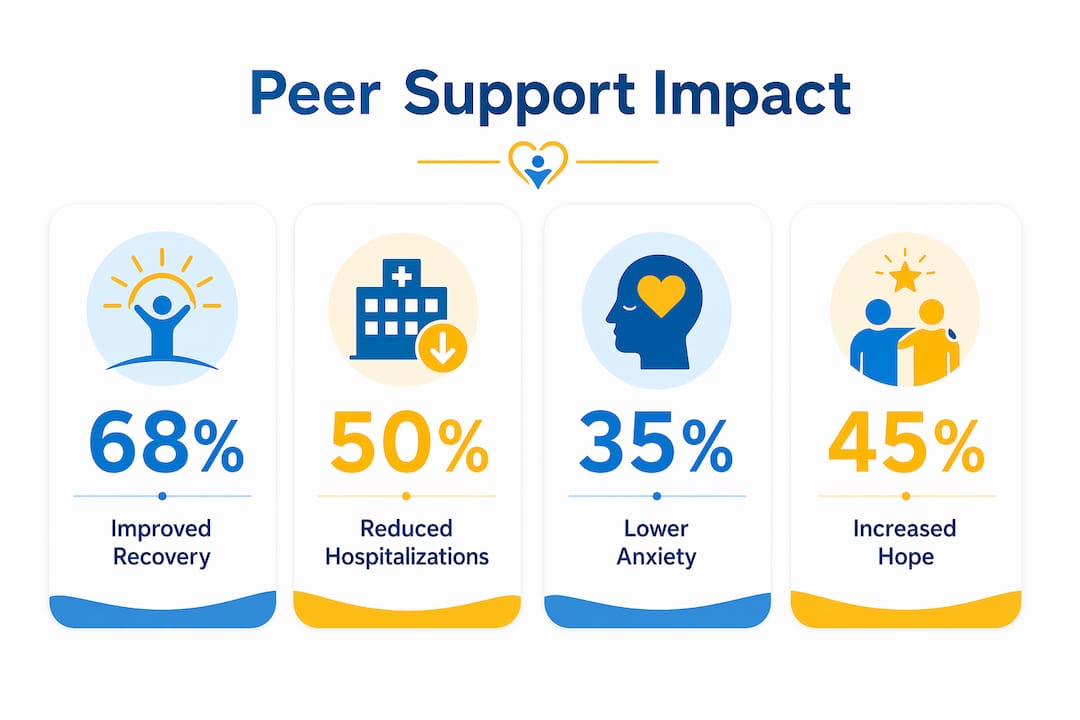
The multicenter UPSIDES randomized controlled trial added important nuance. Participants who received 3 or more peer support sessions showed measurable gains in social inclusion, hope, and empowerment. The average participant received 6.9 sessions, suggesting that meaningful benefits require sustained engagement, not a single conversation.
| Outcome Area | Evidence Finding |
|---|---|
| Depression symptoms | Statistically significant reduction in group-based peer support reviews |
| Social inclusion | Improved in UPSIDES RCT, especially with 3+ sessions |
| Empowerment | Consistent gains across multiple study designs |
| Rehospitalization | Fewer days for participants in structured peer programs |
| Daily functioning | Improved self-efficacy and reduced mental health barriers |
Research also shows that intervention structure shapes outcomes in predictable ways. Manualized peer programs, those following a defined curriculum, produce stronger symptom relief. Flexible, peer-led groups tend to produce better social outcomes like reduced isolation and increased sense of belonging. Neither model is universally superior. The right fit depends on what a person needs most at a given stage of recovery.
“Peer support often improves self-efficacy and daily life functioning, highlighting recovery’s broader dimensions beyond symptom control.” — BMC Psychiatry peer support trial
One honest limitation: the systematic review noted gender imbalances in study samples, which affects how broadly the findings apply. Most studies also focus on severe mental illness rather than moderate anxiety or depression, so the evidence base for milder presentations is still developing. That said, the direction of findings is consistently positive, and improved self-efficacy in daily life is a meaningful outcome regardless of diagnosis severity.
How does peer support differ from and complement clinical therapy?
Peer support and clinical therapy are not competing approaches. They address different needs and operate through different mechanisms, which is exactly why they work well together.
Clinical therapy, whether CBT, EMDR, or psychodynamic work, is delivered by licensed professionals trained to assess, diagnose, and treat mental health conditions. A therapist holds clinical responsibility for your care. A peer support worker holds none of that responsibility. Their role is to share experience, offer encouragement, and help you navigate daily life between clinical appointments.
| Dimension | Clinical therapy | Peer support |
|---|---|---|
| Authority basis | Professional license and training | Lived experience of recovery |
| Primary function | Diagnosis, treatment, skill-building | Emotional support, advocacy, connection |
| Setting | Clinical office or telehealth | Community, peer groups, informal settings |
| Scope | Defined by licensure and ethics codes | Defined by SAMHSA competency frameworks |
| Best used for | Treating symptoms and underlying conditions | Sustaining recovery and reducing isolation |
SAMHSA describes peer support as extending recovery beyond clinical visits by leveraging the credibility that comes from shared experience. A therapist can teach you a coping skill. A peer support worker can sit with you on a hard Tuesday night and remind you that they used that same skill when they were where you are now. That is a different kind of help, and it fills a gap that clinical therapy structurally cannot.
For people managing anxiety, depression, or trauma recovery, the combination of both approaches produces something neither delivers alone. Therapy addresses the root and the symptoms. Peer support sustains the work in real life, reduces the isolation that often accompanies mental health struggles, and keeps hope alive between sessions. Group therapy can serve a similar bridging function, offering shared experience within a clinically structured environment.
Pro Tip: If you are currently in therapy, mention peer support to your therapist. A good clinician will help you integrate both without role confusion, and may even recommend specific programs that align with your treatment goals.
How can you access peer support therapy safely and effectively?
Finding quality peer support requires more than a Google search. The program’s structure, the training of its peer workers, and the clarity of roles all determine whether you benefit or simply spend time in an unproductive group. Here is a practical sequence for getting started:
-
Start with established organizations. Mental Health America, NAMI (National Alliance on Mental Illness), and local community mental health centers all maintain directories of peer support programs. These organizations vet programs for basic quality standards.
-
Ask about peer worker training. Effective peer workers complete formal training and receive ongoing supervision. Clear role definitions and supervised programs are critical to program quality. If a program cannot tell you how its peer workers are trained, look elsewhere.
-
Commit to multiple sessions. Benefits from peer support are stronger with 3 or more sessions, not a single encounter. Treat it as an ongoing relationship, not a one-time resource.
-
Integrate it with your clinical care. Share your peer support participation with your therapist or psychiatrist. The two approaches reinforce each other when your care team knows the full picture.
-
Watch for warning signs. A peer support worker who offers clinical advice, makes diagnoses, or discourages you from professional treatment has stepped outside their role. Good peer support stays in its lane and actively supports your clinical care.
Online peer support communities through platforms like 7 Cups or NAMI’s peer-to-peer programs offer accessible starting points, particularly for people in areas with limited in-person options. California residents have additional access through county mental health departments, which often fund peer support programs as part of the state’s Mental Health Services Act.
Key takeaways
Peer support therapy works because it combines lived experience with structured support, filling the recovery gaps that clinical therapy alone cannot reach.
| Point | Details |
|---|---|
| Core definition | Peer support uses shared lived experience to provide emotional, social, and practical help outside clinical settings. |
| Evidence base | Research shows significant gains in depression reduction, empowerment, and social inclusion, especially with 3+ sessions. |
| Distinct from therapy | Peer workers do not diagnose or treat; their authority comes from personal recovery experience, not clinical licensure. |
| Best used together | Combining peer support with clinical therapy produces stronger recovery outcomes than either approach alone. |
| Quality matters | Supervised, trained peer workers in structured programs deliver measurably better results than informal or unsupported models. |
Why peer support deserves more credit than it gets
I have watched peer support transform people’s recovery trajectories in ways that surprised even their clinical teams. Not because it replaced therapy, but because it did something therapy structurally cannot: it put someone in the room who had already survived what the person was going through.
The most common mistake I see is treating peer support as a lesser option, something you do when you cannot afford therapy or when a waitlist is too long. That framing misses the point entirely. Peer support is not a substitute. It is a different tool for a different job, and the research backs that up clearly.
What I tell people is this: the quality of the peer support program matters enormously. A well-trained peer worker operating within a supervised program is genuinely powerful. An untrained volunteer in an unstructured group can actually reinforce unhelpful patterns. Do not skip the vetting step.
The future of mental health care in California and nationally is moving toward integrated models where peer support workers sit alongside licensed clinicians in the same care teams. That integration is already happening in some county mental health systems, and the outcomes data supports expanding it. If you are managing anxiety, depression, or trauma recovery, peer support is not a consolation prize. It is a legitimate, evidence-backed part of a complete recovery plan.
— Amy
How Revivehealththerapy supports your full recovery
If peer support has shown you what recovery can look like, clinical therapy is where you build the skills to get there. Revivehealththerapy offers evidence-based psychotherapy in California, including EMDR, CBT, and trauma-informed care, at locations in Walnut Creek and Oakland, as well as statewide telehealth sessions.
Peer support and psychotherapy work best as partners. Revivehealththerapy’s therapists understand how to integrate both into a treatment plan that fits your life. Whether you are working through anxiety, depression, or trauma recovery, the team offers sliding-scale fees and accepts most insurance plans, including HSA and FSA. Explore psychotherapy options in California and take the next step toward integrated mental health care.
FAQ
What is the difference between peer support and therapy?
Peer support is provided by individuals with lived mental health experience and focuses on emotional connection, advocacy, and recovery encouragement. Clinical therapy is delivered by licensed professionals who diagnose and treat mental health conditions using evidence-based methods like CBT or EMDR.
How many peer support sessions do you need to see results?
Research from the UPSIDES randomized controlled trial shows that benefits are strongest with three or more sessions. Peer support produces better outcomes when treated as an ongoing relationship rather than a single encounter.
Is peer support therapy evidence-based?
Yes. Systematic reviews and randomized controlled trials show peer support produces statistically significant improvements in depression symptoms, empowerment, social inclusion, and reduced rehospitalization rates, particularly in structured, supervised programs.
Can peer support replace clinical therapy for anxiety or depression?
Peer support does not replace clinical therapy. It complements it by sustaining recovery between sessions, reducing isolation, and reinforcing coping skills in everyday life. For anxiety and depression, combining both approaches produces stronger outcomes than either alone.
How do I find a quality peer support program?
Start with Mental Health America or NAMI directories, which list vetted programs. Ask whether peer workers receive formal training and ongoing supervision, since program structure directly determines the quality and safety of the support you receive.
Recommended
- Group Therapy for Anxiety, Depression & Trauma: 2026 – Revive Health Therapy
- Therapy for Teens: Building Self-Growth and Resilience – ReviveHealthTherapy
- Role of Therapy in Trauma Recovery: Evidence and Impact – ReviveHealthTherapy
- Role of Parents in Therapy: Supporting Child Recovery – ReviveHealthTherapy