
TL;DR:
- Strengths-based therapy focuses on a person’s existing capabilities, values, and past successes rather than solely on symptoms. It improves mental health by surfacing coping evidence, enhancing motivation, and building resilience, especially in cases of depression, anxiety, and trauma. This approach combines concrete behavioral techniques with symptom assessment to create lasting recovery and increased self-confidence.
Strengths-based therapy is defined as a clinical approach that organizes treatment around a person’s existing capabilities, values, and past successes rather than focusing solely on symptoms or deficits. Rooted in positive psychology and resilience science, it operates as a “both/and” model: clinicians still assess symptoms and risks, but they build treatment plans around what already works for the person in front of them. This makes it especially relevant for people managing anxiety, depression, and trauma, where hopelessness and eroded self-confidence are often the biggest barriers to recovery. Understanding why use strengths-based therapy starts with recognizing that what you can do matters just as much as what you are struggling with.
Why use strengths-based therapy to improve mental health outcomes?
Strengths-based therapy shifts focus from deficits to a person’s existing resources, competencies, and evidence of past coping. This is not a rejection of symptom management. It is a deliberate expansion of the treatment frame so that clients have more to work with than a list of problems.

The clinical evidence supports this approach. Meta-analyses of positive psychology interventions show effect sizes around d≈0.29–0.47 for well-being improvements and moderate reductions in depressive symptoms. Those numbers are modest but consistent across multiple study designs. Strengths-based exercises rank among the best-supported categories within positive psychology interventions.
The mechanism behind these results is straightforward. Depression and anxiety erode motivation, engagement, and the ability to see oneself as capable. Surfacing evidence of coping and resilience directly counters the hopelessness and distorted self-perception that keep people stuck. When a person can point to real, concrete examples of their own persistence or help-seeking, the narrative of “I can’t do this” becomes harder to maintain.
Specific exercises accelerate this process. The “use your signature strengths in a new way” exercise, tested in a randomized trial, produced sustained increases in happiness and reduced depressive symptoms at follow-up assessments up to six months after the intervention. That durability matters. Many therapy gains fade quickly. Strengths-based exercises appear to create lasting behavioral habits, not just temporary mood lifts.
- Reduced depressive symptoms through active strengths application
- Improved self-esteem and confidence by building on real competencies
- Greater therapeutic engagement because clients feel seen, not just diagnosed
- Stronger resilience by connecting personal strengths to coping plans
- Increased motivation by linking treatment goals to what already works
Pro Tip: Pair a strengths journal with your therapy sessions. Write down one specific moment each day where you used a personal strength, no matter how small. This practice reinforces the neurological habit of noticing capability rather than defaulting to self-criticism.
“Using strengths in therapy creates a foundation of competence and confidence that enables clients to engage more effectively with challenging work while still acknowledging symptoms.” — Strengths Based Therapy: A Practical Guide for Clinicians
What are the core techniques used in strengths-based therapy?
Strengths-based therapy techniques are concrete and structured. This is not a vague encouragement to “think positive.” Each technique translates abstract personal qualities into observable, behavioral steps that connect directly to functioning and risk reduction.
The most common techniques include:
- Strengths assessment. Clinicians use structured tools or guided conversation to identify specific competencies. Examples include consistent follow-through on commitments, the ability to ask for help under stress, and persistence through setbacks. These are behavioral, not generic.
- Reframing. A therapist helps a person reinterpret a perceived failure through the lens of what they actually did well. Someone who “fell apart” during a panic attack may also have called a friend, which is a genuine strength worth naming.
- Strengths journaling. Writing exercises build the habit of noticing capability. Clients record daily examples of strengths in action, creating a personal evidence base to counter negative self-talk.
- Skill-building linked to strengths. New coping skills are taught in direct connection to existing strengths. A person who is already good at planning can apply that strength to building a structured anxiety management routine.
- Behavioral activation plans. Clinicians create concrete behavioral plans tied to identified strengths and functioning goals. These plans are specific enough to be measurable and linked to risk reduction strategies.
Clinicians must define strengths behaviorally to avoid two common pitfalls. The first is generic framing, where “you’re so strong” replaces specific, usable feedback. The second is avoidance, where focusing on strengths becomes a way to sidestep painful but necessary emotional work. Strengths must be functional and behavioral to prevent either trap.
In trauma contexts, this matters even more. A person processing trauma may have genuine strengths in compartmentalization or social connection. A skilled clinician names those strengths explicitly and links them to the trauma work ahead, rather than using them as a reason to avoid processing the trauma itself.
Pro Tip: If you are working with a therapist on strengths, ask them to write down the specific behavior they observed, not just the label. “You reached out when you were overwhelmed” is more useful than “you’re resilient.” Specificity makes strengths actionable.
How does strengths-based therapy compare with traditional problem-focused therapy?
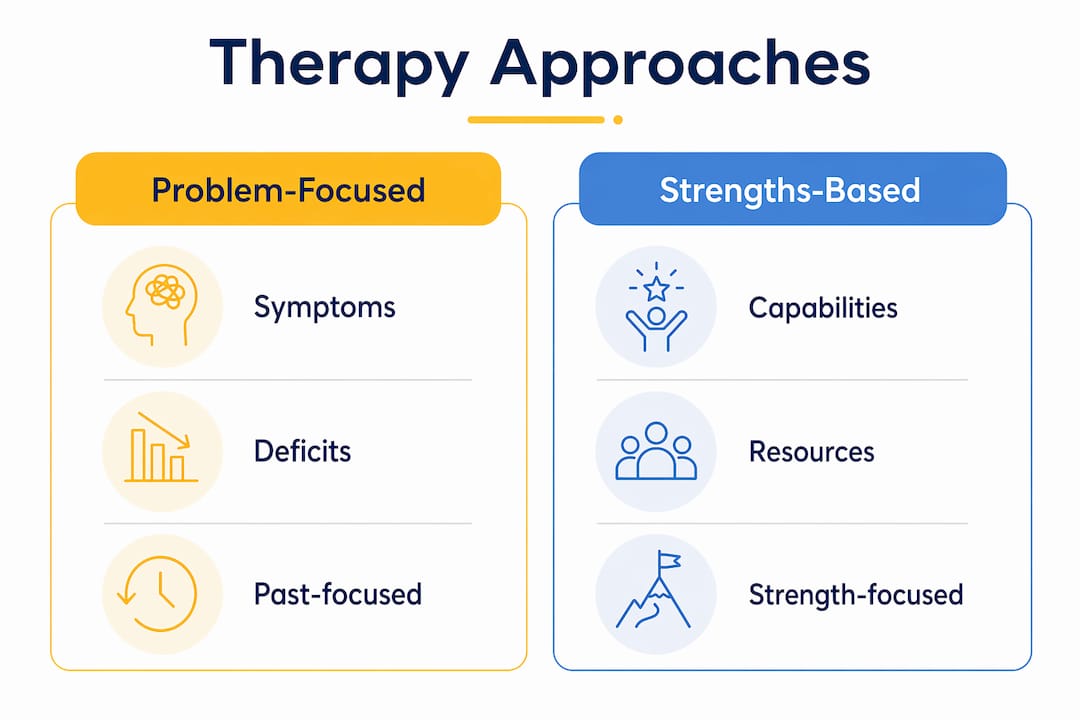
Traditional problem-focused therapy, including many applications of Cognitive Behavioral Therapy (CBT), centers treatment on identifying and correcting maladaptive thoughts, behaviors, and symptoms. Strengths-based therapy does not discard that work. It adds a parallel track that builds on what already functions well.
The practical difference shows up in how sessions feel and what clients leave with. Problem-focused approaches can inadvertently reinforce a person’s identity as someone defined by their disorder. Strengths-based approaches give clients an active role in their own recovery by making their capabilities central to the treatment plan.
| Feature | Problem-focused therapy | Strengths-based therapy |
|---|---|---|
| Primary focus | Symptoms, deficits, maladaptive patterns | Existing capabilities, resources, past successes |
| Client role | Recipient of symptom correction | Active agent using personal strengths |
| Motivation source | Reducing distress | Building on what already works |
| Risk and symptom assessment | Central to treatment | Required and integrated, not replaced |
| Typical outcome emphasis | Symptom reduction | Symptom reduction plus well-being and resilience |
| Risk of misuse | Over-pathologizing | Avoiding necessary trauma or symptom work |
The most important nuance is that strengths work is not a replacement for stabilization or safety planning. A clinician who skips risk assessment because a client “has so many strengths” is practicing poorly. The two tracks must run together. Strengths-focused therapy done well is not soft positivity but a structured clinical approach fully integrated with symptom monitoring and risk management.
The advantages of a strengths-based approach become clearest when clients are stuck. When depression has eroded motivation to the point where problem-focused work feels impossible, starting from a place of demonstrated competence can re-engage the person in treatment. That re-engagement is itself a clinical outcome worth pursuing. You can read more about evidence-based therapy options and how different approaches compare in practice.
Who benefits most from a strengths-focused approach?
Strengths-based therapy shows particular effectiveness across several populations and clinical contexts. The common thread is that each group benefits from having their existing capabilities named and activated as part of treatment.
People with depression and anxiety are the most studied population. Strengths-based interventions counter hopelessness by surfacing real evidence of coping, which directly addresses the cognitive distortions that sustain both conditions. For people managing depression treatment, adding a strengths track to evidence-based care accelerates engagement and builds durable coping habits.
Young adults ages 18–26 represent a population with strong emerging evidence. A pilot randomized controlled trial with 52 participants in this age group showed high acceptability, reductions in depressive symptoms and suicidal ideation, and increased positive emotions following group strengths-based intervention. That combination of outcomes, including reduced suicidal ideation, signals clinical significance beyond simple mood improvement.
Trauma survivors benefit when strengths work is paired carefully with trauma processing. The approach helps clients recognize the coping strategies that kept them functioning during and after trauma. Those strategies become explicit resources in the recovery plan. The key caution is that strengths framing must support, not replace, trauma-focused interventions like EMDR or trauma-focused CBT.
Additional populations where strengths-based approaches show clear benefit include:
- Adolescents navigating identity development and emotional regulation challenges
- Couples and families where identifying shared strengths rebuilds connection
- People in group therapy settings, where peer recognition of strengths amplifies the effect
- Individuals in early recovery from substance use, where self-efficacy is a primary treatment target
Clinician adaptations matter here. A person in acute crisis needs stabilization first. A person with significant trauma history needs careful pacing. Strengths-based work is most effective when the clinician matches the depth and timing of strengths exploration to the client’s current readiness and stability. Group therapy settings can be particularly powerful for this work, as peers often recognize each other’s strengths before individuals can see them in themselves.
Key Takeaways
Strengths-based therapy produces lasting mental health gains by building treatment around what clients already do well, while maintaining full symptom and risk assessment throughout.
| Point | Details |
|---|---|
| Core clinical stance | Treatment is organized around existing capabilities, not just deficits, using a “both/and” approach. |
| Evidence base | Meta-analyses show consistent well-being improvements and depressive symptom reductions with strengths-based interventions. |
| Techniques are behavioral | Strengths must be defined as observable behaviors, not vague traits, to be clinically useful. |
| Comparison with problem-focused therapy | Strengths-based therapy adds a resilience track without replacing symptom monitoring or risk assessment. |
| Best-fit populations | Young adults, people with depression or anxiety, trauma survivors, and adolescents show the strongest evidence of benefit. |
What I’ve learned about strengths-based therapy that most articles miss
The most common misconception I encounter is that strengths-based therapy is the “nice” version of therapy. It is not. Done correctly, it is one of the more demanding clinical approaches because it requires the therapist to hold two tracks simultaneously: genuine curiosity about what the client does well, and rigorous attention to symptoms, safety, and risk.
The clients who benefit most are often the ones who arrive convinced they have no strengths at all. That conviction is itself a symptom of depression or trauma. When a clinician can point to a specific, behavioral example of something the client did that showed competence, and name it clearly, the effect on the therapeutic alliance is immediate. The client feels seen in a way that purely symptom-focused work rarely achieves.
The pitfall I watch for most carefully is using strengths as an escape hatch. A client who is skilled at reframing can use that same skill to avoid sitting with grief or processing a traumatic memory. The clinician’s job is to notice when strengths framing is serving growth versus serving avoidance. That distinction requires clinical judgment, not just warmth.
My recommendation for anyone considering this approach: ask your therapist directly how they integrate strengths work with symptom monitoring. A good answer includes both. A vague answer about “focusing on the positive” is a warning sign. Strengths-based therapy at its best is rigorous, specific, and deeply respectful of the full complexity of what you are carrying.
— Amy
Strengths-based therapy at Revivehealththerapy
Revivehealththerapy integrates strengths-based principles into evidence-based care for individuals across California, including in-person sessions in Walnut Creek and Oakland and secure telehealth statewide.
The clinical team at Revivehealththerapy pairs strengths-focused work with proven methodologies including EMDR, CBT, and mindfulness to treat anxiety, depression, trauma, and relationship challenges. Treatment plans are built around each person’s real capabilities, not just their diagnosis. Sliding-scale fees and insurance acceptance, including HSA/FSA plans, keep care accessible regardless of income. If you are ready to work with a therapist who takes both your strengths and your symptoms seriously, explore psychotherapy options at Revivehealththerapy and schedule a consultation today.
FAQ
What is strengths-based therapy?
Strengths-based therapy is a clinical approach that organizes treatment around a person’s existing capabilities, values, and past successes while still assessing symptoms and risks. It draws on positive psychology and resilience science to build confidence, motivation, and lasting coping skills.
How does strengths-based therapy work for depression and anxiety?
It counters the hopelessness and distorted self-perception common in depression and anxiety by surfacing real evidence of coping and competence. Research shows strengths-based exercises produce consistent reductions in depressive symptoms and improvements in well-being.
Is strengths-based therapy appropriate for trauma survivors?
Yes, when applied carefully. Strengths framing supports trauma recovery by identifying existing coping resources, but it must be paired with trauma-focused interventions like EMDR or trauma-focused CBT rather than used as a substitute for processing traumatic material.
What techniques are used in strengths-based therapy?
Core techniques include strengths assessment, reframing, strengths journaling, skill-building linked to personal strengths, and behavioral activation plans. Each technique translates abstract personal qualities into specific, observable behaviors tied to functioning goals.
How is strengths-based therapy different from positive thinking?
Strengths-based therapy is a structured clinical approach that includes full symptom monitoring and risk assessment. It is not a directive to think positively. Clinicians define strengths behaviorally and integrate them into treatment plans alongside conventional symptom-focused care.
One Response