
TL;DR:
- Secure telehealth relies on HIPAA-aligned safeguards like encryption, multi-factor authentication, and signed BAAs to protect patient data. Choosing HIPAA-compliant platforms with formal security controls prevents legal risks and ensures privacy for virtual mental health services. Regular updates to security practices and patient awareness are essential for maintaining compliance and confidentiality.
Secure telehealth is defined as the delivery of remote healthcare services using HIPAA-aligned technical, administrative, and operational safeguards that protect patient data at every point of care. As telehealth accounts for roughly 40% of outpatient mental health visits in the US as of 2026, defining secure telehealth is no longer a niche concern. It is the standard expectation for any provider offering virtual mental health services. Platforms like Zoom for Healthcare and Doxy.me are built specifically to meet these requirements, while consumer tools fall short in ways that carry real legal and clinical consequences. Understanding what makes a telehealth session genuinely secure helps you ask better questions, choose safer providers, and protect your most sensitive health information.
What are the core technical requirements for secure telehealth?
Secure telehealth rests on a specific set of technical controls, not general good intentions. Encryption in transit requires TLS 1.2+, and encryption at rest requires AES-256 or stronger. These two standards protect your data while it travels across networks and while it sits stored on servers.

Authentication is equally non-negotiable. Phishing-resistant multi-factor authentication such as hardware security keys or TOTP authenticator apps is now required. SMS-based verification codes are considered weak and have been flagged as insufficient in recent Office for Civil Rights enforcement actions. That distinction matters because many platforms still default to SMS.
Session controls and audit logging complete the technical picture. Telehealth session logs must capture who joined, which device was used, which records were accessed, and any data exports. These logs must be retained for a minimum of six years under HIPAA. A platform that cannot produce this audit trail is not compliant, regardless of how it markets itself.
Operational security extends to the physical environment as well. Clinicians must secure home office networks using WPA3 or at minimum WPA2 with updated router firmware, and they must document these safeguards in a formal Security Risk Analysis. A pre-pandemic risk analysis that ignores telehealth workflows is outdated and does not satisfy current requirements.
- End-to-end encryption: TLS 1.2+ in transit, AES-256 at rest
- Phishing-resistant MFA: hardware keys or TOTP apps, not SMS
- Audit logs: session records retained for six years minimum
- BAA in place: signed Business Associate Agreement with every vendor
- Network security: WPA3 or WPA2 with current firmware, documented in your Security Risk Analysis
Pro Tip: Ask any telehealth vendor directly whether they will sign a Business Associate Agreement before your first session. If they hesitate or say it is not necessary, that is a clear disqualifier.
How do telehealth platforms differ from consumer video tools?
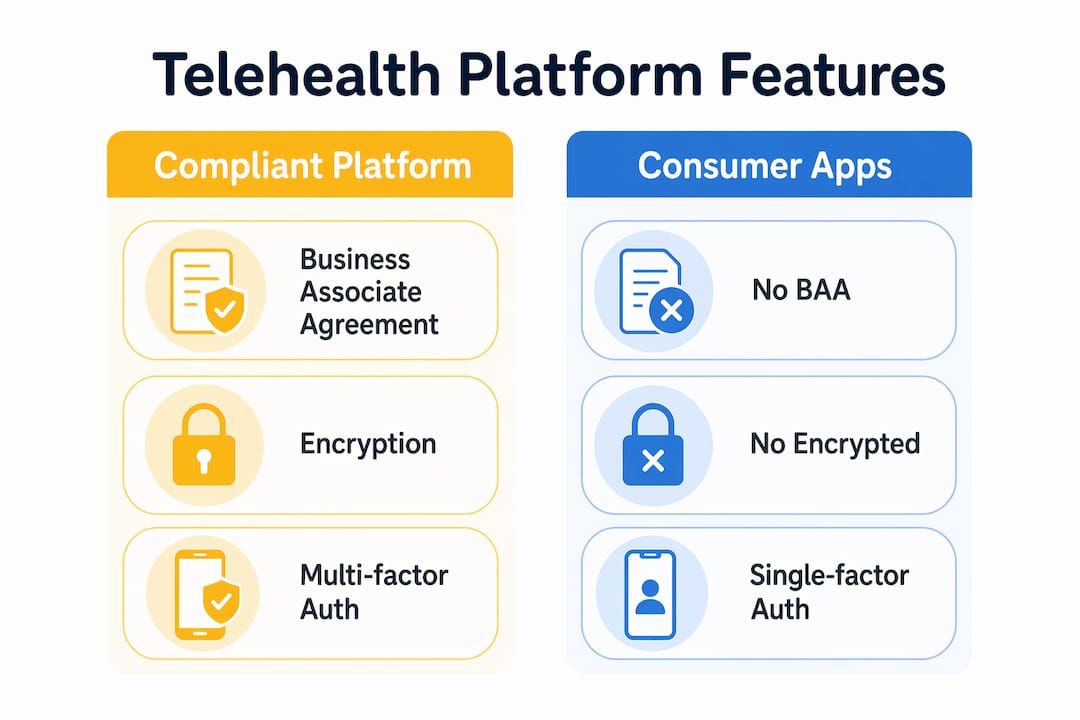
The gap between a HIPAA-compliant telehealth platform and a standard video app is not cosmetic. Consumer platforms like FaceTime, WhatsApp, and standard Zoom lack the Business Associate Agreements and technical safeguards required by HIPAA. Using them for therapy constitutes a HIPAA violation even if no breach ever occurs. The violation is in the structure of the tool, not just the outcome.
Compliant platforms enforce access controls and document all clinical access by design, not by policy alone. That means the platform itself prevents unauthorized access rather than relying on a clinician to remember best practices. Zoom for Healthcare, Doxy.me, and SimplePractice are examples of platforms built with these controls embedded.
| Feature | Compliant telehealth platform | Consumer video app |
|---|---|---|
| Business Associate Agreement | Required and provided | Not available |
| Encryption standard | TLS 1.2+ and AES-256 | Varies, often unspecified |
| Audit logging | Full session logs retained 6 years | Not available |
| Access controls | Role-based, documented | None |
| Virtual waiting room | Standard feature | Not standard |
| HIPAA status | Compliant | Non-compliant for healthcare |
The regulatory consequences of using the wrong tool are serious. The Office for Civil Rights can impose fines for HIPAA violations regardless of whether patient harm occurred. For patients, the risk is that their mental health disclosures travel through systems with no contractual obligation to protect them.
What privacy measures are essential for virtual mental health sessions?
Mental health teletherapy carries a higher privacy burden than many other telehealth specialties. The content of sessions, including disclosures about trauma, relationships, and psychiatric history, is among the most sensitive health information a person can share. Telehealth-specific informed consent must cover privacy risks, the limitations of virtual care, and emergency protocols unique to remote sessions. Generic consent forms written before telehealth existed do not meet this standard.
Your physical environment during a session is part of your privacy protection. A therapist calling from a shared office or a patient sitting in a coffee shop creates real confidentiality risks that no platform can fix. Both parties need a private space with a closed door. Headphones reduce the risk of audio being overheard even in a private room.
The following measures define what secure teletherapy looks like in practice:
- Informed consent: Covers privacy risks, technology limitations, and emergency contact procedures specific to virtual care
- Private physical space: Both clinician and patient in a closed, private environment during every session
- Session recording policy: Explicit consent required before any recording; recordings stored in encrypted, HIPAA-compliant storage
- Identity verification: Clinicians confirm patient identity at the start of each session, especially for new patients
- Virtual waiting room: Patients wait in a secure holding area before the clinician admits them, preventing accidental session overlap
- Secure messaging: Any between-session communication uses encrypted, HIPAA-compliant messaging, not standard email or SMS
Understanding your therapy confidentiality rights before your first session gives you a clear baseline for evaluating whether a provider meets these standards.
How do you evaluate and choose a secure telehealth platform?
Choosing a secure platform starts with a short, direct checklist. The presence or absence of these features tells you more than any marketing claim.
- Signed BAA: The vendor must provide a signed Business Associate Agreement before any protected health information is transmitted. Annual verification of BAAs is now standard practice, including review of updated sub-processor lists and AI data flows.
- Encryption documentation: Ask for written confirmation of TLS 1.2+ in transit and AES-256 at rest. Reputable platforms publish this in their security documentation.
- MFA enforcement: Confirm that multi-factor authentication is mandatory for all clinician accounts, not optional.
- Audit log access: Ask whether you can request session logs and how long they are retained. Six years is the HIPAA minimum.
- Third-party audits: Platforms that undergo regular independent security audits are more trustworthy than those relying on self-certification alone.
- Incident response policy: Ask how the vendor notifies you in the event of a breach and what their response timeline looks like.
Secure telehealth involves managing security across multiple platforms and vendor systems, not just the video call itself. Scheduling software, patient portals, billing systems, and messaging tools all handle protected health information. Each one requires its own BAA and security review.
Pro Tip: Run a quick search for the platform name plus “HIPAA BAA” before your first appointment. Most compliant vendors publish their BAA process publicly. If you cannot find it in under two minutes, call and ask directly.
HIPAA documentation including risk analyses, policies, and BAAs must be retained for a minimum of six years. Providers who cannot produce these records on request are not operating a compliant program. That gap in documentation is a red flag for patients evaluating a provider’s seriousness about privacy.
For patients using personal devices, basic hygiene matters. Keep your operating system and apps updated. Use a private Wi-Fi network rather than public hotspots. Log out of the telehealth platform after every session. These steps do not replace platform-level security, but they close gaps that platform controls cannot reach.
If you are exploring telehealth therapy in California, state-specific rules layer on top of federal HIPAA requirements. California’s Confidentiality of Medical Information Act adds additional protections for patient data, which means California-based providers must meet a higher combined standard.
Key takeaways
Secure telehealth requires simultaneous compliance across technical controls, vendor agreements, and clinical practices. No single feature makes a platform secure on its own.
| Point | Details |
|---|---|
| Encryption is non-negotiable | TLS 1.2+ in transit and AES-256 at rest are the minimum technical standards. |
| BAAs define legal accountability | Every vendor handling patient data must sign a Business Associate Agreement, reviewed annually. |
| Consumer apps violate HIPAA | FaceTime, WhatsApp, and standard Zoom lack required safeguards and constitute violations by design. |
| Informed consent must be telehealth-specific | Consent forms must address virtual care risks, privacy limitations, and emergency protocols. |
| Security is an ongoing practice | Regular risk analyses, audit log reviews, and BAA updates are required, not one-time tasks. |
What I’ve learned about secure telehealth that most guides skip
Working in and around mental health services in California, I have watched the same mistake repeat itself. A clinician adopts a consumer video platform because it is familiar and free. They tell themselves they will switch once things get busier. They never switch. The platform becomes embedded in their workflow, and the compliance gap grows wider every month.
A HIPAA-compliant telehealth platform is not a product checkbox but a continuously evolving system. That framing changes everything. It means you cannot buy compliance once and move on. It means your Security Risk Analysis needs to be updated when you add a new scheduling tool, when your video platform changes its sub-processors, or when you start using any AI-assisted feature.
The other thing most guides understate is the patient’s role. Clinicians carry the legal burden, but patients make choices that affect their own privacy. Using a shared family device for therapy, joining a session from a public space, or communicating through personal email all create exposure that no platform can prevent. The best telehealth relationships include an honest conversation about these risks at the start.
Regulatory scrutiny is increasing, not decreasing. The Office for Civil Rights has signaled stronger enforcement focus on telehealth in 2026. Providers who treated the pandemic-era flexibility as permanent are now facing a tighter compliance environment. For patients, that scrutiny is a good thing. It pushes providers toward the standards that protect you.
— Amy
Secure, confidential therapy is available statewide through Revivehealththerapy
Revivehealththerapy offers evidence-based psychotherapy through HIPAA-compliant telehealth sessions available to clients across California. Every session uses encrypted, secure platforms with proper Business Associate Agreements in place, meeting the technical and administrative standards described throughout this article.
Revivehealththerapy specializes in trauma-informed care, EMDR, CBT, and mindfulness-based approaches for individuals, couples, families, and teens. Services are available in person in Walnut Creek and Oakland, and remotely statewide. Sliding-scale fees and insurance acceptance, including HSA and FSA plans, make care accessible across income levels. If you are ready to start therapy with a provider who takes your privacy seriously, contact Revivehealththerapy to schedule a consultation.
FAQ
What is secure telehealth?
Secure telehealth is the delivery of remote healthcare using HIPAA-aligned safeguards including encryption, multi-factor authentication, audit logging, and signed Business Associate Agreements to protect patient data throughout every session.
What makes a telehealth platform HIPAA-compliant?
A HIPAA-compliant platform provides a signed BAA, uses TLS 1.2+ and AES-256 encryption, enforces phishing-resistant MFA, and maintains session audit logs for a minimum of six years.
Can therapists use FaceTime or Zoom for therapy sessions?
Standard FaceTime, WhatsApp, and consumer Zoom are not HIPAA-compliant for therapy. They lack Business Associate Agreements and required technical safeguards, making their use a HIPAA violation regardless of whether a breach occurs.
What is a Business Associate Agreement in telehealth?
A Business Associate Agreement is a legally binding contract between a healthcare provider and a vendor that handles patient data. It defines each party’s security obligations and is required under HIPAA before any protected health information is shared.
How long must telehealth records and security documents be kept?
HIPAA requires covered entities to retain risk analyses, policies, BAAs, and session logs for a minimum of six years from the date of creation or last effective date.
2 Responses