
TL;DR:
- Self-esteem therapy is structured psychotherapy that helps adults identify and replace negative core beliefs about themselves. It produces lasting improvements in self-worth and mental health, especially when using CBT, ACT, or psychodynamic approaches. Most clients experience progress within two to three months, but deep-rooted issues may require longer therapy commitments.
Self-esteem therapy is a clinical process that helps adults identify and transform deep-seated negative beliefs about themselves to build a stable, realistic sense of self-worth. Unlike motivational coaching or positive affirmations, this is structured psychotherapy. It targets the hidden thoughts driving low confidence, such as “I am not enough” or “I do not deserve good things,” and replaces them with grounded self-acceptance. Adults dealing with anxiety, depression, or persistent self-doubt find that self-esteem counseling addresses the root causes of their distress, not just the surface symptoms.
What is self-esteem therapy and how does it work?
Self-esteem therapy is defined as a structured therapeutic approach focused on uncovering and changing negative core beliefs rather than promoting surface-level positivity. A therapist guides you through identifying the automatic, self-critical thoughts that shape your daily experience. These thoughts often operate below conscious awareness, which is why willpower alone rarely changes them.
The process works through several key mechanisms:
- Identifying negative core beliefs: Your therapist helps you name the specific beliefs driving low self-worth, such as “I am a failure” or “I am unlovable.”
- Cognitive restructuring: You examine the evidence for and against those beliefs, learning to challenge distorted thinking with facts rather than feelings.
- Building a compassionate inner voice: Therapy replaces harsh self-judgment with realistic, kind self-talk. This is not about false positivity. It is about accuracy.
- Behavioral experiments: You test new beliefs in real life. For example, setting a boundary and observing that the relationship survives.
- Skill-building between sessions: Journaling, thought records, and mindfulness practices extend the work beyond the therapy room.
The therapist’s role is that of a non-judgmental, supportive guide. The relationship itself models what healthy regard looks like, which is often corrective for adults who grew up in critical or dismissive environments.
Pro Tip: Keep a brief daily log of moments when you acted against your self-critical voice. These small wins are the raw material your therapist uses to build lasting change.

Which therapy modalities are used for self-esteem improvement?
The best therapy modality depends on the individual’s root causes. CBT, ACT, and psychodynamic approaches each address distinct therapeutic goals, and a skilled therapist will match the method to your history and needs.
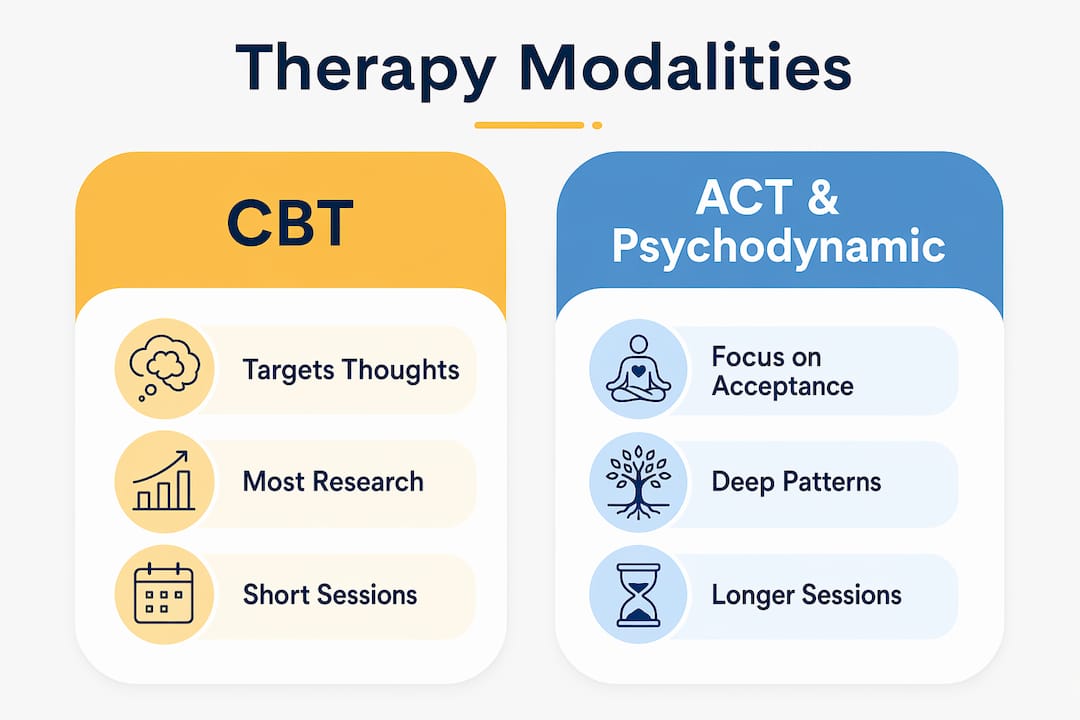
Cognitive Behavioral Therapy (CBT) targets automatic negative thoughts directly. It is the most researched approach for low self-esteem and teaches practical tools for catching and reframing distorted thinking in real time.
Acceptance and Commitment Therapy (ACT) works well when clients feel stuck in repetitive thought loops. Rather than fighting self-critical thoughts, ACT therapy teaches you to observe them without being controlled by them. You then commit to actions aligned with your values, which builds self-worth through lived experience.
Psychodynamic and schema therapy go deeper into early-life relational patterns. If your low self-esteem traces back to childhood criticism, neglect, or trauma, these approaches examine how those experiences created the schemas, or core belief templates, you still operate from today.
| Modality | Primary focus | Best suited for | Typical session range |
|---|---|---|---|
| CBT | Automatic thoughts and cognitive restructuring | Anxiety-linked self-doubt, perfectionism | 12–20 sessions |
| ACT | Values alignment and thought defusion | Chronic self-criticism, avoidance patterns | 12–16 sessions |
| Psychodynamic | Early relational patterns and schemas | Childhood-rooted low self-worth | 20+ sessions |
| Schema therapy | Deep core belief restructuring | Persistent, treatment-resistant low esteem | 20–40 sessions |
A 2019 meta-analysis found that structured therapy for low self-esteem, especially CBT and psychodynamic therapy, produces large, sustained improvements in self-esteem and interpersonal functioning. Gains held at both 6-month and 1-year follow-ups. That finding matters because it confirms therapy creates durable change, not just temporary relief.
Pro Tip: Ask a prospective therapist which modality they use and why they recommend it for your specific history. A good therapist explains their reasoning clearly.
Who benefits from self-esteem therapy?
Low self-esteem is a foundational risk factor for anxiety and depression, not just a personality trait. Therapy that targets core negative beliefs also reduces symptoms of anxiety and depression and improves emotional regulation. This means individual therapy for self-esteem often delivers broader mental health gains than clients expect.
Adults who benefit most from self-esteem counseling typically recognize several patterns in their lives:
- Persistent self-criticism that does not respond to logic or reassurance from others
- Difficulty accepting compliments or attributing success to their own abilities
- People-pleasing behavior driven by fear of rejection or abandonment
- Avoidance of opportunities due to fear of failure or judgment
- Anxiety or depression that feels tied to a core sense of inadequacy
- Relationship patterns marked by excessive dependence or emotional withdrawal
The benefits of self-esteem therapy extend well beyond self-image. Clients report stronger boundaries, more satisfying relationships, and greater resilience during setbacks. Emotional regulation improves because the internal threat response, triggered by self-critical thoughts, becomes less reactive. Mindfulness-based approaches, which Revivehealththerapy integrates into care, show particular strength here. Research on mindfulness in therapy confirms its impact on reducing anxiety and depression alongside self-worth work.
What to expect in self-esteem therapy
Knowing what the process looks like reduces the anxiety many adults feel about starting. Here is a realistic picture of how therapy typically unfolds:
- Initial assessment: Your first sessions focus on understanding your history, current symptoms, and goals. The therapist identifies which modality fits your needs and explains the plan.
- Early sessions (weeks 1–4): You begin mapping your negative core beliefs and the situations that trigger them. This phase can feel uncomfortable because you are naming thoughts you have long avoided.
- Middle phase (weeks 5–12): Active restructuring begins. You practice challenging distorted beliefs, run behavioral experiments, and build new self-perceptions through real-world evidence.
- Consolidation (weeks 12 onward): Progress is reviewed, skills are reinforced, and the therapist prepares you to maintain gains independently. Some clients continue beyond this phase, especially when childhood trauma is involved.
Progress is commonly seen within 2–3 months of weekly sessions, though the timeline varies with severity and personal history. Adults with deep-rooted childhood relational wounds typically need longer commitments.
Insurance coverage for therapy varies by plan and location. Revivehealththerapy accepts insurance and offers sliding-scale fees, making access more realistic for adults across income levels. Insurance and therapy costs in California depend on your specific plan, so verifying benefits before your first session is worth the call. Many public systems also allow self-referral, meaning you do not need a doctor’s referral to begin.
When selecting a therapist, look for licensure (LCSW, MFT, or licensed psychologist), experience with self-esteem or related issues, and a clear explanation of their approach. The therapeutic relationship itself is a strong predictor of outcomes, so a good fit matters as much as credentials.
Key Takeaways
Self-esteem therapy is a structured, evidence-based process that changes negative core beliefs at their root, producing lasting improvements in self-worth, emotional regulation, and mental health.
| Point | Details |
|---|---|
| Core definition | Self-esteem therapy targets deep negative beliefs, not surface positivity or affirmations. |
| Proven effectiveness | CBT and psychodynamic therapy produce large, sustained gains held at 1-year follow-up. |
| Broader mental health gains | Therapy reduces anxiety and depression symptoms alongside improving self-worth. |
| Realistic timeline | Most clients see meaningful progress within 2–3 months of weekly sessions. |
| Modality matters | CBT, ACT, and psychodynamic therapy each suit different root causes and histories. |
The inner critic does not disappear. That is actually the point.
The most common misconception I encounter about self-esteem therapy is that the goal is to silence the inner critic. Adults come in hoping therapy will make that harsh internal voice stop. What actually happens is more interesting and more durable.
The goal is not to silence the inner critic but to change your relationship with it. You learn to observe self-critical thoughts rather than be swept away by them. That shift, from fusion with a thought to observation of it, is where real freedom lives. A client once described it as finally being able to hear the critic without believing it was the news.
Therapy progress is rarely linear. Setbacks happen, especially when the work touches childhood wounds. A week that feels like regression is often the sign that something real is being processed. The clients who make the deepest changes are the ones who stay curious during hard weeks rather than concluding that therapy is not working.
Seeking therapy is not a sign of weakness. Healthy self-esteem involves realistic self-acceptance, and choosing to build it is one of the most grounded decisions an adult can make. The work you do between sessions matters as much as the sessions themselves. Therapy gives you the tools. Practice is what makes them yours.
— Amy
Self-esteem support at Revivehealththerapy
Adults in California dealing with low self-worth, anxiety, or depression do not have to figure out the right approach alone. Revivehealththerapy offers evidence-based individual therapy using CBT, ACT, EMDR, and mindfulness, matched to each client’s specific history and goals.
Services are available in person at Walnut Creek and Oakland, and through secure telehealth statewide. Sliding-scale fees and insurance acceptance, including HSA and FSA plans, make starting therapy a realistic step rather than a distant one. If you are ready to address what is driving your self-doubt at its source, seeking psychotherapy in California is a strong first move. Revivehealththerapy’s team is ready to support that process.
FAQ
What is self-esteem therapy in simple terms?
Self-esteem therapy is structured psychotherapy that helps adults identify and change negative core beliefs about themselves. It uses evidence-based methods like CBT and ACT to build a stable, realistic sense of self-worth.
Is self-esteem therapy effective for anxiety and depression?
Yes. Therapy targeting negative core beliefs also reduces symptoms of anxiety and depression, since low self-esteem is a foundational risk factor for both conditions.
How long does self-esteem therapy take?
Most adults see meaningful progress within 2–3 months of weekly sessions. Adults with childhood trauma or deeply rooted patterns typically benefit from longer commitments of 20 or more sessions.
What is the difference between CBT and ACT for self-esteem?
CBT directly challenges and restructures negative automatic thoughts. ACT teaches clients to observe self-critical thoughts without being controlled by them, then act according to personal values. Both are effective; the best fit depends on your specific history.
Do I need a referral to start self-esteem counseling?
Many therapy practices, including those offering telehealth, accept self-referrals. Checking your insurance plan for mental health benefits before your first session helps clarify coverage and out-of-pocket costs.