
TL;DR:
- Narrative therapy is a collaborative approach that helps clients rewrite their life stories by separating problems from identity. It emphasizes externalizing issues, identifying unique strengths, and constructing empowering narratives through tailored techniques. This method promotes agency, reduces shame, and is effective for various mental health challenges, including trauma, anxiety, and depression.
Narrative therapy is defined as a collaborative, non-directive psychotherapy developed in the 1980s by Michael White and David Epston that separates the person from the problem and positions clients as the experts in their own lives. This approach treats your life as a story you can actively rewrite, rather than a fixed diagnosis you must accept. Widely applied for anxiety, depression, trauma, and emotional regulation, it gives you real agency in the healing process. The Australian Psychological Society recognizes narrative therapy as a legitimate and meaningful framework in modern counseling. If you have ever felt defined by your struggles, this model offers a direct challenge to that belief.

What is narrative therapy and how does it work?
Narrative therapy is built on one foundational idea: you are not your problem. The problem is the problem. Michael White and David Epston developed this framework after observing that traditional diagnostic models often left clients feeling labeled and stuck. By treating problems as external forces rather than internal flaws, the approach frees clients to examine their difficulties with curiosity instead of shame.
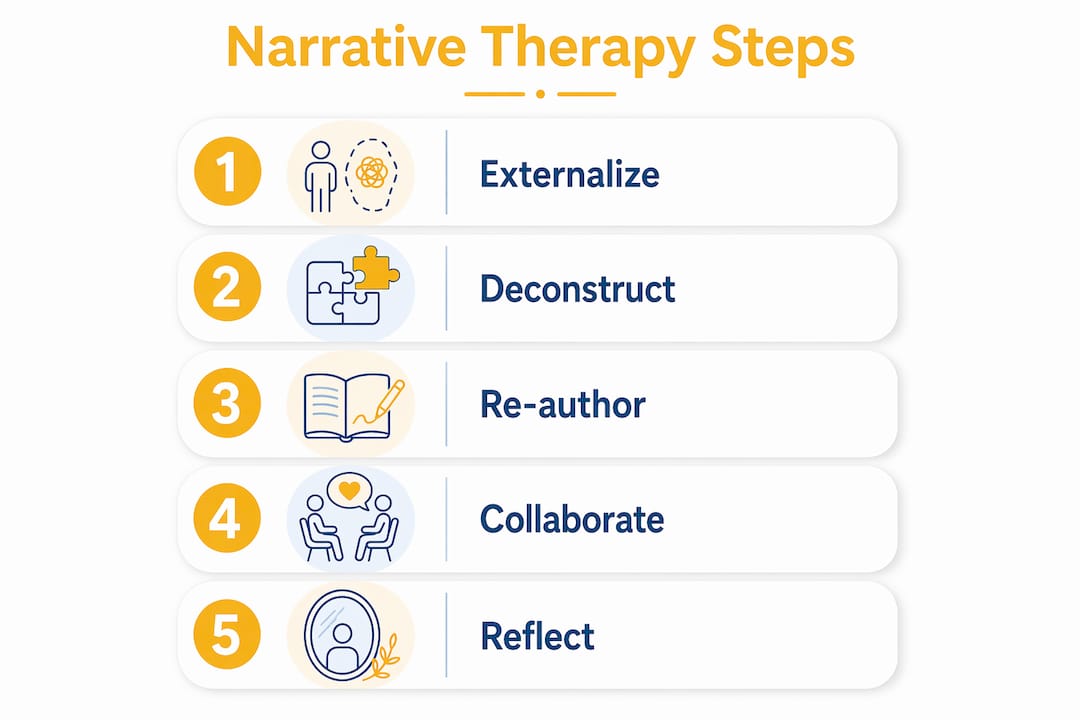
The therapeutic process centers on three core moves. First, the therapist helps you externalize the problem by naming it as something separate from your identity. Second, you and your therapist explore your history together to find moments when the problem did not win. Third, you use those moments to build a new, preferred story about who you are.
The therapist’s role is decentered, meaning they act as a collaborative partner rather than an authority figure who diagnoses and directs. This is a significant departure from many traditional therapy models. The therapist trusts that you hold the most important knowledge about your own life.
A key skill therapists use is called double-listening. This means hearing both the problem story and the preferred narrative at the same time. Most people only tell the story of their struggles. A skilled narrative therapist listens beneath that story for moments of strength, resistance, and resilience that the client has overlooked.
Pro Tip: If you are starting narrative therapy, try writing down one moment this week when you handled a difficulty better than expected. That small moment is exactly the kind of “unique outcome” your therapist will want to explore with you.
There is no standardized session count in narrative therapy. The process is principle-based and tailored entirely to you. Some people find meaningful shifts in a handful of sessions; others work over many months.
What narrative therapy techniques are commonly used?
Narrative therapy uses a specific set of techniques that distinguish it from approaches like cognitive behavioral therapy (CBT) or psychodynamic therapy. Each technique serves the goal of helping you move from a problem-saturated story to a preferred, empowering one.
-
Externalization. Externalizing the problem means naming it as something outside your identity. Instead of saying “I am anxious,” you might say “Anxiety has been pushing me around lately.” This small shift in language creates psychological distance and reduces self-blame dramatically.
-
Deconstruction. The therapist helps you examine where your problem story came from. Whose voice does it carry? What cultural messages or past relationships shaped it? Deconstruction exposes the story as constructed, not fixed, which makes it possible to change.
-
Unique outcomes identification. Unique outcomes are moments when you successfully resisted or managed the problem. These are often overlooked because they do not fit the dominant problem story. A therapist amplifies these moments to build an alternative narrative grounded in your actual strengths.
-
Re-authoring. Once unique outcomes are identified, you and your therapist work to build a new story around them. This is not positive thinking. It is a careful, evidence-based process of constructing a more accurate account of who you are.
-
Therapeutic documents. Letters and documents written between sessions serve as tangible reminders of your progress and autonomy. A therapist might write you a letter summarizing a breakthrough moment, or you might keep a journal that tracks your preferred story as it develops.
Pro Tip: Ask your therapist to write you a summary letter after a significant session. Rereading it during a difficult week can reconnect you to insights that feel distant when the problem story gets loud again.
These techniques work together rather than in isolation. Externalization creates the opening; deconstruction clears the old story; unique outcomes and re-authoring build the new one; and therapeutic documents lock in the gains.
What are the benefits of narrative therapy for mental health?
Narrative therapy offers a set of benefits that set it apart from more diagnosis-centered approaches. The most significant is that it does not pathologize the client. You are never the disorder. That framing alone reduces shame and opens space for genuine change.
Benefits across mental health conditions
Narrative therapy addresses a wide range of mental health challenges with a consistent, empowering framework:
- Anxiety and depression. Externalizing these conditions helps clients stop identifying with them. “Depression has been telling me I am worthless” is a very different statement from “I am worthless.” The first invites resistance; the second invites despair.
- Trauma and PTSD. Narrative therapy for trauma works by helping clients reclaim their stories from victimization. Rather than being defined by what happened to them, clients become the authors of how they survived and what they carry forward.
- Emotional regulation. By identifying the stories that trigger emotional flooding, clients gain perspective and choice. The problem becomes something to negotiate with, not something that controls them.
- Family and relationship challenges. Narrative therapy applies equally well in family and couples contexts, where it helps each person externalize shared problems rather than blaming one another.
How narrative therapy compares to other approaches
| Feature | Narrative therapy | Cognitive behavioral therapy (CBT) |
|---|---|---|
| View of the client | Expert in their own life | Learner of new thought patterns |
| Focus | Story and identity | Thoughts and behaviors |
| Therapist role | Collaborative partner | Structured guide |
| Core mechanism | Re-authoring narratives | Cognitive restructuring |
| Documentation | Therapeutic letters and journals | Thought records and worksheets |
The comparison above is not a ranking. Both approaches have strong evidence bases. Narrative therapy is particularly well suited for clients who feel reduced by diagnostic labels or who need to process identity-level questions alongside symptom relief. You can explore evidence-based therapy options to understand which approach fits your situation best.
What should clients expect in a narrative therapy session?
A narrative therapy session does not follow a rigid script. The structure is flexible, but the flow is consistent enough that you can know what to expect.
Sessions typically begin with you sharing your story in your own words. The therapist listens without interrupting to redirect or correct. This is intentional. The goal is to understand the full shape of the problem story before working to change it.
From there, the therapist begins asking questions designed to externalize the problem and locate unique outcomes. These are not leading questions. They are genuinely curious inquiries like, “Has there been a time recently when Anxiety tried to take over and you did not let it?” That question does two things at once: it names the problem as external, and it searches for evidence of your strength.
The session structure in narrative therapy is built around collaboration, not prescription. Your therapist will not hand you a homework sheet of cognitive exercises. Instead, you might leave with a therapeutic letter, a journaling prompt, or simply a new question to sit with before the next session.
Between sessions, therapeutic documents play a real role. A letter from your therapist summarizing a key insight can serve as an anchor during a difficult week. These documents are not administrative. They are part of the treatment itself.
The number of sessions varies widely. Some clients notice meaningful shifts after six to eight sessions. Others work for a year or more, particularly when addressing complex trauma. The process is guided by your needs, not a preset timeline.
Key Takeaways
Narrative therapy works because it separates identity from the problem, giving clients the agency to re-author their stories rather than simply manage their symptoms.
| Point | Details |
|---|---|
| Person is not the problem | Externalizing problems reduces shame and opens space for change. |
| Re-authoring builds real change | Unique outcomes become the foundation of a new, evidence-based self-story. |
| Therapist as partner | The decentered therapist role preserves client expertise and fosters genuine collaboration. |
| No fixed session count | Therapy length is tailored to individual needs, not a standardized protocol. |
| Therapeutic documents extend gains | Letters and journals between sessions reinforce progress and autonomy outside the therapy room. |
Why narrative therapy changed how I think about healing
The most common misconception I encounter is that narrative therapy is just “talking about your feelings” in a slightly more creative way. It is not. The technique of externalization alone is one of the most clinically precise moves in modern psychotherapy. When a client shifts from “I am depressed” to “Depression has been pulling me under,” something measurable changes in how they relate to their own experience.
What I find most underappreciated is the double-listening skill. Most therapists are trained to listen for problems. Narrative therapists are trained to listen for the story beneath the problem story. That second layer is where healing actually lives. A client might spend twenty minutes describing how anxiety has ruined their career, and a skilled narrative therapist will catch the one sentence where the client says, “but I still showed up.” That sentence is the thread that unravels the whole problem narrative.
The pitfall I see most often is therapists slipping into a directive role. The moment you start steering a client toward the “right” alternative story, you have undermined the entire model. The client’s preferred story must emerge from their own history, not from the therapist’s idea of what a healthy life looks like.
Narrative therapy is not the right fit for every person or every presenting concern. But for clients who feel trapped by a label, defined by a diagnosis, or stuck in a story they did not choose, it offers something rare: a method that treats them as the author, not the subject, of their own life. That shift is not just therapeutic. It is, in the truest sense, liberating for trauma survivors.
— Amy
Narrative therapy services at Revivehealththerapy
Revivehealththerapy offers narrative therapy and trauma-informed care to individuals, couples, families, and teens across California. Whether you are working through anxiety, depression, or the aftermath of trauma, the team at Revivehealththerapy brings a personalized, evidence-based approach to every session.

Sessions are available in person at offices in Walnut Creek and Oakland, as well as through secure telehealth for clients anywhere in California. Sliding-scale fees and insurance acceptance, including HSA and FSA plans, make care accessible regardless of income. If you are ready to explore whether narrative therapy is the right fit, start with a consultation to connect with a therapist who understands your story.
FAQ
What is narrative therapy in simple terms?
Narrative therapy is a type of counseling that treats your problems as separate from your identity. It helps you rewrite the story you tell about yourself, shifting from a problem-focused account to one that reflects your strengths and resilience.
How is narrative therapy different from CBT?
CBT focuses on identifying and changing unhelpful thought patterns, while narrative therapy focuses on reshaping the broader life story that gives those thoughts their power. Both are evidence-based; the right choice depends on your specific needs and goals.
Is narrative therapy effective for trauma?
Narrative therapy for trauma is particularly effective because it helps clients reclaim their stories from victimization and build an account of survival and agency rather than one defined by what happened to them.
How long does narrative therapy take?
There is no fixed session count in narrative therapy. The process is tailored to each client, with some people experiencing meaningful change in a few sessions and others working over many months for deeper concerns.
Can narrative therapy be done via telehealth?
Narrative therapy translates well to telehealth because it is conversation-based and does not require in-person exercises or physical materials. Therapeutic letters and documents can be shared digitally, preserving the full benefit of the approach.