
TL;DR:
- You can switch therapists while maintaining insurance coverage by proactively requesting continuity-of-care protection. It is crucial to verify your new therapist’s network status through the NPI number before your first appointment. Following the correct procedures helps avoid coverage gaps and reduces out-of-pocket costs during treatment transitions.
Switching therapists while keeping your insurance coverage is fully achievable when you know the right steps. The formal term for the protection that makes this possible is “continuity-of-care coverage,” a provision that lets you maintain in-network rates for 30–120 days after a provider change under laws like the No Surprises Act. Most people assume they will lose coverage the moment they leave a therapist. The reality is that proactive coordination with your insurer, combined with careful verification of your new provider’s network status, protects both your wallet and your treatment progress. This guide covers how to switch therapists without losing coverage, from filing the right paperwork to transferring your records.
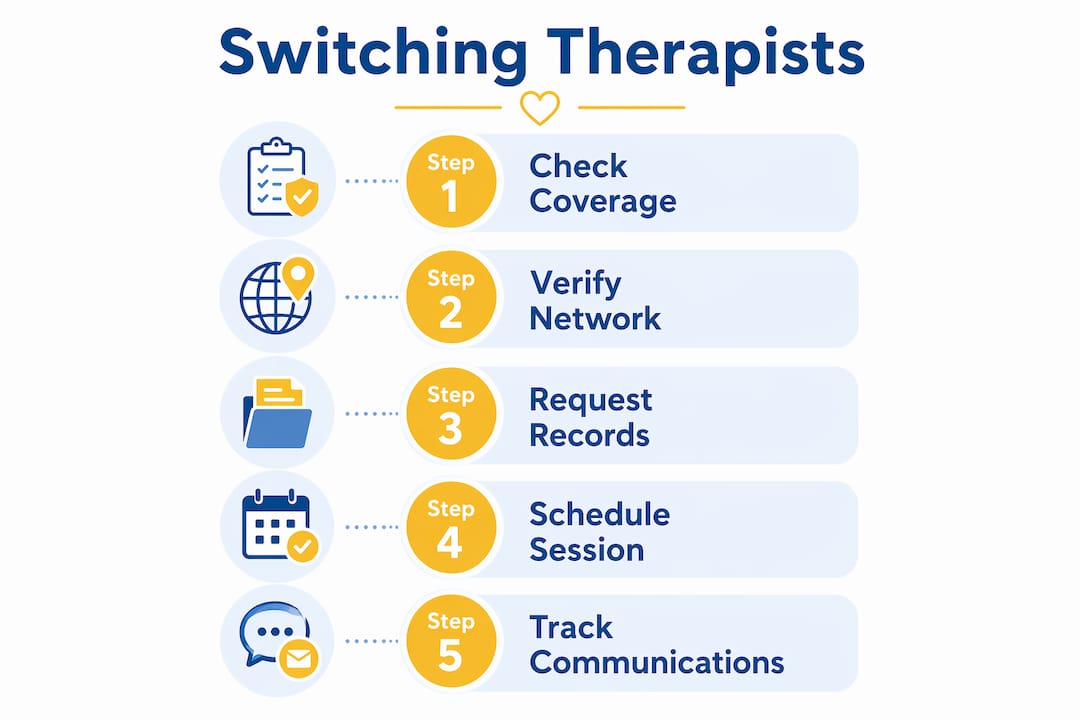
How to switch therapists without losing coverage: your insurance rights
Continuity-of-care coverage is the single most important protection you have during a therapist transition. It extends in-network rates for 30–120 days after your provider leaves the network or you initiate a switch, giving you time to find a new in-network therapist without paying full out-of-pocket costs. That window is not a gift. You have to ask for it.
These protections are not automatic. Continuity-of-care coverage requires a formal written request submitted to your insurer, typically within 30 days of receiving a termination notice from your provider. Miss that deadline and you lose the protection entirely. The No Surprises Act, which took effect in 2022, strengthened these requirements for most commercial health plans, but the burden of action still falls on you.
To qualify, you generally need to show that you are in active treatment. That means providing documentation such as recent session records, a letter from your current therapist confirming ongoing care, and a clear reason why an abrupt switch would disrupt your treatment. Insurers vary in their specific requirements, so call the member services number on your insurance card and ask directly what their continuity-of-care process involves.
Pro Tip: Keep a written log of every call you make to your insurer, including the date, the representative’s name, and a summary of what was said. That record protects you if a claim is later denied.
| Point | Details |
|---|---|
| Standard coverage window | Continuity-of-care typically extends in-network rates for 30–120 days after a provider change. |
| Filing deadline | Submit your formal request within 30 days of receiving your provider’s termination notice. |
| Documentation needed | Provide recent session records and a therapist letter confirming active treatment status. |
| No Surprises Act | This federal law strengthens continuity protections for most commercial plans since 2022. |
| Action required | Coverage extensions are never automatic; you must request them in writing. |
How do you verify a new therapist’s network status?
Verifying your new therapist’s in-network status before your first appointment is the single step that prevents the most expensive mistakes. Out-of-network charges can exceed $150 per session, compared to $20–$40 in-network copays. That gap adds up fast across a course of treatment.

The biggest mistake people make is trusting insurer directories alone. Online directories lag behind reality because therapists join and leave networks frequently, and directory updates can take weeks or months. A therapist listed as in-network today may have terminated their contract last month.
The correct approach is to verify through two independent sources: the therapist’s office and your insurer’s member services line. Ask both parties to confirm the therapist’s National Provider Identifier (NPI) number is actively linked to your specific plan. The NPI is a unique 10-digit number assigned to every licensed provider. Matching it to your policy removes any ambiguity about coverage status.
Pro Tip: Call your insurer and ask them to verify coverage for the specific NPI number, not just the therapist’s name. Names can be duplicated; NPI numbers cannot.
Use this checklist before booking your first appointment with a new therapist:
- Obtain the therapist’s NPI number from their office or the NPPES registry at npiregistry.cms.hhs.gov.
- Call your insurer’s member services line and confirm the NPI is active under your specific plan.
- Ask the therapist’s office to confirm they accept your insurance and your specific plan tier.
- Request a written confirmation of in-network status from the therapist’s billing department.
- Ask your insurer whether a referral or prior authorization is required before your first session.
What are the steps to transition therapists without a coverage gap?
The most effective way to prevent a coverage gap is to schedule your first appointment with the new therapist before you end care with your current one. Behavioral health wait times average 25–50 days for new patients. That means if you wait until after your last session to start searching, you are almost guaranteed a gap in care.
Here is the full sequence to follow:
- Confirm your new therapist’s network status using the NPI verification steps above before doing anything else.
- Request continuity-of-care coverage from your insurer in writing, especially if your current therapist is leaving the network or you are mid-treatment.
- Book your first appointment with the new therapist while still attending sessions with your current provider.
- Request your medical records from your current therapist. Under HIPAA, providers cannot withhold records due to unpaid balances or disputes. You have an unconditional right to them.
- Specify electronic transfer when requesting records. Electronic transmission is faster than paper and reduces the risk of lost documents. HIPAA requires prompt compliance, and specifying the format speeds the process.
- Prepare a written summary of your therapy history to share with your new therapist. Include your primary concerns, any diagnoses, the approaches used (such as CBT, EMDR, or mindfulness), and what has and has not worked.
- Schedule a final or transition session with your current therapist if you feel comfortable doing so. This session gives you closure and lets the therapist provide a clinical summary that supports continuity of care.
- Confirm your first new-therapist appointment is covered under your plan before attending.
Pro Tip: Write a one-page summary of your therapy history before your first session with a new provider. It saves time, reduces repetition, and helps the new therapist understand your clinical context immediately.
Choosing the right therapeutic fit is a clinical necessity, not a preference. Research confirms that failing to progress after several sessions is a clear signal that a provider change is warranted.
What are the most common mistakes when changing therapists with insurance?
The most damaging mistake is missing the 30-day filing deadline for continuity-of-care coverage. Once that window closes, your insurer has no obligation to extend in-network rates, and you absorb the full cost difference. Set a calendar reminder the day you receive any termination notice.
Coverage warning: If your therapist leaves the network unexpectedly, you have a narrow window to act. Contact your insurer within 30 days, request continuity-of-care coverage in writing, and begin searching for a new in-network provider immediately. Waiting even two weeks can eliminate your protection entirely.
A second common problem is delays in records transfer. If your records do not arrive before your first new appointment, your new therapist starts without clinical context. To speed things up, request electronic transfer explicitly and follow up with the sending office within five business days if you have not received confirmation.
Wait times also catch people off guard. Behavioral health patients wait 25–50 days on average to see a new provider. Patients are three times more likely to seek out-of-network care simply because in-network providers are unavailable quickly. Starting your search early is the only reliable way to avoid that outcome.
The emotional side of switching is real too. Many people feel guilt about leaving a therapist, especially one they have worked with for years. Therapists expect clients to change providers and do not take it personally. Your wellbeing is the clinical priority, not the continuity of any particular relationship.
Pro Tip: Document every insurance interaction in writing. After each call, send a follow-up email to your insurer summarizing what was agreed. Written records are your strongest defense against denied claims.
Key Takeaways
Switching therapists without losing coverage requires proactive filing, NPI verification, and early scheduling before your current care ends.
| Point | Details |
|---|---|
| File continuity-of-care requests early | Submit your written request within 30 days of any provider termination notice to preserve in-network rates. |
| Verify NPI, not just the directory | Confirm your new therapist’s NPI is active under your specific plan by calling both the office and your insurer. |
| Start searching before you stop | Book your first new appointment while still in current care, given average wait times of 25–50 days. |
| Use HIPAA to get your records fast | Request electronic transfer of records; providers cannot legally withhold them for any billing dispute. |
| Document everything in writing | Keep logs of all insurer calls and send follow-up emails to create a paper trail for any future claim disputes. |
Why switching therapists is an act of self-advocacy, not failure
People spend enormous energy worrying about how to tell their therapist they are leaving. That energy is almost always misplaced. A good therapist’s primary clinical goal is your progress. When the fit is not working, staying out of loyalty actively works against that goal.
I have seen this pattern repeatedly: someone stays with a therapist for months past the point of progress because they do not want to seem ungrateful. The result is stagnation, not care. The right therapeutic fit is a clinical necessity. Recognizing when you need a different approach, whether that means a different modality like EMDR versus CBT, a different communication style, or simply a fresh perspective, is exactly the kind of self-awareness that therapy is designed to build.
The insurance side of switching feels intimidating, but it is genuinely manageable once you know the sequence. Calling your insurer, filing a continuity-of-care request, and verifying an NPI are administrative tasks. They take an hour, not a week. The step-by-step therapy process for Californians is well-documented, and the protections are real.
What I find most encouraging is that switching therapists, done well, often accelerates progress. A new provider brings fresh clinical eyes. The act of preparing your therapy history summary, which I recommend to everyone, forces you to reflect on what has worked and what you actually need next. That reflection is therapeutic in itself.
If you are uncomfortable having a direct conversation with your current therapist, you are not obligated to. A brief written note or a message through the patient portal is sufficient. Therapists understand. What matters is that you keep moving toward care that actually serves you.
— Amy
Revivehealththerapy makes changing therapists with insurance straightforward
Finding a new therapist who accepts your insurance should not feel like a second job. Revivehealththerapy accepts major insurance plans and HSA/FSA payments, and the team actively helps clients navigate the paperwork side of transitions, including insurance verification and records coordination.

Whether you are looking for in-person sessions in Walnut Creek or Oakland, or prefer secure telehealth anywhere in California, Revivehealththerapy offers evidence-based approaches including EMDR, CBT, and mindfulness-based therapy. Sliding-scale fees are available for those who need them. If you are ready to find a provider who fits both your clinical needs and your coverage, explore your therapy options and connect with a therapist who can support your next step in care.
FAQ
What is continuity-of-care coverage in mental health?
Continuity-of-care coverage is an insurance provision that extends in-network rates for 30–120 days when your therapist leaves the network or you switch providers mid-treatment. You must formally request it from your insurer, typically within 30 days of a termination notice.
How do I verify my new therapist is in-network?
Call your insurer’s member services line and ask them to confirm your new therapist’s National Provider Identifier (NPI) is active under your specific plan. Do not rely on online directories alone, as they frequently lag behind actual network changes.
Can my therapist withhold my records when I switch?
No. Under HIPAA, providers cannot withhold medical records due to unpaid bills or disputes. Request your records in writing and specify electronic transfer to speed up the process.
How long does it take to see a new therapist?
Behavioral health new patient wait times average 25–50 days. Start searching for a new in-network provider before ending care with your current therapist to avoid any gap in treatment.
Do I have to tell my current therapist I am leaving?
You are not legally required to notify your current therapist, though a brief message or a final session is generally recommended for clinical continuity. Therapists support client transitions and prioritize your wellbeing over the continuation of any particular relationship.
Recommended
- Navigating Insurance for Child Therapy: A Parent’s Guide – Revive Health Therapy
- Insurance and Therapy: Impact on California Families – ReviveHealthTherapy
- How to Choose a Therapist in California for Lasting Change – ReviveHealthTherapy
- How to Find a Therapist for Accessible Trauma Care – ReviveHealthTherapy