
The three treatments with the strongest evidence for PTSD are Prolonged Exposure (PE), Cognitive Processing Therapy (CPT), and Eye Movement Desensitization and Reprocessing (EMDR). Both the VA/DoD Clinical Practice Guideline and the American Psychiatric Association recommend these trauma-focused psychotherapies as first-line care, prioritizing them over medication when therapy is accessible. When those options aren’t available or aren’t a good fit, structured alternatives like Written Exposure Therapy (WET), Cognitive Therapy for PTSD (CT-PTSD), and Present-Centered Therapy (PCT) have real evidence behind them. Medications, particularly sertraline, paroxetine, and venlafaxine, can reduce symptoms and work well alongside therapy or when therapy isn’t an option.
Here’s what to expect as you move forward:
- Shared decision-making matters. The best treatment is the one you and a qualified clinician choose together, weighing your goals, history, and practical constraints.
- Telehealth has expanded access significantly. Most evidence-based PTSD therapies can be delivered remotely, which removes a major barrier for people outside urban centers.
- Progress is measurable. Good PTSD care includes regular symptom tracking, not just open-ended conversation.
Key Takeaways
Trauma-focused psychotherapies, specifically PE, CPT, and EMDR, are the most evidence-backed PTSD treatments available and should be the first conversation you have with any qualified provider.
| Point | Details |
|---|---|
| First-line therapies | PE, CPT, and EMDR are strongly recommended by VA/DoD and APA guidelines as the treatments with the strongest evidence. |
| Brief alternatives exist | WET (5 sessions), CT-PTSD, and PCT are structured options when first-line therapies are unavailable or not preferred. |
| Medications have a defined role | Sertraline and paroxetine are FDA-approved for PTSD; venlafaxine is commonly used; all work best alongside or after psychotherapy. |
| Shared decision-making is the method | Use the free PTSD Treatment Decision Aid to compare options and bring a structured summary to your provider conversation. |
| Revivehealththerapy | Offers EMDR, trauma-focused therapy, and telehealth statewide in California, with sliding-scale fees and insurance acceptance. |
Table of Contents
- What do the guidelines say about PTSD therapy options?
- The three front-line trauma-focused therapies explained
- What are the other evidence-based psychotherapy options?
- What role do medications play in PTSD treatment?
- How do you choose the right PTSD treatment for you?
- How do you find and access PTSD care in the United States?
- When should you consider changing your treatment plan?
- A trauma-informed perspective on sequencing PTSD care
- Revivehealththerapy offers evidence-based trauma care across California
- Sources
What do the guidelines say about PTSD therapy options?
The clinical consensus is unusually clear. The VA/DoD CPG and National Center for PTSD guidance both place trauma-focused psychotherapies at the top of the evidence hierarchy, above medications and above general supportive counseling. The APA’s own PTSD treatment guideline reaches the same conclusion.
What makes a therapy “trauma-focused”? It specifically targets either the memory of the traumatic event or the distorted meanings a person has attached to it. That distinction matters because general supportive therapy, while helpful for building coping skills, doesn’t directly process the trauma itself. Trauma-focused approaches do, and that’s why they produce larger and more durable symptom reductions in meta-analyses and systematic reviews.
Key evidence summary:
- Trauma-focused therapies generally produce larger symptom reductions than pharmacotherapy across most analyses, though some head-to-head trials show comparable results in specific populations.
- Effects from PE, CPT, and EMDR tend to be durable, with gains maintained at follow-up assessments months after treatment ends.
- Typical course length runs multiple weekly sessions over a few months for most manualized trauma-focused protocols, shorter than many people expect.
- When therapy is unavailable, medications are a reasonable alternative, but guidelines still recommend returning to psychotherapy when access improves.
The three front-line trauma-focused therapies explained
Head-to-head trials comparing PE, CPT, and EMDR consistently find similar effectiveness across populations. No single therapy reliably outperforms the others, which means the choice between them should be driven by your preferences, your therapist’s training, and what’s practically available to you.
Prolonged Exposure (PE)
PE is best suited for people who have been avoiding trauma-related thoughts, feelings, places, or situations, which describes most people with PTSD. The therapy works by gradually and systematically confronting those avoided memories and cues in a safe, structured way.
Core techniques: Imaginal exposure (revisiting the trauma memory in session through verbal recounting) and in-vivo exposure (approaching real-world situations that feel threatening but are objectively safe). Sessions also include psychoeducation about PTSD and breathing retraining.
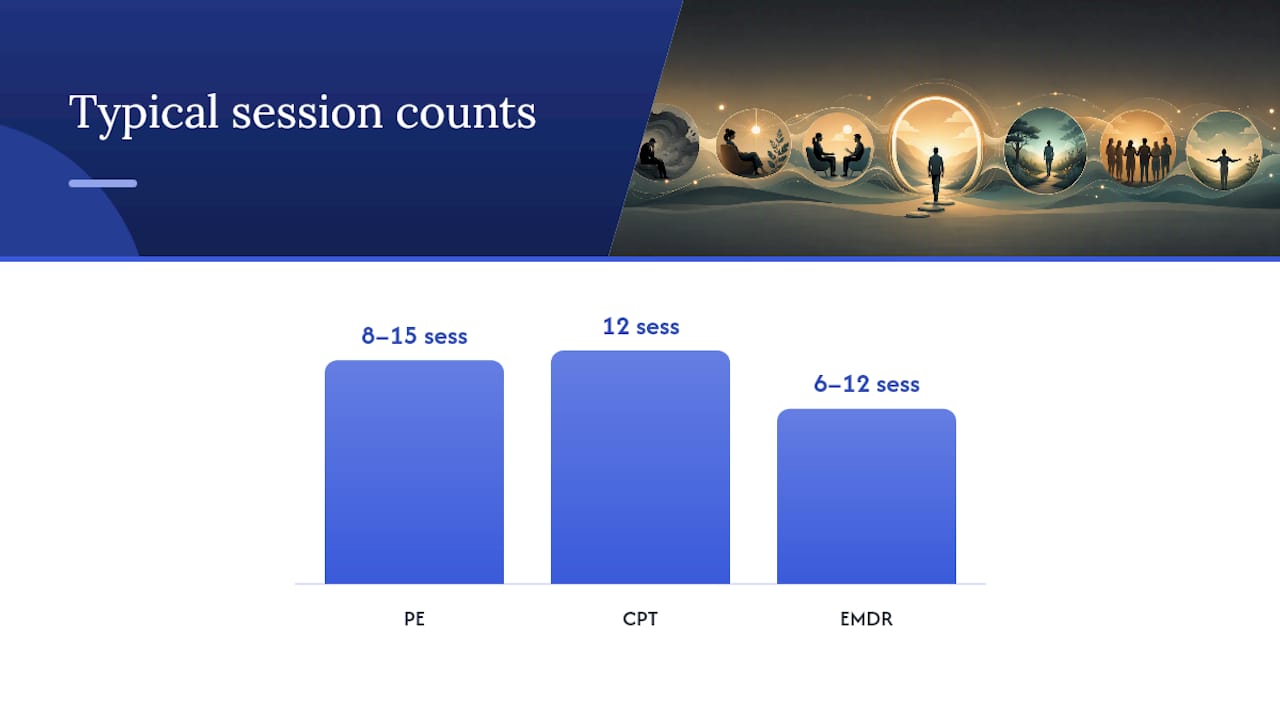
Typical length: 8–15 weekly sessions, each running 60–90 minutes.
Who it fits best: Adults with clear avoidance patterns, single-incident trauma, and the capacity to tolerate distress during sessions. It’s also one of the most studied therapies for veterans and combat-related PTSD.
Risks and challenges: Temporary symptom increases during early exposure work are common. Dropout rates in some trials run higher than CPT, often because the imaginal exposure feels intense. A good therapist will pace this carefully.
Availability: PE-trained therapists are available in most major U.S. cities and through VA facilities. Telehealth delivery is well-supported by evidence.
Pro Tip: Ask any prospective PE therapist specifically how they handle the pacing of imaginal exposure. A therapist who rushes to the hardest memories in session two is not following the protocol correctly.
Cognitive Processing Therapy (CPT)
CPT targets the “stuck points” — the distorted beliefs that trauma creates about yourself, others, and the world. Where PE leans heavily on revisiting the memory, CPT spends more time examining and restructuring the thoughts that keep you stuck.
Core techniques: Written trauma accounts (in some versions), structured worksheets to identify and challenge stuck points, and Socratic dialogue with the therapist.
Typical length: 12 sessions, usually delivered weekly or twice weekly, each 50–60 minutes.
Who it fits best: People who struggle more with guilt, shame, or distorted beliefs than with avoidance. CPT also works well for survivors of sexual trauma and for people who feel uncomfortable with the imaginal exposure component of PE.
Risks and challenges: The homework load is real. CPT involves written worksheets between sessions, and people who don’t engage with the between-session work tend to get less out of it.
Availability: Widely available through VA, community mental health centers, and private practice. CPT has strong telehealth evidence.
Eye Movement Desensitization and Reprocessing (EMDR)
EMDR uses bilateral stimulation, typically eye movements, taps, or tones, while the person holds the trauma memory in mind. The mechanism is still debated in the research literature, but the clinical outcomes are not: EMDR consistently reduces PTSD symptoms across multiple trials and reviews.

Core techniques: Eight-phase protocol including history-taking, preparation, assessment of target memories, desensitization using bilateral stimulation, installation of positive cognitions, and body scan.
Typical length: 6–12 sessions for single-incident trauma; complex trauma often requires more.
Who it fits best: People who find it difficult to verbalize the trauma or who prefer a less talk-heavy approach. EMDR also tends to work faster for single-incident traumas like accidents or assaults.
Risks and challenges: Emotional processing between sessions can be intense. Some people experience vivid dreams or emotional shifts outside of session. For detailed session-level preparation, EMDR therapy approaches vary by protocol and presenting problem.
Availability: EMDR-trained therapists are available in most states. Telehealth EMDR is practiced widely, though some clinicians prefer in-person for the bilateral stimulation component.
Side-by-side comparison
| Dimension | Prolonged Exposure (PE) | Cognitive Processing Therapy (CPT) | EMDR |
|---|---|---|---|
| Guideline recommendation | Strongly recommended (VA/DoD, APA) | Strongly recommended (VA/DoD, APA) | Strongly recommended (VA/DoD, APA) |
| Core technique | Imaginal + in-vivo exposure | Cognitive restructuring worksheets | Bilateral stimulation + memory processing |
| Typical session count | 8–15 sessions | 12 sessions | 6–12 sessions |
| Best fit | Avoidance-dominant, combat/single-incident trauma | Guilt, shame, distorted beliefs, sexual trauma | Difficulty verbalizing trauma, single-incident trauma |
| Main risks / dropout | Temporary distress increase; higher dropout in some trials | Homework burden; lower dropout than PE in some studies | Between-session emotional intensity |
| Availability | VA, private practice, telehealth | VA, community mental health, telehealth | Private practice, some VA, telehealth |
What are the other evidence-based psychotherapy options?
When PE, CPT, or EMDR aren’t practical or acceptable, guidelines recommend structured alternatives rather than unstructured supportive counseling. These aren’t second-rate options; they’re manualized treatments with real trial data, and for some people they’re a better fit.
Written Exposure Therapy (WET) is the most compelling brief alternative. Delivered in just 5 sessions, WET involves writing about the traumatic event in a structured way during each session, with no between-session homework. Trials have shown it to be non-inferior to CPT in some comparisons, which is a remarkable result for a protocol half the length. For people with limited time, transportation barriers, or strong reluctance to engage in extended therapy, WET is worth discussing with a provider.
Cognitive Therapy for PTSD (CT-PTSD) is a structured cognitive approach developed by Anke Ehlers and David Clark that focuses on the idiosyncratic meanings people assign to their trauma and its aftermath. It’s widely used in the UK and has strong trial evidence, though it’s less commonly available in U.S. community settings than PE or CPT.
Present-Centered Therapy (PCT) takes a different angle entirely. Rather than processing the trauma memory, PCT focuses on current life problems and building adaptive coping. It consistently outperforms waitlist controls, but systematic reviews show it generally produces smaller effects than trauma-focused therapies. PCT may be a reasonable starting point for people who aren’t ready to engage with trauma processing, or as a bridge while waiting for a trauma-focused slot.
Other approaches with more limited or mixed evidence include Acceptance and Commitment Therapy (ACT), Dialectical Behavior Therapy (DBT), Accelerated Resolution Therapy (ART), and psychodynamic approaches. These can be useful in specific contexts, particularly for stabilization in complex trauma or when significant emotional dysregulation needs to be addressed before trauma processing begins. Mindfulness-based approaches have also gained attention in recent clinical commentary, with evolving guidance suggesting they may serve as useful adjuncts, though the evidence base for standalone mindfulness treatment of PTSD is not yet as strong as for the front-line therapies. For a deeper look at how these approaches fit into trauma recovery strategies, the evidence picture is nuanced but navigable.
What role do medications play in PTSD treatment?
Medications reduce PTSD symptoms and are a legitimate option when therapy is unavailable, unacceptable, or used alongside psychotherapy. That said, the VA/DoD guideline is explicit: individual trauma-focused psychotherapy is preferred over medication when both are accessible.
The two FDA-approved medications for PTSD are sertraline (Zoloft) and paroxetine (Paxil), both SSRIs. Venlafaxine (Effexor XR), an SNRI, is commonly prescribed for PTSD though it is not uniformly listed as FDA-approved for this indication across all guidance. All three target mood, anxiety, and sleep disruption, which are the most functionally impairing PTSD symptoms for many people.
Practical considerations:
- Onset takes 4–8 weeks for meaningful symptom reduction; don’t judge a medication’s effectiveness in the first two weeks.
- Side effects vary by agent: SSRIs commonly cause initial nausea, sleep changes, and sexual side effects; venlafaxine can raise blood pressure at higher doses.
- Combination treatment (therapy plus medication) is often used when symptoms are severe enough to interfere with engaging in therapy, or when partial response to one modality alone isn’t sufficient.
- Regular monitoring with a prescriber is needed, especially in the first months of treatment.
One clear safety warning: Benzodiazepines (such as lorazepam, clonazepam, or alprazolam) are generally not recommended for PTSD. They can blunt the emotional processing that trauma-focused therapies require, may worsen long-term outcomes, and carry significant dependence risk. Recent clinical commentary reinforces this caution, along with similar concerns about cannabis as a primary PTSD treatment.
How do you choose the right PTSD treatment for you?
Choosing should be a collaborative conversation, not a unilateral prescription. The PTSD Treatment Decision Aid from the National Center for PTSD is a free, structured tool that walks you through your options, lets you weigh your preferences, and generates a summary you can bring to a provider. It’s underused and genuinely useful.
A stepwise decision checklist:
- Clarify your primary symptoms. Is avoidance the biggest problem? Guilt and shame? Emotional dysregulation? The answer shapes which therapy fits best.
- Assess your capacity for trauma-focused work. Are you currently stable enough to engage with trauma memories, or do you need stabilization work first?
- Consider practical constraints. How many sessions can you realistically commit to? Do you have transportation or scheduling barriers that make a 5-session protocol more realistic than a 12-session one?
- Identify comorbidities. Depression, substance use, and chronic pain all affect treatment sequencing. A prescriber or therapist should assess these before starting.
- State your medication preferences. Some people are strongly opposed to medication; others prefer to start with it. Both are valid starting points for the conversation.
Questions to ask a prospective therapist or prescriber:
- Are you specifically trained in PE, CPT, or EMDR? Where and when did you receive that training?
- How do you measure progress during treatment? What tools do you use?
- What’s your approach if I’m not improving after several sessions?
- Do you have a crisis plan for between-session distress?
Red flags to watch for:
- A therapist who promises rapid or guaranteed recovery.
- Pressure to use treatments without a clear evidence base.
- Refusal to discuss safety planning or crisis resources.
- No structured assessment at the start of treatment.
For complex PTSD, the BMJ’s guidance on C-PTSD management recommends personalized, phase-based treatment that addresses affect regulation and relational patterns before or alongside trauma processing. Standard evidence-based therapies can still reduce core PTSD symptoms in complex cases, but the sequencing often needs to be adjusted.
How do you find and access PTSD care in the United States?
The fastest practical paths to care are telehealth, VA services for eligible veterans, and community mental health centers with sliding-scale fees.
Insurance and cost:
- Check whether your plan covers outpatient mental health at in-network rates. Most plans are required to cover mental health parity under federal law.
- Out-of-network therapists can often provide a superbill for partial reimbursement. HSA and FSA accounts can cover therapy costs.
- Sliding-scale fees are available at many community clinics and some private practices. Don’t assume therapy is unaffordable before asking.
- Waitlists at community mental health centers can run weeks to months. Starting with a telehealth provider often gets you into care faster.
Telehealth:
Most evidence-based PTSD therapies, including PE, CPT, and EMDR, have been delivered effectively via telehealth. The evidence for online therapy is strong enough that telehealth is no longer a compromise; for many people it’s the preferred format. Some clinicians prefer in-person for the imaginal exposure components of PE or for the bilateral stimulation in EMDR, but neither is a hard requirement. Safety planning for between-session distress is especially worth discussing before starting remote trauma work.
VA resources:
Veterans can access PE, CPT, and EMDR through VA facilities and the VA’s telehealth programs. The National Center for PTSD website (ptsd.va.gov) provides a therapist locator, treatment decision aids, and self-help tools for veterans and civilians alike.
Verifying clinician training:
Ask directly. A therapist who says they “use EMDR” or “do exposure therapy” without completing a recognized training program is not the same as one who has completed the full protocol training. For finding a qualified trauma therapist, the key questions are training source, supervision history, and how many clients they’ve treated with the specific protocol.
Common barriers and practical workarounds:
- Stigma: Framing therapy as a medical treatment for a recognized condition, not a sign of weakness, helps. PTSD has a clear neurobiological basis and responds to structured treatment.
- Geographic access: Telehealth removes most geographic barriers. Statewide telehealth licensing means you can often see a specialist in a major city from a rural area.
- Financial: Sliding scale, HSA/FSA, and community mental health centers are the main levers. Some training clinics at universities offer reduced-fee therapy with supervised trainees.
When should you consider changing your treatment plan?
If measurable progress isn’t visible within an agreed timeline, it’s time to have a direct conversation with your provider about adjusting the plan.
Most manualized PTSD therapies build in natural reassessment points. By sessions 4–6 of a 12-session protocol, you should see some movement on a standardized symptom measure like the PCL-5 (PTSD Checklist for DSM-5). A flat or worsening score at that point isn’t a reason to panic, but it is a reason to talk.
Next steps when progress stalls:
- Discuss whether the technique or pacing needs adjustment. Sometimes the exposure hierarchy needs restructuring, or the stuck points in CPT need a different approach.
- Consider adding medication if you’re in therapy alone and symptoms remain severe.
- Switch modalities. If PE isn’t working after a genuine trial, CPT or EMDR may produce a different result.
- Ask for a referral to a specialized trauma program if your symptoms are complex or treatment-resistant.
- Use the PTSD Treatment Decision Aid again to reassess your preferences with new information.
Patient advocacy matters here. Asking for a second opinion is not disloyal to your therapist. Bringing a decision aid to the conversation gives you a structured way to raise concerns without it feeling confrontational.
A trauma-informed perspective on sequencing PTSD care
The most important thing a trauma-informed clinic does before starting any protocol is assess. Not just symptom severity, but stability, safety, social support, and readiness for trauma processing. Jumping straight into imaginal exposure with someone who is in active crisis, using substances heavily, or lacks basic safety is a clinical error, regardless of how strong the evidence for PE is.
At Revivehealththerapy, the approach starts with a thorough intake that maps presenting symptoms, trauma history, and practical constraints. From there, treatment is chosen collaboratively, with clinicians trained in PE, CPT, and EMDR offering the full range of first-line options. Progress is tracked with standardized measures, not just clinical impression. And when a client’s needs fall outside what the clinic can offer, referral to a more specialized level of care is part of the plan, not an afterthought.
Therapeutic alliance is often the primary engine for success in complex trauma cases. That means the early sessions aren’t wasted time; they’re building the trust that makes trauma processing possible. For clients with complex PTSD, stabilization and affect regulation work often precede intensive trauma processing, consistent with phase-based recommendations in the clinical literature.
Not every modality is right for every person, and a good trauma-informed provider says so plainly.
Revivehealththerapy offers evidence-based trauma care across California
Revivehealththerapy provides trauma-focused psychotherapy, including EMDR, CPT-informed approaches, and mindfulness-integrated care, for adults, teens, couples, and families in California. In-person sessions are available in Oakland, Walnut Creek, and San Francisco. Secure telehealth therapy is available statewide, so geography isn’t a barrier to getting started with a trained clinician.
Sliding-scale fees, insurance acceptance, and HSA/FSA payment options make care accessible across income levels. The intake process includes a thorough assessment to match you with the right approach, not just the first available slot. If you’re ready to start or want to understand which trauma-focused therapy in California fits your situation, contact Revivehealththerapy to schedule an initial consultation. For those specifically seeking EMDR, the EMDR therapy service page outlines what to expect and how to book.
Sources
The following sources underpin the guidance in this article and are worth reading directly if you want the primary evidence:
- Overview of Psychotherapy for PTSD – PTSD: National Center for PTSD
- A Review of PTSD and Current Treatment Strategies – PMC
- PTSD: How is treatment changing? – Harvard Health Blog
- Diagnosis and management of complex post-traumatic stress disorder (C-PTSD) | The BMJ
- Psychotherapy for complex post-traumatic stress disorder: efficacy and therapeutic factors – Frontiers
- Pubmed
This article is general information, not a substitute for advice from a qualified doctor. Consult a qualified healthcare professional about your own circumstances before acting on anything here.
Recommended
- Psychotherapy in trauma recovery: evidence-based options CA 2026 – Revive Health Therapy
- Psychotherapy in California 2026: Evidence & Options – Revive Health Therapy
- Role of Therapy in Trauma Recovery: Evidence and Impact – ReviveHealthTherapy
- Trauma Recovery Strategies List: Proven Methods That Work – Revive Health Therapy
One Response