
Mindfulness-based cognitive therapy is an evidence-based treatment for preventing depressive relapse, and it also helps many people currently struggling with depressive symptoms. It performs comparably to maintenance antidepressants for relapse prevention and holds up well against active psychotherapy controls. MBCT tends to fit best for people with a history of recurrent depression, residual symptoms after treatment, or a preference for a non-pharmacologic maintenance plan. Group courses and practitioner-supported self-help formats both carry real supporting evidence, so start by reading how the research breaks down or talk to a clinician about fit.
TL;DR:
- MBCT lowers relapse risk over 60 weeks, especially in people with residual symptoms after initial treatment.
- It performs comparably to maintenance antidepressants over 24 months, offering an alternative for medication-tired patients.
- The most effective candidates have recurrent depression, residual symptoms, or a history of childhood maltreatment, with contraindications including active suicidality or psychosis.
- In-person group MBCT is ideal, but practitioner-supported self-help and telehealth formats are proven effective and more accessible.
- Continued practice after course completion, including tapering and periodic refreshers, is essential for maintaining relapse prevention benefits.
Table of Contents
- What Is MBCT for Depression and How Does the 8-Week Program Work?
- Does the Research Support MBCT for Preventing Depression Relapse?
- How Does MBCT Actually Change a Depressed Brain and Mind?
- Who Benefits Most From MBCT for Depression?
- Group Course, Self-Help, or Telehealth: Which MBCT Format Fits?
- What Does an MBCT Course Actually Feel Like Week to Week?
- MBCT vs. Antidepressants and MBCT vs. CBT: Which Should You Choose?
- How Do You Find and Vet a Legitimate MBCT Program?
- Are There Contraindications or Risks With MBCT for Depression?
- Can You Combine MBCT With Medication or Other Therapy?
- How Should You Prepare Before Starting an MBCT Course?
- What Happens After MBCT Ends? Long-Term Maintenance Strategies
- A Clinician’s View on Where MBCT Actually Delivers
- How ReviveHealthTherapy Supports Your Depression Treatment Options
- Sources
What Is MBCT for Depression and How Does the 8-Week Program Work?
Mindfulness-based cognitive therapy grew out of a straightforward observation. Zindel Segal, Mark Williams, and John Teasdale noticed that standard cognitive behavioral therapy for depression worked well while people were in it, but relapse rates stayed stubbornly high once treatment ended. They borrowed the structure of Jon Rabat-Zinn’s mindfulness-based stress reduction program and grafted on cognitive strategies aimed specifically at the thought patterns that precede a depressive slide.
The result is a manualized, 8-week group program, and the structure is fairly consistent no matter where you take it.
- Weekly group sessions, typically two to two and a half hours long, led by a trained instructor.
- Guided mindfulness practices including body scans, sitting meditation, and mindful movement, paired with CBT-based exercises on recognizing negative thought patterns.
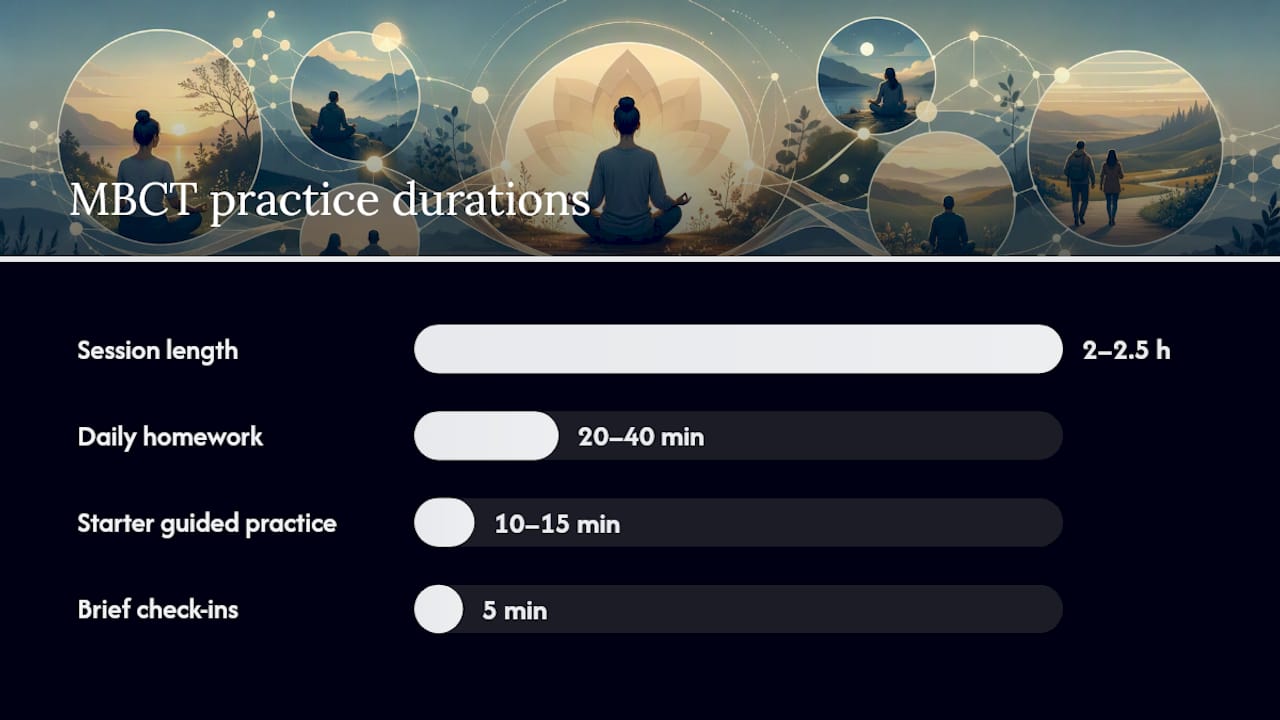
- Daily homework between sessions, generally 20 to 40 minutes of practice, as outlined by the standard program structure.
- A specific focus on relapse prevention, teaching participants to recognize early warning signs of a depressive episode before it fully takes hold.
That last point separates MBCT from a generic meditation class or a relaxation app. This is skills training, and the skill being trained is catching your mind before it spirals into old grooves. If you have wondered whether mindfulness-based therapy for depression is just meditation with a clinical label slapped on, it is not. The practices are borrowed from mindfulness traditions, but the goal, the sequencing, and the cognitive framing are pulled straight from depression research.
Does the Research Support MBCT for Preventing Depression Relapse?
Yes, and the evidence here is unusually strong for a psychotherapy intervention. An individual patient data meta-analysis by Kuyken and colleagues found that MBCT reduced the risk of depressive relapse compared with usual care, with benefits holding across roughly 60 weeks of follow-up. The effect was most pronounced in people carrying residual depressive symptoms into the maintenance phase, which tells you something important: MBCT is not just for people who feel fine and want insurance against a future episode. It is often most useful for people who never fully symptom-free in the first place.
Key finding: In the pooled patient data reviewed by Kuyken and colleagues, MBCT lowered relapse risk over roughly 60 weeks, with the strongest benefit in people who still had lingering depressive symptoms after their acute treatment ended.
The PREVENT trial pushed this question further by asking whether MBCT could actually replace maintenance antidepressants rather than just supplement them. Researchers randomized 424 people with recurrent depression to either MBCT or ongoing medication. Over 24 months, the PREVENT trial found that MBCT performed comparably to maintenance antidepressants for time to relapse, without statistical superiority. What it did prove is that MBCT works about as well as staying on antidepressants, which reframes the choice entirely. This is not “MBCT versus doing nothing.” It is “MBCT versus a pill you might be tired of taking.”
A more recent trial adds weight to the delivery-format question. The LIGHTMind randomized trial, published in JAMA Psychiatry, tested practitioner-supported MBCT self-help against practitioner-supported CBT self-help in 410 people with mild to moderate depression. At 16 weeks, the MBCT-SH group showed a clinically meaningful reduction on the PHQ-9 compared with CBT-SH, with evidence supporting cost-effectiveness. That is a meaningful result: a lower-intensity, workbook-and-check-in model outperforming a comparably supported CBT alternative in a large, well-powered sample.
None of this means the evidence base is flawless. Systematic reviews consistently flag a few weak spots:
- Heterogeneity across trials in dose, teacher training, and comparison groups makes pooled effect sizes harder to interpret cleanly.
- Long-term follow-up beyond two years remains sparse, so durability past that window is less certain.
- Results against well-matched active controls (rather than usual care or waitlists) are more mixed than headline relapse-prevention numbers suggest.
Reviews summarizing MBCT’s clinical perspectives generally frame it as strongly supported for relapse prevention, with a somewhat thinner but still credible case for treating current depressive symptoms directly.
How Does MBCT Actually Change a Depressed Brain and Mind?
The mechanism that clinicians talk about most is cognitive defusion, sometimes called decentering. It is the shift from thinking “I am a failure” to noticing “there is the thought that I am a failure.” That distinction sounds small on paper. In practice, it is the difference between being swallowed by a thought and watching it pass through, which is exactly the skill MBCT drills for eight weeks straight.
That shift produces a few downstream effects that show up across the literature:
- Reduced repetitive negative thinking, meaning less time spent in the rumination loops that reliably precede depressive relapse.
- Improved emotion regulation, giving people more space between a triggering event and their reaction to it.
- Greater self-compassion, which softens the self-critical spiral that often follows a setback.
- Measurable neurocognitive shifts, including changes in prefrontal activation patterns and reduced amygdala reactivity, documented in systematic reviews of MBCT’s neurocognitive outcomes.
The neuroscience is genuinely interesting here, and not just as a footnote. Depression is associated with an amygdala that fires too readily and a prefrontal cortex that struggles to rein it back in. MBCT practice appears to strengthen the regulatory relationship between those regions, which lines up neatly with what people report subjectively: less time hijacked by a bad thought, more capacity to notice it and choose a different response.
Pro Tip: The skill you are actually building in MBCT is noticing the moment right before the spiral starts, not eliminating bad thoughts altogether. Most people expect the practice to make negative thoughts disappear. It does not. It changes your relationship to them, and that relationship change is where the clinical benefit lives.

Who Benefits Most From MBCT for Depression?
MBCT is not a one-size intervention, and the research is fairly specific about where it earns its strongest results. People with a history of three or more depressive episodes tend to see the biggest relapse-prevention benefit, likely because their depression has become more automatic and pattern-driven, which is exactly the terrain mindfulness-based skills are built to interrupt. People carrying residual symptoms after acute treatment, rather than those in full remission, also tend to show larger effect sizes.
A few other factors shape who is likely to respond well:
- Number of prior depressive episodes, with recurrent history predicting stronger relapse-prevention benefit.
- A history of childhood maltreatment, which some studies link to differential response patterns worth discussing with a provider.
- Current symptom severity at the start of the course, since moderate residual symptoms often predict more room for improvement than either mild symptoms or full remission.
There are also clear boundaries on when MBCT is not the right first move. Active suicidality, untreated psychosis, or active substance dependence generally call for higher-intensity or specialized care before a structured 8-week group program makes sense. A responsible MBCT provider screens for these issues before enrollment, not after a crisis surfaces mid-course.
Group Course, Self-Help, or Telehealth: Which MBCT Format Fits?
The traditional model is an in-person group led by a trained instructor, and it carries real advantages: instructor fidelity to the manual, real-time correction of practice technique, and the group itself functions as a source of support and normalization. Depression is isolating, and sitting in a room with seven other people who also can’t seem to shut their brain off at 2 a.m. does something a workbook cannot replicate.
That said, group availability is limited by geography and by the relatively small pool of adequately trained MBCT teachers, which has pushed research toward lower-intensity alternatives.
- Practitioner-supported MBCT self-help pairs a structured workbook or digital program with brief check-ins from a trained clinician. The LIGHTMind trial found this format outperformed a comparable CBT self-help model for mild to moderate depression, with a high probability of cost-effectiveness.
- Fully digital or app-based mindfulness programs without practitioner contact have the weakest evidence base of the three and are better thought of as a general wellness tool than a depression treatment.
- Telehealth-delivered group MBCT can preserve most of the fidelity of in-person groups when the instructor is properly trained and the platform supports real interaction, though screening protocols and supervision structures need deliberate adaptation for remote delivery.
The honest trade-off is this: full-fidelity group MBCT with a well-trained instructor is probably the gold standard, but access constraints are real. Practitioner-supported self-help is not a consolation prize. It is a legitimately evidence-backed option, particularly for mild to moderate presentations where waiting months for a group opening does more harm than starting a supported program today.
What Does an MBCT Course Actually Feel Like Week to Week?
Each session runs roughly two to two and a half hours, and the homework between sessions is where the real work happens: 20 to 40 minutes daily, mixing body scans, sitting meditation, and short mindful movement sequences. It is not a light ask, and clinicians who deliver this course regularly will tell you that weeks two and three are often the hardest.
That is not a design flaw. Slowing down and paying closer attention to your own mind tends to make you notice difficult feelings that were previously running in the background. For someone dealing with depression, that increased awareness can briefly feel worse before it feels better, which is precisely why a trained instructor matters. They normalize that dip and help participants understand it as a signal that the practice is working, not evidence that it is failing.
A few adherence strategies genuinely move the needle:
- Start with shorter guided practices (10 to 15 minutes) in the first two weeks rather than jumping straight to full-length body scans.
- Set a fixed daily time and a phone reminder rather than relying on finding a spare moment.
- Use brief practitioner check-ins, even a five-minute call or message, to troubleshoot barriers before they become a reason to quit.
- Expect week two or three to feel harder, and treat that as data rather than a stop sign.
Depression itself often saps the energy and motivation homework requires, and low adherence is one of the most common reasons people drop out before session four. Graded practice schedules address this directly.
Pro Tip: If a body scan feels impossible some mornings, do five minutes of mindful breathing instead of skipping entirely. Consistency at a lower dose beats sporadic full-length sessions by a wide margin, and it keeps the habit alive through the weeks when depression is actively working against you.
MBCT vs. Antidepressants and MBCT vs. CBT: Which Should You Choose?
There is no universal winner here, and the research supports treating this as a genuine choice rather than a hierarchy. The PREVENT trial’s hazard ratio of 0.89 for MBCT versus maintenance antidepressants means the two approaches performed similarly over 24 months of follow-up, without one clearly outperforming the other.
That result matters more than it might first appear, because it reframes the decision away from “which is more effective” and toward “which fits this person’s life.” Someone who has struggled with medication side effects, who has had trouble staying consistent with a prescription, or who simply prefers not to take a daily pill indefinitely now has evidence-backed permission to choose MBCT as a maintenance strategy rather than a fallback.
On relapse prevention specifically, MBCT and continued antidepressant use produced statistically comparable outcomes in the PREVENT trial’s 24-month follow-up, with neither approach proving superior.
Set against CBT and other active psychotherapy comparisons, MBCT holds up differently depending on what you’re measuring. Systematic reviews of mindfulness-based interventions consistently find MBCT and related approaches clearly outperform non-specific or waitlist controls, and land roughly on par with CBT for depression outcomes at post-treatment in many analyses. Neither therapy dominates the other across the board; where CBT vs. MBCT differs most is in what skill each one teaches. CBT for depression leans on restructuring the content of negative thoughts. MBCT leans on changing your relationship to those thoughts without necessarily disputing their content.
A few factors should drive the actual decision:
- Prior response to medication, including tolerability and side effect burden.
- Personal relapse history and whether residual symptoms are still present.
- Access to a properly trained MBCT instructor or a practitioner-supported self-help program.
- Personal preference, since motivation to stick with either approach strongly predicts outcome.
Someone with three prior depressive episodes and a strong dislike of daily medication is a very different case from someone newly diagnosed and open to either path. Reviewing the full range of evidence-based depression treatments before committing to one path is worth the time.
How Do You Find and Vet a Legitimate MBCT Program?
Start with clinical programs affiliated with hospitals, university psychology clinics, or licensed therapy practices rather than unaffiliated wellness retreats. A referral from a psychiatrist or primary therapist is often the fastest route to a properly screened, appropriately staffed course.
Before enrolling, ask a few direct questions:
- Is the instructor formally trained and certified in MBCT specifically, not just a general meditation teacher?
- What is the group size, and does the format allow for real individual attention?
- Does the intake process screen for suicidality, active psychosis, or substance dependence before enrollment?
- Is there any structured follow-up or outcome measurement, such as periodic PHQ-9 scores, to track whether the course is actually helping?
A few red flags should make you walk away immediately: no screening process at all, an instructor unable to describe their specific MBCT training, or anyone promising the course will “cure” depression. MBCT is a skills-based, evidence-supported tool. It is not a cure, and any provider who frames it that way is overselling. If symptoms worsen significantly during the course, or if suicidal thinking emerges, that calls for immediate escalation to a higher-intensity level of care rather than pushing through the remaining sessions.
Are There Contraindications or Risks With MBCT for Depression?
MBCT is generally well tolerated, but it is not risk-free, and treating it as universally gentle does a disservice to people in acute crisis. The most consistently cited contraindication is active, severe suicidality. A structured 8-week group program is not built to respond to a psychiatric emergency in real time, and someone at acute risk needs a higher level of care first, with MBCT potentially reintroduced later as a maintenance tool once stabilized.
Untreated psychosis and active substance dependence are similarly poor fits for the standard group format, since both can interfere with the sustained attention and emotional processing the practices require. A well-run program screens for these conditions during intake rather than discovering them mid-course.
A less discussed but real issue is that slowing down and turning attention inward can, for a subset of people, temporarily intensify distressing thoughts or memories rather than settle them. This is more likely in people with significant trauma history, which is one reason trauma-informed screening matters before starting. It is not a reason to avoid mindfulness-based work altogether. It is a reason to do it with a trained clinician present who can adjust the pace and check in regularly, rather than through an unsupervised app with no one on the other end.
Can You Combine MBCT With Medication or Other Therapy?
Yes, and in practice, that combination is common rather than the exception. Nothing about the evidence suggests MBCT and antidepressant medication are mutually exclusive. Many people use MBCT as a relapse-prevention layer while continuing a stable medication regimen, particularly if they’ve had multiple prior episodes and want as much protection as possible.
Combining MBCT with ongoing individual psychotherapy, including CBT, generally works well too, since the two approaches reinforce different skills. CBT strengthens the ability to identify and challenge distorted thinking; MBCT strengthens the ability to notice a thought forming and choose not to engage it in the first place. Used together, they cover more ground than either alone.
The main practical consideration is timing and workload. Starting MBCT while also beginning a new medication or a new intensive therapy can be a lot to manage at once, especially given the daily homework MBCT requires. Coordinating with whichever provider manages your medication, and being upfront about your MBCT commitment, helps avoid the course becoming one more thing that falls off the plate during a hard week. A therapist familiar with mindfulness-informed approaches can help sequence these pieces sensibly rather than stacking them all at once.
How Should You Prepare Before Starting an MBCT Course?
The single most useful thing you can do before week one is set realistic expectations about the workload. This is not a passive treatment you receive. It is an active skills course that asks for 20 to 40 minutes of daily practice on top of weekly sessions, and going in expecting that commitment prevents the early drop-out that undermines so many good-faith attempts.
It also helps to expect a temporary uptick in difficult feelings during the first two or three weeks, as mentioned earlier. Knowing that in advance turns a discouraging moment into an anticipated checkpoint rather than a reason to quit.
A short pre-course checklist:
- Block out a consistent daily time slot for practice before the course starts, not after.
- Mention any trauma history, active suicidal thoughts, or substance use during intake screening rather than after a session raises it.
- Clear space for slightly increased emotional intensity in the first couple of weeks, particularly around sleep and mood tracking.
- Bring a genuinely open mind to the group format if that’s the format chosen. Isolation is part of depression’s grip, and the shared room is doing real clinical work, not just providing company.
Readiness is less about feeling “ready” in a motivated sense and more about having cleared the logistical and emotional space to actually show up for eight consecutive weeks.
What Happens After MBCT Ends? Long-Term Maintenance Strategies
The course ends at week eight, but the relapse-prevention benefit depends heavily on what happens after that final session. The Kuyken meta-analysis tracked benefit out to roughly 60 weeks, which strongly suggests the skills need continued, if reduced, practice to hold their protective effect rather than functioning as a one-time inoculation.
Most instructors recommend tapering rather than stopping: moving from daily 20 to 40 minute sessions to a shorter daily practice, maybe 10 minutes, plus a longer weekly sitting. Many programs also offer optional monthly refresher sessions or alumni groups, which recreate some of the accountability and community that made the original eight weeks work.
Practical maintenance habits that show up repeatedly in clinical guidance include keeping a brief mood or thought log to catch early warning signs, scheduling a periodic check-in with the original instructor or a therapist, and treating a return of early symptoms as a cue to intensify practice rather than a sign the course failed. The full course structure and follow-up expectations are worth revisiting even after the group ends, since the skills are meant to keep working long after the workbook closes.
A Clinician’s View on Where MBCT Actually Delivers
The clients who do best with MBCT are rarely the ones who arrive expecting to feel calm. They’re the ones who arrive expecting to get better at noticing, and who are willing to sit with the discomfort that noticing sometimes brings. The biggest implementation hurdle isn’t skepticism about mindfulness. It’s underestimating the homework. People sign up thinking of it as a class they attend, not a daily practice they build, and that mismatch is where most early drop-out comes from.
Telehealth and practitioner-supported self-help formats have earned their place in the toolkit, not as a lesser substitute but as a genuinely appropriate option for the right person. Someone with mild to moderate symptoms, a reasonable degree of self-motivation, and limited access to an in-person group is often well served by a supported self-help model. Someone with a long history of severe, recurrent depression usually benefits more from the structure and accountability of a full group course. Matching format to severity, rather than defaulting to whichever option is most convenient, is where clinical judgment earns its keep.
What continues to surprise people is how mechanical the skill actually is once you break it down. It isn’t about becoming a calmer person in some abstract sense. It’s about building a specific, repeatable pause between a thought and a reaction, and that pause is trainable in a way that gives people back a sense of agency depression tends to strip away.
— Amy
How ReviveHealthTherapy Supports Your Depression Treatment Options
If you’ve read this far weighing group MBCT against medication, CBT, or a supported self-help format, you don’t have to sort that out alone. Revivehealththerapy offers mindfulness-informed CBT alongside trauma-focused approaches like EMDR, delivered through both in-person sessions in Oakland, Walnut Creek, and San Francisco, and secure telehealth available across California. That combination means you can start with whichever intensity actually matches your situation, rather than being boxed into one format because it’s the only one your local search turned up.

Every clinician on the team works from an evidence-based foundation, and sliding-scale fees plus insurance and HSA/FSA acceptance keep that care realistic for a range of budgets, not just people with generous coverage. If residual depressive symptoms, a history of relapse, or medication fatigue sound familiar from what you just read, book a consultation to discuss psychotherapy options and find out which approach actually fits your history, not just your diagnosis.
This article is general information, not a substitute for advice from a qualified doctor. Consult a qualified healthcare professional about your own circumstances before acting on anything here.
Sources
- Mindfulness-Based Cognitive Therapy in Clinical Practice: A Systematic Review of Neurocognitive Outcomes and Applications for Mental Health and Well-Being – PMC
- PREVENT trial (MBCT versus maintenance antidepressants) – PubMed
- Clinical Effectiveness and Cost‑Effectiveness of Supported MBCT‑SH vs Supported CBT‑SH (LIGHTMind) – JAMA Psychiatry