
Behavioral activation is an evidence-based, action-focused therapy that reduces depressive symptoms by rebuilding contact with meaningful, values-aligned activity. It works even when motivation hasn’t shown up yet, because action tends to come before feeling better, not after. You can start a simple version on your own; if symptoms are severe or you’re having thoughts of self-harm, work with a trained therapist instead of going it alone.
TL;DR:
- Behavioral activation produces sustained improvements in depression by encouraging engagement in meaningful activities, with effects lasting at least 12 months.
- It is especially effective for mild to moderate depression, with self-guided formats benefiting less than therapist-guided sessions, particularly for severe cases.
- Core techniques include activity monitoring, values-based scheduling, and gradual task scaling, which can be started independently for low-energy or financial constraints.
- While not suited for severe or psychotic depression, BA remains a valuable tool to prevent relapse when combined with ongoing activity monitoring and maintenance routines.
- Starting with self-guided exercises can be effective, but those with active suicidal thoughts or significant trauma should seek professional, trauma-informed care.
Table of Contents
- What Is Behavioral Activation, and How Does It Differ From CBT and DBT?
- How Does Behavioral Activation Work?
- What Are the Core Techniques Used in Behavioral Activation?
- What Do Behavioral Activation Exercises Actually Look Like?
- What Does the Research Say About Behavioral Activation’s Effectiveness?
- Should You Try Behavioral Activation on Your Own or See a Therapist?
- How Clinicians Apply Behavioral Activation in Practice
- When Might Behavioral Activation Not Be the Right Fit?
- How Do You Maintain Progress After Behavioral Activation Treatment?
- Why Behavioral Activation Deserves More Credit Than It Gets
- Ready to Start Behavioral Activation With Support in California?
- Where to Learn More About Behavioral Activation
- Sources
What Is Behavioral Activation, and How Does It Differ From CBT and DBT?
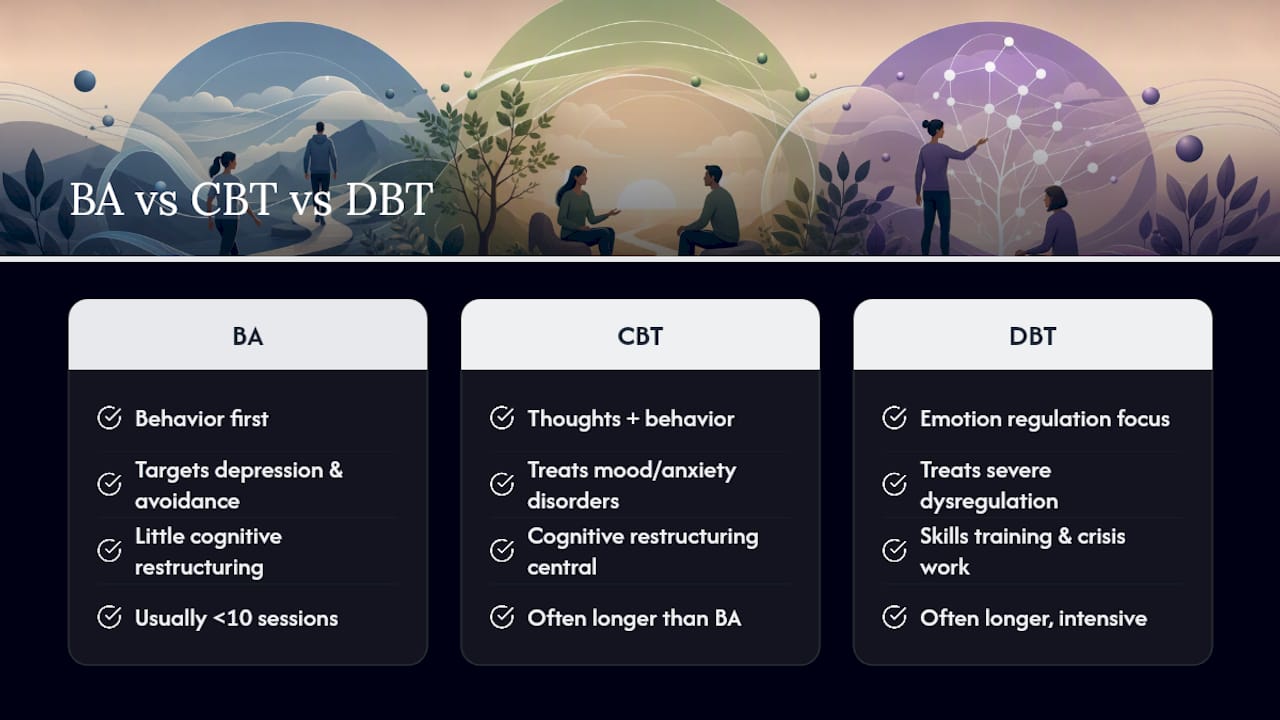
Behavioral activation (BA) is a targeted, behavior-focused psychotherapy that grew out of cognitive behavioral therapy but stands on its own as a treatment for depression. Rather than starting with thoughts, BA starts with behavior: what you do, when you do it, and what happens to your mood afterward. The Ohio State Wexner Medical Center describes it as a therapy that directly addresses withdrawal and avoidance, two behaviors that keep depression locked in place.
Full CBT layers in cognitive restructuring, the work of identifying and challenging distorted thoughts (“I’ll fail, so why bother”). BA skips most of that and focuses squarely on rearranging your daily behavior to increase contact with reward. If you’re weighing which approach fits your situation, a CBT vs. DBT comparison can help clarify the distinction further. DBT, by contrast, was built for intense emotion dysregulation and includes specialized skills training for crisis moments and interpersonal conflict. It shares some behavioral DNA with BA but serves a different clinical purpose.
One reason BA has spread so widely: it’s brief. Most structured courses run under 10 sessions, and clinicians can learn to deliver it faster than more complex therapies, which is part of why it shows up in primary care clinics and even digital self-guided programs. It can be delivered one-on-one, in groups, or through structured self-help formats. If depression coexists with anxiety or trauma, BA is often woven into a broader CBT-based treatment plan rather than used as a standalone track.
How Does Behavioral Activation Work?
Depression has a predictable mechanical pattern. You feel low, so you cancel plans, skip the gym, stop calling friends. That withdrawal feels protective in the moment, but it quietly cuts you off from reinforcement, the small hits of pleasure, connection, and accomplishment that keep mood stable. Fewer rewarding experiences lead to lower mood, which triggers more withdrawal. It’s a closed loop, and it tightens on its own.
BA breaks that loop through something called functional analysis: a structured look at what triggers avoidance and what a person gets out of it short term (relief) versus what it costs them long term (isolation, stagnation, deepening low mood). A therapist, or a person working through a self-guided worksheet, maps specific situations. Skipping a friend’s text. Not showering before noon. Avoiding the gym after work. Each one gets traced back to its trigger and forward to its consequence.
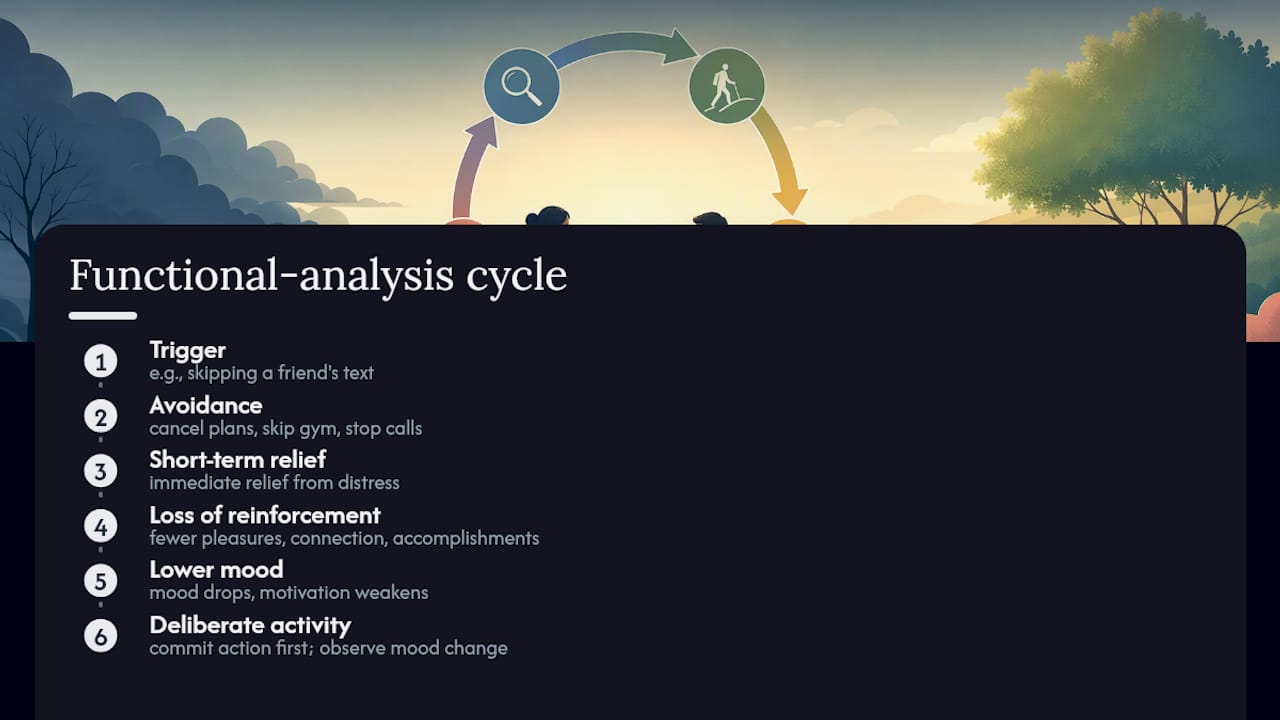
This is where BA’s core, slightly counterintuitive principle comes in: action usually needs to happen before motivation returns, not the other way around. Waiting to “feel like it” before calling a friend or going for a walk often means waiting indefinitely, because depression suppresses exactly the drive you’re waiting for. BA treats each activity as a behavioral experiment. You commit to the action first, then observe what happens to your mood, rather than using your mood as the gatekeeper for whether you act.
The ABCT fact sheet on behavioral activation frames this clearly: BA isn’t about staying busy for its own sake. It’s about deliberately restoring access to activities tied to what actually matters to you, which is what makes the reward durable instead of hollow.
What Are the Core Techniques Used in Behavioral Activation?
BA runs on a handful of concrete tools, and you can start applying most of them today without waiting for a first session.
Activity monitoring comes first. For a few days, you log what you did, when, how long it lasted, and a quick 0 to 10 rating for pleasure and a separate 0 to 10 rating for mastery, that sense of having accomplished something. Two separate ratings matter more than they sound: a single mood score often misses smaller gains that show up in one dimension but not the other. Patterns tend to jump out fast. Maybe mornings are dead zones. Maybe screen time correlates with your lowest mood scores of the day.
Values-based activation comes next. Instead of picking random tasks, you sort potential activities by what genuinely matters to you, career, relationships, health, creativity, and rank them by pleasure versus mastery. A phone call to a sibling might score low on pleasure but high on mastery. Both count.
Graded scheduling turns values into a doable calendar. Steps to implement behavioral activation successfully usually include:
- Break large goals into the smallest version that still counts as progress.
- Attach each task to a specific day and time, not a vague intention.
- Use reminders or “if this, then that” cues (implementation intentions) to reduce reliance on willpower.
- Schedule slightly below your energy ceiling, not at your best-day capacity.
A basic weekly cycle looks like this:
- Monitor activity and mood for 3 to 5 days.
- Identify two or three values-aligned activities, one low-effort, one moderate.
- Schedule them at fixed times and treat them as commitments, not options.
- Rate pleasure and mastery immediately after each one.
- Adjust difficulty up or down based on what the ratings show.
Pro Tip: Pair every scheduled activity with a stated expectation beforehand (“I expect this will feel like a 3 out of 10”) and a rating afterward. The gap between expectation and reality is often where the real insight shows up, and it’s usually more encouraging than people predict.
Common snags: low energy days, social anxiety around reconnecting, and cost. The fix is almost always the same, shrink the task further rather than skipping it. A five-minute walk still counts.
What Do Behavioral Activation Exercises Actually Look Like?
Concrete examples make this far less abstract. Low-energy starters include opening a window for fresh air, changing into daytime clothes, or making one warm meal from scratch. Social reconnection can be as small as sending one text message, not scheduling a whole outing. Mastery tasks might mean paying one bill, organizing a single drawer, or finishing one work email you’ve been avoiding. Self-care options range from a 10-minute walk to a shower with your favorite scent.
A sample first week might look like this:
- Monday and Tuesday: activity monitoring only, no changes yet.
- Wednesday: one low-energy task (open curtains, 10-minute walk).
- Thursday: one mastery task (organize one small space).
- Friday: one social task (text a friend).
- Saturday: repeat the highest-rated task from earlier in the week.
- Sunday: review ratings, plan next week’s slight increase.
For physical limitations, swap walks for seated stretching. For financial constraints, favor free or already-owned resources over new purchases. If you’re building activities for a child or teen, a curated activity list for kids ages 5 to 13 offers a useful starting bank of age-appropriate ideas.
What Does the Research Say About Behavioral Activation’s Effectiveness?
A 2026 systematic review and meta-analysis pooled 105 trials covering 13,933 patients and found BA produced a standardized mean difference of 0.67 (95% CI 0.54 to 0.80) for adult outpatients compared with control conditions, a solidly meaningful effect in clinical trial terms. Self-guided BA showed a smaller but still significant effect (SMD 0.36, 95% CI 0.20 to 0.51).
That data comes from the most comprehensive meta-analysis of behavioral activation trials to date, and one detail stands out: the benefits held up at 12-month follow-up, not just immediately after treatment ended. That durability matters more than a short-term bump, since relapse is depression’s defining risk.
Separate systematic reviews of behavioral activation therapies confirm BA performs comparably to other evidence-based treatments across delivery formats, including brief and group-based versions, and can scale into settings like primary care where longer therapies are harder to deliver.
The caveats are real. Trial quality and methods vary considerably across the pooled studies, pediatric evidence is thinner than adult evidence, and self-guided formats consistently underperform therapist-guided ones, even though they widen access. The practical takeaway: BA helps most people with mild to moderate depression, and it helps a meaningful subset with more severe presentations too, but severity and self-guided delivery both shift the odds.
Should You Try Behavioral Activation on Your Own or See a Therapist?
Self-guided BA is worth trying first if your depression is mild to moderate, you have no active suicidal ideation, and no complicating condition like untreated trauma or bipolar disorder. If any of those apply, or if daily functioning has broken down (missed work, missed meals, isolation lasting weeks), a trained therapist should lead the process.
A typical BA course with a clinician involves collaborative activity monitoring, weekly homework, and roughly 8 to 16 sessions depending on severity. When vetting a therapist for accessible trauma-informed care, ask directly whether they use BA, how they structure homework, and whether telehealth is available.
If you’re in crisis or having thoughts of self-harm, contact the 988 Suicide and Crisis Lifeline immediately rather than starting a self-help plan.
How Clinicians Apply Behavioral Activation in Practice
Revive Health Therapy uses BA alongside CBT and trauma-informed care, tailoring activity targets to each person’s values rather than a generic checklist. For trauma survivors, activation is paced carefully so it doesn’t trigger overwhelm. Sessions are available in-person in the Bay Area or through secure telehealth, and Revive Health Therapy accepts sliding-scale fees, insurance, and HSA or FSA payment, which keeps structured BA accessible across income levels.
When Might Behavioral Activation Not Be the Right Fit?
BA isn’t a universal solution, and knowing its limits matters as much as knowing its strengths. It tends to underperform for severe melancholic or psychotic depression, where energy and cognitive capacity are too depleted to engage with scheduling and follow-through, even in graded form. People with significant untreated trauma may need stabilization work first, since pushing activation before establishing safety can backfire.
BA also assumes a baseline ability to plan and track, which makes it harder to use during acute crises, active substance use, or unmanaged psychosis. In those cases, stabilizing the underlying condition typically has to come first. Some people find the monitoring itself aversive, particularly those with a history of restrictive or perfectionistic tendencies, where tracking can turn into self-judgment rather than useful data.
Motivation to engage matters too. BA requires a degree of buy-in and follow-through that’s genuinely difficult during the lowest points of depression. That’s not a flaw in the person, it’s a mismatch between the demand of the technique and where they currently are. A therapist can adjust pacing, but self-guided users without that flexibility sometimes abandon BA prematurely and conclude it “didn’t work” when the real issue was starting at too high a difficulty level.
BA also isn’t designed to address every driver of depression. Grief, chronic pain, and complex relationship dynamics often need approaches layered alongside BA rather than instead of it, and it combines well with medication when a prescriber is also involved, since neither approach cancels out the other’s benefit.
How Do You Maintain Progress After Behavioral Activation Treatment?
Relapse prevention starts before treatment ends, not after. Most structured BA courses end with a review of which activities produced the strongest pleasure and mastery ratings, so you leave with a personalized list rather than a generic one.
The most reliable long-term strategy is treating activity monitoring as an occasional check-in tool, not a finished project. Reintroducing a brief log for a few days whenever mood starts dipping catches slippage early, often before a full relapse sets in. Watch specifically for the return of avoidance patterns identified during treatment, since those original triggers rarely disappear permanently; they resurface under stress.
Build in a maintenance rhythm: one values-aligned activity per week that’s non-negotiable, regardless of mood. This keeps the behavior-mood link active instead of letting it atrophy. For people managing recurring depression, pairing BA maintenance with ongoing evidence-based psychotherapy provides a check against early warning signs a person might miss on their own. Combining BA with mindfulness practices also helps some people notice the early urge to withdraw before it turns into a multi-day avoidance spiral.
Why Behavioral Activation Deserves More Credit Than It Gets
The conventional wisdom on depression treatment still leans heavily on insight and cognitive work, understanding why you feel a certain way. BA’s evidence base suggests that’s backwards for a lot of people. Insight rarely produces behavior change on its own; behavior change reliably produces mood change, and often faster than talk-focused approaches alone.
What’s underrated about BA specifically is how little it demands upfront. You don’t need to feel ready, understand your depression, or believe the plan will work. You need one small action and a way to track what happens afterward. That’s a lower bar than most treatment approaches ask people to clear, which is exactly why it works for people too depleted to engage with anything more demanding.
Where BA gets misapplied is when people treat it as “just stay busy.” The ABCT’s own framing is explicit that this isn’t busywork, it’s values-driven. Skip that step and BA becomes a checklist that produces exhaustion instead of reward. Get it right, and the mechanism is straightforward enough that most people can start today, with or without a therapist.
— Amy
Ready to Start Behavioral Activation With Support in California?
If you’ve read this far, you already know BA works better with structure and accountability than it does alone with a blank worksheet. Revive Health Therapy is built for exactly that middle ground, evidence-based psychotherapy that pairs BA techniques with full CBT and trauma-informed care, without requiring you to pick one approach and hope it’s the right one.
Sessions are available in-person in Oakland and Walnut Creek, or through secure telehealth anywhere in California, so distance or a packed schedule isn’t a barrier to starting. Sliding-scale fees and insurance or HSA/FSA acceptance mean cost doesn’t have to be the reason you delay treatment either. A first visit typically starts with a conversation about your symptoms, history, and goals, then a collaborative plan, BA-informed or otherwise, built around what you actually value.
Explore why psychotherapy works and reach out to schedule your first appointment.
Where to Learn More About Behavioral Activation
For readers who want to go deeper into the evidence or grab practical tools, these sources back the claims in this guide:
- The 2026 meta-analysis pooling 105 trials on BA’s effectiveness.
- The ABCT fact sheet explaining BA’s core principles.
- A systematic review of BA therapies across delivery formats.
- A printable list of pleasurable activities for building your own activation plan.
This article is general information, not a substitute for advice from a qualified doctor. Consult a qualified healthcare professional about your own circumstances before acting on anything here.
Sources
- Behavioral activation for depression: A comprehensive systematic review and meta-analysis (UCL Discovery, 2026)
- Behavioral Activation | ABCT fact sheet
- Behavioural activation therapies for depression in adults (systematic review, PMC)
- Behavioral activation | Ohio State Wexner Medical Center