
Scheduling clashes, childcare stress, and the worry of being seen walking into a therapist’s office keep far too many California couples from getting the support they need. With telehealth marriage therapy, you can connect with licensed therapists in your own space, overcoming barriers that once felt insurmountable. Sliding-scale fees make therapy accessible so you don’t have to choose between emotional health and affordability. Discover how video sessions help couples address anxiety and relationship challenges without extra costs or travel.
Table of Contents
- Telehealth Marriage Therapy Essentials
- How Online Sessions Support Couples
- Therapeutic Approaches and Methods Used
- Legal, Privacy, and Insurance Considerations
- Costs, Access, and Common Pitfalls
Key Takeaways
| Point | Details |
|---|---|
| Telehealth Increases Accessibility | Couples can seek therapy from home, eliminating barriers like scheduling conflicts and transportation issues. |
| Effective Therapeutic Methods | Evidence-based approaches such as Cognitive-Behavioral Therapy and Mindfulness are adapted for video delivery, maintaining effectiveness. |
| Affordability and Sliding-Scale Fees | Telehealth typically offers lower costs than in-person therapy, making professional support accessible regardless of financial situation. |
| Privacy Protocols in Place | HIPAA compliance and encrypted platforms ensure confidentiality during therapy sessions, allowing for safe discussions of sensitive issues. |
Telehealth Marriage Therapy Essentials
Telehealth marriage therapy removes the friction that keeps many California couples from getting help. Scheduling conflicts, childcare logistics, and the stigma of walking into a therapist’s office no longer have to stand in your way.
Here’s what makes telehealth work for couples:
- Attend from home where you feel safer and more comfortable discussing sensitive issues
- Schedule around your lives without adding commute time or finding childcare coverage
- Reduce upfront costs with sliding-scale fees that adjust to your income level
- Access licensed therapists statewide without geographic limitations
- Maintain privacy in your own space during therapy sessions
Many couples worry that video therapy won’t be as effective as face-to-face sessions. The research tells a different story. Videoconferencing for couples therapy produces therapeutic outcomes comparable to in-person sessions, with couples reporting similar improvements in relationship satisfaction and mental health over time.
What you’ll need to get started:
- A stable internet connection and private space for 50-minute sessions
- A device (computer, tablet, or phone) with a camera and microphone
- Honest willingness to show up and engage with your partner
- Basic information about your relationship concerns and therapy goals
Couples often face barriers to traditional therapy like scheduling conflicts and childcare responsibilities. Telehealth directly addresses these obstacles, making professional support accessible when you need it most.
The shift to video therapy does require some adjustment. Your therapist may use different techniques for managing conflict or ensuring safety during emotionally charged conversations. This isn’t a limitation—it’s an adaptation that actually works.
ReviveHealthTherapy offers evidence-based approaches like cognitive-behavioral therapy (CBT) and mindfulness-based techniques delivered securely through telehealth. You can work with a trauma-informed therapist who understands relationship dynamics without the barriers that previously made therapy feel impossible.
Virtual sessions create the same therapeutic relationship and outcomes as in-person therapy, with the added benefit of accessibility and affordability.
The timing matters too. Many couples wait too long to seek help, hoping problems resolve on their own. Telehealth removes excuses to delay—you can start therapy this week from your living room.
Pro tip: Choose a consistent session time each week and designate a quiet space where both partners feel safe speaking openly, even if it’s just a bedroom with the door closed.
How Online Sessions Support Couples
Online therapy sessions create a unique advantage for couples that in-person therapy cannot replicate. You’re sitting together in your own space, without the formality or pressure of an office setting.
Here’s how telehealth specifically benefits couples:
- Easier scheduling means you can find time slots that work for both partners
- Home comfort reduces anxiety and encourages more honest conversations
- No commute time that could trigger conflict before the session even starts
- Family system engagement happens naturally when therapy occurs in your living environment
- Cost savings with sliding-scale fees make consistent therapy affordable
When couples sit down together for online therapy sessions, something shifts. You’re not traveling to a strange office or sitting in a waiting room. The familiar surroundings actually help you be more authentic.
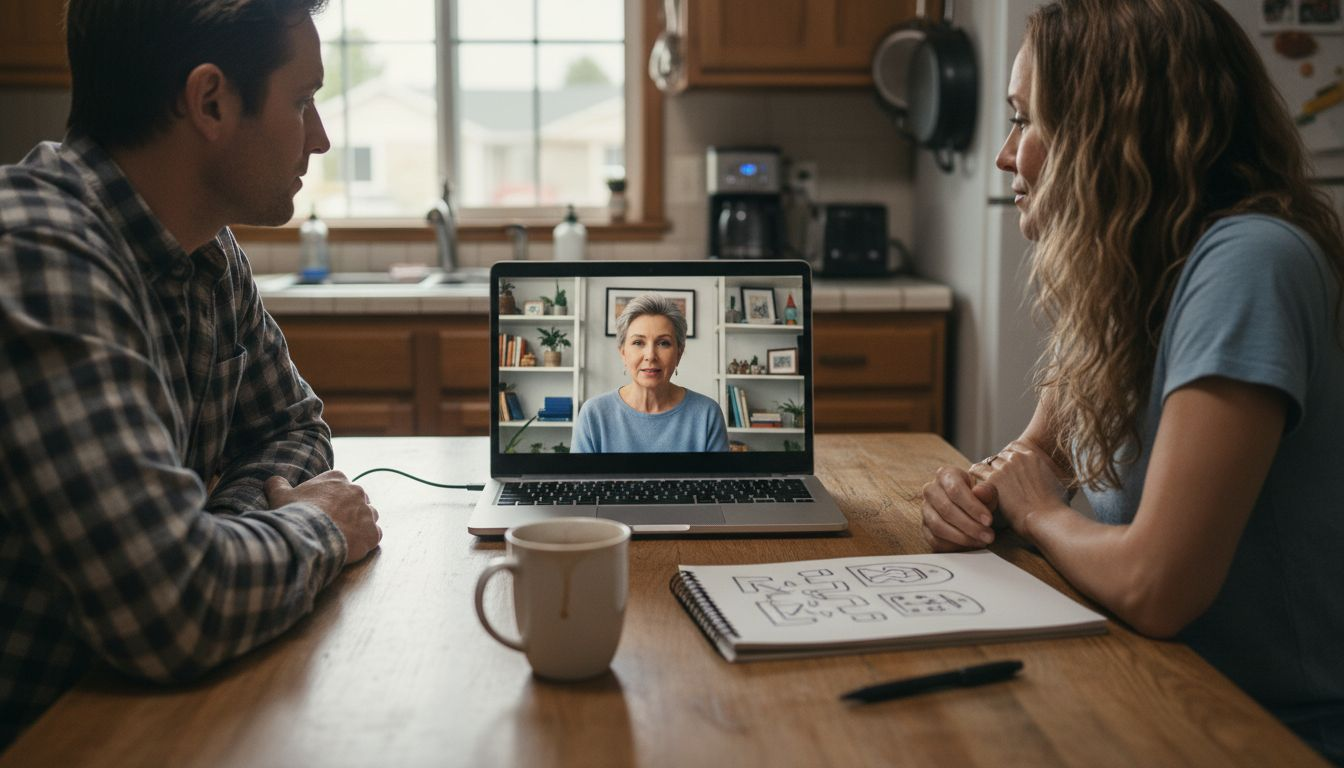
Telehealth services provide cost-effective access while removing transportation barriers that keep many California couples from seeking help. Your therapist can see both of you clearly on video, notice body language, and respond to the dynamic between you in real time.
Therapists trained in video-based couples work adapt their techniques to the online environment. They’re watching for the small moments—when one partner leans away, when tension rises, when connection happens. These observations guide the therapy just as effectively as in-person sessions.
Your home becomes the therapy space, which actually reveals how you interact in your real life. A therapist can see your actual environment, understand your daily stressors, and help you apply skills immediately in the place where your relationship actually happens.
Online sessions create the same therapeutic alliance and client satisfaction as traditional therapy, with added convenience and accessibility.
The research shows that therapists reach underserved couples by overcoming transportation and scheduling barriers. Rural couples and those with inflexible work schedules finally have options.
Your therapist will use evidence-based approaches like cognitive-behavioral therapy or mindfulness techniques, adapted for the video format. The methodology remains the same; only the delivery changes.
Pro tip: Test your internet connection and camera angle before your first session, and agree with your partner beforehand about which room you’ll use so neither person feels ambushed or uncomfortable in the space.
Therapeutic Approaches and Methods Used
ReviveHealthTherapy uses evidence-based methods specifically adapted for couples therapy delivered online. These aren’t watered-down versions of traditional therapy—they’re carefully tailored approaches that work just as effectively through video.
The primary methods include:
- Cognitive-behavioral therapy (CBT) helps couples identify thought patterns that fuel conflict and develop healthier responses
- Mindfulness-based techniques teach you and your partner to stay present during conversations instead of reacting automatically
- Emotionally focused therapy (EFT) addresses the emotional distance between partners and rebuilds secure attachment
- Behavioral couples therapy focuses on concrete actions—communication skills, problem-solving, and rebuilding trust
- Trauma-informed approaches recognize how past experiences shape your relationship dynamics
Behavioral couples therapy and cognitive-behavioral approaches are adapted specifically for remote delivery while maintaining their proven effectiveness. Your therapist adjusts interventions to keep you both engaged and interactive through the video platform.
CBT works particularly well for couples dealing with anxiety or depression affecting your relationship. Your therapist helps you recognize automatic thoughts like “They don’t care about me” and challenge them with evidence from your actual interactions.
Mindfulness techniques reduce reactivity during heated discussions. Instead of shutting down or escalating, you learn to pause, breathe, and respond consciously. This skill transforms how couples communicate when tension rises.
Adapted therapeutic methods for telehealth maintain the same clinical effectiveness as in-person delivery across various relationship issues.
Emotionally focused therapy rebuilds the emotional connection that may have fractured. It’s not about “fixing” your partner—it’s about understanding the cycle you’re stuck in and breaking free from it together.
Your therapist might assign homework between sessions. You could practice a new communication technique, track patterns in your arguments, or complete exercises that deepen emotional intimacy.
The flexibility of telehealth lets you work with therapists trained in multiple modalities. You’re not limited by geography—you can find someone whose approach resonates with your specific relationship challenges.
Pro tip: Ask your therapist which approach they specialize in and how it addresses your specific concerns before your first session, so you both start with aligned expectations.
Here’s how major couples therapy methods differ when delivered through telehealth:
| Therapy Method | Main Focus | Online Adaptation Needed | Best For |
|---|---|---|---|
| Cognitive-behavioral (CBT) | Thoughts and behavior change | Real-time feedback and homework | Communication issues |
| Mindfulness-based | Present-focused awareness | Guided exercises onscreen | Reducing automatic reactivity |
| Emotionally focused (EFT) | Rebuilding emotional connections | Observation of interactions | Attachment and trust problems |
| Behavioral couples therapy | Communication and trust skills | Online roleplay, action steps | Habit change and agreements |
Legal, Privacy, and Insurance Considerations
Telehealth marriage therapy involves real privacy and legal considerations you need to understand before your first session. ReviveHealthTherapy takes these seriously, but you should know what protections exist and what your responsibilities are.
Key privacy protections include:
- HIPAA compliance ensures your therapy records and communications stay confidential and secure
- Encrypted video platforms prevent unauthorized access to your sessions
- Limited record sharing means your therapist won’t discuss your case without written consent
- State licensing requirements guarantee your therapist meets California standards
- Informed consent documents clearly explain how your information is used and protected
Ethical integration of technology requires compliance with laws and informed consent, so your therapist will have you sign detailed consent forms before treatment begins. These documents explain confidentiality limits, emergency procedures, and how records are maintained.
Insurance coverage depends on your specific plan. ReviveHealthTherapy accepts most insurance plans, including HSA and FSA funds. Check with your provider about whether telehealth couples therapy is covered at the same rate as in-person therapy.
Sliding-scale fees exist for those without insurance or with high deductibles. You won’t be turned away because of cost—ReviveHealthTherapy adjusts fees based on your actual income.
Your therapist maintains strict confidentiality except in emergencies involving danger to self or others, or when required by law.
One important limitation: therapists must break confidentiality if someone discloses abuse or immediate danger. Your therapist will explain these limits upfront so you understand when their hands are legally tied.
California has specific telehealth laws governing couples therapy. Your therapist must be licensed in California and maintain secure communication systems. ReviveHealthTherapy staff stays current with these evolving regulations.
Insurance coverage and therapy impact families differently based on your specific plan, deductible, and provider network status. Ask ReviveHealthTherapy directly about your plan before starting.
Keep copies of any consent forms, billing statements, and session notes you receive. This protects you and creates a clear record of your treatment.
Pro tip: Before your first session, contact your insurance company directly to confirm telehealth couples therapy coverage and ask for your out-of-pocket costs in writing.
Costs, Access, and Common Pitfalls
Telehealth marriage therapy costs vary widely, but it’s generally more affordable than traditional in-person sessions. ReviveHealthTherapy uses sliding-scale fees that adjust based on your actual income, making therapy accessible regardless of your financial situation.
Typical cost ranges include:
- With insurance you pay your regular copay, often $25-50 per session
- Without insurance sliding-scale fees typically range from $30-150 per session
- HSA/FSA funds cover telehealth therapy the same as in-person appointments
- No hidden fees for platform use or administrative costs
- Upfront pricing so you know exactly what you’ll pay before starting
Access has improved dramatically. Telehealth during COVID-19 increased access to couple and family therapy, especially in remote or underserved areas where couples previously had no options. You can now work with licensed therapists statewide without geographic limitations.
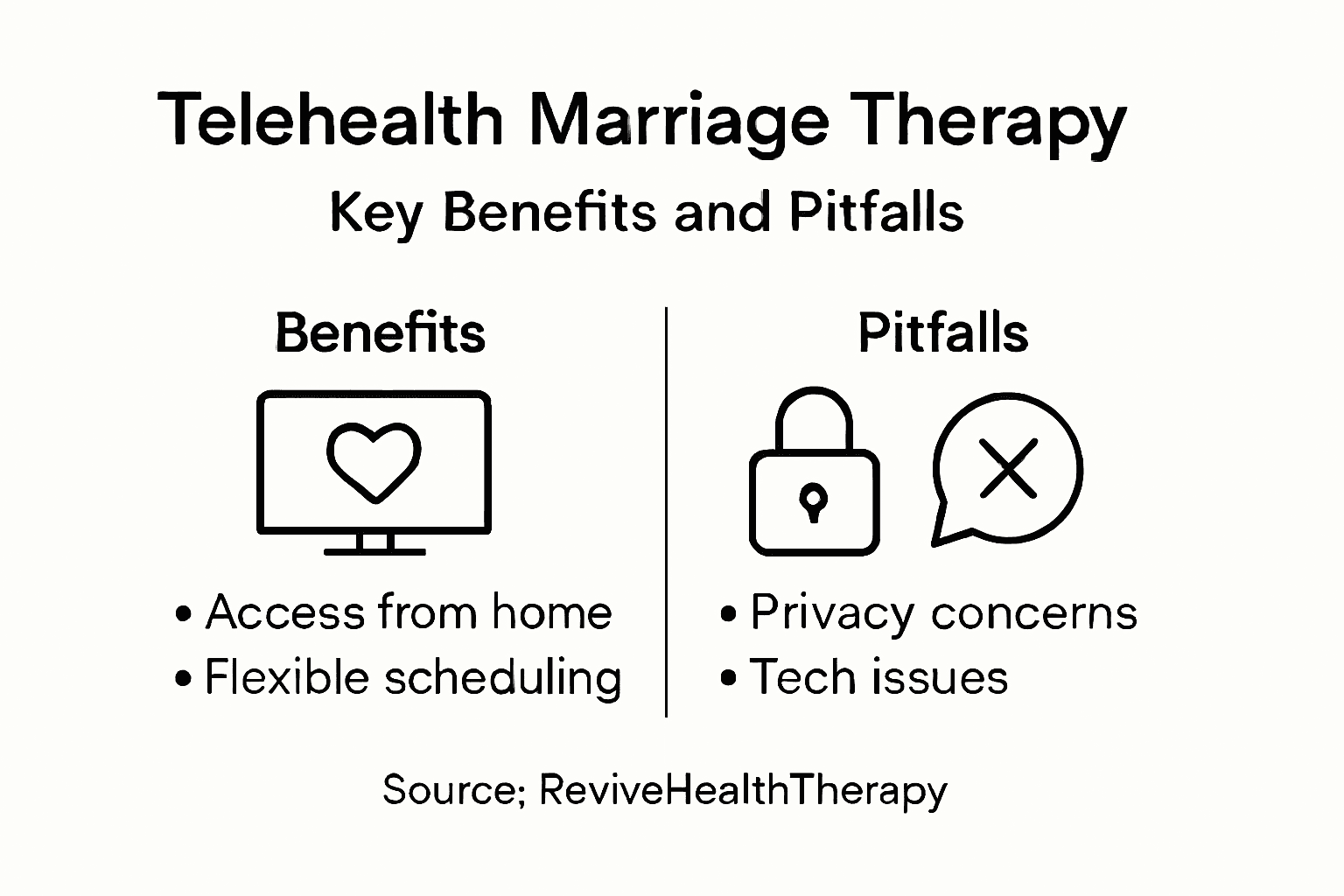
Common pitfalls exist, though. Technology limitations, privacy concerns, and digital literacy gaps present real challenges for some couples. Poor internet connections can interrupt sessions. Some people struggle with video platforms initially.
Affordable therapy means different things to different families, but the core principle is clear: cost shouldn’t prevent you from getting help.
Below is a summary of typical telehealth therapy costs and payment options:
| Payment Method | Out-of-Pocket Cost | Coverage Scope | When to Choose |
|---|---|---|---|
| Insurance Copay | $25–$50 per session | With qualifying plan | If therapy is covered |
| Sliding-scale Fee | $30–$150 per session | Based on household income | Without insurance or high deductible |
| HSA/FSA Funds | Varies by session rate | Pre-tax medical accounts | For tax-advantaged payment |
| Upfront Self-Pay | Published rate (no extra) | Transparent pricing | No insurance, prefer clarity |
Insurance reimbursement policies create inconsistencies. One partner’s insurance might cover telehealth while another’s doesn’t. Always verify your specific plan’s coverage before scheduling.
Technical disruptions and insurance coverage gaps remain the biggest barriers to telehealth access, even as the modality becomes more widespread.
High-conflict couples sometimes struggle more with video therapy than in-person sessions. Managing escalated conflict through a screen requires specific therapist skills and clear agreements with both partners about session boundaries.
Privacy concerns arise when couples share homes with others. Make sure you can find a truly private space for 50-minute sessions without interruptions or people overhearing sensitive conversations.
Start by confirming your insurance covers telehealth couples therapy and understanding your exact out-of-pocket costs. Ask ReviveHealthTherapy about sliding-scale options if your insurance has high deductibles.
Pro tip: Test your internet speed and video quality the day before your first session, and identify a quiet, private space where both partners feel completely safe speaking openly.
Strengthen Your Relationship with Telehealth Marriage Therapy
Couples often face barriers like scheduling conflicts, privacy concerns, and the anxiety of seeking help that prevent them from improving their connection. Telehealth marriage therapy removes these obstacles by allowing you to engage in meaningful, evidence-based sessions from the comfort and safety of your own home. If you are ready to overcome communication challenges, rebuild trust, and foster emotional intimacy, personalized support is within reach.
Explore how Uncategorized – ReviveHealthTherapy can help you navigate these relationship challenges with flexible telehealth options designed specifically for California couples. Don’t wait until problems deepen—take the empowering step to invest in your partnership today. To get started or learn more about how teletherapy fits your lifestyle, contact us directly at ReviveHealthTherapy Contact Page. Our team is ready to support your journey to connection and healing.
Frequently Asked Questions
What are the main benefits of telehealth marriage therapy?
Telehealth marriage therapy allows couples to attend sessions from home, which can reduce anxiety and foster more honest conversations. It also eliminates travel time and scheduling conflicts, making it easier for both partners to engage in therapy without additional stress.
Is telehealth marriage therapy as effective as in-person therapy?
Yes, research indicates that videoconferencing for couples therapy produces outcomes comparable to in-person sessions. Couples report similar improvements in relationship satisfaction and mental health when participating in video therapy.
What equipment do I need for online marriage therapy sessions?
You will need a stable internet connection, a device with a camera and microphone (like a computer, tablet, or phone), and a private space for a 50-minute session. A willingness to engage honestly with your partner is also essential.
How much does telehealth marriage therapy typically cost?
Costs can vary widely, but generally, sliding-scale fees range from $30 to $150 per session for those without insurance. If you have insurance, your copay is often $25 to $50 per session. It’s advisable to check with your provider regarding coverage for telehealth services.
4 Responses