
TL;DR:
- EMDR helps teens reprocess traumatic memories without requiring detailed verbal disclosure.
- The therapy is effective, rapid, and tailored to adolescents’ needs, often reducing PTSD symptoms significantly.
- Support from parents, proper preparation, and patience enhance EMDR’s success for teen trauma recovery.
Watching your teenager struggle after trauma is one of the hardest experiences a parent can face. You see the nightmares, the withdrawal, the grades slipping, and you want answers that actually work. EMDR (Eye Movement Desensitization and Reprocessing) is one of the most rigorously studied trauma therapies available today, and it was built for exactly this kind of pain. Unlike traditional talk therapy, EMDR doesn’t require your teen to relive every detail out loud. This guide walks you through every phase of the process so you know what to expect, how to help, and why so many California families are choosing EMDR as their first step toward real healing.
Table of Contents
- What is EMDR and why is it effective for teens?
- Preparing your teen for EMDR: What parents need to know
- Step-by-step EMDR protocol for teens: The 8 phases explained
- Common questions and troubleshooting: Supporting your teen during EMDR
- Our perspective: What parents should really expect from EMDR for teens
- Get expert EMDR support for your teen
- Frequently asked questions
Key Takeaways
| Point | Details |
|---|---|
| EMDR is evidence-based | Research shows EMDR is a proven, rapid tool for trauma recovery in teens—even when talking is difficult. |
| Tailored for teens | EMDR therapy features age-appropriate methods like art, tapping, and privacy autonomy to suit teen needs. |
| Stepwise approach | Eight clear EMDR phases guide trauma healing from preparation to reassessment, making progress transparent. |
| Preparation is key | Careful groundwork, therapist choice, and parental support strongly influence EMDR outcomes for teens. |
| Family involvement matters | Ongoing encouragement and monitoring between sessions boost your teen’s success with EMDR. |
What is EMDR and why is it effective for teens?
EMDR is a structured therapy that helps the brain reprocess traumatic memories so they lose their emotional charge. During sessions, a therapist guides your teen through a series of bilateral stimulation exercises, which means stimulating both sides of the brain in an alternating rhythm. This can look like following a moving light with the eyes, listening to alternating tones through headphones, or using gentle tapping. The goal is to help the brain file the traumatic memory correctly, the way it would file an ordinary memory, so it stops triggering intense fear or distress.
What makes EMDR especially well-suited for teenagers is its less-verbal structure. Many teens simply cannot or will not talk through trauma in detail. EMDR sidesteps that barrier entirely. Therapists can weave in art, music, and movement, and teens often have more control over the pace than they would in traditional talk therapy. That sense of autonomy matters enormously for adolescents.
The research behind EMDR is compelling. EMDR is proven to rapidly reduce PTSD symptoms and can be effective even when teens struggle to talk about trauma. Studies show recovery rates of 51 to 61 percent after just a few weeks of treatment, which is significantly faster than many traditional approaches. EMDR RCT findings consistently show EMDR is as effective as Trauma-Focused CBT (TF-CBT) and far superior to a waitlist approach.
Here is what parents can expect EMDR to address in teens:
- PTSD and acute stress following accidents, abuse, or loss
- Anxiety and panic rooted in unresolved traumatic events
- Emotional dysregulation, including sudden anger or emotional shutdown
- School avoidance tied to social or academic trauma
- Relationship difficulties stemming from attachment wounds
Parents who are starting teen counseling for the first time often worry that therapy will feel invasive or overwhelming for their child. EMDR’s gentle, structured approach tends to ease that concern quickly. Many teens also find that EMDR helps them with steps to reduce anxiety in daily life, not just in the therapy room.
Pro Tip: When searching for a provider, look specifically for EMDRIA-certified therapists. Certification means the clinician has completed specialized training and meets ongoing standards for EMDR practice.
Now that we’ve highlighted EMDR as a leading trauma therapy for teens, the next step is making sure your teen is ready and well-supported for their first sessions.
Preparing your teen for EMDR: What parents need to know
Preparation is not a formality in EMDR. It is a full phase of treatment, and for teens, it can make or break the entire experience. Before any trauma processing begins, the therapist spends dedicated time building trust, teaching coping tools, and helping your teen feel genuinely safe.

EMDR for teens involves age-specific adaptations: shorter sessions if needed, privacy protections, use of art and music, and options like the Butterfly Hug, where teens cross their arms and tap their own shoulders alternately. These adaptations are not watered-down versions of adult therapy. They are intentional design choices that make the process more accessible and effective for adolescent brains.
As a parent, your role during this phase is supportive but not intrusive. You can help by:
- Explaining session basics to your teen before they go, including how long sessions last and that they control the pace
- Respecting privacy, since teens are more likely to engage when they know their disclosures stay confidential
- Gathering practical tools the therapist recommends, such as headphones, a journal, or art supplies
- Practicing safe-place exercises at home, a simple visualization technique taught in early sessions
Here is a quick reference for what to prepare:
| Tool | Purpose | Who provides it |
|---|---|---|
| Headphones | Bilateral audio tones | Parent/teen |
| Journal | Between-session reflection | Parent/teen |
| Art supplies | Creative processing in session | Therapist/parent |
| Comfort object | Grounding during distress | Teen’s choice |
| Safe-place script | Anxiety regulation at home | Therapist |
“Family encouragement and consistent home support are directly linked to better EMDR outcomes for adolescents. When teens feel their parents believe in the process, they engage more fully.”
You can also find an EMDRIA-certified provider directory to locate qualified therapists near you in California. Understanding the broader teen therapy benefits can also help you set realistic and encouraging expectations before the first appointment. For families ready to move forward, exploring EMDR services for youth is a practical next step.
Pro Tip: Ask the therapist to share a simple distress-monitoring tool your teen can use between sessions. Tracking emotional patterns at home gives the therapist valuable data and keeps your teen actively involved in their own healing.
Step-by-step EMDR protocol for teens: The 8 phases explained
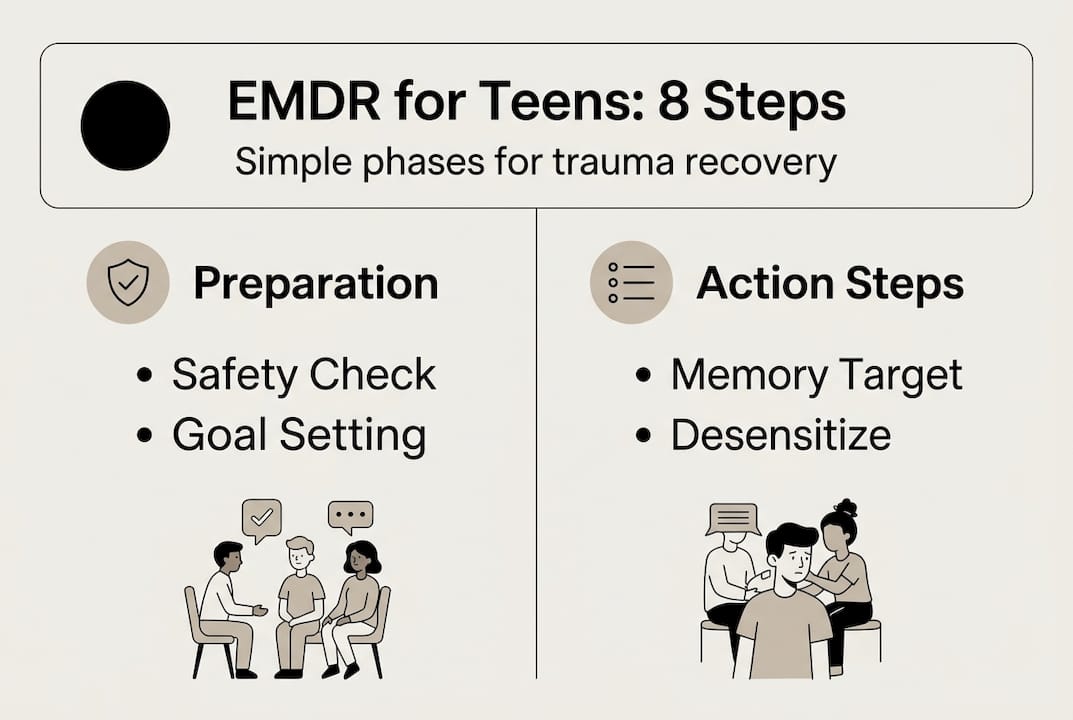
With your teen prepped and all tools ready, here is how the EMDR process actually unfolds, step by step. EMDR therapy for teens follows an 8-phase protocol adapted with age-friendly techniques.
- History and treatment planning — The therapist gathers background on your teen’s trauma history and identifies target memories to process.
- Preparation — Coping skills are taught, including the safe-place visualization and bilateral stimulation methods like the Butterfly Hug.
- Assessment — The therapist and teen identify the specific memory, the negative belief attached to it (such as “It was my fault”), and a positive belief to work toward.
- Desensitization — Bilateral stimulation begins while the teen focuses on the target memory. Distress gradually decreases across multiple sets.
- Installation — The positive belief is strengthened and linked to the processed memory.
- Body scan — The teen checks for any remaining physical tension connected to the memory.
- Closure — Each session ends with grounding and stabilization exercises to ensure the teen leaves feeling safe.
- Reevaluation — The next session opens by checking whether progress held and whether new material has surfaced.
Group EMDR shows significant trauma symptom drops for teens (p<.001), and individual EMDR studies show that a meaningful percentage of teens lose their PTSD diagnosis entirely after completing the protocol. That is not a small result. That is a life changed.
| Feature | EMDR for teens | EMDR for adults |
|---|---|---|
| Session length | 45 to 60 minutes | 60 to 90 minutes |
| Language used | Simple, concrete | Abstract, reflective |
| Bilateral stimulation | Tapping, music, art | Eye movements, tones |
| Pacing | Teen-controlled | Therapist-guided |
| Creative integration | Frequent | Optional |
For a deeper look at full EMDR protocol details or to understand how EMDR compares to TF-CBT, both resources offer helpful context. You can also find a broader overview on EMDR for teens that covers real-world outcomes across different trauma types.
Common questions and troubleshooting: Supporting your teen during EMDR
Even with a clear process, parents and teens can encounter bumps along the way. Here is how to handle them with confidence.
The most common challenges families report include session resistance, emotional overwhelm between appointments, and the unsettling feeling that progress has stalled. All of these are normal. EMDR stirs things up before it settles them down, and that temporary discomfort is often a sign the brain is actively reprocessing.
Here are practical steps parents can take:
- If your teen resists going — Talk openly about what specifically feels scary. Sometimes just naming the fear reduces it. Offer to speak with the therapist together.
- If your teen seems more emotional at home — This is common after processing sessions. Use grounding techniques like slow breathing or the 5-4-3-2-1 sensory exercise.
- If progress feels slow — Ask the therapist to explain what phase you are in. Progress in phases 1 and 2 looks different from progress in phase 4.
- If your teen won’t talk about sessions — That is okay. Respect the boundary and stay available without pressuring disclosure.
“Family support is a strong predictor of EMDR success. Teens whose parents remain calm, curious, and non-reactive during hard weeks show faster overall recovery.”
Monitor teen distress between sessions using tools provided by the therapist, and combine family and individual therapy if possible for the strongest outcomes. Research also notes that NICE guidelines suggest TF-CBT first, with EMDR recommended when teens struggle to engage verbally, and expert consensus confirms EMDR’s effectiveness across both scenarios.
Pro Tip: Encourage your teen to keep a simple feelings journal between sessions. Even three words per day gives the therapist useful material and helps your teen build emotional awareness over time.
Exploring counseling benefits for recovery and reviewing key therapy approaches can help you stay informed and confident as a parent throughout the process.
Our perspective: What parents should really expect from EMDR for teens
Here is something most articles won’t tell you: EMDR is not a straight line upward. Parents often come in expecting a steady weekly improvement, and when week three feels harder than week one, they panic. That panic is understandable, but it is also one of the biggest obstacles to successful treatment.
In our experience working with California teens and their families, the most meaningful breakthroughs often happen quietly. A teen starts sleeping through the night. They laugh at dinner again. They stop flinching at a sound that used to trigger them. These are not dramatic moments. They are the real results of EMDR, and they show up in everyday life long before they show up in a formal assessment.
We also want to be honest: EMDR works best when it is not the only support in place. Pairing it with family sessions, school-based support, or even mindfulness practice can accelerate healing in ways that individual EMDR alone cannot always achieve. You can read about real-world EMDR experiences from families who have navigated this process.
Patience is not passive. It is an active, powerful investment in your teen’s recovery.
Get expert EMDR support for your teen
If you want customized, expert EMDR support for your teen’s healing journey, here is how to get started.
At ReviveHealthTherapy, our California-based clinicians specialize in adolescent trauma and are trained in EMDR protocols designed specifically for teens. We offer both in-person sessions in Walnut Creek and Oakland, as well as secure telehealth appointments statewide, so geography is never a barrier to care.

Whether your teen is just beginning to open up or has been carrying trauma for years, our team meets them exactly where they are. Explore our Teen Therapy services, connect with our EMDR specialists in California, or review our complete therapy guide to understand all your options. We accept insurance and offer sliding-scale fees, because every teen deserves access to effective care.
Frequently asked questions
How long does EMDR therapy for teens typically last?
Most teens need 3 to 6 weeks for single-event trauma and 8 to 12 or more weeks for complex situations, with one session per week at 60 to 90 minutes each.
What makes EMDR different from traditional talk therapy for teens?
EMDR uses bilateral stimulation such as tapping or eye movements and requires far less verbal detail, making it accessible for teens who find talking about trauma difficult.
Is EMDR safe for teens with severe trauma or behavioral issues?
Yes. EMDR is endorsed for complex trauma and high-risk behaviors in teens, particularly when delivered by EMDRIA-certified therapists with adolescent experience.
How do I find an EMDR therapist for my teenager in California?
Use the EMDRIA certified therapist directory to filter by location and specialty, ensuring your provider has specific training and experience working with teens.
Does EMDR work for teens who struggle to talk about trauma?
Absolutely. EMDR is specifically designed for less verbal processing, using experiential and creative methods that make it ideal for teens who find sharing their trauma out loud too difficult.
Recommended
- Healing Trauma Process 2026: Step-by-Step Recovery Guide – ReviveHealthTherapy
- Psychotherapy in trauma recovery: evidence-based options CA 2026 – Revive Health Therapy
- 7 Effective Types of Trauma Therapy for Recovery – ReviveHealthTherapy
- Why Seek Individual Therapy for Trauma Recovery – ReviveHealthTherapy
- How to create a safe space for healing: trauma-informed guide
3 Responses