
TL;DR:
- Structured checklists, like GAD-7 and SCARED, help manage and monitor anxiety effectively.
- Combining checklists with evidence-based therapies like CBT and mindfulness improves outcomes.
- Regular use and professional support are essential for overcoming anxiety across ages and settings.
Anxiety can hit without warning, and when it does, good intentions rarely hold up. You might know you need to slow down, breathe, or reach out for help, but in the middle of a racing heart or a sleepless night, knowing and doing feel miles apart. That gap is exactly where structured checklists earn their value. Whether you are managing your own anxiety or supporting a child through it, a practical, evidence-based checklist turns vague worry into clear, manageable steps. This article walks you through two trusted screening tools, the GAD-7 for adults and SCARED for children, plus strategies that make both work harder for your family.
Table of Contents
- Understanding the need for anxiety management checklists
- Checklist 1: GAD-7 for adults – self-check for anxiety levels
- Checklist 2: SCARED for children and teens – empowering parents and caregivers
- Evidence-based anxiety management strategies to pair with checklists
- Why checklists succeed where good intentions fail
- Connect with California’s leading anxiety support resources
- Frequently asked questions
Key Takeaways
| Point | Details |
|---|---|
| Checklists provide clarity | Using structured tools breaks anxiety management down into simple, actionable steps. |
| Validated tools exist | The GAD-7 and SCARED checklists are proven and free resources for adults, parents, and children. |
| Pair with proven strategies | Combining checklists with therapy and mindfulness leads to stronger anxiety reduction. |
| Accessible support in California | Therapy, including CBT and telehealth, is widely available and often covered by Medi-Cal. |
Understanding the need for anxiety management checklists
Anxiety does not announce itself neatly. It shows up as irritability, avoidance, stomachaches in kids, or constant worst-case thinking in adults. Without a plan, it is easy to feel like you are always reacting instead of managing. That is where checklists change the game.
A well-designed checklist does something powerful: it removes the guesswork. Instead of asking yourself “Am I anxious?” you ask “Did I sleep enough? Did I notice three triggers this week? Did my child avoid school again?” Those are answerable questions, and answerable questions lead to action.
Here is what makes an anxiety management checklist genuinely useful:
- Evidence-based questions grounded in validated research, not generic wellness advice
- Daily or weekly tracking so you can spot patterns over time
- Symptom monitoring that covers physical, emotional, and behavioral signs
- Clear next steps when scores or patterns suggest you need more support
- User-friendly format that works for both adults and children
For California families, this matters even more. Access to care varies widely across the state, and having a checklist can help you decide when self-management is enough and when it is time to connect with a professional.
“Checklists are not a replacement for therapy. They are a bridge. They help you see clearly enough to take the next right step.”
The proven anxiety therapies most widely used today, especially Cognitive Behavioral Therapy (CBT), are built on exactly this kind of structured self-monitoring. CBT is the gold-standard treatment for anxiety, typically running 12 to 16 weeks and working through cognitive restructuring and gradual exposure to feared situations. It is effective for both adults and children, and it works best when paired with ongoing self-awareness tools.
Adding mindfulness strategies alongside your checklist routine can also help regulate the nervous system between therapy sessions, giving you more data and more calm to work with.
Pro Tip: Keep your checklist somewhere visible, like a phone home screen or a sticky note on the fridge. Anxiety thrives in avoidance, and out-of-sight tools get skipped.
Checklist 1: GAD-7 for adults – self-check for anxiety levels
The GAD-7 is one of the most trusted anxiety screening tools available. It stands for Generalized Anxiety Disorder 7-item scale, and it gives you a fast, reliable snapshot of how anxiety is affecting your daily life. The GAD-7 is a validated self-report scale that screens for generalized anxiety in adults, with scores ranging from 0 to 21.
Here is how to complete it:
- Think about the past two weeks only
- Rate how often each of the 7 symptoms bothered you: Not at all (0), Several days (1), More than half the days (2), Nearly every day (3)
- The seven items ask about: feeling nervous or on edge, inability to stop worrying, worrying too much, trouble relaxing, restlessness, irritability, and fear that something awful might happen
- Add up your scores for a total between 0 and 21
- Compare your total to the scoring guide below
| Score range | Severity level | Suggested next step |
|---|---|---|
| 0 to 4 | Minimal anxiety | Continue self-care practices |
| 5 to 9 | Mild anxiety | Monitor symptoms, try coping tools |
| 10 to 14 | Moderate anxiety | Consider speaking with a counselor |
| 15 to 21 | Severe anxiety | Seek professional support promptly |
Scores in the moderate to severe range are a clear signal to reach out. California residents have access to a range of psychotherapy solutions that can help, including telehealth options that remove the barrier of distance or scheduling.
If you are unsure what kind of support fits your situation, reviewing therapy options for anxiety can help you figure out the right match before your first appointment.
Pro Tip: The GAD-7 is not a diagnosis. It is a starting point. A score of 10 or above does not mean something is permanently wrong. It means you deserve more support right now, and that support is available.
Checklist 2: SCARED for children and teens – empowering parents and caregivers
When anxiety shows up in a child, it rarely looks like adult anxiety. It might look like a stomachache every Sunday night, a refusal to go to birthday parties, or constant questions about whether something bad will happen to a parent. The SCARED tool was built for exactly this.
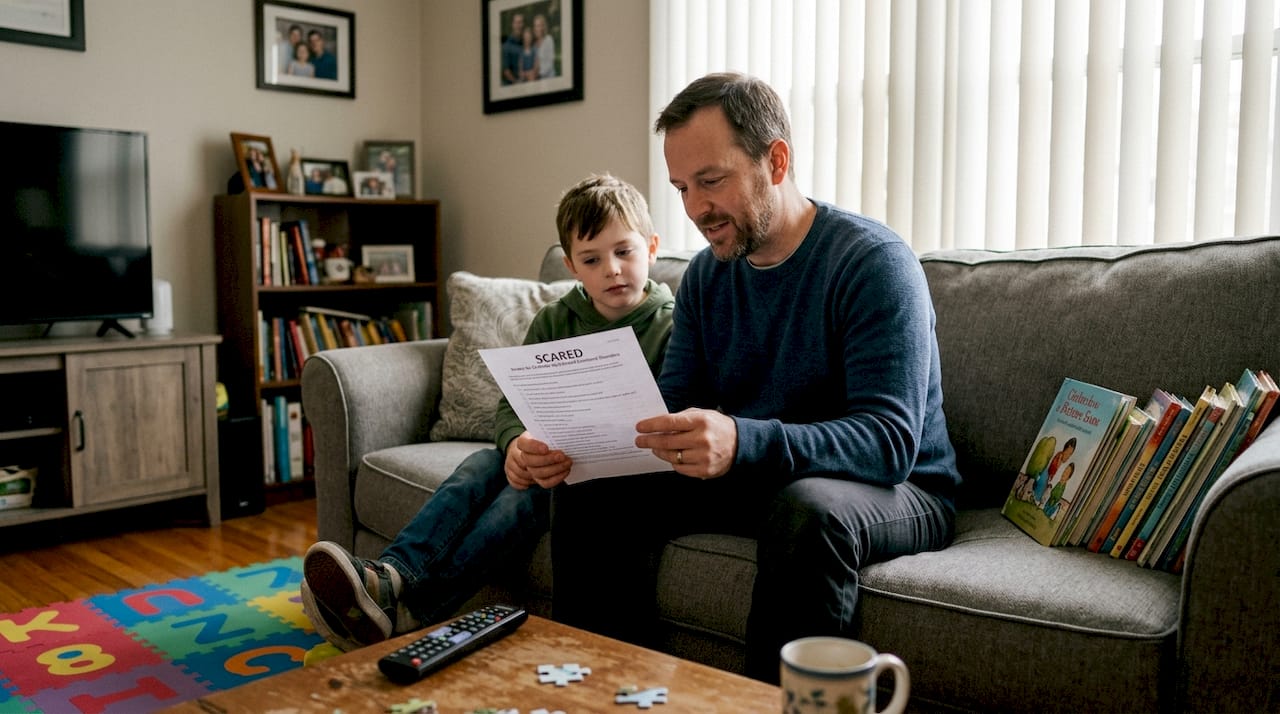
SCARED stands for Screen for Child Anxiety Related Emotional Disorders. The SCARED is a validated screening tool for anxiety disorders in children and teens ages 8 to 18. Both the child and parent complete separate versions, which gives a fuller picture of what is happening.
Here is how to use it:
- Download the parent and child versions (both are free)
- Each person rates 41 items on a 3-point scale: Not true (0), Somewhat true (1), Very true (2)
- Items cover five anxiety types: panic disorder, generalized anxiety, separation anxiety, social anxiety, and school avoidance
- Add up all 41 items for a total score
- A total score of 25 or higher suggests a possible anxiety disorder and warrants professional evaluation
SCARED covers anxiety types that are often missed in children:
- Panic symptoms like racing heart and dizziness
- Worrying about the future or making mistakes (generalized anxiety)
- Separation fears, especially at bedtime or school drop-off
- Social fears around embarrassment or judgment from peers
- School avoidance or physical complaints before school
| Feature | GAD-7 | SCARED |
|---|---|---|
| Who completes it | Adult self-report | Child and parent versions |
| Age range | Adults | Ages 8 to 18 |
| Number of items | 7 | 41 |
| Concern threshold | Score 10 or above | Score 25 or above |
| Anxiety types covered | Generalized anxiety | 5 anxiety subtypes |
If your child scores at or above 25, the next step is not panic. It is a conversation with a professional who understands childhood anxiety. CBT for families is one of the most effective approaches, and learning more about anxiety therapy types can help you and your child feel prepared before the first session.
Evidence-based anxiety management strategies to pair with checklists
Checklists tell you where you are. Strategies move you forward. The two work best together, and the good news is that the most effective strategies are also the most accessible.
CBT-based strategies are the foundation. Cognitive restructuring helps you identify thoughts that fuel anxiety and replace them with more balanced ones. Exposure, meaning gradually facing feared situations in small steps, reduces avoidance over time. CBT typically produces results within 12 to 16 weeks, and California clinics offering CBT and EMDR often accept Medi-Cal, making this approach reachable for many families.
Mindfulness practices are a daily tool, not a one-time fix. Even five minutes of focused breathing or a body scan can lower cortisol (the stress hormone) and interrupt the anxiety cycle. Pairing mindfulness for anxiety with your weekly checklist review helps you notice what is working and what is not.
Here are strategies that pair directly with checklist use:
- Daily symptom journaling: Write two to three sentences about your anxiety level each morning. Over weeks, patterns become obvious.
- Trigger tracking: Each time your checklist flags a high-symptom day, note what happened before it. This builds self-awareness faster than any app.
- Scheduled worry time: Set a 15-minute window each day to think through worries. Outside that window, redirect. This is a core CBT technique.
- Breathing anchors: Use a simple 4-7-8 breath (inhale 4 counts, hold 7, exhale 8) as a physical reset when checklist scores spike.
Statistic to know: CBT reduces anxiety symptoms significantly within 12 to 16 weeks for most adults and children, making it one of the fastest-acting talk therapies available.
Knowing when to reach out is just as important as the strategies themselves. If your GAD-7 stays above 10 for two consecutive check-ins, or your child’s SCARED score stays at 25 or above, that is the moment to connect with a therapist. You can learn what to expect by reading a therapy step-by-step guide before your first session.
Pro Tip: Pair your checklist review with a habit you already have, like Sunday coffee or a Tuesday lunch break. Attaching a new behavior to an existing one makes it stick.
Understanding why evidence-based therapy matters can also help you feel more confident choosing a therapist rather than settling for whoever has an opening.
Why checklists succeed where good intentions fail
Here is something most anxiety advice gets wrong: it assumes motivation is the missing ingredient. It is not. When anxiety is high, motivation is one of the first things to go. The brain under stress narrows its focus, avoids complexity, and defaults to familiar patterns, even harmful ones.
Checklists work not because they inspire you but because they remove the need for inspiration. They provide what we call forced clarity, a pre-made decision about what to do next. You do not have to think. You just follow the list.
For families managing anxiety across different ages and needs, this is especially valuable. A parent who is anxious themselves cannot always model calm for a child. But they can follow a checklist. And following a checklist, consistently, builds the kind of therapy for anxiety outcomes that good intentions alone never produce.
Checklists also break overwhelming goals into clear daily actions, which is exactly how lasting behavioral change happens. Paired with ongoing therapy, they are not just a coping tool. They are a progress tracker, a communication aid with your therapist, and a daily reminder that you are doing something real.
Connect with California’s leading anxiety support resources
You have the checklists. You have the strategies. The next step is knowing that you do not have to figure out the rest alone.
At Revive Health Therapy, we offer mental health services for adults and mental health services for children across California, using evidence-based approaches like CBT, EMDR, and mindfulness. Whether you prefer in-person sessions in Walnut Creek or Oakland, or need the flexibility of telehealth mental health support, we make it easy to get started. We accept insurance, HSA/FSA plans, and offer sliding-scale fees so cost is not a barrier. Reach out today and let us help you turn your checklist scores into a real plan forward.
Frequently asked questions
What makes an anxiety management checklist effective?
An effective checklist is built on evidence-based methods like CBT, includes consistent tracking, and points you toward professional help when scores suggest you need it.
How often should I use the GAD-7 or SCARED checklist?
Most experts recommend using screening tools like GAD-7 monthly or whenever you notice a significant change in anxiety symptoms.
Are there free anxiety management checklists for Californians?
Yes. Both the GAD-7 and SCARED are free and widely available online, and many California clinics offer printable versions at no cost.
Do Medi-Cal plans cover therapy for anxiety in California?
Yes. Medi-Cal covers CBT and other evidence-based therapies for anxiety, making professional support accessible to eligible Californians.
Who should use a child/parent anxiety checklist?
Parents, caregivers, and children ages 8 to 18 can all use the SCARED tool, which is validated for early detection and guides families toward the right level of support.
Recommended
- Mental health checklist for California teens: strategies & support – Revive Health Therapy
- Youth anxiety in California: Key strategies for parents – Revive Health Therapy
- Manage anxiety with proven therapies in California 2026 – Revive Health Therapy
- How to manage teen anxiety with proven therapies in CA – Revive Health Therapy
- How to Calm Racing Thoughts — The Caia Journal
One Response