
TL;DR:
- Group therapy is as effective as individual therapy for anxiety, depression, and trauma recovery.
- It offers unique benefits like peer validation, social learning, and practicing real-world skills.
- Suitable for many, but not during active crises or severe social avoidance.
Most people assume that sharing a room with strangers while discussing personal struggles is the last thing that could heal anxiety, depression, or trauma. Yet group therapy is as effective as individual therapy for these exact conditions. The myth that it is less personal or somehow a compromise persists, but the research says otherwise. For Californians navigating long waitlists, high costs, and the lingering weight of the past few years, group therapy may actually be the most powerful option available. This article breaks down how it works, when it fits best, and why its benefits go far beyond saving money.
Table of Contents
- What is group therapy? Core principles and how it works
- How effective is group therapy for anxiety, depression, and trauma recovery?
- Unique benefits of group therapy: Why it’s not ‘just cheaper’ than individual care
- When is group therapy the right (or wrong) choice? Cautions and preparation tips
- Our perspective: What most people miss about group therapy’s real power
- Find group therapy and trauma recovery help in California
- Frequently asked questions
Key Takeaways
| Point | Details |
|---|---|
| Evidence-based results | Group therapy matches individual therapy for anxiety, depression, and trauma recovery. |
| Unique social benefits | It builds peer support, practical skills, and reduces isolation in ways solo care cannot. |
| Preparation is key | Pre-group screening and setting expectations help ensure a positive experience and better results. |
| Accessible options exist | Virtual and insurance-covered group therapy makes getting help in California easier than ever. |
What is group therapy? Core principles and how it works
Group therapy is a structured, therapist-led treatment where typically 5 to 15 people meet on a regular basis, usually weekly, to work through shared mental health challenges. It is not a support group or a drop-in chat. It is clinical, goal-directed treatment with sessions lasting between 60 and 120 minutes, guided by a licensed therapist trained in group dynamics.
Sessions typically follow one of several structured formats:
- Cognitive behavioral therapy (CBT) groups: Focus on identifying and reshaping unhelpful thought patterns and behaviors.
- Interpersonal therapy (IPT) groups: Address how relationships and communication styles affect emotional health.
- Process-oriented groups: Center on the relationships and interactions happening within the group itself, in real time.
One of the most important concepts in group therapy is the idea of the social microcosm. Think of it as a small, safe version of the real world. The way you interact with group members often mirrors patterns from your daily life, your relationships, your workplace, your family. A skilled therapist notices these patterns and helps you understand and change them in the moment.
Several core therapeutic factors make group therapy work:
- Cohesion: A sense of belonging and trust among members.
- Universality: The relief of realizing you are not alone in your experience.
- Hope: Watching others improve is genuinely motivating.
- Catharsis: Expressing difficult emotions in a safe setting reduces their grip on you.
“The group becomes a living laboratory where members practice new ways of connecting, communicating, and healing together.”
Before joining, most programs include a pre-group screening, which is a brief interview or questionnaire that helps the therapist assess fit and set clear expectations. Ground rules around confidentiality and respect are established early, so members can feel safe enough to engage honestly. If you are exploring psychotherapy options in California, understanding how group therapy is structured helps you make an informed choice.
How effective is group therapy for anxiety, depression, and trauma recovery?
The effectiveness data here is clear and worth knowing. Meta-analyses consistently show that group therapy produces results comparable to individual therapy across anxiety, depression, and PTSD. This is not a minor finding. It means that sharing the therapeutic process with others does not dilute it.
According to AGPA practice guidelines, effect sizes for group therapy are meaningful across the major conditions:
| Condition | Effect size (group therapy) |
|---|---|
| Depression | g = 0.31 |
| Anxiety | g = 0.28 |
| PTSD/Trauma | g = -0.71 to -0.90 |
These numbers indicate moderate to strong improvements. For trauma in particular, the effect size range suggests that group-based approaches can drive significant symptom reduction. Brief group CBT for depression and anxiety shows stable gains that hold up at the 12-month follow-up mark, which means the benefits are not just a short-term boost.
Key reasons group therapy works so well:
- It reduces isolation, which is one of the most damaging aspects of anxiety and depression.
- Members build practical coping skills together and reinforce each other’s progress.
- Hearing others name feelings you cannot articulate yourself is profoundly validating.
- Culturally adapted groups, designed for specific communities, show even stronger outcomes.
Despite this evidence, fewer than 5% of private practices offer group therapy as a primary service. That gap between what the research supports and what gets offered is a real problem. Learning about evidence-based therapy benefits can help you advocate for the right treatment.
For trauma specifically, group therapy works because shared experience normalizes what can feel like an isolating or shameful history. Exploring trauma recovery therapy options alongside group formats gives you a fuller picture of what healing can look like. The role of therapy in trauma recovery is well-established, and groups amplify that process through peer connection.

Unique benefits of group therapy: Why it’s not ‘just cheaper’ than individual care
Cost savings are real. But framing group therapy purely as a budget option misses what actually makes it powerful. There are things that happen in a group that simply cannot happen in a one-on-one session.
What makes group therapy distinctively valuable:
- Peer validation: Hearing someone else say “me too” after you share something painful is different from a therapist responding with empathy. Both matter. They work differently.
- Social learning: Watching how another person navigates a conflict or expresses a boundary teaches you in a way no textbook or therapist explanation can.
- Role-playing and feedback: Practicing a difficult conversation with group members, then getting honest feedback, builds real-world skills quickly.
- Altruism: When you help someone else in the group, it shifts your sense of identity. You stop seeing yourself only as someone who needs help.
The psychologist Irvin Yalom identified a set of therapeutic factors unique to groups, including universality (the relief that others share your struggles), altruism (the healing that comes from helping others), and interpersonal learning (growth through real relationships in the room). Group therapy outcomes show it can be superior to individual therapy specifically for loneliness, social anxiety, and shame-based struggles, precisely because the healing mechanism is social.
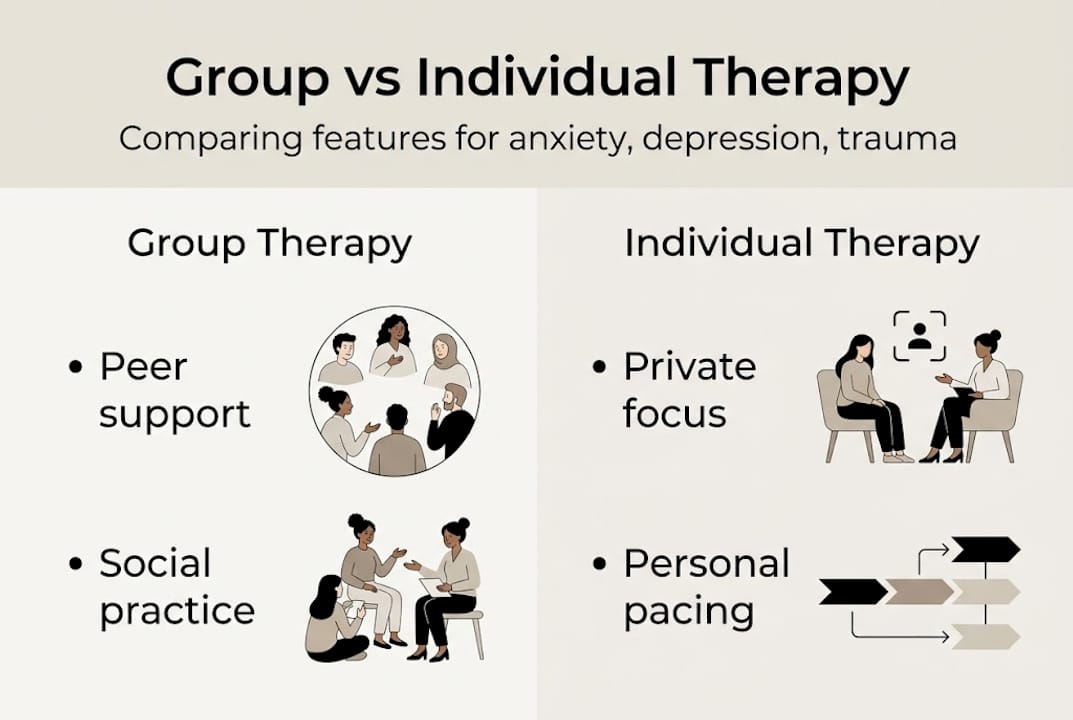
Comparison: Group therapy vs. individual therapy
| Feature | Group therapy | Individual therapy |
|---|---|---|
| Peer support | Yes | No |
| Social skill practice | High | Limited |
| Cost per session | Lower | Higher |
| Personal focus per session | Shared | Dedicated |
| Sense of belonging | Strong | Varies |
| Feedback from multiple perspectives | Yes | No |
Pro Tip: If social anxiety is part of what you are dealing with, a group format is not something to avoid. It is often the most direct path to change, because the thing you fear is also the thing that heals you.
For those who prefer remote access, online therapy benefits apply to group formats as well. Virtual groups remove commute barriers and expand access. Pairing group work with strong self-care for mental health practices further supports the progress you make in sessions.
When is group therapy the right (or wrong) choice? Cautions and preparation tips
Group therapy is not one-size-fits-all. Knowing when it is the right fit saves you time and sets you up for a better experience.
Group therapy is a strong fit when you are dealing with:
- Mild to moderate anxiety or depression
- Social isolation or difficulty connecting with others
- Trauma recovery with some stabilization already in place
- A desire to build interpersonal skills in a structured, supported setting
When to pause and consider other options:
- Active crisis or immediate safety concerns
- Severe social avoidance that makes participation feel impossible
- Conditions requiring intensive individual focus
- Highly hostile or conflictual group dynamics
AGPA guidelines are clear that group therapy is not appropriate during acute crisis or for individuals whose needs require the undivided attention of a therapist. In those cases, individual therapy is the better starting point.
How to prepare for your first group therapy experience:
- Complete the pre-screening: Be honest about your history, goals, and concerns. This helps the therapist match you with the right group.
- Set realistic expectations: Growth in group therapy is often gradual. Give yourself at least 8 to 12 sessions before evaluating fit.
- Clarify ground rules: Understand the confidentiality policy, attendance expectations, and what happens if conflict arises.
- Expect discomfort early: The first few sessions can feel awkward. That is normal. Most members report settling in by session three or four.
- Communicate with your therapist: If something feels off, say so. Dropouts often happen when concerns go unspoken.
Pro Tip: Bring a written list of what you hope to get from group therapy to your screening. It clarifies your goals and signals to the therapist that you are ready to engage.
For Californians wondering about mental health access in California, including insurance coverage and telehealth options for group formats, there is more support available now than at any point in recent memory.
Our perspective: What most people miss about group therapy’s real power
Here is something most articles skip over: the reason group therapy feels intimidating is the same reason it works. Vulnerability in front of others is hard. It is also where the real change happens. Individual therapy is a controlled environment where you practice insight. Group therapy is where you practice being a person, with all the discomfort and reward that comes with it.
In California, virtual group therapy and insurance coverage have significantly reduced the practical barriers that used to keep people from even trying it. That shift matters. But access only helps if people are willing to show up and engage.
What we see consistently is that people who approach group therapy with openness, rather than treating it as a fallback option, get more out of it than they expected. The social microcosm is real. The skills transfer. The belonging is genuine. Therapy accessibility in California is improving, but it takes knowing your options to use them well. Group therapy deserves to be a first choice, not a last resort.
Find group therapy and trauma recovery help in California
If anything here has resonated with you, that clarity is worth acting on. At Revive Health Therapy, we offer trauma-informed, evidence-based group and individual therapy across California, with in-person sessions available in Oakland and secure telehealth options statewide.
Our Oakland therapy team specializes in anxiety, depression, and trauma recovery therapy using approaches like EMDR, CBT, and mindfulness. We accept insurance, including HSA and FSA plans, and offer sliding-scale fees. You do not have to figure this out alone. Reach out to us to learn which format fits your needs and take the first step toward lasting support.
Frequently asked questions
How does group therapy compare to individual therapy for anxiety or depression?
Group therapy is equally effective for anxiety and depression as individual therapy, and it adds peer support, social learning, and shared accountability that one-on-one sessions cannot replicate.
Is group therapy covered by insurance or available virtually in California?
Many group therapy programs in California are covered by insurance, and virtual group therapy options through secure telehealth platforms are widely available statewide.
Who should avoid group therapy?
Group therapy is not ideal during acute crisis or for individuals with severe social avoidance, though pre-screening helps identify who will benefit most and ensures appropriate placement.
What happens in a typical group therapy session?
Sessions are therapist-led and structured around sharing, skill-building, role-playing, and supportive feedback, with a focus on real-time interpersonal dynamics among members.
Recommended
- Why Seek Individual Therapy for Trauma Recovery – ReviveHealthTherapy
- Psychotherapy in California 2026: Evidence & Options – Revive Health Therapy
- Psychotherapy in trauma recovery: evidence-based options CA 2026 – Revive Health Therapy
- Healing Trauma Process 2026: Step-by-Step Recovery Guide – ReviveHealthTherapy
- Why Naming Your Feelings Helps — The Caia Journal