
TL;DR:
- Emotional regulation is a skill that can be developed through consistent practice, especially during adolescence. Building awareness, practicing mindful breathing, and using various coping tools help teens manage intense feelings better. Professional support becomes essential when self-help strategies are insufficient for long-term emotional stability.
Picture this: your teen slams a door so hard the walls shake, or bursts into tears over a text message, and you have no idea how to help. Or maybe you’re the teen, feeling a wave of fury or panic that seems impossible to control, no matter how hard you try. These moments are exhausting for everyone involved. The good news is that emotional regulation is a skill, not a personality trait you’re born with or without. Research shows that teen brains are still developing the exact systems responsible for emotional control, which means the right steps and consistent practice can genuinely change things for your family.
Table of Contents
- Why emotional regulation matters for teens
- What you need: Building blocks of emotional regulation
- Step-by-step guide: Core emotional regulation skills for teens
- Troubleshooting: Common mistakes and barriers
- How to measure progress: Signs of improved emotional regulation
- What actually works: Why personalizing emotional regulation is key
- Support beyond self-help: Take the next step
- Frequently asked questions
Key Takeaways
| Point | Details |
|---|---|
| Foundational skills | Building self-awareness and supportive environments is the first step for emotional regulation. |
| Actionable steps | Mindfulness, breathing techniques, and flexible coping tools work best when practiced regularly. |
| Common pitfalls | Expect gradual progress and personalize your coping toolbox for long-term success. |
| The role of support | Parental empathy, peer connections, and professional guidance all boost regulation skills. |
| When to seek help | If emotions are overwhelming despite effort, expert help is an empowering next step. |
Why emotional regulation matters for teens
The teenage years are not just emotionally intense by accident. The prefrontal cortex, the part of the brain responsible for decision-making, impulse control, and managing reactions, is still maturing in teens, and this explains why feelings can seem to come out of nowhere and take over completely. When this area is still developing, emotions hit fast and hard, and the brakes are slow to respond.
This isn’t a character flaw. It’s biology. But that doesn’t mean teens are helpless. Targeted interventions using mindfulness, Dialectical Behavior Therapy (DBT), and Cognitive Behavioral Therapy (CBT) give teens practical tools to build awareness and slow down their emotional responses before they cause damage. Without these skills, the cost is real. Poor emotional regulation is linked to impulsive decisions, damaged friendships, academic struggles, and increased vulnerability to anxiety and depression.
Here’s what the research says about the impact:
| Challenge | Effect without regulation skills | Effect with regulation skills |
|---|---|---|
| Peer conflict | Escalates quickly, damages friendships | Resolved with communication |
| Academic stress | Freezes or avoids, grades suffer | Managed with coping strategies |
| Family tension | Cycles of conflict and withdrawal | More open dialogue |
| Mental health risk | Higher rates of anxiety and depression | Reduced symptoms over time |
Research confirms that mindfulness-based interventions show small to moderate effects in improving emotional regulation in adolescents, including real reductions in dysregulation and improvements in coping ability. Small effects compound over time, especially when teens start early.
Key reasons why building these skills early matters:
- Teens who regulate well are better equipped to handle adult stress and responsibility
- Emotional resilience built during adolescence creates lasting neural pathways
- Early intervention prevents harder-to-treat patterns from becoming entrenched
- Strong regulation supports teen self-growth in academics, relationships, and identity
Learning about relaxation therapy methods can also help teens and parents understand the physical side of stress response and why calming the body is often the first move.
Now that you know why emotional regulation is so critical during the teen years, let’s review what you need to start building these skills.
What you need: Building blocks of emotional regulation
Before jumping into specific steps, it helps to understand what conditions support emotional regulation and what gets in the way. Research on school-based programs and global meta-analyses of Social Emotional Learning (SEL) confirms that life skills training and mindfulness programs produce significant gains in social-emotional skills when the right building blocks are in place.

Here’s a comparison of what helps versus what hinders:
| Facilitating factors | Hindering factors |
|---|---|
| Parental empathy and warmth | Authoritarian or harsh parenting |
| Peer support and connection | Peer victimization or bullying |
| Life skills education at school | Lack of access to mental health tools |
| Consistent trusted adults | Socioeconomic hardship and instability |
| Access to coping tools | Stigma around asking for help |
According to research, parental empathy facilitates regulation while authoritarian parenting actively hinders it. That means the relationship between parent and teen is as powerful as any technique or tool.
The essential building blocks include:
- Emotional awareness: Knowing what you feel before you react is the foundation of everything else
- Safe environment: A home and school where teens feel heard, not judged
- Peer connections: Healthy friendships that normalize vulnerability and emotional honesty
- Coping toolbox: A personal collection of strategies for different types of stress
- Trusted adult support: At least one adult who listens without immediately lecturing
You can find solid practical coping tips to start building your toolbox, and exploring family therapy for teens can help address relationship dynamics that make regulation harder at home.
Pro Tip: Ask your teen to rate their emotional state on a scale of 1 to 10 at random times throughout the week. This small habit builds the self-awareness muscle that makes every other skill easier to use.
With the basics in place, you can start practicing specific, evidence-based steps for regulating emotions.
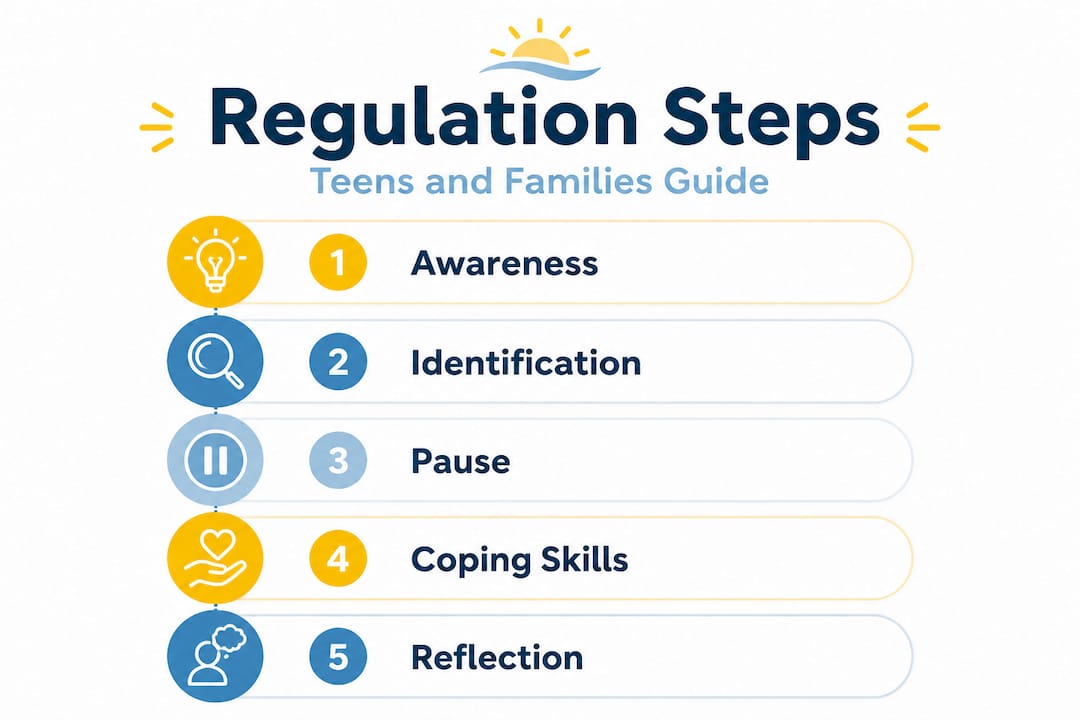
Step-by-step guide: Core emotional regulation skills for teens
Here is a clear, sequential guide that teens and parents can use together. Each step is grounded in evidence from mindfulness, CBT, and DBT research. Mindfulness-based interventions yield small-to-moderate effects in reducing stress and improving regulation in adolescents, and a large meta-analysis of 213 SEL programs shows meaningful gains in skills and behavior, while DBT specifically reduces self-harm and emotional crises in high-risk teens.
-
Name your feeling. Before you can manage an emotion, you have to identify it. Go beyond “bad” or “upset.” Are you embarrassed? Anxious? Lonely? Frustrated? Naming feelings precisely reduces their intensity. Researchers call this “affect labeling,” and brain imaging studies show it actually calms the amygdala (the brain’s alarm center).
-
Pause and breathe. Take three slow, deep breaths before responding to any stressful situation. This activates the parasympathetic nervous system, which literally slows your heart rate and brings the rational brain back online. This isn’t about avoiding emotions. It’s about creating a tiny gap between feeling and action.
-
Check the facts. Ask yourself: Does my reaction match what actually happened? Teens often experience emotions at a 10 when the situation is a 3. CBT skills teach you to question assumptions, consider alternative explanations, and test whether your thoughts match reality. CBT strategies for teens guide this process in structured ways when practiced with a therapist.
-
Choose your tool. Based on how you feel and what the situation is, pick a strategy from your toolbox. Options include: calling a trusted friend, going for a walk, journaling, using a grounding exercise (name 5 things you can see), listening to music, or practicing mindfulness. The key is having multiple options so you’re not stuck with one approach that may not fit every scenario.
-
Evaluate what worked. After the situation passes, reflect briefly. Did the tool help? Did you recover faster than last time? Did you say something you regret, or hold it together in a way that felt new? Using a simple mental health checklist can help teens and parents track which strategies are gaining traction over time.
“The goal isn’t to stop feeling emotions. It’s to stop emotions from making all your decisions for you.”
Pro Tip: Teens should practice these steps when they are calm, not only during a crisis. Just like athletes drill skills before a big game, emotional regulation tools need rehearsal before the moment of peak stress.
Practicing these steps isn’t always easy. In the next section, we cover mistakes to avoid and what to do when it doesn’t go smoothly.
Troubleshooting: Common mistakes and barriers
Even the best tools fail when the conditions aren’t right or when expectations are off. Here are the most common mistakes teens and parents make, and what to do instead.
Expecting instant results. Emotional regulation is not a switch you flip. It’s a muscle you build through consistent, imperfect practice over weeks and months. Many teens try a breathing exercise once, decide it doesn’t work, and give up. Staying patient with slow progress is itself a regulation skill.
Using only one approach. If deep breathing is the only tool in the toolbox, you’re going to hit situations where it’s simply not enough. Research confirms that no single strategy fits all teens or situations. A toolbox mindset, flexible and stocked with multiple strategies, outperforms a single-method approach every time.
Lack of empathy at home. When parents react to a teen’s emotional outburst with punishment or dismissal, they accidentally reinforce the idea that big feelings are shameful. This increases suppression, not regulation. The parent’s role is to model calm, reflect the teen’s feeling back to them, and problem-solve together after things cool down.
Peer pressure and social anxiety. Social fears can make it feel impossible to use regulation skills in real time. A teen might know they should pause and breathe, but if their friends are watching, that feels awkward or weak. Practicing skills in lower-stakes situations builds the confidence to use them when it really counts.
Common barriers to watch for:
- Bullying or social rejection that triggers chronic emotional flooding
- Stress at home from financial hardship or family conflict
- Feeling like no adult truly understands what the teen is going through
- Stigma around therapy or “needing help”
- Using screens or substances to avoid difficult feelings instead of processing them
Pro Tip: Parents, ask your teen what support looks like to them. You may think you’re being helpful, but research shows that 93% of parents feel they provide adequate support while only 58% of teens agree. The gap between intent and impact is real. Asking closes it.
Understanding the full picture of teen therapy types can help families figure out when self-help strategies are enough and when professional support would make a meaningful difference.
With challenges addressed, let’s recap how to know you’re making meaningful progress in your emotional regulation journey.
How to measure progress: Signs of improved emotional regulation
Progress in emotional regulation rarely looks like a straight line upward. It looks more like fewer meltdowns per week, or recovering in 20 minutes instead of three hours. Here’s how to track it meaningfully.
| Sign of progress | What it looks like in daily life |
|---|---|
| Improved mood stability | Fewer extreme highs and lows throughout the day |
| Faster recovery from upsets | Bouncing back in minutes rather than hours |
| Better communication | Expressing feelings with words instead of reactions |
| Stronger relationships | Less conflict with friends and family |
| Increased self-awareness | Noticing emotions before they fully escalate |
Research on school-based life skills and SEL programs confirms significant gains in social-emotional skills among teens who consistently practice these approaches. And mindfulness-based programs produce measurable improvement in regulation and stress reduction even with moderate engagement.
Small improvements matter. A teen who used to yell for 30 minutes and now yells for 10 is making real progress. Celebrate the trend, not just the outcome. When emotional challenges still regularly overwhelm despite consistent practice, professional support is a smart and proactive next step, not a sign of failure. Learning about the benefits of teen counseling can help families make that decision with clarity and confidence.
What actually works: Why personalizing emotional regulation is key
Here’s an honest perspective that most guides skip over. Emotional regulation is not a curriculum. You cannot hand a teen a five-step PDF and expect the work to be done. What actually produces lasting change is a personalized, evolving approach that respects the teen’s unique temperament, history, and environment.
Most articles treat emotional regulation like it has a single correct answer. It doesn’t. No single strategy fits all teens, even teens from the same family. One teenager may find journaling transformative while their sibling finds it unbearable. One teen responds to adult guidance with relief, another shuts down entirely if they sense they’re being managed. The adults in a teen’s life need to listen more than they prescribe.
Progress is not linear, and pretending otherwise sets teens up to feel like failures when they have a hard week after a good month. What we’ve seen across evidence-based practice is that the teens who build lasting regulation skills are the ones who have adults around them who stay curious and flexible, not rigidly attached to one method. Supporting building resilience means allowing teens to own their own coping strategy, not just follow someone else’s.
Adult support and peer support work differently and both are needed. Adults provide stability, wisdom, and structural support. Peers provide belonging, validation, and the courage to be honest about hard feelings. Neither alone is enough. The most effective path combines both, supported by professional guidance when things feel stuck.
Support beyond self-help: Take the next step
When self-guided practice isn’t moving the needle, professional support can make all the difference. Therapy doesn’t replace the steps above. It deepens them, models them in real time, and helps teens understand the patterns underneath their emotional responses.
At Revive Health Therapy, we specialize in teen therapy services that are grounded in evidence-based approaches including CBT, DBT, EMDR, and mindfulness. We work with teens and their families across California through both in-person sessions in Walnut Creek and Oakland, and secure telehealth statewide. If you’re wondering why seek psychotherapy when things feel manageable, the answer is simple: building skills early creates more resilience later. Our trauma-informed care for teens approach ensures every teen feels safe, understood, and genuinely supported from session one.
Frequently asked questions
What is the first step for teens to regulate emotions?
The first step is building emotional awareness, specifically recognizing and naming emotions as they arise, because you cannot manage what you haven’t noticed yet.
How can parents best support teen emotional regulation?
Parents support teens most effectively by practicing empathy, keeping communication open, and modeling healthy coping behaviors, since parental empathy facilitates regulation while authoritarian responses hinder it.
How do I know if emotional regulation skills are working?
Look for better mood stability, fewer impulsive reactions, and improved relationships with family and friends, as SEL and life skills programs consistently show these gains with regular practice.
What if emotional regulation strategies don’t help enough?
If strong feelings still disrupt daily life despite consistent effort, seeking professional support is the recommended next step, since DBT and structured therapy address what self-guided tools alone often cannot.
Are mindfulness and CBT really effective for teens?
Yes. Research shows that MBIs improve emotion regulation in adolescents with small to moderate effect sizes, and CBT produces measurable reductions in anxiety, stress, and emotional dysregulation across multiple studies.
Recommended
- Therapy for Teens: Building Self-Growth and Resilience – ReviveHealthTherapy
- 7 Types of Teen Therapy Every Parent Should Know – ReviveHealthTherapy
- Mental health checklist for California teens: strategies & support – Revive Health Therapy
- Role of Family Therapy for Teens: Enhancing Communication and Wellbeing – ReviveHealthTherapy
- Why Naming Your Feelings Helps — The Caia Journal
- Build Self-Awareness: Practical Steps for Personal Growth