
If “employee mental health benefits” means what most workers actually need, it means direct access to therapist-led psychotherapy, not a benefits packet from HR. The fastest route is to contact a licensed California clinician who provides evidence-based care, either by telehealth video or in person. For most working adults, telehealth is the quicker way in.
That’s the practical answer. Here’s how to act on it right now:
- Search a statewide directory like Psychology Today and filter by specialty, insurance, and telehealth availability.
- Check that the clinician holds an active California license (LMFT, LCSW, PsyD, PhD, or LPCC) before booking.
- If you want a local option that already screens for evidence-based methods, reach out to Revivehealththerapy directly.
Key Takeaways
Getting real employee mental health benefits means bypassing plan jargon and booking evidence-based psychotherapy directly, and telehealth video now delivers outcomes comparable to in-person care for most conditions.
| Point | Details |
|---|---|
| Skip the benefits maze | Go straight to a licensed clinician offering CBT, EMDR, or mindfulness-based therapy instead of starting with plan documents. |
| Telehealth holds up | Video sessions match in-person effectiveness for most conditions; phone-only loses nonverbal cues clinicians rely on. |
| Verify before you book | Confirm license status through the California Board of Psychology before your first session. |
| Know your appeal rights | Denied mental health claims can go to an Independent Medical Review through California’s Department of Managed Health Care. |
| Revivehealththerapy as an option | Offers EMDR, CBT, and trauma-informed care via telehealth statewide or in person in Walnut Creek and Oakland, with sliding-scale and insurance billing available. |
Table of Contents
- What “Employee Mental Health Benefits” Means in This Guide
- How Do You Access and Pay for Therapy in California?
- Does Video Therapy Work as Well as In-Person Sessions?
- How Do You Choose a Therapist Who Actually Practices Evidence-Based Care?
- What Happens When You Book Your First Session?
- What Mental Health Benefits Do California Employers Typically Offer?
- How Do You Check What Your Plan Actually Covers?
- Can an Employee Assistance Program Get You Into Therapy Faster?
- How Do You Appeal a Denied Mental Health Claim in California?
- What This Guide Gets Right That Conventional Advice Misses
- Why Revivehealththerapy Is a Practical Next Step
- Frequently Asked Questions
- Sources
What “Employee Mental Health Benefits” Means in This Guide
This article covers one thing: how to get real, clinician-led psychotherapy in California, whether you’re paying out of pocket, using insurance, or tapping an employer-sponsored option. It does not cover how HR departments design benefit plans or administer employee assistance contracts.
What’s included:
- Evidence-based modalities: cognitive behavioral therapy (CBT), EMDR, and mindfulness-based approaches
- Session formats: in-person visits, telehealth video, and hybrid arrangements
- Who this serves: individual adults, couples, teens, and families looking for therapy
What’s excluded:
- Employee Assistance Program (EAP) structure and how employers select vendors
- Benefits plan design, premium negotiation, or HR administration
- Generic workplace wellness programming that doesn’t involve a licensed clinician
If you’re an employee trying to figure out what your plan covers, later sections address that. But the core focus here stays on getting you into a therapist’s office or onto a secure video call.
How Do You Access and Pay for Therapy in California?
You have more entry points than most people realize. Direct-hire practices, statewide telehealth platforms, sliding-scale clinicians, and community mental health clinics all serve different budgets and urgency levels.
Telehealth has become the dominant access route for a reason. UCLA data reported by the Los Angeles Times found that a significant portion of California adults used a hybrid of telehealth and in-person care, while a similar share relied exclusively on in-person sessions. Video visits now compete directly with the waiting room, and many therapists reserve telehealth slots specifically for short-notice openings.
Here’s how to move through the access and payment maze without wasting weeks:
- Decide your budget path first. In-network insurance keeps costs predictable; out-of-network care means paying upfront and filing a superbill for partial reimbursement.
- Ask about sliding-scale fees directly. Many California clinicians, including smaller practices, adjust rates based on income, but you often have to ask rather than wait for it to be advertised.
- Confirm HSA/FSA eligibility before your first session. Psychotherapy almost always qualifies, but get it in writing from your plan administrator if you’re unsure.
- Test your telehealth setup in advance. A private room, stable internet, and headphones matter more than people expect for confidentiality and focus.
Some employers also offer digital, self-guided CBT programs as a lower-cost benefit. Research on internet-based CBT for employees shows real symptom reduction, but outcomes improve substantially when a coach or clinician provides ongoing support rather than leaving the program fully self-directed.
Pro Tip: Call three clinicians in one afternoon and ask each the same two questions: “Do you offer sliding scale?” and “Can you provide a superbill for out-of-network claims?” You’ll have a real comparison within an hour instead of guessing from a website.
Does Video Therapy Work as Well as In-Person Sessions?
For most conditions, yes. CBT and EMDR both carry strong evidence for treating anxiety, depression, and trauma, and neither loses much effectiveness when delivered by video.
Researchers cited in the Los Angeles Times’ telehealth reporting note that video-based sessions are generally comparable to in-person therapy, while phone-only sessions can lose important nonverbal cues that clinicians rely on to gauge distress or disengagement. If you have a choice between phone and video, take video.
Work-focused CBT deserves special mention if job stress or a return-to-work situation is part of what’s driving you to seek care. A systematic review and meta-analysis found meaningful symptom improvement and higher return-to-work rates among people who completed work-focused CBT, though the studies varied enough in design that no single number tells the whole story.
One area where the evidence gets murkier: workplace post-incident interventions, like mandatory group debriefings after a traumatic event at work. A systematic review from UCL examined 80 studies and 11 clinical guidelines and found no single intervention established as clearly superior. Quality was inconsistent across the board.
That’s a caution worth taking seriously: generic, one-size-fits-all debriefing sessions are different from individualized, clinician-led trauma care. If your workplace offers a group session after a difficult incident, it’s not a substitute for one-on-one evidence-based therapy if you’re still struggling weeks later.
- CBT and EMDR: strong evidence base for anxiety, depression, and trauma
- Video telehealth: comparable outcomes to in-person for most conditions
- Phone-only sessions: workable, but you lose nonverbal information
- Generic workplace debriefings: mixed evidence, not a replacement for individual care
How Do You Choose a Therapist Who Actually Practices Evidence-Based Care?
Start by verifying the license, not the marketing copy. California requires clinicians to hold an active credential, LMFT, LCSW, PsyD, PhD, or LPCC, and you can confirm status through the California Board of Psychology’s licensee lookup in a couple of minutes.
Once you’ve confirmed the license, the real vetting happens in a short conversation. Most practices offer a free 15-to-20-minute consultation call, and that’s your chance to ask direct questions rather than rely on a bio page.
- Ask what specific approach they use for your concern. A vague answer like “I use a mix of techniques” is less reassuring than “I use EMDR for trauma and CBT for anxiety, and here’s how sessions are structured.”
- Ask about experience with your situation. Workplace stress, trauma, relationship conflict, and mood disorders each benefit from different clinical backgrounds.
- Ask how telehealth sessions actually run. What platform do they use, is it HIPAA-compliant, and what happens if the connection drops mid-session?
- Ask about fees and billing clearly. Sliding scale availability, insurance status, and superbill policy should all have straight answers.
- Ask what happens in a crisis. A therapist should have a clear protocol for after-hours emergencies, even if they’re not a 24/7 crisis line themselves.
Watch for red flags: hesitation around confidentiality questions, no clear fee structure, or an intake process that drags on for weeks with no explanation.
Pro Tip: If a therapist can’t explain their treatment approach in one or two plain sentences, that’s worth noting. Clear communicators tend to also be clear in session, which matters more than credentials alone.
What Happens When You Book Your First Session?
Start with a directory search filtered by specialty, insurance, and telehealth availability, and have a short intake script ready: your main concern, whether you’ve been in therapy before, and any medications you’re currently taking.
Most practices run an initial intake session (45 to 60 minutes) focused on history-gathering, followed by two to three sessions where the therapist proposes a treatment plan and you both assess fit. Weekly sessions are standard at the start.
- Have your insurance card or HSA/FSA details ready before the first call
- Ask about cancellation policies and fees upfront, most practices require 24 to 48 hours’ notice
- If confidentiality around a workplace situation worries you, ask directly how notes are stored and whether anyone outside the practice can access them
- Telehealth often means faster openings than in-person, sometimes within days rather than weeks
What Mental Health Benefits Do California Employers Typically Offer?
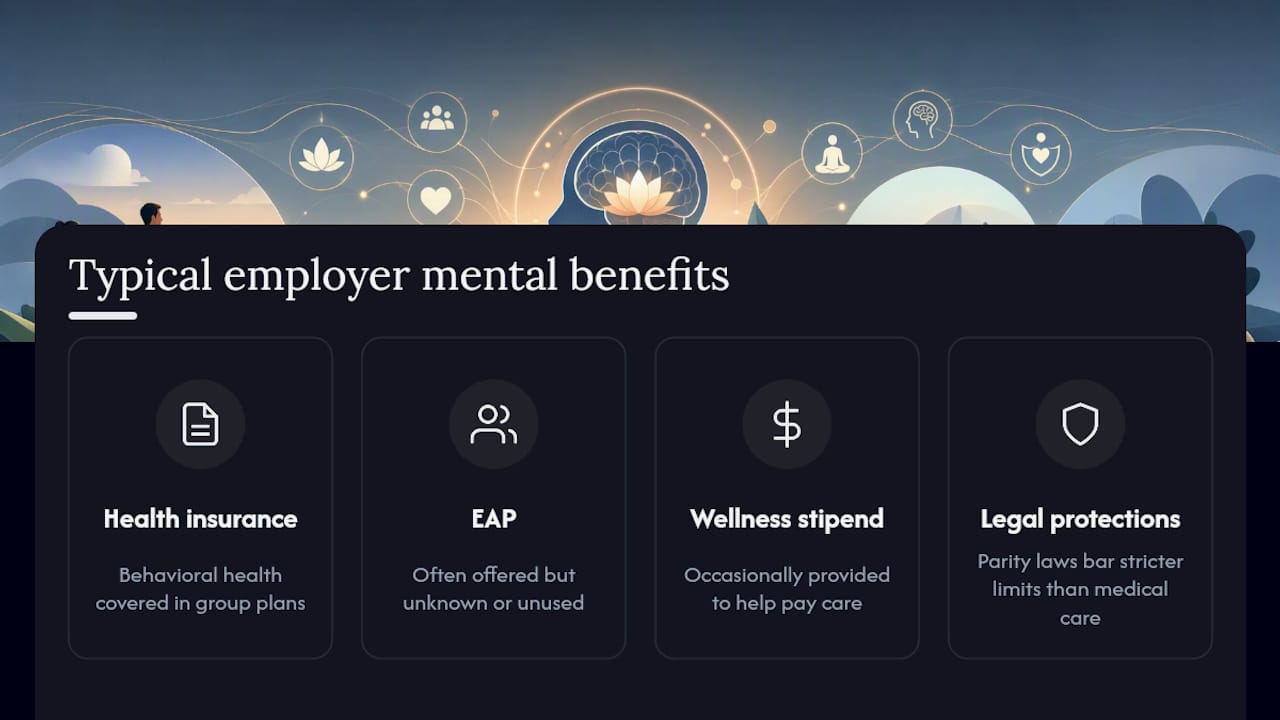
Most California employers provide some combination of health insurance with behavioral health coverage, an Employee Assistance Program, and occasionally supplemental wellness stipends. Federal law under the Mental Health Parity and Addiction Equity Act requires that group health plans covering mental health treat those benefits comparably to medical and surgical benefits, meaning copays, visit limits, and prior authorization rules can’t be more restrictive for therapy than for a broken arm.
California adds its own layer. State law generally requires health plans to cover medically necessary treatment for mental health conditions, and the California Mental Health Parity Act has historically pushed insurers to cover a broad range of diagnoses rather than a short list of “severe” conditions. None of this guarantees you unlimited free therapy. It means your plan can’t quietly cap mental health visits at five per year while allowing unlimited physical therapy visits for a knee injury.
The gap between what’s legally required and what employees actually use is wide. Many workers don’t know their plan includes an EAP, don’t know their HSA covers therapy copays, or assume out-of-network care is unaffordable without ever asking about a superbill. Knowing the baseline legal protections gives you leverage when a claim gets denied or a benefits rep gives you a vague answer.
How Do You Check What Your Plan Actually Covers?
Call the number on the back of your insurance card and ask three specific questions: how many outpatient mental health visits are covered per year, what your copay or coinsurance is for an out-of-network provider, and whether you need prior authorization before starting therapy.
Get the answers in writing when possible, either through a portal message or a follow-up email summary. Verbal answers from call center staff sometimes conflict with what actually gets processed once a claim is filed.
If you have an HSA or FSA, check your plan’s summary plan description for a list of eligible expenses. Psychotherapy copays and even some direct-pay therapy costs typically qualify, but reimbursement rules vary by plan administrator, so confirm before assuming a session is covered.
Ask specifically about telehealth parity too. Some older plans still reimburse video sessions at a lower rate than in-person visits, even though California generally requires parity for telehealth-delivered care. If your explanation of benefits shows a lower payout for a video session than an equivalent in-person one, that’s worth a phone call to your insurer.
Can an Employee Assistance Program Get You Into Therapy Faster?
An EAP typically offers a set number of free counseling sessions, often three to eight, arranged through your employer’s benefits vendor rather than billed to insurance. It’s designed as a short-term bridge, not ongoing treatment.
The practical value is speed. EAPs often connect you with a clinician within days, which matters if you’re dealing with an acute stressor and don’t want to wait weeks for a first available appointment elsewhere. The tradeoff is that EAP therapists usually aren’t chosen for their specialty in EMDR or trauma work specifically, and the session cap means you’ll likely need a plan for what happens after session eight.

A reasonable strategy: use the EAP for the first few sessions while you search for a longer-term therapist who takes your insurance or offers sliding-scale pricing. That way you’re not starting therapy from zero once the free sessions run out. Ask your EAP counselor directly whether they can help with a referral to ongoing care, most are equipped to do exactly that.
How Do You Appeal a Denied Mental Health Claim in California?
Start with an internal appeal directly to your insurer, generally required within 180 days of a denial. Request the denial in writing with the specific reason cited, since insurers are required to state why a claim was rejected, whether it’s lack of medical necessity, an out-of-network issue, or a documentation gap.
If the internal appeal fails, California allows you to file for an Independent Medical Review through the Department of Managed Health Care, which is free and often faster than pursuing litigation. Mental health claim denials get overturned at meaningful rates when the treatment was clearly medically necessary and properly documented, so it’s worth pursuing rather than accepting a denial at face value.
Keep records of every call, including the date, the representative’s name, and what was said. Denials tied to “lack of medical necessity” are often reversible when your therapist submits clinical notes showing a documented diagnosis and treatment plan, so ask your clinician directly for a letter of medical necessity if a claim gets rejected.
What This Guide Gets Right That Conventional Advice Misses
Most articles about employee mental health benefits are written for HR departments, which means employees searching for actual help end up wading through benefits jargon before finding a single actionable step. That’s backward. If you’re anxious, burned out, or dealing with trauma, you don’t need a lecture on parity law before you need a phone number.
The data backs up a simpler priority: get into evidence-based care fast, and don’t assume in-person is superior. Telehealth video holds up well against in-person sessions for most conditions, and the access advantage, faster scheduling, no commute, more flexibility around work hours, often outweighs any marginal benefit of sitting in a physical room. Phone-only is the real downgrade, not video.
The other thing conventional advice underplays: your legal protections around parity mean less in practice than knowing exactly which questions to ask a clinician or your insurer. A five-minute intake call that confirms sliding-scale pricing or superbill support gets you further than reading the fine print on your plan’s summary of benefits.
Why Revivehealththerapy Is a Practical Next Step
If you’ve read this far, you already know the fastest path to relief is a licensed clinician using proven methods, not a benefits portal. Revivehealththerapy offers exactly that: EMDR, CBT, and mindfulness-based trauma-informed care delivered by licensed clinicians who specialize in anxiety, depression, trauma, and relationship work.
Sessions are available via secure telehealth statewide or in person at locations in Walnut Creek and Oakland, so whether you want the flexibility of video or prefer face-to-face sessions, both are on the table. Pricing includes sliding-scale options for people paying out of pocket, and the practice accepts insurance along with HSA/FSA funds, so a copay or reimbursement path is usually available. Clinicians work with individuals, couples, teens, and families, which matters if the person needing support isn’t you alone but a partner or a teenager in your household.
If you’re ready to move past research and into an actual appointment, reach out through Revivehealththerapy’s contact page to ask about availability, sliding-scale rates, or which clinician specializes in your specific concern. A short intake call is usually enough to get a session on the calendar within the week.
Frequently Asked Questions
What are employee mental health benefits in practical terms?
In this context, it means direct access to licensed, evidence-based psychotherapy, whether paid through insurance, an EAP, sliding-scale fees, or HSA/FSA funds, rather than employer benefits administration.
Is telehealth therapy as effective as in-person sessions?
For most conditions, yes. Video-based sessions generally perform comparably to in-person therapy, while phone-only sessions can lose nonverbal cues that matter for accurate clinical assessment.
How many free sessions does an EAP typically offer?
Most Employee Assistance Programs provide three to eight free counseling sessions as a short-term bridge, not ongoing treatment, so plan for a transition to longer-term care if you need more.
What should I do if my mental health claim gets denied?
File an internal appeal with your insurer first, then pursue an Independent Medical Review through California’s Department of Managed Health Care if the denial stands.
How do I verify a therapist’s license in California?
Use the California Board of Psychology’s licensee lookup or check credentials directly through a statewide directory like Psychology Today.