
If a therapy client is uninsured or chooses to self-pay, they are entitled to a written Good Faith Estimate that itemizes expected charges before treatment starts. Therapists must deliver it within strict CMS timeframes, in writing, covering every planned service. If the final bill comes in $400 or more above that estimate, the client can dispute it through a federal resolution process.
TL;DR:
- A Good Faith Estimate must be provided within one to three business days of scheduling an appointment, depending on the booking timeline.
- The estimate must include specific details such as patient information, provider and location data, service description, diagnosis codes if available, and total expected costs.
- For ongoing therapy, a single GFE can cover up to 12 months if it clearly states session frequency, duration, and total costs, with updates required if plan changes.
- Bills exceeding the initial GFE by $400 or more allow clients to dispute charges through the federal Patient-Provider Dispute Resolution process within 120 days.
- Standardized workflows, early insurance status flagging, and secure delivery methods like encrypted portals help practices ensure compliance and proper documentation.
Table of Contents
- Who Needs a Good Faith Estimate for Therapy, and When?
- What Must a Therapy Good Faith Estimate Include?
- How Fast Does a GFE Have to Be Delivered?
- How Do You Estimate Costs for an Ongoing Course of Therapy?
- What Happens if the Bill Is Higher Than the Estimate?
- Building a Clinic-Ready GFE Workflow
- Common Mistakes That Trigger Compliance Problems
- Where to Find Official GFE Resources
- How We Apply Good Faith Estimates in Practice
- Get a Clear Cost Estimate Before Your First Session
- Sources
Who Needs a Good Faith Estimate for Therapy, and When?
A good faith estimate applies to two groups: people with no health insurance at all, and insured people who tell their provider they don’t want to bill insurance for that particular course of care. Both count as “self-pay” under the No Surprises Act, and both get the same protection.
The trigger isn’t the diagnosis or the treatment plan. It’s the moment someone schedules an appointment or asks about price. A prospective client calling to ask “what does an intake session cost?” has just triggered the duty to provide an estimate, even before a session is booked. Someone scheduling their first EMDR session as a self-pay client triggers it the moment the appointment goes on the calendar.
In a group practice, one clinician usually needs to be designated the “convening provider,” meaning they own responsibility for pulling together the full estimate, including any co-treating clinicians. Solo practitioners are automatically their own convening provider.
Front-desk staff or intake coordinators typically ask a short set of questions to catch this early:
- “Do you plan to use insurance benefits for these sessions, or would you like to pay out of pocket?”
- “Are you currently enrolled in a health plan, or are you uninsured?”
- “Would you like an estimate of costs before your first appointment?”
Answering “self-pay” or “uninsured” to any of these should flag the file for a GFE, automatically if the scheduling system supports it. A tool like eligibility verification software can catch insurance status at intake so no self-pay client slips through unflagged.
What Must a Therapy Good Faith Estimate Include?
CMS specifies exact fields, and skipping any one of them is a compliance gap, not a stylistic choice. A therapy GFE needs to contain:
- Patient identifying information. Full name and date of birth, matched to the person actually receiving care.
- Provider and facility information. The rendering provider’s name, National Provider Identifier (NPI), and Tax Identification Number (TIN), along with the practice location where services will happen.
- Description of the primary service. Plain language describing what the therapy is for, such as “individual outpatient psychotherapy for anxiety symptoms.”
- Diagnosis codes where known. ICD-10 codes if a diagnosis has already been established; if not yet determined, the estimate should say so rather than guess.
- Service codes and itemized charges. CPT codes such as 90837 for a 60-minute psychotherapy session, paired with the specific fee charged for each code.
- Expected frequency and duration. How often sessions will occur and over what period, since therapy rarely happens once.
- Total expected cost. A dollar figure covering the full estimated course of care, not just a single visit.
- Required disclaimer language. A statement that the estimate is not a contract, that actual charges may differ if the care plan changes, and that the patient has dispute rights if the bill runs $400 or more over the estimate.
When part of the treatment involves another provider (a prescribing psychiatrist alongside a therapist, for instance), the convening provider has to coordinate and include that co-provider’s expected charges too. If a diagnosis or treatment approach is still undetermined at intake, APA’s practical guidance recommends stating the uncertainty plainly rather than omitting the field altogether.
How Fast Does a GFE Have to Be Delivered?
The turnaround windows are fixed by CMS and don’t flex for busy front offices. When a client schedules an appointment at least 3 business days out, the GFE is due within 1 business day of scheduling. Schedule 10 or more business days out, and the practice has 3 business days. If someone simply asks for pricing without booking anything, the same 3-business-day clock applies.

Delivery method matters for proof. A mailed estimate counts from its postmark date, not when it lands in a mailbox. Electronic delivery, through a secure patient portal or encrypted email, counts from the timestamp the system generates. Standard, unencrypted email is a HIPAA risk and a documentation weak point. Practices should keep every issued GFE on file for at least six years and be able to produce a prior estimate immediately if a client requests one later in treatment.
Practical proof-of-delivery habits worth building into the workflow:
- Route all GFEs through a patient portal that logs the exact delivery timestamp automatically.
- If email is unavoidable, use an encrypted platform rather than a standard inbox.
- Keep a simple spreadsheet or scheduling-system flag showing which clients received a GFE and on what date.
Pro Tip: Build the GFE trigger directly into your scheduling software so booking a self-pay appointment automatically starts the countdown and logs delivery. Manual tracking is where most missed-deadline violations happen.
How Do You Estimate Costs for an Ongoing Course of Therapy?
Therapy rarely ends after one visit, and CMS accounts for that. A single GFE can cover up to a full 12 months of recurring care as long as it states the frequency, expected duration, and total projected cost.
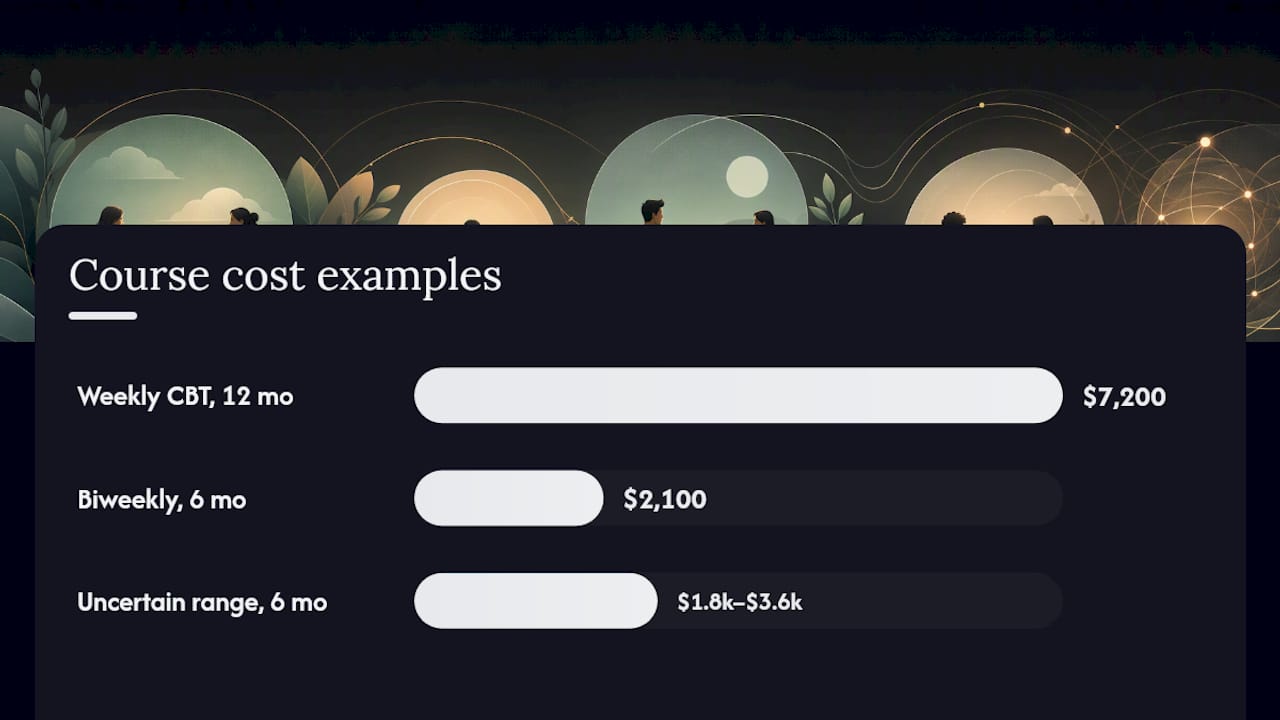
The math is straightforward. Multiply the per-session fee by the expected number of sessions, then state that total plainly. A few worked examples show how this plays out:
- Weekly CBT for a year. A $150 session fee at roughly 48 sessions annually projects to about $7,200 for the 12-month estimate.
- Biweekly short-term therapy. A client doing 12 sessions every other week at $175 per session lands around $2,100 for a six-month course.
- Therapy plus occasional psychiatric add-on. A weekly $150 therapy session alongside a quarterly $200 medication management visit from a co-treating prescriber needs both line items itemized separately, then summed into one total.
When the course of care is genuinely uncertain, Psychiatry recommends stating a range rather than a false-precision single number, something like “sessions are expected to range from 12 to 24 over the next six months, at $150 each, for an estimated total of $1,800 to $3,600.” Overestimating carries no penalty; underestimating is what creates dispute risk. If a treatment plan changes mid-course, a fresh GFE should replace the old one.
A single recurring GFE, capped at 12 months and rebuilt whenever the plan changes, is the simplest and most defensible approach for outpatient therapy specifically.
What Happens if the Bill Is Higher Than the Estimate?
The magic number is $400. If the actual charges come in $400 or more above the good faith estimate for comparable services, the client has the right to dispute the bill through the federal Patient-Provider Dispute Resolution process.
The steps generally run like this:
- Contact the provider’s billing office first and ask for a reconciliation or an explanation of the gap.
- If that doesn’t resolve it, file a PPDR claim with HHS or CMS within 120 calendar days of receiving the bill in question.
- Pay a small administrative fee to initiate the dispute (waived or refunded for successful claims under CMS rules).
- Wait for a third-party decision, which typically settles on either the original GFE amount, the billed amount, or a middle figure.
Providers facing a dispute need documentation ready: the original GFE, any updates issued, notes on why care expanded (a client disclosed new trauma history mid-course, for instance, requiring additional sessions), and billing records showing what was actually charged. A well-kept paper trail is usually the difference between a quick resolution and a drawn-out one. Clients who paid more than the arbitrator’s determined amount are entitled to a refund of the difference.
Building a Clinic-Ready GFE Workflow
A repeatable process beats scrambling every time a new self-pay client books. The sequence that tends to hold up under audit looks like this:
- Intake: Flag insurance status the moment someone calls or books online.
- Generate: Pull the standard fields into a template, don’t rebuild it from scratch each time.
- Deliver: Send through a portal or encrypted channel and log the timestamp.
- Update: Reissue whenever frequency, diagnosis, or scope of care shifts materially.
A sample line for a recurring therapy estimate might read: “This estimate covers weekly 53-minute individual psychotherapy sessions (CPT 90837) at $175 per session, for an expected 45 sessions over 12 months, totaling approximately $7,875. This estimate is not a contract and is valid for 12 months from the date issued.” Reviewing current sliding-scale rates before drafting each estimate keeps the fee side accurate for clients on adjusted pricing.
Pro Tip: Store every GFE in the client’s chart alongside a one-line update log, “reissued 3/2026 due to added biweekly EMDR sessions,” so any auditor or dispute reviewer can trace the history in seconds.
Common Mistakes That Trigger Compliance Problems
Most GFE violations aren’t intentional. They’re operational gaps that repeat until someone notices.
- Never delivering the estimate at all, often because front-desk staff didn’t realize a self-pay client had been scheduled.
- Missing the delivery window, usually from a scheduling system that doesn’t flag the trigger date.
- Leaving out required fields, like the NPI, TIN, or the dispute-rights disclaimer.
- Treating the GFE like a signed contract, then refusing to adjust it when the treatment plan legitimately changes.
The fixes are mostly procedural: standardize one template across the practice, script the intake question so it’s asked the same way every time, and run a monthly spot-check comparing scheduled self-pay clients against issued GFEs. Practices juggling multiple co-treating providers or complex billing situations often benefit from a short consult with a health law attorney or billing consultant to confirm the workflow holds up.
Where to Find Official GFE Resources
For the primary rules and downloadable forms, start with CMS’s No Surprises Act hub, which includes a sample GFE template and technical guidance updated as regulations evolve. The CMS Help and Guides page breaks down turnaround timing in plain language.
For mental-health-specific interpretation, APA’s practice guidance includes a sample GFE form built for psychologists, and psychiatry.org’s FAQ document walks through recurring-care examples with real numbers. If a bill dispute needs to move forward, the PPDR filing process starts through CMS’s federal complaint channels.
How We Apply Good Faith Estimates in Practice
We build a 12-month recurring GFE into every self-pay intake at Revivehealththerapy, then reissue it the moment a treatment plan shifts, added EMDR sessions, a change in frequency, a new co-treating provider. Sliding-scale rates get built into the estimate at the exact adjusted fee a client qualifies for, not a generic list price, and telehealth sessions carry their own line item since delivery format doesn’t change the CPT code but does affect scheduling cadence.
A client moving from insurance billing to self-pay mid-course gets a fresh estimate within a day of that request, not folded quietly into the next invoice.
— Amy
Get a Clear Cost Estimate Before Your First Session
Revivehealththerapy is the practical alternative to guessing what therapy will cost before you start. We provide written, itemized Good Faith Estimates for every self-pay and uninsured client, whether you’re booking in-person sessions in Walnut Creek or Oakland or joining us through secure telehealth anywhere in California.

Sliding-scale pricing means your estimate reflects what you’ll actually pay, not a flat list rate, and if you carry out-of-network insurance, we can provide a superbill for reimbursement alongside your GFE. If a bill ever comes in above your estimate by $400 or more, we’ll walk you through your options before you have to figure out federal dispute forms on your own. Ready to see what your care will actually cost? Learn more about starting psychotherapy and request your Good Faith Estimate today.
This article is general information, not a substitute for advice from a qualified lawyer. Consult a qualified legal professional about your own circumstances before acting on anything here.
Sources
- CMS Good Faith Estimate guidance (Help/Guides)
- APA guidance on No Surprises Act and GFEs
- American Psychiatric Association — No Surprises Act FAQs and examples