
Grounding is the practice of anchoring your attention to the present moment through physical sensations, breath, or mental focus instead of a spiraling thought. The fastest technique to try right now is the 5-4-3-2-1 method: name 5 things you see, 4 you feel, 3 you hear, 2 you smell, and 1 you taste, then take one slow belly breath. Practice it during calm moments too, and if symptoms stay frequent or severe despite regular practice, that’s a signal to talk to a therapist.
TL;DR:
- Grounding techniques should be practiced regularly during low-level anxiety to build familiarity and effectiveness before facing acute panic or trauma episodes.
- The 5-4-3-2-1 sensory method and physical techniques like cold exposure and limb shaking are quick, discreet options suitable for public or private settings.
- For trauma survivors, grounding practices should avoid intense sensory shocks or closed-eye exercises to prevent re-traumatization or dissociation triggers.
- Combining multiple grounding methods, such as breathing with sensory scans, enhances their calming effect and provides a customizable toolkit for different situations.
- If symptoms persist or worsen despite regular grounding, seeking professional therapy, especially trauma-specific approaches like EMDR or CBT, becomes essential.
Table of Contents
- 10 Grounding Techniques You Can Use Right Now
- Physical Grounding: Using Movement and Touch to Calm Your Body
- The 5-4-3-2-1 Sensory Method, Step by Step
- Cognitive Grounding: Redirecting Your Thoughts on Purpose
- Breathing and Body Scans to Calm a Racing Nervous System
- Building the Habit: When and How to Practice Grounding
- Grounding for Trauma, PTSD, and Dissociation: What’s Different
- When Grounding Doesn’t Work: Troubleshooting and Building Your Kit
- How Therapists Use Grounding in Treatment
- When to Consider Therapy for Ongoing Anxiety or Trauma
- Sources
- FAQ
10 Grounding Techniques You Can Use Right Now
These are ranked by speed and discretion, not importance. Pick whichever fits the moment you’re actually in.
- 5-4-3-2-1 sensory scan: Silently name five things you see, four you feel, three you hear, two you smell, one you taste.
- Cold water on wrists: Run cold water over your inner wrists or splash your face; the temperature shift interrupts panic fast.
- Feet flat on the floor: Press both feet down and notice the floor’s texture and temperature through your shoes.
- Category naming: Pick a category (dog breeds, cities, fruits) and list as many as you can.
- Count backward from 100 by 7s: The math load crowds out looping thoughts.
- Grip a textured object: A coin, key, or fabric edge in your pocket works discreetly in public.
- Name your location out loud or in your head: “I am at my desk, in Oakland, on a Tuesday.”
- Slow exhale count: Breathe in for four counts, out for six, twice.
- Press palms together: Push your hands together hard for five seconds, release, repeat three times.
- Recite something memorized: A poem, prayer, or song lyric occupies verbal working memory and quiets rumination.
Physical Grounding: Using Movement and Touch to Calm Your Body
Physical grounding works by giving your nervous system a strong, immediate sensation to focus on instead of the racing thoughts driving your anxiety. Cleveland Clinic groups these techniques separately from sensory and cognitive methods because they rely on movement, pressure, or temperature rather than passive observation.
Ice and cold exposure. Hold an ice cube in your palm or press it against the inside of your wrist for 20 to 30 seconds. The intensity of cold demands attention in a way mild sensations don’t, which is exactly the point. If ice isn’t available, a cold soda can, a metal doorknob, or splashing your face with cold water from a sink produces a similar effect. Skip this one if you have circulation issues or open wounds on your hands; a cold, damp washcloth is a gentler substitute.
Feet on the floor. Sit or stand and press both feet firmly into the ground. Notice the pressure under your heels, the texture of the floor through your shoes, and whether one foot feels different from the other. This takes seconds and works seated at a desk, standing in a checkout line, or sitting through a meeting.
The 10-1 shakeout. Shake your hands vigorously for a count of 10, then 9, then 8, down to 1. It sounds almost silly, but the rhythmic counting plus the physical release of tension does double duty: cognitive distraction and muscle discharge at once.
Progressive muscle relaxation, shortened. Tense your shoulders toward your ears for five seconds, then release. Do the same with your fists, then your jaw. Three muscle groups, 30 seconds total, works anywhere you can sit still for half a minute.
- In private: full ice application, shaking out limbs, or lying down for a full body scan.
- In public: pressing feet into the floor, squeezing a textured object in your pocket, or subtly tensing and releasing your hands under a table.
- Posture cue: uncross your arms and legs when possible. An open posture gives your body more surface area to register grounding input.
Pro Tip: Keep a small cold pack or a textured stone in your bag or car. Having the physical object ready removes the “what do I even do” hesitation that often stalls grounding before it starts.
The physiological logic here is straightforward: strong sensory input, whether cold, pressure, or movement, gives your brain something concrete to process, which tends to lower the arousal that anxiety and panic run on.
The 5-4-3-2-1 Sensory Method, Step by Step
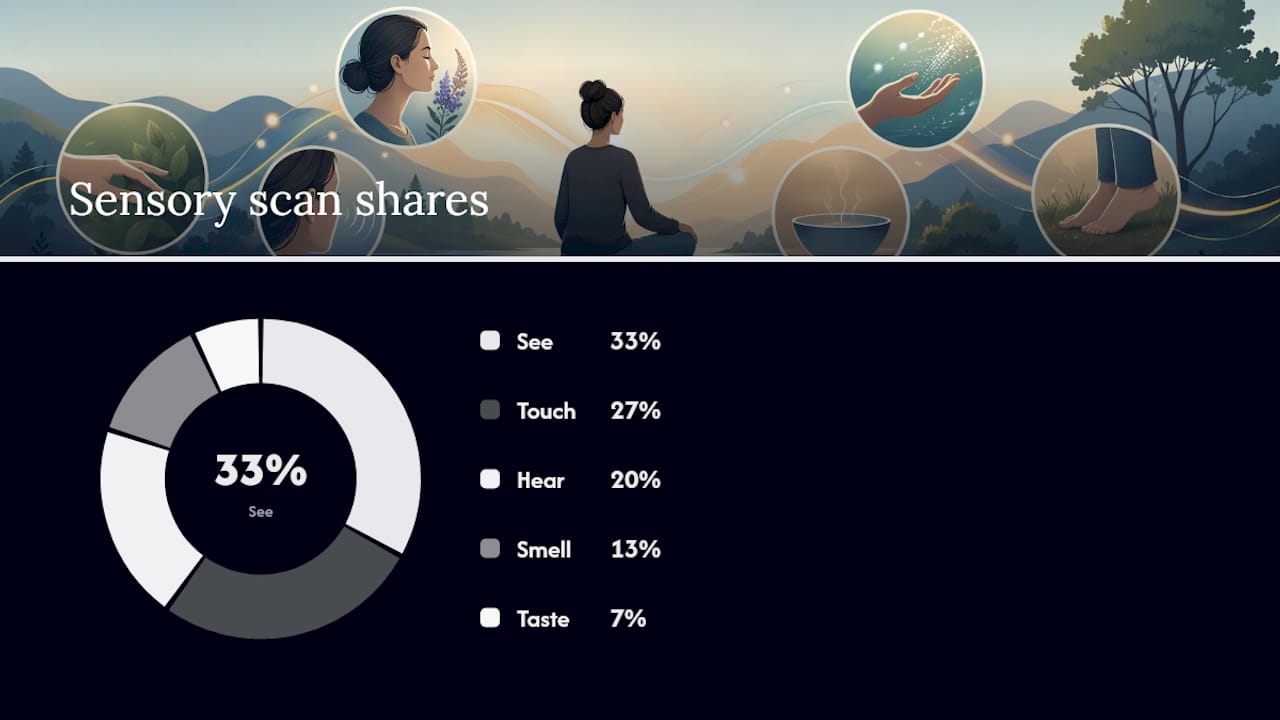
The 5-4-3-2-1 method is the most widely taught sensory grounding exercise, and for good reason: it forces engagement across nearly every sense at once, which makes it harder for your mind to wander back to the distressing thought. The University of Manchester’s clinical handout lays out the sequence clearly, and it’s become a standard reference in trauma-informed practice.
Here’s the full script:
- 5 things you can see. Say them aloud or in your head: “a lamp, a window, my hands, a chair, a crack in the wall.”
- 4 things you can feel. The fabric of your sleeve, the chair against your back, your feet in your shoes, the temperature of the air.
- 3 things you can hear. Traffic outside, your own breathing, a hum from an appliance.
- 2 things you can smell. Coffee, laundry detergent on your shirt, outdoor air if you’re near a window.
- 1 thing you can taste. Even if it’s just the lingering taste of your last meal or a sip of water.
If smell or taste feels impossible to access in the moment, that’s common, especially in sterile environments like offices or hospitals. Swap in a second round of touch or sound instead: two more textures you can feel, or a second sound you hadn’t noticed. The order matters less than the act of scanning across multiple senses.
Multi-sensory engagement works because it’s harder for the brain to sustain a single anxious thought loop while actively processing five separate sensory channels. Cleveland Clinic frames this as shifting attention out of hypothetical future worries or past memories and into what’s actually happening around you right now, which gives your nervous system room to settle before you tackle whatever triggered the spiral.
A short mini-script for flashbacks specifically: “I see [object]. I feel [object]. That was then. This is now.” Repeating a “then versus now” phrase alongside the sensory scan reinforces the present-moment anchor.
Cognitive Grounding: Redirecting Your Thoughts on Purpose
Mental grounding works differently than sensory or physical methods. Instead of engaging your body, you give your brain a specific, absorbing task that leaves no room for the anxious or intrusive thought to keep running. It’s particularly useful when you’re stuck in your head with nowhere private to move or touch anything.
- Category naming. Pick something concrete: types of trees, countries starting with a certain letter, songs by a specific artist. List as many as you can in 30 seconds.
- Backward counting or simple math. Count down from 100 by 7s, or multiply small numbers in sequence. The harder the math, the more it occupies working memory.
- Memory games. Recall the details of a recent meal, a walk you took, or a room in your house, down to colors and objects. This works well for rumination because it requires active reconstruction, not passive drifting.
- Reciting something memorized. A poem, a prayer, lyrics to a song you know by heart. The rhythm and structure give your mind a track to follow.
- Anchoring statements. Short, factual phrases repeated to yourself: “I am safe right now. This feeling will pass. I have handled this before.”
Matching the task to the distress matters. Worry about the future (a work deadline, a health scare) tends to respond well to math or category tasks, since they demand active problem-solving that crowds out “what if” thinking. Flashbacks or trauma-related intrusions respond better to anchoring statements paired with orientation cues, “I am here, it is [today’s date], I am in [location]”, because the goal isn’t distraction so much as reminding your brain what year and place you’re actually in.
A short script worth memorizing: “Name three things I know are true right now. My name is ___. I am in ___. Today is ___.” Simple, repeatable, and usable without paper or a phone.
Breathing and Body Scans to Calm a Racing Nervous System
Breathing techniques work alongside grounding by directly slowing the physical arousal, the racing heart, shallow breath, and tight chest, that anxiety produces. Mayo Clinic’s mindfulness guidance notes that even brief daily practice with these methods builds real benefit over time, not just in the moment of crisis.
- Box breathing. Inhale for a count of 4, hold for 4, exhale for 4, hold for 4. Repeat four full cycles. Sit upright with your shoulders relaxed, not hunched, since a compressed chest makes the exercise harder.
- Belly breathing. Place one hand on your chest and one on your stomach. Breathe so only the stomach hand rises, for a count of 4 in and 6 out. Do this for one minute.
- A 90-second body scan. Close your eyes if it feels safe to. Start at your scalp and move attention slowly down: forehead, jaw, shoulders, chest, stomach, hands, legs, feet. Notice tension without forcing it to release, just observe.
Pairing works well in practice: belly breathing first to slow your heart rate, then the 5-4-3-2-1 scan to redirect attention outward. Or start with a body scan to locate where you’re holding tension, then use physical grounding, pressing your feet down, tensing and releasing a muscle group, to address that specific spot.
Building the Habit: When and How to Practice Grounding
The single biggest mistake people make with grounding is only trying it during a full-blown panic attack. By then, your nervous system is already flooded, and any new skill is harder to access. Cleveland Clinic’s guidance on timing is blunt about this: start practicing as soon as you notice anxiety building, not after it peaks.
- Practice during low-level anxiety, a mildly stressful email, a minor argument, so the technique becomes familiar before you need it under real pressure.
- Set a daily micro-practice of 2 to 10 minutes: one round of 5-4-3-2-1 in the morning, or a 90-second body scan before bed.
- Rotate through three techniques (one sensory, one physical, one cognitive) for a week each, so you know which ones actually work for your specific triggers.
- Keep a one-line journal note after using a technique: what triggered it, which method you tried, whether it helped. Patterns show up faster than you’d expect.
- Practice grounding for two or three minutes before something predictably stressful, a commute, a hard conversation, a medical appointment, so it’s already active before the stress hits.
Revive Health Therapy’s guide on staying grounded covers additional rehearsal strategies if you want to build a more structured personal practice.
Grounding for Trauma, PTSD, and Dissociation: What’s Different
Trauma-informed grounding requires extra care because some standard techniques can backfire for survivors. Closing your eyes during a body scan, for instance, can increase vulnerability for someone with a history of assault or abuse. Strong sensory input like intense cold or loud sounds can also feel overwhelming rather than calming for people prone to dissociation.
- Skip eye-closing exercises if they increase anxiety; keep eyes open and focused on a neutral point in the room instead.
- Avoid intense sensory shocks (very loud noise, extreme cold) for dissociation-prone individuals; use gentle, incremental cues instead, naming your location, touching a textured object slowly.
- For dissociation specifically, orientation tasks should build up gradually rather than flooding the senses all at once, according to trauma-informed care guidance from the National Center for Biotechnology Information.
- If a technique triggers a stronger emotional reaction instead of calming one, stop and switch to a different sense or a simpler task.
- Use grounding as a bridge between distressing moments and your next therapy session, not as a replacement for trauma-focused treatment.
Research on grounding’s effectiveness for PTSD, dissociation, and panic is largely practice-based rather than built on large controlled trials, which means these techniques work well as daily coping tools but aren’t a substitute for structured trauma therapy. The VA’s clinical toolkit on managing strategies reinforces this: grounding sits alongside, not instead of, professional trauma care. If dissociative episodes are frequent or you’re not sure whether what you’re experiencing is dissociation, Revive Health Therapy’s clinical guide on dissociation versus daydreaming walks through the distinction in plain language.
When Grounding Doesn’t Work: Troubleshooting and Building Your Kit
If a technique isn’t landing, switch sensory channels before giving up on grounding altogether. Someone who can’t focus on sight might do much better with touch or sound. Shortening the task also helps: if 5-4-3-2-1 feels like too much when you’re overwhelmed, cut it to just naming three things you see.
- Don’t blame yourself if a technique doesn’t work the first, second, or tenth time; a nonjudgmental stance toward your own attention wandering actually improves results over time, according to Cleveland Clinic’s practice guidance.
- Combine methods rather than relying on one: belly breathing plus 5-4-3-2-1, or ice plus a repeated grounding phrase like “this is temporary.”
- Build a small portable kit: a textured object, a small cold pack, a card with your anchoring statements written down, and headphones for a calming sound if needed.
- Notice acceptance itself as a tool, gently observing a distracting thought without fighting it can be as useful as the exercise itself, a concept echoed in broader mindfulness-based approaches to noticing that emphasize nonjudgmental awareness.
Pro Tip: If you keep reaching for the same technique and it stops working, that’s often fatigue, not failure. Rotate to a completely different sense category instead of repeating the same exercise harder.
How Therapists Use Grounding in Treatment
Therapists typically teach clients two to four grounding tools early in treatment and have them practice between sessions so the skills are already familiar before deeper trauma work begins. Grounding isn’t the endpoint. It’s preparation. A client who can reliably self-regulate with a breathing pattern or sensory scan is in a much stronger position to tolerate the emotional intensity of CBT exposure work or EMDR reprocessing sessions.
At Revivehealththerapy, clinicians build grounding into the early phase of trauma-informed care, tracking which techniques a client responds to and adjusting as treatment progresses. If grounding alone isn’t reducing how often distress spikes, or how intense it gets, that’s usually the clearest sign it’s time to bring in structured therapeutic support rather than more self-help tools.
— Amy
When to Consider Therapy for Ongoing Anxiety or Trauma
Grounding techniques are genuinely useful for in-the-moment relief, but they have limits. If anxiety, panic, or trauma symptoms are showing up frequently, lasting for hours, or interfering with work, relationships, or sleep, that’s the point where self-directed techniques stop being enough on their own.
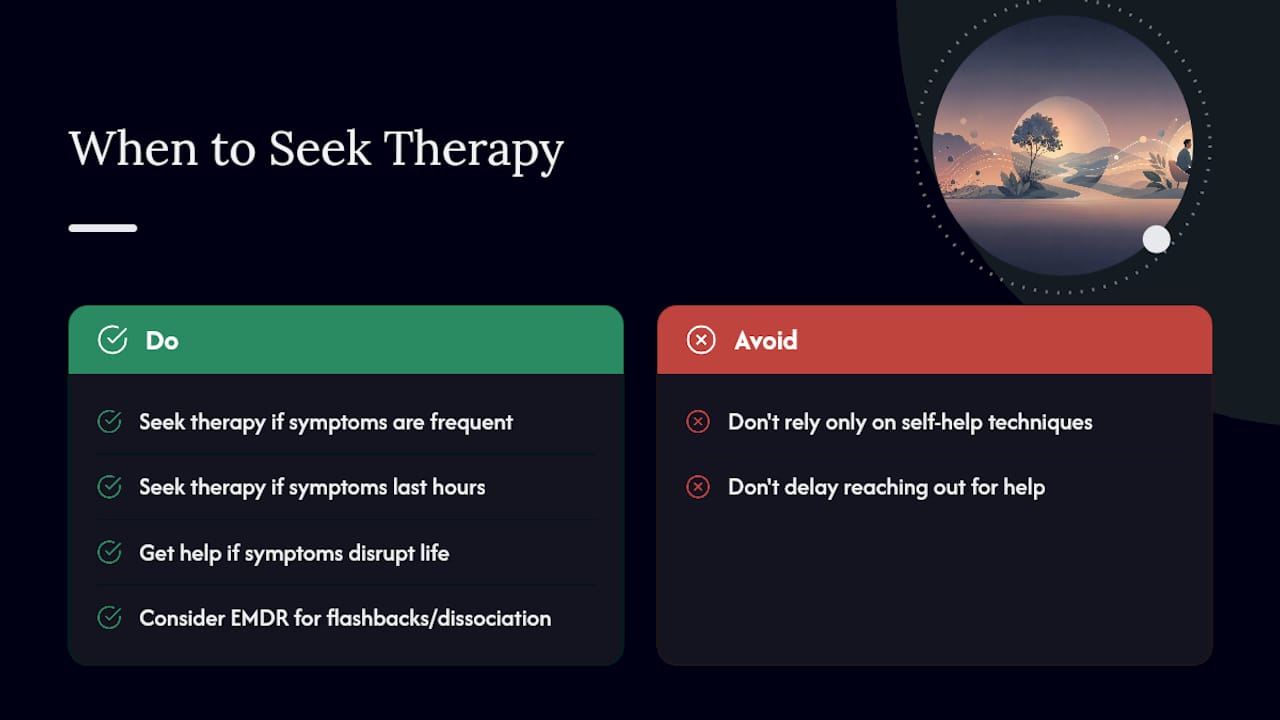
Qualified clinicians build treatment plans around specific triggers, combining trauma-informed care with methods like EMDR and CBT, delivered in-person at multiple locations and through secure telehealth services. Sliding-scale fees and insurance or HSA/FSA acceptance aim to make care more accessible. If frequent flashbacks, dissociation, or panic are part of your picture, the EMDR therapy program is designed specifically for that kind of trauma processing, and the why seek psychotherapy page walks through what to expect from a first session. When you’re ready, reach out through the contact page to find a therapist who fits your situation.
Sources
- 5-4-3-2-1 grounding method (document/excerpt)
- Grounding techniques — Cleveland Clinic
- Ptsd
- Mindfulness exercises — Mayo Clinic
This article is general information, not a substitute for advice from a qualified doctor. Consult a qualified healthcare professional about your own circumstances before acting on anything here.
FAQ
What Is the Fastest Grounding Technique for a Panic Attack?
The 5-4-3-2-1 sensory method combined with one slow belly breath works within about a minute for most people because it forces attention across multiple senses at once.
Are Grounding Techniques Safe for PTSD and Trauma Survivors?
Most are, but some, like closing your eyes or intense sensory input, can trigger certain survivors, so gentler, gradual orientation tasks are safer starting points for trauma-related dissociation.
How Often Should I Practice Grounding Techniques?
Practice for 2 to 10 minutes daily during calm moments, not just during crises, since rehearsing the skill ahead of time makes it far easier to access under real stress.
Can Grounding Techniques Replace Therapy?
No. Grounding reduces in-the-moment distress, but if symptoms are frequent, severe, or tied to trauma, working with a therapist trained in approaches like EMDR or CBT addresses the underlying cause rather than just the immediate spike.
What’s the Difference Between Sensory, Cognitive, and Physical Grounding?
Sensory grounding uses your five senses, cognitive grounding uses mental tasks like counting or naming categories, and physical grounding uses movement or touch, such as pressing your feet into the floor or holding ice.