
The window of tolerance is the zone of nervous system arousal where you can think clearly, feel your emotions without drowning in them, and respond to stress instead of reacting to it. Step outside that zone and you land in one of two states: hyperarousal (fight or flight) or hypoarousal (shutdown). The fix isn’t one-size-fits-all calm. It’s matching your response to which direction you’ve been pushed.
TL;DR:
- Trauma and chronic stress can narrow the window of tolerance, making individuals more reactive to smaller triggers and slower to recover from dysregulation.
- Signs of hyperarousal include racing heart, anxiety, irritability, and pacing, while hypoarousal manifests as numbness, sluggishness, emotional flatness, or withdrawal.
- Mapping personal triggers, responses, and recovery times helps identify whether a person tends to hyper- or hypoarouse, guiding targeted self-regulation strategies.
- Matching regulation techniques to the current state is crucial, with breathing and grounding for hyperarousal, and movement or sensory input for hypoarousal.
- Expanding the window through therapy, healthy habits, and mindfulness is a gradual process requiring consistent practice over months, often with professional support.
Table of Contents
- What Is the Window of Tolerance?
- Why Trauma Makes the Window Narrower
- How to Tell Which Side of the Window You’re On
- Mapping Your Personal Window
- What to Do Right Now, Depending on Which Direction You’ve Gone
- Widening the Window for Good
- How Trauma-Informed Therapy Actually Applies This Model
- A Few Honest Words on What This Work Actually Feels Like
- Ready to Widen Your Own Window With Support?
- Sources
- FAQ
What Is the Window of Tolerance?
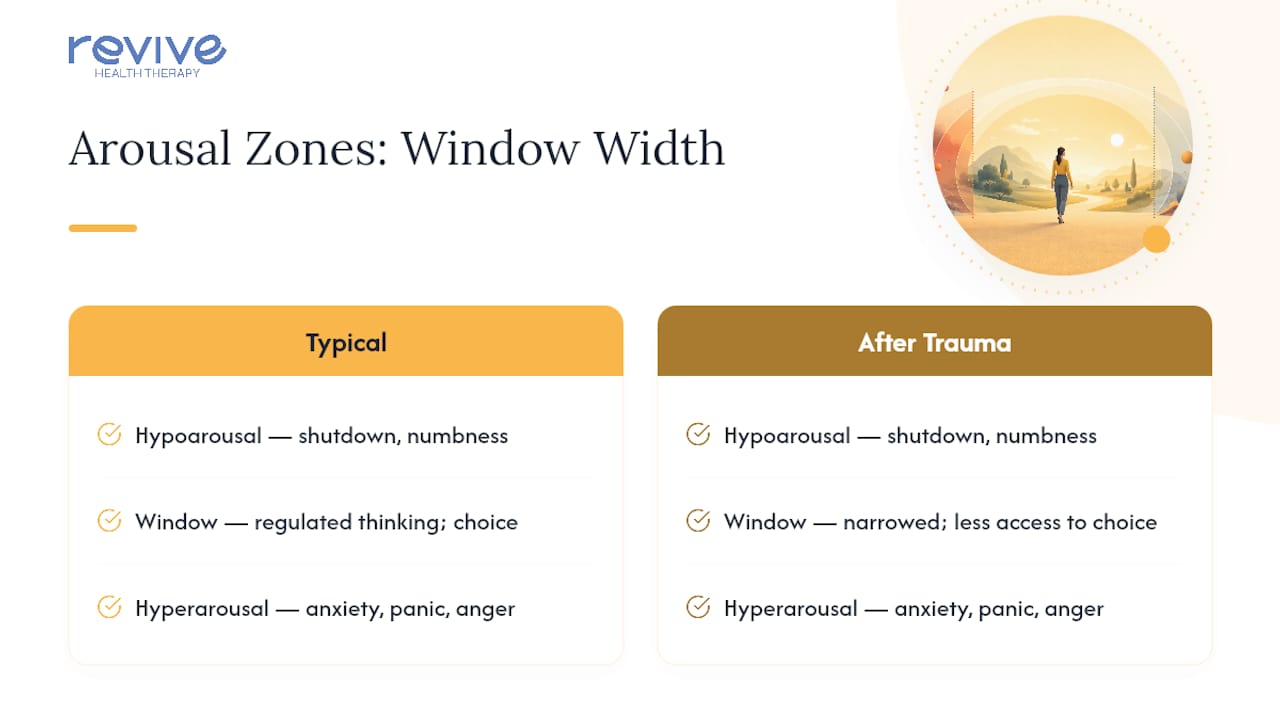
Psychiatrist Dan Siegel coined the term to describe the range of arousal within which a person can function effectively without feeling overwhelmed or numb. Inside that range, the nervous system stays regulated enough that the thinking parts of the brain and the survival parts can work together instead of one hijacking the other.
Arousal, in this context, isn’t about excitement. It refers to how activated your autonomic nervous system is at any given moment, the internal dial that runs everything from heart rate to how much bandwidth you have for problem-solving. When arousal sits within a manageable range, you have access to executive function: the ability to weigh options, read social cues accurately, and choose a response rather than default to a reflex.
Being inside the window looks less dramatic than people expect. It’s not euphoria or perfect calm. It’s a kind of grounded presence, the sense that whatever is happening, you can handle it. You can hear feedback without spiraling. You can feel angry without yelling. You can notice anxiety without it swallowing the room.
Two forces can push people out of that range: overly high activation or overly low activation. Psychology Tools describes hyperarousal as the fight-or-flight end, marked by anxiety, panic, or anger, and hypoarousal as the freeze or shutdown end, marked by numbness, dissociation, or collapse. Everyone’s window differs in size. Genetics, temperament, and life history shape this size, explaining why the same stressor may affect individuals very differently.
Why Trauma Makes the Window Narrower
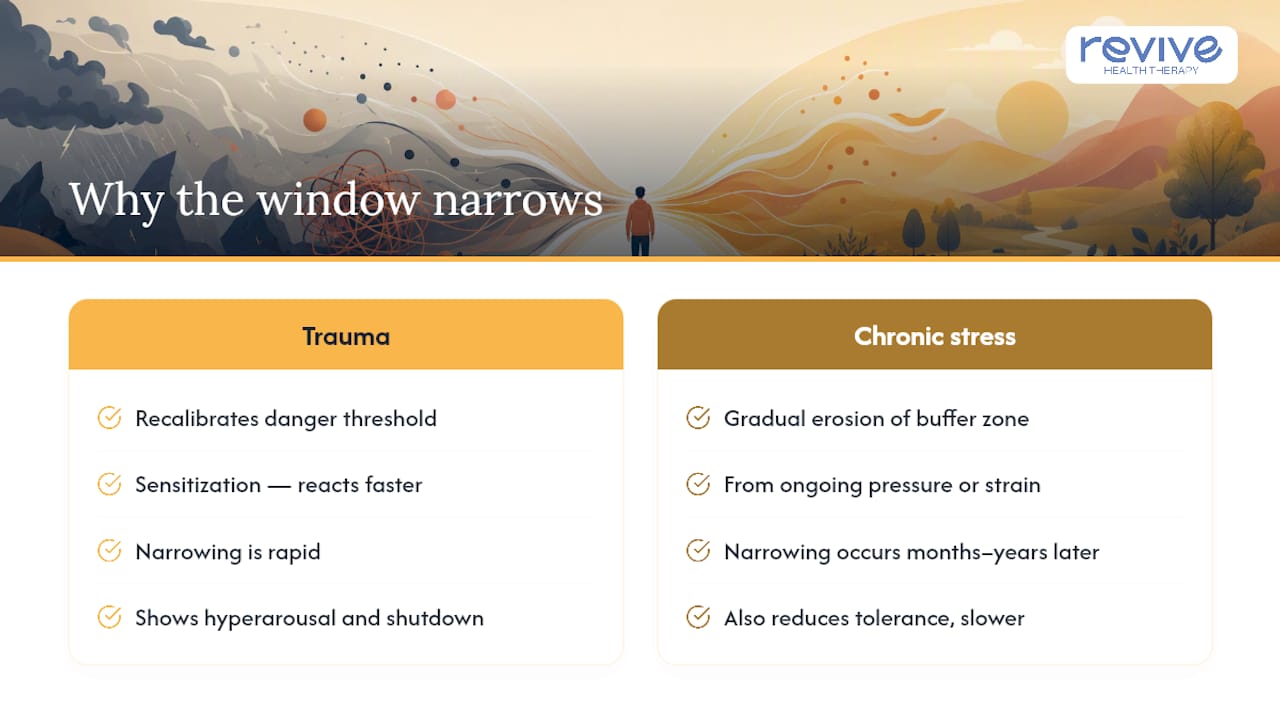
Trauma doesn’t just create bad memories. It recalibrates the threshold at which your nervous system decides something is dangerous. A review on autonomic dysregulation and the window of tolerance links repeated or severe trauma to long-term changes in arousal and mood regulation, meaning the nervous system stays primed for threat even in objectively safe situations.
This is sensitization, and it works a lot like a smoke detector that’s been triggered by burnt toast one too many times. Eventually it goes off at the smell of bread. The alarm isn’t broken. It’s doing exactly what repeated exposure trained it to do: react faster and harder to less provocation.
For someone with a trauma history, this shows up as a narrower window on both ends. Smaller stressors trigger hyperarousal faster: a curt email reads as an attack, a raised voice at the next table spikes a full-body startle response. On the other side, situations that call for engagement instead trigger shutdown: going quiet in conflict, feeling foggy during something that should be simple, checking out during conversations that matter.
None of this is a character flaw or a motivation problem. It’s a physiological adaptation, a nervous system doing what it learned to do to survive something. That distinction changes how you approach fixing it. You don’t talk yourself out of a narrowed window with willpower any more than you’d talk your way out of a fever. You work with the biology, gradually, and usually with support.
Chronic, non-traumatic stress narrows the window too, just more slowly. Ongoing work pressure, caregiving strain, financial insecurity: all of it erodes the buffer zone over months and years, even without a single defining traumatic event.
How to Tell Which Side of the Window You’re On
Hyperarousal and hypoarousal look almost like opposite disorders, but they’re two exits from the same window. Learning to spot your own pattern quickly is the entire foundation of doing anything about it.
Signs of hyperarousal:
- Racing heart, shallow or rapid breathing, muscle tension, jitteriness
- Racing thoughts, difficulty concentrating, catastrophic or worst-case thinking
- Anxiety, panic, irritability, anger that feels disproportionate to the trigger
- Snapping at people, pacing, fidgeting, or an urge to flee the situation
Signs of hypoarousal:
- Heavy limbs, low energy, flat or slowed breathing, feeling physically frozen
- Foggy thinking, trouble finding words, a delayed or “far away” quality to thought
- Numbness, emotional flatness, a sense of disconnection from your own body
- Withdrawing, going silent, staring blankly, moving slower than the moment calls for
A quick self-check takes less than a minute. Do a fast body scan from head to toe and notice where tension or heaviness sits. Then rate your arousal on a scale of 1 to 10, where 1 is shut down and 10 is panic, with your comfortable range somewhere in the middle. If you frequently find yourself near either extreme multiple times daily, monitoring this pattern may be helpful.
Occasional trips outside the window are normal and expected. What warrants professional support is a pattern: dissociation that interferes with daily tasks, panic that doesn’t resolve with self-regulation, or shutdown episodes that last hours instead of minutes. If your own attempts at regulation aren’t moving the needle after a few weeks of consistent practice, that’s a sign to bring in a therapist rather than a sign the tools don’t work.
Mapping Your Personal Window
Most people have never actually charted their own pattern. They know they get overwhelmed but couldn’t tell you their typical triggers, how fast they escalate, or how long recovery usually takes. Mapping fixes that, and it takes about ten minutes to set up.
- Establish your baseline. For two or three calm days, note your resting arousal level and what regulated feels like in your body. This becomes your reference point.
- Log each dysregulation event. Every time you notice yourself outside the window, write down the trigger, the physical sensations, the thought pattern running through your head, and which direction you went (hyper or hypo).
- Track your immediate response. Did you yell, freeze, withdraw, over-explain, go silent? Write it exactly as it happened, without editing it into something more flattering.
- Time your recovery. Note roughly how long it took to return to baseline. This number is the one most people are surprised by, and it’s the clearest marker of progress over weeks and months.
- Look for patterns after a week or two. Certain triggers, times of day, or people tend to cluster. Sleep deprivation and hunger often show up as multipliers that shrink the window further.
A simple log template covers five columns: trigger, bodily sensation, thought pattern, immediate response, and recovery time. The JHU Counseling Center’s window of tolerance worksheet offers a practical version of this exact structure if you want a ready-made format instead of building your own.
Once you have several weeks of data, the map helps identify your typical direction of response to stress for choosing matched strategies, and provides a baseline recovery time to track progress over time, which can indicate increasing capacity.
What to Do Right Now, Depending on Which Direction You’ve Gone
The single biggest reason self-regulation techniques fail is direction mismatch. A breathing exercise built to calm an anxious body will not help someone who’s frozen and needs to come back online. Psychology Today’s coverage of coping-strategy mismatch makes the same point: hyperarousal needs down-regulation, hypoarousal needs up-regulation, and using the wrong one wastes the moment.
If you’re hyperaroused, try one of these:
- Paced breathing. Inhale for four counts, hold for four, exhale for six. The extended exhale activates the parasympathetic system and slows your heart rate within a minute or two.
- 5-4-3-2-1 grounding. Name five things you see, four you can touch, three you hear, two you smell, one you taste. It pulls attention out of the threat loop and into the present room.
- Cold water on the face or wrists. This triggers the mammalian dive reflex, which drops heart rate quickly and reliably.
- Progressive muscle release. Tense a muscle group hard for five seconds, then release. Working up from feet to shoulders discharges physical tension fast.
If you’re hypoaroused, try one of these instead:
- Gentle movement. Stand up, stretch, walk around the block. Movement reintroduces sensation and signals safety to a system that’s gone still.
- Sensory stimulation. A strong scent, a textured object to hold, sour candy, bright light: anything that gives the nervous system something concrete to register.
- Social contact. A short conversation, even a text exchange, can re-engage the social nervous system that shutdown tends to switch off.
- Orienting. Look around the room and name what you see out loud. It’s a small task, but it reconnects you to the present environment.
Grounding scripts like these are worth having written down somewhere you’ll actually find them mid-crisis, not buried in a note app you forget exists. A set of clinician-backed grounding techniques can give you a few more options to keep on hand.
Pro Tip: When you’re hypoaroused, resist the urge to jump straight to intense activity. Going from frozen to a hard workout can overshoot the window entirely and land you in hyperarousal instead. Titrate it: start with standing up, then walking, then something more vigorous only if your body asks for it.
Widening the Window for Good
Immediate tools manage a moment. Expanding your baseline capacity is a different project, and it happens through repeated, gradual exposure paired with real nervous-system support, not through a single breakthrough session.
Several evidence-based therapies are built specifically around this goal:
- EMDR (Eye Movement Desensitization and Reprocessing) helps reprocess traumatic memories that keep the threat threshold artificially high.
- Somatic Experiencing works directly with bodily sensation to release stored survival-response energy rather than relying on talk alone.
- Sensorimotor Psychotherapy integrates body awareness with traditional talk therapy to address trauma held in physical patterns.
- CBT stabilization work builds cognitive skills, like identifying distorted threat appraisals, that support a wider baseline before deeper processing begins.
Clinicians commonly sequence this work in two stages: stabilization and skills-building first, then titrated trauma processing at the edges of the window, always with safety and dual awareness maintained throughout. Jumping straight to processing without stabilization tends to overwhelm rather than heal.
Foundational health habits matter more here than people expect. Consistent sleep, regular movement, and stable nutrition all directly affect your baseline arousal level, and skipping them undercuts even the best therapy. Mindfulness practice supports the same goal by improving interoceptive awareness, your ability to notice internal sensations early enough to intervene before full dysregulation sets in.
Progress here is gradual, and SimplyPsychology’s overview of the model frames it accurately: expect the window to widen slowly, measured less by dramatic breakthroughs and more by shorter recovery times and fewer full-blown episodes. A realistic timeline runs months, not weeks, particularly for anyone working through longstanding trauma patterns.
How Trauma-Informed Therapy Actually Applies This Model
Trauma-informed care at Revivehealththerapy is built around the same sequencing clinicians use elsewhere: stabilization before processing, skills before excavation. Combining EMDR, CBT, mindfulness, and somatic strategies gives therapists more than one lever to pull, because not every client’s nervous system responds the same way to the same technique.
Clinicians prioritize stabilization first for a practical reason: processing a traumatic memory while someone’s window is already narrow risks flooding a system that has no capacity left to absorb it. Skills like grounding, breath regulation, and basic emotional literacy come first so the harder work has somewhere safe to land.
A typical early treatment pathway starts with an intake conversation focused on current functioning and safety, not a deep dive into trauma history on day one. From there, a therapist usually builds out a regulation toolkit over the first several sessions before introducing any trauma-specific processing work like EMDR. If you’re evaluating a therapist, it’s worth asking directly how they sequence stabilization versus processing, and what happens if a session brings up more than you can handle in the room.
Access matters as much as method. In-person sessions are available in several locations, with secure telehealth offered statewide for anyone who can’t make it to an office regularly. Sliding-scale fees and insurance acceptance, including HSA and FSA plans, are built in specifically because cost shouldn’t be the reason someone stays stuck outside their window. Reading more on how to open up to a therapist can also help if the idea of that first conversation feels like its own obstacle.
A Few Honest Words on What This Work Actually Feels Like
Leaving your window isn’t a failure, and it doesn’t mean the work isn’t sticking. Some of the steadiest progress I’ve seen described in trauma research still includes plenty of days that end in shutdown or a snapped response to something small. What changes isn’t the absence of those moments. It’s how fast you find your way back.
Small, boring, repeated practices beat occasional heroic efforts. Five minutes of grounding daily does more over three months than one intense session every few weeks. And if you’ve been trying to do this alone and the needle hasn’t moved, that’s not a personal shortcoming. It’s a sign this particular work often needs another nervous system in the room to help regulate yours. That’s what therapy is for.
— Amy
Ready to Widen Your Own Window With Support?
Reading about regulation techniques gets you part of the way. What actually moves the needle is having a trained nervous system in the room with yours, especially in the early sessions where stabilization work happens before anything else. This approach builds stabilization into trauma-informed treatment plans, using EMDR, CBT, and somatic strategies matched to how a particular nervous system tends to dysregulate, not a generic script applied to everyone.
A first contact usually starts with a short intake conversation about your current functioning and what’s bringing you in, not an immediate deep dive into trauma history. From there, you and your therapist build a regulation toolkit together before any deeper processing work begins. Sessions are available in person at various locations, or through secure telehealth, with sliding-scale fees and insurance, HSA, and FSA acceptance to help keep cost from being a barrier. If you’re ready to find out what stabilization-first care actually looks like, you can explore psychotherapy options in California and take the first step toward a wider window.
Sources
- Window of Tolerance — Psychology Tools
- Autonomic dysregulation and the Window of Tolerance (PubMed review)
- Why your coping strategy isn’t working and what to try — Psychology Today
- Window of Tolerance — SimplyPsychology
- Window of Tolerance (Moving Towards) info sheet — JHU Counseling Center
This article is general information, not a substitute for advice from a qualified doctor. Consult a qualified healthcare professional about your own circumstances before acting on anything here.
FAQ
What Is the Window of Tolerance in Simple Terms?
It’s the range of stress or emotional intensity you can handle while still thinking clearly and staying in control of your reactions. Go above that range and you hit hyperarousal; go below it and you hit hypoarousal, or shutdown.
What Are the 7 Trauma Responses?
Trauma responses are commonly grouped into fight, flight, freeze, and fawn, with some frameworks adding flop, friend, and attach as further variations on the same survival mechanisms. Definitions vary across sources, so treat the exact count as a loose organizing tool rather than a fixed clinical list.
What Are the 4 F’s of PTSD?
The four F’s typically refer to fight, flight, freeze, and fawn, the core survival responses the nervous system defaults to when it perceives danger. Each maps onto either the hyperarousal or hypoarousal side of the window of tolerance.
How Can I Increase My Window of Tolerance?
Widening your window combines evidence-based therapy, such as EMDR, Somatic Experiencing, Sensorimotor Psychotherapy, or CBT stabilization work, with consistent lifestyle foundations like sleep, movement, and mindfulness practice. Progress shows up gradually as shorter recovery times after dysregulation, not as a sudden permanent shift.
How Do I Know If I Need Professional Help for Dysregulation?
If dysregulation happens often, lasts hours instead of minutes, or interferes with work and relationships despite consistent self-regulation practice, it’s time to bring in a trauma-informed therapist. A trauma-informed therapist can help build stabilization skills that self-directed practice alone often can’t reach.