
TL;DR:
- A holistic approach to mental health addresses physical, emotional, social, environmental, and spiritual factors, not just symptoms.
- Research shows that structured mind-body practices like mindfulness and yoga produce moderate, meaningful improvements when combined with clinical treatments.
- Effective care requires coordination, transparency, and sustained practice to avoid reliance on unstructured methods that may delay necessary therapy or medication.
If you’ve been searching for a holistic approach to managing anxiety, depression, or emotional overwhelm, you’ve probably encountered two extremes: people who swear holistic healing is all you need, and clinicians who dismiss it entirely. The truth sits firmly in the middle. Cambridge defines holistic as treating the complete person rather than isolated symptoms, and that definition holds real clinical weight. When applied thoughtfully to mental health, a holistic framework does not replace proven therapies. It deepens them.
Table of Contents
- Key takeaways
- What holistic mental health actually means
- The research behind holistic interventions
- Balancing holistic wellness with clinical care
- Practical holistic self-care that complements therapy
- My honest take on holistic care in mental health
- Start your holistic mental health journey
- FAQ
Key takeaways
| Point | Details |
|---|---|
| Holistic means whole-person care | It addresses physical, emotional, social, and environmental factors, not just symptoms. |
| Evidence backs key approaches | Mindfulness and yoga show moderate, measurable effects on anxiety and depression in large-scale research. |
| Adjunct, not replacement | Complementary methods work best alongside clinical treatments like CBT or EMDR, not instead of them. |
| Structure matters | Programs with defined timelines and outcome tracking produce better results than unstructured self-care. |
| Professional coordination is critical | Share all holistic practices with your therapist or prescriber to keep your care plan safe and coherent. |
What holistic mental health actually means
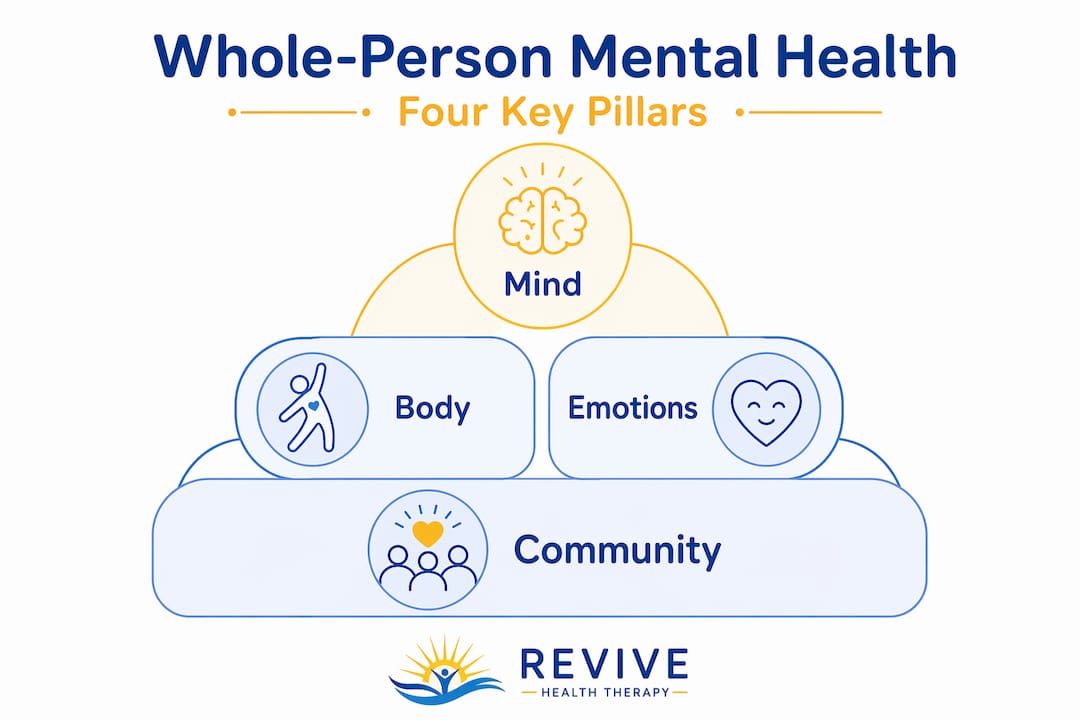
The word “holistic” gets used loosely, so it’s worth being precise. Merriam-Webster emphasizes treating complete systems rather than individual parts. Applied to mental health, that means your anxiety is not just a chemical imbalance to be corrected. It is shaped by how well you sleep, the quality of your relationships, your stress history, your physical health, and even your sense of meaning or purpose.
A whole-person model recognizes several interacting dimensions:
- Physical: Sleep quality, nutrition, chronic pain, exercise habits, and substance use all influence mood and cognitive function.
- Mental and emotional: Thought patterns, emotional regulation skills, trauma history, and self-perception shape how you experience daily life.
- Social: Connection, belonging, conflict patterns, and isolation have measurable effects on mental wellness.
- Environmental: Workplace stress, neighborhood safety, access to nature, and financial security all contribute to psychological state.
- Spiritual or existential: Sense of purpose, values, and meaning-making, whether religious or secular, matter to long-term emotional health.
This contrasts sharply with a symptom-only model, where a diagnosis leads directly to a single medication or one type of therapy without examining the broader context. Holistic wellness does not reject medication or structured psychotherapy. It asks what else is contributing to suffering and what else might support recovery. For people dealing with anxiety or depression, that broader view often surfaces factors that clinical symptom checklists miss entirely. Well-being science frameworks like the GENIAL model confirm that emotional regulation, social connection, and even exposure to nature are not soft extras. They are core ingredients of mental health.
The research behind holistic interventions
This is where things get genuinely interesting, because the evidence is stronger than most people expect and more nuanced than holistic advocates often admit.
A 2026 meta-analysis of 30 trials involving more than 24,000 participants found that mindfulness-based programs delivered over 8 to 12 weeks produced a pooled effect size of Hedges’ g = -0.45 for anxiety and depression combined. For anxiety specifically, the effect was stronger at g = -0.56. To put that in plain terms: these are moderate, clinically meaningful improvements, comparable to what many short-term psychotherapy interventions produce.
Yoga shows a similar pattern. A 2026 network meta-analysis of 183 randomized controlled trials reported a standardized mean difference of 0.49 for yoga and 0.44 for mindfulness, placing both among the highest-performing well-being interventions tested. That analysis also found that many interventions produce similar moderate effects, which makes an interdisciplinary approach particularly valuable since combining modalities may address different pathways simultaneously.
| Intervention | Effect Size (s.m.d.) | Typical Program Duration |
|---|---|---|
| Yoga | 0.49 | 8 to 12 weeks |
| Mindfulness | 0.44 | 8 to 12 weeks |
| Gratitude practices | Moderate | Variable |
| Combined mind-body | Moderate to strong | 8 to 12 weeks |
Gratitude practices and other complementary elements add smaller but consistent benefits, particularly when layered into a structured program rather than practiced sporadically. Mind-body interventions share a core mechanism: they engage contemplative awareness and embodied regulation, both of which calm the nervous system and interrupt rumination loops that drive anxiety and depression.
Pro Tip: If you try mindfulness or yoga for mental health, commit to a structured 8-week program with consistent scheduling and a simple way to track your mood weekly. Unstructured occasional practice produces far weaker results than the research shows.
Balancing holistic wellness with clinical care
Here is the tension most articles skip over. Holistic healing methods are genuinely useful, and they also carry real risk when used as a substitute for clinical treatment in serious cases.

VA and DoD clinical guidelines are clear on this point. Trauma-focused CBT, stress inoculation training, and pharmacotherapy remain first-line treatments for conditions like PTSD, major depression, and severe anxiety disorders. Complementary and alternative medicine (CAM) modalities are described as feasible adjuncts, meaning they can support primary treatment but lack sufficient evidence to stand alone. Yet more than one-third of U.S. adults already use CAM therapies, often without telling their primary care provider or therapist.
That gap between use and disclosure is where things can go wrong. Safe integration requires transparency and structure. Here is what that looks like in practice:
- Tell your therapist and prescriber about every supplement, practice, or complementary modality you use. Interactions between herbal supplements and psychiatric medications are real and sometimes serious.
- Ask your provider which holistic practices are compatible with your current treatment plan, rather than assuming all natural approaches are automatically safe.
- Use collaborative care models where nurse practitioners, therapists, and other providers share information, particularly for complex presentations involving trauma or co-occurring conditions.
- Track your symptoms consistently. If a holistic practice is helping, you should be able to observe measurable change over 6 to 8 weeks.
- Never reduce or stop prescribed medication based on improvement from CAM practices alone without consulting your prescriber.
Coordinated care that integrates clinical oversight with complementary practices is consistently safer and more effective than either approach used in isolation. The goal is not to choose between evidence-based therapy and holistic treatment options. It is to build a care plan where they reinforce each other.
Pro Tip: Bring a written list of your current holistic practices to every therapy appointment. Your therapist can help you assess which ones are working and flag any that might interfere with your treatment progress.
Practical holistic self-care that complements therapy
Once you have a clinical foundation in place, self-directed holistic practices become genuinely powerful. The key word is “complement.” These strategies work best when your therapist knows you are using them. You can learn more about self-care approaches for anxiety that pair well with professional treatment.
Here is a structured way to build holistic self-care into your routine:
- Start with a morning mindfulness anchor. Even 10 minutes of breath-focused attention before checking your phone recalibrates your nervous system before the stress of the day sets in. Apps like Insight Timer offer guided sessions, but a simple body scan works just as well.
- Prioritize sleep as treatment, not luxury. Sleep deprivation amplifies emotional reactivity and impairs the kind of cognitive processing that therapy depends on. Aim for a consistent sleep and wake time, and reduce screen exposure 60 minutes before bed.
- Move your body with intention. You do not need a gym. Three weekly sessions of yoga, walking, or any rhythmic physical activity improve mood through multiple pathways: cortisol regulation, neuroplasticity, and social engagement if done in a group setting.
- Build a gratitude practice with specificity. Generic gratitude journaling has weak evidence. What works better is writing one or two specific things you appreciated that day and briefly noting why. The detail activates different cognitive processing than vague positivity.
- Strengthen one social connection weekly. Isolation fuels both anxiety and depression. You do not need to expand your social circle. Deepening existing relationships through intentional, undistracted conversation consistently shows up in well-being research as one of the most protective factors available.
- Review and adjust monthly. Holistic self-care only works if you evaluate it. Every four weeks, assess which practices are actually shifting your mood and which you are doing out of habit without benefit. Drop what is not working and build on what is.
The mindfulness research is emphatic that structure and measurement are what separate effective programs from feel-good rituals. Apply that principle to your own self-care, and you will get dramatically better results.
My honest take on holistic care in mental health
I have spent years watching people approach mental health with the best intentions and still get stuck. The pattern I see most often is not that they chose the wrong therapy. It is that they approached holistic healing the same way they’d approach a wellness trend: with enthusiasm but without structure, tracking, or a clinical partner to help them interpret what they are experiencing.
The promise of a whole-person approach is real. I have seen clients make significant progress when we layered mindfulness and lifestyle changes onto solid evidence-based therapy. The difference was always coordination. They were not doing yoga instead of processing trauma. They were doing yoga while processing trauma, and the body regulation they built in yoga made the trauma work more tolerable.
What I want people to understand is that evidence-based therapy and holistic practices are not competing philosophies. They address different layers of the same problem. Therapy changes how you think about and process difficult experiences. Lifestyle and mind-body practices change how your nervous system responds to stress in real time. You need both levels of intervention for lasting change.
The uncomfortable truth I have learned is this: unstructured holistic care can become a way of avoiding the harder work of clinical treatment. If your mindfulness practice feels peaceful but your depression has not shifted in six months, something is missing. Comfort is not the same as healing. A good integrative approach keeps you honest about which one you are experiencing.
— Amy
Start your holistic mental health journey
Knowing what a whole-person approach looks like in theory is very different from having a care team that actually delivers it. At Revivehealththerapy, integrative mental health care is built into how we work. Our therapists draw on EMDR, CBT, mindfulness, and trauma-informed methods, combining evidence-based structure with the depth that a whole-person framework requires. We offer both in-person sessions in Walnut Creek and Oakland and secure telehealth therapy for clients anywhere in California, with sliding-scale fees and insurance accepted. If you are ready to move from reading about why psychotherapy works to actually experiencing a plan built around you, we are here to help you take that step.
FAQ
What does holistic mean in mental health?
Holistic mental health means treating the whole person, including physical health, emotional patterns, relationships, environment, and sense of purpose, rather than focusing only on symptom reduction. It recognizes that these factors interact and all influence psychological well-being.
Can holistic therapy replace medication or clinical treatment?
No. Clinical guidelines consistently position complementary and alternative approaches as adjuncts to first-line treatments like CBT or pharmacotherapy, not replacements. Substituting holistic methods for clinical care in serious conditions can delay effective treatment and worsen outcomes.
How long does it take for holistic approaches like mindfulness to work?
Research consistently points to 8 to 12 weeks of structured practice as the window for measurable improvement. A 2026 meta-analysis found moderate effect sizes for anxiety and depression within that timeframe, which underscores the importance of commitment over time rather than sporadic practice.
What holistic practices have the best evidence for anxiety?
Mindfulness-based programs and yoga have the strongest research backing among mind-body approaches, both showing moderate effect sizes in large randomized controlled trials. Structured programs with consistent scheduling and outcome tracking outperform informal or occasional practice.
Is holistic mental health care accessible in California?
Yes. Telehealth has expanded access significantly, allowing people across California to access integrative, whole-person mental health care from home. Providers like Revivehealththerapy offer integrative therapy options through telehealth statewide, with sliding-scale fees to reduce financial barriers.
Recommended
- Why seek holistic therapy? Your guide to whole-person healing – Revive Health Therapy
- Wellness medication vs. therapy: Effective paths for mental health – Revive Health Therapy
- Top 4 Mental Health Services for Adults in 2026 – ReviveHealthTherapy
- Why Seek Psychotherapy: Transforming Mental Wellness – ReviveHealthTherapy