
The fastest anxiety relief comes from your breath and your senses, not your thoughts. A physiological sigh, box breathing, or the 5-4-3-2-1 grounding technique can quiet a racing nervous system in under two minutes, while body scans and mindful movement build the kind of baseline resilience that keeps anxiety from spiking in the first place. The Mayo Clinic frames mindfulness exercises as tools that pull attention out of worry loops and back into the present moment, which is exactly what makes them useful in the middle of a bad day.
Here’s the quick sort:
- For a panic spike right now: physiological sigh, box breathing, or discreet tactile grounding.
- For anticipatory worry before an event: 5-4-3-2-1 grounding or labeling thoughts.
- For daily resilience over weeks: a short body scan, mindful walking, or a few minutes of stretching.
- For racing thoughts at bedtime: 4-7-8 breathing paired with a body scan.
The World Health Organization counts anxiety disorders among the most common mental health conditions worldwide, and mindfulness sits high on the list of self-management tools clinicians recommend alongside therapy. At Revivehealththerapy, mindfulness is woven into trauma-informed sessions using EMDR and CBT rather than treated as a stand-alone fix. That distinction matters for how you use the exercises below.
TL;DR:
- Physiological sighs, box breathing, or tactile grounding provide quick relief during an acute anxiety spike, often reducing symptoms within seconds to minutes.
- For anticipatory worry, sensory grounding techniques like 5-4-3-2-1 are more effective than breathing exercises because they interrupt cognitive looping.
- Building long-term resilience requires consistent practice over at least eight weeks, with daily exercises such as body scans, mindful walking, or breathing routines.
- Trauma history may cause mindfulness exercises to increase distress, so adjustments like shorter or eyes-open practices are recommended, and professional support may be necessary.
- Pairing mindfulness with therapy, especially trauma-informed approaches, leads to more durable anxiety management than using exercises alone.
Table of Contents
- Mindfulness Exercises for Anxiety You Can Do Right Now
- Which Exercise to Choose for Common Anxiety Moments
- How to Build a Daily Mindfulness Habit in 4 to 8 Weeks
- When Mindfulness Helps, When It Backfires, and When to Call a Professional
- Clinical Credentials Behind This Guide
- Key Takeaways
- Sources
Mindfulness Exercises for Anxiety You Can Do Right Now
These are scripts, not concepts. Pick one based on where you are and what you have five minutes for.
-
The physiological sigh. Use this when anxiety spikes suddenly, in a meeting, before a call, mid argument. Takes 30 to 60 seconds. Inhale through your nose, then take a second, shorter inhale on top of it without exhaling. Release everything through your mouth in one long, slow exhale. Repeat two or three times. Some research on the physiological sigh points to fast reductions in heart rate and subjective anxiety after just a few rounds. The tip that makes this work: make the exhale twice as long as the inhale, not the other way around.
-
Box breathing. Good for pre-performance nerves, waiting rooms, or any moment you need steady focus rather than full relaxation. Takes two to four minutes. Inhale for a count of four, hold for four, exhale for four, hold for four. Repeat the square for several cycles. Breathing techniques like this one help activate the parasympathetic nervous system, according to Ohio State’s health team. Count in your head, not out loud. It keeps the exercise usable anywhere, including a crowded elevator.
-
4-7-8 breathing. Best for bedtime anxiety or winding down after a stressful day. Takes three to five minutes. Inhale through the nose for four counts, hold for seven, exhale slowly through the mouth for eight. Do several full cycles. Breathe through your nose specifically on the inhale. Nasal breathing appears to have a calming edge over mouth breathing for some people, likely tied to how scent-processing regions of the brain connect to emotion regulation.
-
The five to ten minute body scan. Best done daily, ideally at a consistent time, to build baseline calm rather than fix an acute spike. Lie down or sit comfortably. Starting at your feet, mentally scan upward through each body part, noticing tension without trying to force it away. Spend a brief moment on each region. When your mind drifts, and it will, just guide it back without judgment. That return to the present is the actual practice, according to Mayo Clinic’s framing of mindfulness. Trying to achieve a blank mind is not the goal and chasing it usually backfires.
-
5-4-3-2-1 grounding. Use this for anticipatory worry, dissociation, or any moment thoughts are spiraling faster than you can name them. Takes two to three minutes. Name five things you can see, four you can touch, three you can hear, two you can smell, one you can taste. Say them out loud if you’re alone, silently if you’re not. Grounding techniques work partly because they force your brain to process outside sensory data, which interrupts the internal rumination loop.
-
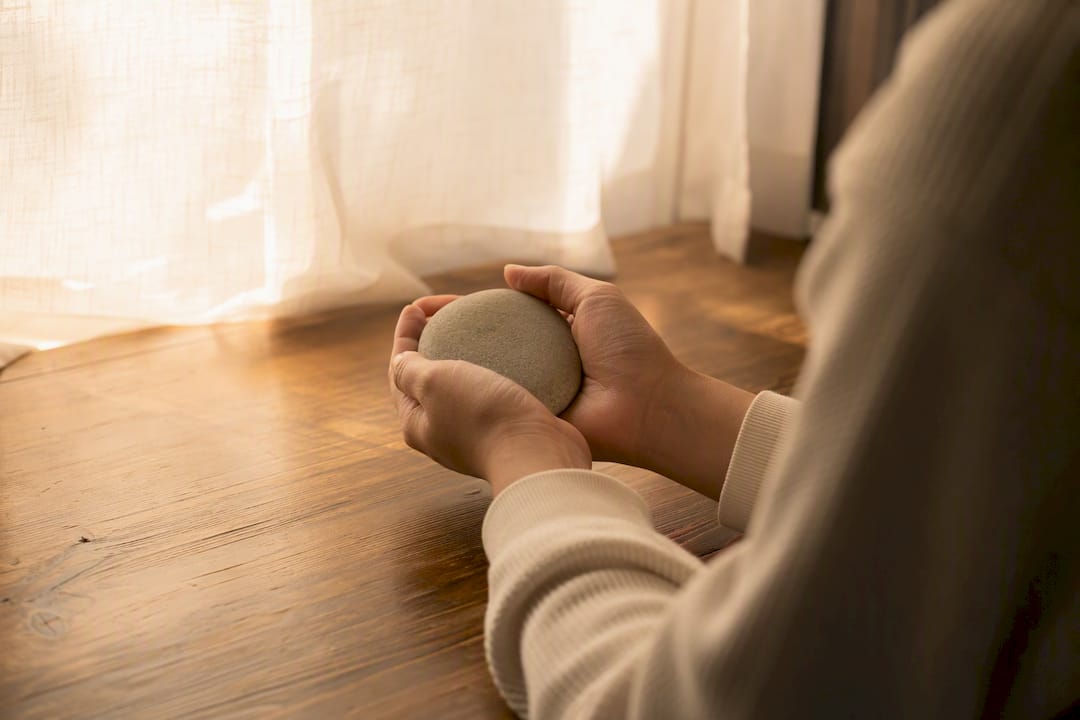
Discreet tactile grounding. Best for public settings, meetings, or anywhere the full 5-4-3-2-1 script would draw attention. Takes under a minute. Keep a coin, a smooth stone, or a textured keychain in your pocket. When anxiety rises, run your thumb over its edges or ridges and describe the texture to yourself in detail. This kind of quiet anchor works anywhere, according to a breakdown of the 5-4-3-2-1 method from Verywell Mind.
-
Mindful walking. Good for restlessness, work breaks, or anxiety that comes with excess physical energy. Takes several minutes. Walk at a normal pace and narrate the physical sensation: foot lifting, moving forward, landing. Let sounds and sights register without chasing them into a story. Movement-based mindfulness tends to be more accessible than sitting still for people who find stillness itself uncomfortable, a pattern noted by Cleveland Clinic.
-
The one-minute pause. Best for transitions between tasks or meetings, when you don’t have time for a full exercise. Stop, plant both feet on the floor, and take three slow breaths while noticing one sound and one physical sensation. That’s it. Set a recurring phone reminder for this one. It works far better as a habit than as something you remember only when you’re already overwhelmed.
-
Labeling thoughts. Use this during worry loops that keep circling the same three fears. Silently note “I am worrying” or “there’s the anxious thought” when you catch your mind spinning. Naming the thought creates distance from it, and that metacognitive gap reduces reactivity more than trying to argue the thought away.
-
Loving-kindness micro-practice. Best for anxiety tangled with self-criticism or shame. Takes two minutes. Silently repeat a short phrase toward yourself, “may I be safe, may I be at ease,” then extend it to someone you care about. It sounds simple, but the shift from self-attack to warmth changes the emotional tone of the moment.
-
Brief progressive muscle relaxation. Good for physical tension, tight shoulders, clenched jaw, that anxiety often carries. Takes three to five minutes. Tense one muscle group for five seconds, then release and notice the contrast. Work from feet to face. Pro Tip: Pair this with the 4-7-8 breath, tensing on the inhale and releasing on the long exhale, and you get two nervous system resets in one exercise.
-
Sensory grounding with a pocket object. Overlaps with tactile grounding but works well as a bedtime or desk-drawer ritual. Keep an object with a distinct smell or texture nearby, like a small sachet of lavender or a piece of fabric, and use it as a fast sensory reset when anxiety builds during work or before sleep.
Which Exercise to Choose for Common Anxiety Moments
Not every technique fits every moment, and picking the wrong one can waste the two minutes you actually have. Here’s how to match the exercise to the situation.
- Sudden panic or a racing heart: Reach for the physiological sigh first. It works faster than box breathing because the exaggerated exhale gives your nervous system an immediate signal to downshift.
- Anticipatory worry before a specific event: 5-4-3-2-1 grounding beats breathing exercises here because the anxiety isn’t purely physiological, it’s cognitive, looping around a future scenario. Sensory grounding interrupts that loop directly.
- Insomnia from a busy mind: 4-7-8 breathing combined with a body scan. The extended exhale slows your heart rate while the scan gives your attention something structured to do besides replay the day.
- Workplace stress, especially in shared spaces: Discreet tactile grounding or the one-minute pause. Full breathing scripts and audible grounding lists aren’t practical at a shared desk.
- Anxiety that shows up while you’re already moving, on a walk, commuting, pacing, mindful walking outperforms seated techniques because it works with the movement instead of asking you to stop and sit down.
One trade-off worth knowing: breath-holding techniques like box breathing can occasionally spike anxiety for people who are sensitive to the sensation of held breath, sometimes because it echoes the breathlessness of a panic attack. If that happens, drop the hold entirely and switch to the physiological sigh or a body scan, neither of which requires holding your breath at all.
Duration matters more than most people expect. Structured programs such as MBSR (Mindfulness-Based Stress Reduction) show measurable reductions in anxiety symptoms with regular practice studied over roughly eight weeks, not after a single session. A single grounding exercise can defuse a moment. Only sustained practice changes your baseline.
How to Build a Daily Mindfulness Habit in 4 to 8 Weeks
Random exercises help in the moment. A routine changes your resting anxiety level. Here’s a simple ramp that doesn’t demand a meditation cushion or an hour you don’t have.
- Week 1: Practice a breathing exercise, box breathing or 4-7-8, for several minutes daily, at a consistent time if possible. Right after your morning coffee or right before bed works well because it’s already a fixed point in your schedule.
- Week 2: Keep the breathing practice and add a brief body scan, either right after breathing or at a separate time of day.
- Week 3: Introduce mindful walking several times this week, replacing some seated sessions on busy days.
- Week 4 and beyond: Aim for a moderate amount of practice most days, mixing breathing, body scan, and movement based on your schedule. Some days that’s one long session. Other days it’s three five-minute pieces.
A few things make this stick. Anchor the practice to an existing habit, right after brushing your teeth, right before you check your phone, so you’re not relying on willpower to remember. Use a timer instead of guessing, since watching the clock yourself pulls you out of the exercise. Guided audio helps a lot in the early weeks when sitting with your own instructions feels awkward; recordings from apps or Revivehealththerapy’s own evidence-based mindfulness resources can carry you through the parts where you’d otherwise give up.
Pro Tip: Log consistency, not quality. A checkmark for “I did five minutes” beats a journal entry rating how calm you felt, because the second one turns practice into another thing you can fail at.

Give it the full eight weeks before judging whether it’s working. That timeframe lines up with where structured mindfulness programs start showing measurable change, and expecting results in week two just sets you up to quit early. If you want a fuller structure to follow, Revivehealththerapy’s step-by-step mindfulness workflow breaks this ramp down into a more detailed weekly guide.
For readers who want the physiology behind why any of this works, the partner explainer from BreatheFree on why deep breathing calms anxiety covers the science in more depth than we have room for here.
When Mindfulness Helps, When It Backfires, and When to Call a Professional
Mindfulness is not universally calming, and pretending otherwise does readers a disservice. For most people, most of the time, it lowers stress and interrupts anxious spirals. For some people, especially those with trauma histories, sitting still with closed eyes can increase distress rather than reduce it.
Watch for these red flags during practice:
- Panic that intensifies rather than eases as you continue an exercise.
- A sense of detachment from your body or surroundings that feels disorienting rather than calming, a sign of dissociation.
- Any thoughts of self-harm or suicide surfacing during or after practice.
- A noticeable drop in your ability to function at work, in relationships, or with daily tasks.
If any of these show up, stop the exercise, use a grounding technique that keeps your eyes open, naming objects in the room works well, and reach out to a mental health professional rather than pushing through alone.
Trauma-sensitive adaptations exist for a reason. Shorter practices, eyes-open versions of body scans, and movement-based options like mindful walking tend to be safer starting points than long seated sessions for people with trauma histories. Clinical programs pair independent practice with occasional therapist check-ins specifically because that combination improves both adherence and safety. Therapy modalities like CBT and trauma-informed EMDR don’t compete with mindfulness, they give it structure and a professional to flag problems early. If practice on your own consistently destabilizes you, that’s a sign to work with a clinician who can guide trauma-sensitive mindfulness approaches directly.

Clinical Credentials Behind This Guide
This guide reflects the clinical approach used across Revivehealththerapy’s practice, where mindfulness is one tool among several, not a stand-alone treatment plan.
- Written from the clinical perspective of Amy, a mental health professional specializing in trauma-informed psychotherapy and mindfulness-based approaches.
- Revivehealththerapy provides evidence-based psychotherapy, including EMDR, CBT, and mindfulness, for individuals, couples, families, children, and teens.
- Services are available in person in Walnut Creek, Oakland, and San Francisco, plus secure telehealth statewide across California.
- Sliding-scale fees and HSA/FSA acceptance keep care accessible across income levels, and insurance options are available through superbills for out-of-network plans.
- Clinical resources on the site, including a breakdown of how mindfulness eases anxiety and a piece on mindfulness’s real impact within therapy, go deeper into how these techniques integrate with formal treatment.
A Therapist’s Honest Note on Practicing This Consistently
Most people who try mindfulness for anxiety give up around week two, right when it starts to feel repetitive and before it starts to feel useful. That gap is normal, not a sign you’re doing it wrong. The skill isn’t in finding the perfect exercise. It’s in returning to whichever one you picked, again and again, even on days it feels pointless.
In clinical settings, the pattern shows up often: someone starts with five minutes of breathing before bed, sees nothing dramatic for weeks, and then notices almost by accident that a situation that used to trigger a full spiral now just causes a ripple. Small, unglamorous, and easy to miss if you’re waiting for a breakthrough moment.
If anxiety keeps returning to the same intensity no matter how consistent your practice gets, that’s not a failure of mindfulness. It’s usually a sign the anxiety has roots that self-guided exercises alone can’t reach, and that’s exactly what therapy is built to address alongside the tools in this guide.
— Amy
Key Takeaways
Mindfulness exercises reduce anxiety fastest when matched to the moment: breathing and grounding for acute spikes, body scans and movement for lasting resilience.
| Point | Details |
|---|---|
| Match exercise to situation | Use breathing or grounding for sudden panic, body scans and movement for daily resilience. |
| Give it eight weeks | Structured mindfulness practice shows measurable change around eight weeks of regular use. |
| Track consistency, not calm | Log whether you practiced, not how relaxed you felt, to avoid quitting during a slow week. |
| Watch for red flags | Increasing panic, dissociation, or self-harm thoughts during practice mean stop and seek help. |
| Pair practice with therapy | Combining mindfulness with CBT or trauma-informed care produces the most durable results. |
Sources
- Mindfulness exercises – Mayo Clinic
- Grounding techniques — Cleveland Clinic
- How breathing exercises can calm anxiety effectively — Ohio State
- Mindfulness for anxiety — Simply Psychology
This article is general information, not a substitute for advice from a qualified doctor. Consult a qualified healthcare professional about your own circumstances before acting on anything here.