
TL;DR:
- Family mindfulness improves emotional regulation, reduces stress, and strengthens parent-child bonds.
- Consistent, authentic practice led by parents is crucial for long-term success.
- Starting with brief exercises like grounding and mindful breathing is effective for all ages.
Mornings can feel like a sprint before the starting gun fires. The lunches aren’t packed, someone can’t find their shoes, and the emotional temperature in the house is already rising before 8 a.m. Sound familiar? For many California families, stress isn’t occasional. It’s the background noise of daily life. The good news is that mindfulness doesn’t require a silent retreat or an hour of free time. Small, consistent practices woven into your existing routine can meaningfully reduce stress, strengthen the parent-child bond, and build emotional resilience for everyone in the household. This guide walks you through exactly how to make that happen.
Table of Contents
- Understanding mindfulness for families
- Preparing your family for mindfulness practice
- Step-by-step guide to family mindfulness routines
- Troubleshooting and keeping your family on track
- Our perspective: Why family mindfulness works long-term and what most guides miss
- How Revive Health Therapy supports family mindfulness and emotional wellness
- Frequently asked questions
Key Takeaways
| Point | Details |
|---|---|
| Practice together | Families that practice mindfulness jointly see greater stress reduction and improved relationships. |
| Simple routines work | Quick and easy exercises like mindful breathing and senses grounding can fit any schedule. |
| Consistency matters | Regular, imperfect practice is more powerful than occasional perfection for long-term benefits. |
| Model as a parent | Children learn best when parents participate and model mindfulness authentically. |
Understanding mindfulness for families
Mindfulness means paying attention to the present moment without judgment. That sounds simple, but for a household managing homework, work deadlines, and after-school activities, it can feel foreign at first. For families, mindfulness isn’t about achieving perfect silence or clearing the mind entirely. It’s about noticing what’s happening inside and around you, together.
Parents benefit in real, measurable ways. Mindfulness-based interventions like MBCT and mindful parenting programs significantly reduce parental depression, anxiety, and stress while improving how parents perceive their children’s behavior. That shift in perception matters enormously. When a parent feels less overwhelmed, they respond rather than react. Children feel that difference immediately.
Kids benefit too, but perhaps not in the ways you’d expect. Mindfulness helps children build emotional regulation, which is the ability to recognize and manage feelings before they escalate. It also improves behavior and deepens the parent-child connection. These aren’t small side effects. They’re foundational skills that follow kids into adulthood.
Here’s what mindfulness practice can offer your family:
- Calmer responses to frustration and conflict
- Better sleep and lower cortisol levels
- Increased empathy between family members
- Stronger emotional vocabulary for children
- Reduced parental burnout
One key finding stands out above the rest: practicing together matters more than practicing separately. Joint parent-child mindfulness using apps like Headspace reduces stress in high-stress California families specifically when both parent and child participate. Solo practice helps. But shared practice amplifies the effect.
“Mindfulness practiced as a family isn’t just a wellness activity. It’s a shared language for handling life’s hard moments together.”
If you’re looking for a broader foundation, our mental health tips for families offer practical context for building emotional wellness at home. You can also explore how mindfulness in therapy shapes lasting mental health outcomes.
Now that you see why mindfulness matters for families, let’s prepare your household for success.
Preparing your family for mindfulness practice
Setting your family up for success starts before you ever close your eyes or take a deep breath. Preparation removes the friction that causes most families to give up after the first week.
First, consider your environment. You don’t need a dedicated meditation room. A cleared corner of the living room, a quiet spot in the backyard, or even a bedroom floor works fine. Consistency of location actually helps signal to the brain that it’s time to slow down.
Next, think about timing. Research on MYmind family training found that structured mindfulness outperforms child medication alone in improving parental stress and sleep outcomes. Structured means scheduled. Morning routines before the day accelerates and bedtime wind-downs before sleep are the two highest-yield windows for most families.
Here’s a simple preparation checklist before you begin:
- Choose a consistent time (morning or bedtime works best)
- Pick a quiet, low-distraction space
- Agree on a realistic session length (3 to 5 minutes for younger children)
- Get family buy-in by framing it as “our time” rather than a chore
- Use a wellness checklist for meditation to stay organized in the early weeks
| Age group | Recommended length | Best practices |
|---|---|---|
| Ages 3 to 6 | 2 to 3 minutes | Breathing with stuffed animals, sound listening |
| Ages 7 to 10 | 3 to 5 minutes | 5-4-3-2-1 grounding, mindful coloring |
| Ages 11 to 14 | 5 to 10 minutes | Gratitude journaling, body scans |
| Adults | 10 to 20 minutes | Guided meditation, mindful breathing |
Common barriers include resistance from older children, inconsistency due to busy schedules, and skepticism from partners. Address resistance by giving kids some control. Let them choose which practice to try. Skeptical partners are more likely to engage when they see tangible results in the household’s mood within 2 to 3 weeks.
Pro Tip: Don’t launch mindfulness during a stressful week. Pick a relatively calm weekend to introduce it, frame it as an experiment rather than a commitment, and let curiosity lead the conversation.
To better understand the clinical side of what you’re starting, our overview of what is mindfulness therapy explains the techniques professionals use and how they translate to everyday family life.
With preparation in place, your family can move to the step-by-step process.
Step-by-step guide to family mindfulness routines
Here’s where the practice actually begins. These steps build on each other, so work through them in order during your first month.
Step 1: Start with the 5-4-3-2-1 senses exercise. Ask each family member to name 5 things they see, 4 they can touch, 3 they hear, 2 they smell, and 1 they taste. This grounding technique works for all ages and takes under three minutes. It’s especially powerful when anxiety is already elevated.
Step 2: Practice mindful breathing together. Sit facing each other and breathe in for four counts, hold for two, and breathe out for six. Do this three to five times. Making eye contact during this exercise deepens the connection.
Step 3: Try a gratitude circle. Each person names one specific thing they’re grateful for from the day. Keep it concrete. Not “I’m grateful for my family” but “I’m grateful Mom made my favorite dinner.” Specificity builds real emotional awareness.
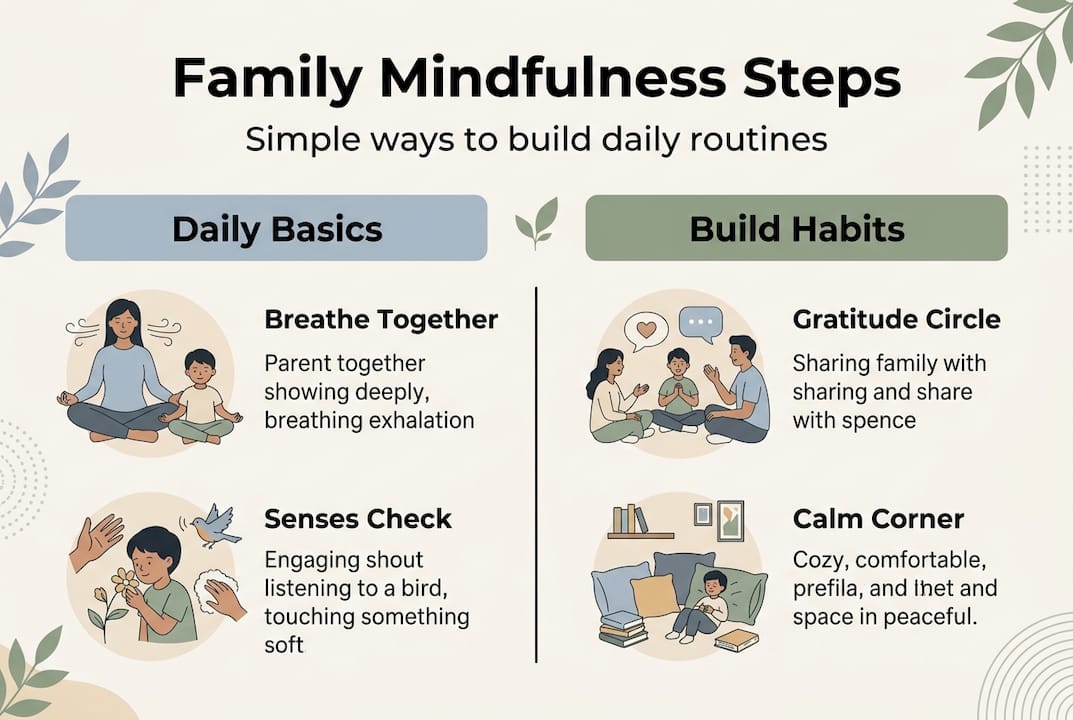
Step 4: Create a calm corner. Designate a physical spot in your home where anyone can go to regulate emotions without judgment. Stock it with a stress ball, a favorite book, or headphones with calming music.
Step 5: Introduce a guided app session once a week. Online mindful parenting training for stressed mothers reduces over-reactive discipline and improves self-compassion. Apps extend this benefit into daily life without requiring a structured class.
| Approach | Best for | Effort level |
|---|---|---|
| Guided app (Headspace, Calm) | Beginners, busy schedules | Low |
| Offline breathing exercises | Young children, no-screen routines | Very low |
| Gratitude circles | Dinner or bedtime conversation | Low |
| Professional mindful parenting | High-stress families, clinical support | Moderate |
Pro Tip: Rotate who leads the practice. When a child leads the breathing exercise, engagement jumps. It gives them ownership and teaches leadership in a low-stakes setting.
For additional support beyond the home, our mindfulness strategies for anxiety explain evidence-based techniques that pair well with these family routines. You can also explore mental health self-care ideas to build a fuller wellness routine for yourself.
Following these steps, you’ll want to know what successful mindfulness looks like and how to keep your family motivated.
Troubleshooting and keeping your family on track
Even the best-planned mindfulness routines hit a wall. A child refuses to participate. A parent skips a week. Life speeds up and the practice quietly disappears. These challenges are normal. Here’s how to move through them.

When children resist: Don’t force it. Resistance often signals that the practice feels like another obligation rather than a shared experience. Revisit the choice element. Ask your child which activity they’d prefer. Shorter sessions and more playful formats work better for reluctant participants.
When the practice feels forced: That’s a signal, not a failure. Forced mindfulness produces anxiety, not calm. Scale back. Even one minute of quiet breathing together counts. Quality of presence matters more than duration.
Signs your practice is working:
- Children use words like “I feel worried” instead of acting out
- Family arguments de-escalate faster
- Bedtime becomes less of a battle
- Parents notice improved patience in themselves
- Kids start initiating the practice on their own
“The most powerful indicator of success isn’t perfect sessions. It’s the moments between sessions when your child uses a mindfulness skill without being prompted.”
For sustaining momentum, parent practice is the most critical factor. Child-only approaches are measurably less effective than those where parents actively participate. Your presence and modeling teach far more than any technique.
Celebrate small wins out loud. When a sibling uses a breathing exercise to calm down instead of yelling, name it. “I noticed you took some breaths when you were frustrated. That took real skill.” Recognition reinforces the behavior.
If your family is navigating a particularly stressful period, grief, a major transition, or mental health challenges, additional support is worth exploring. Pairing mindfulness with professional guidance significantly improves outcomes. Research on music and mental health also suggests that incorporating sound-based practices can deepen relaxation and emotional processing alongside mindfulness work.
Our mental health checklist for parents can help you assess when at-home practices might benefit from professional reinforcement.
Let’s step back and share some lessons learned from evidence and practice.
Our perspective: Why family mindfulness works long-term and what most guides miss
Most mindfulness guides focus on technique. The breathing method. The right app. The best time of day. Those details matter, but they’re not what makes family mindfulness last.
What actually sustains the practice is parent authenticity. Children have finely tuned radar for when adults are going through the motions. If you sit down for a breathing exercise while mentally composing your grocery list, your child feels that disconnection. When you genuinely engage, when you admit that you also struggle to stay present, something shifts.
Modeling imperfection is underrated. Telling your child, “I got frustrated at work today and I’m going to take three slow breaths before dinner” is more powerful than any formal session. That moment shows them that mindfulness is a real life tool, not a performance.
The myth of overnight calm is real. Most families expect peace within a week. Real change in emotional regulation patterns takes 4 to 8 weeks of consistent practice. Inconsistent but authentic beats consistent but hollow every time. Our resource on mindfulness in therapy explains why that consistency, even in small doses, rewires the brain’s stress response over time.
Stop chasing perfect practice. Start chasing present practice.
How Revive Health Therapy supports family mindfulness and emotional wellness
Building a mindfulness practice at home is a strong start, and sometimes families benefit from professional support to deepen or personalize that work.

At Revive Health Therapy, our therapists understand the unique pressures California families face, from high-cost living stress to multicultural dynamics and everything in between. We offer teen therapy services tailored to adolescents navigating anxiety, emotional regulation, and identity. For the whole family, psychotherapy for families provides structured support when mindfulness alone isn’t enough. Whether you’re just beginning or looking to reinforce what you’ve built, we’re here to help. Connect with a therapist to take the next step toward lasting emotional wellness for your family.
Frequently asked questions
What is the easiest mindfulness practice for kids and adults to start with?
Start with the 5-4-3-2-1 senses grounding exercise or mindful breathing. Both take under three minutes and work for every age group without any equipment.
Do mindfulness apps like Headspace really help families?
Yes. Parent-child mindfulness via apps has been shown to reduce stress in high-stress families, particularly when both the parent and child participate in the sessions together.
How can I keep my family motivated to make mindfulness a habit?
Schedule short daily routines, celebrate visible progress, and make sure parents participate actively. Research confirms that child-only approaches are less effective than practices where parents model and join in.
Is mindfulness safe and effective for families with special needs like ASD or ADHD?
MYmind family training research shows mindfulness outperforms child medication alone in improving parental stress and sleep, making it a well-supported option for families navigating ASD and ADHD challenges.
Recommended
- Mental health tips for families in California 2026 – ReviveHealthTherapy
- CBT for families: how therapy helps California families – Revive Health Therapy
- Essential mental health checklist for California parents – Revive Health Therapy
- Practical mental health coping tips for Californians – Revive Health Therapy
- Caia Evergreen – A Calm AI Companion for When Your Thoughts Feel Loud
One Response