
TL;DR:
- Peptides are emerging as promising adjuncts in mental health treatment, primarily through gut-brain mechanisms and diverse delivery routes. However, most are still in early-stage research, and unregulated products pose significant safety and efficacy risks. Integrating peptide therapy with evidence-based psychotherapy remains the most responsible approach for addressing anxiety and depression.
You’ve probably seen peptides marketed as the next frontier in mental health treatment, promising everything from erased anxiety to sharper cognition overnight. The reality is more nuanced, and more interesting. Research into peptides for mental health is genuinely advancing, with compounds derived from everyday food sources now showing antidepressant and pro-cognitive effects in early clinical trials. But between legitimate science and wellness-industry hype, there’s a wide gap worth understanding before you spend a dollar or swallow a capsule.
Table of Contents
- Key takeaways
- How peptides affect mood and brain function
- Key peptides being studied for anxiety and depression
- Safety, regulation, and what’s actually in that vial
- Integrating peptide therapy into a real mental health plan
- My take on where peptide research is actually headed
- Ready to build a mental health plan that actually works?
- FAQ
Key takeaways
| Point | Details |
|---|---|
| Peptides are not magic bullets | Most mental health peptides are still in preclinical or early clinical stages, with limited human evidence. |
| Delivery method matters | Oral, intranasal, and injectable routes produce different absorption profiles and clinical outcomes for the same peptide. |
| Gut-brain axis is central | Several promising peptides work by modulating gut receptors, not the brain directly, which changes how they’re dosed and evaluated. |
| Safety data is thin | Unregulated peptides sold online carry real risks, from purity problems to unknown long-term effects. |
| Psychotherapy remains foundational | Peptide therapies, even when evidence-backed, are most useful as adjuncts to proven treatments like CBT and EMDR, not replacements. |
How peptides affect mood and brain function
The term “peptide” simply refers to a short chain of amino acids, smaller than a full protein, that the body uses as signaling molecules. Think of them as biological text messages: short, specific, and targeted. Your body already produces hundreds of them naturally, including oxytocin, endorphins, and neuropeptide Y. What researchers are now exploring is whether administering specific peptides externally can deliberately shift how the brain regulates mood, cognition, and stress response.
The gut-brain connection
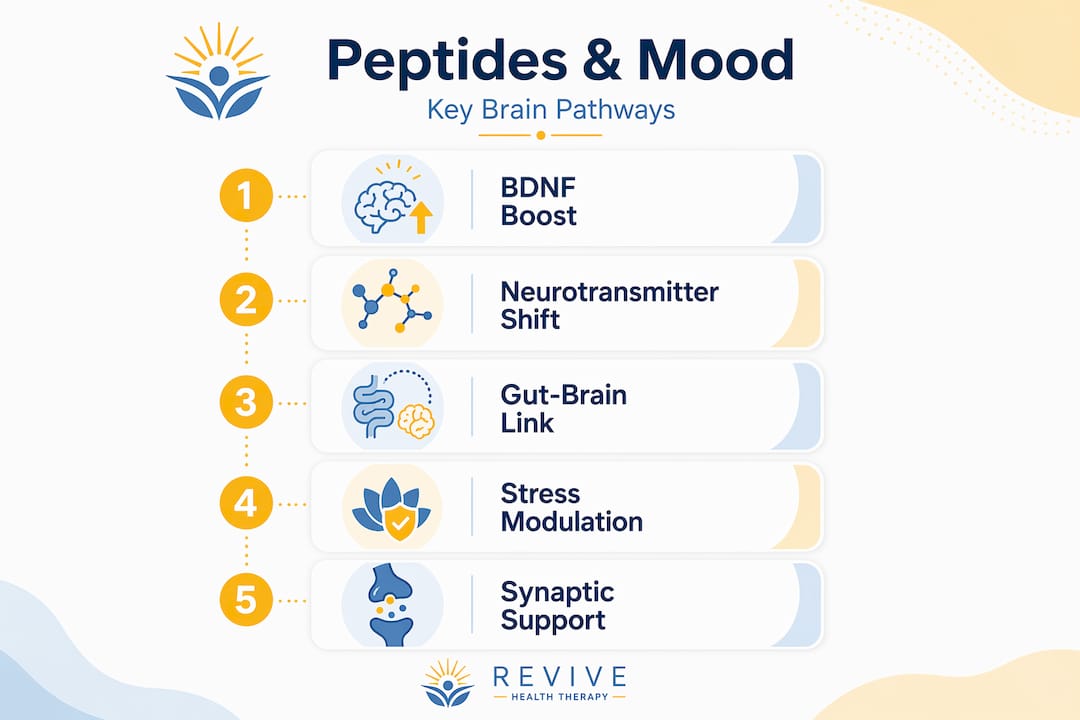
One of the most striking findings in recent peptide research is how many mental health effects run through the gut, not the brain directly. The vagus nerve serves as a two-way communication highway between your digestive system and your central nervous system. Peptides that bind to receptors in the intestinal lining can activate this nerve, triggering changes in brain cortical activity and neurotransmitter regulation. DGX-001, derived from a common food source, works exactly this way. Rather than crossing the blood-brain barrier, it targets gut receptors that send signals upward through the vagus nerve, producing antidepressant and pro-cognitive effects without requiring direct brain access.
Delivery routes and why they matter
How a peptide enters your body dramatically changes whether it does anything useful.
- Oral administration: Most peptides break down in the digestive tract before they can act systemically. DGX-001 is a notable exception, designed specifically for oral bioactivity targeting intestinal receptors.
- Intranasal delivery: Bypasses the blood-brain barrier by traveling along olfactory nerve pathways. Selank and Semax are most commonly studied via this route, with anxiety score reductions observed within two weeks in some trials.
- Subcutaneous or intramuscular injection: Provides reliable systemic delivery but introduces compliance barriers and infection risks, especially outside clinical settings.
Pro Tip: If you’re evaluating a peptide product online and it claims full oral bioavailability for a compound known to degrade in the gut, that claim should raise immediate skepticism. Ask for pharmacokinetic data, not just testimonials.
The multiple CNS mechanisms at play across different peptides explain why they aren’t interchangeable. Semax boosts BDNF and activates TrkB receptors, supporting neuroplasticity. Selank modulates serotonin gene expression and increases GABA release, producing a calming effect without sedation. Each peptide speaks a different biochemical dialect.
Key peptides being studied for anxiety and depression
This is where the science gets genuinely interesting, and where you need to separate preclinical excitement from actual human data.
DGX-001 and PE-22-28
DGX-001 is currently among the most clinically advanced food-derived peptides for mental health applications. Phase 1 trial data shows it is safe and orally active, with participants reporting improved sleep quality alongside pro-cognitive and antidepressant signals. Early EEG measurements showed changes in brain cortical activity before mood improvements became apparent, suggesting the sleep and cognitive pathways activate first.

PE-22-28, sometimes called Mini-Spadin, works through an entirely different route. It blocks the TREK-1 potassium channel, which suppresses serotonergic neuron excitability in healthy brains. By blocking this channel, PE-22-28 promotes synaptogenesis and neuroplasticity rapidly. In animal studies, it doubled the number of new hippocampal cells after just four days, without the serotonin syndrome risk associated with SSRIs. No human clinical trials exist yet, so this one stays in the “watch this space” category.
Semax, Selank, and Oxytocin
| Peptide | Primary mechanism | Delivery | Evidence level |
|---|---|---|---|
| Semax | BDNF/TrkB activation, neuroprotection | Intranasal | Human trials, limited RCTs |
| Selank | Serotonin regulation, GABA release, anxiolytic | Intranasal | Human anxiety trial data |
| DGX-001 | Gut AVPR1a receptor, vagus nerve signaling | Oral | Phase 1 completed |
| PE-22-28 | TREK-1 potassium channel blockade | Injection (preclinical) | Animal studies only |
| Oxytocin | Social bonding, amygdala modulation | Intranasal | Widely studied, mixed results |
| BPC-157 | Serotonergic/dopaminergic modulation | Oral/injection | Largely preclinical, anecdotal |
Selank has arguably the strongest anxiety-specific human data of any peptide in this category. Studies show it reduces anxiety in generalized anxiety disorder patients within two weeks of intranasal use, without the sedation that typically accompanies benzodiazepines. This is a meaningful clinical distinction.
Oxytocin, the so-called “bonding hormone,” genuinely reduces anxiety and promotes trust in controlled settings. Its effects are highly context-dependent, though, meaning it works better in social situations than in isolation and doesn’t function as a standalone antidepressant. You can read more about related emerging treatments in the context of GLP-1 medications and mental health, which shares some mechanistic overlap in gut-brain signaling research.
BPC-157 deserves a candid note. It’s one of the most hyped peptides in online wellness communities for everything from gut healing to mood improvement. The preclinical data shows behavioral benefits in rodent models via serotonergic and dopaminergic pathways, but human evidence is essentially nonexistent. Enthusiasm has significantly outpaced research here.
Safety, regulation, and what’s actually in that vial
The regulatory landscape around peptides for mental health use is genuinely complicated, and consumers often have no idea how exposed they are. In the United States, the FDA classifies most therapeutic peptides as drugs, meaning they require clinical trial approval before being sold for medical use. Many peptides sold online operate in a legal gray area, marketed as “research chemicals” to sidestep drug regulations.
The practical consequences are serious:
- Purity problems: Analysis of online peptide markets shows contamination and mislabeled concentrations are common. You may not be getting what the label says.
- No standardized dosing: Without clinical trials, nobody knows what dose is effective or safe for a specific person’s weight, metabolism, or medical history.
- Reported side effects: A review of more than 12,000 user posts on peptide use identified injection site reactions, gastrointestinal distress, and emotional numbness as recurring complaints, though this data is anecdotal.
- Unknown long-term effects: Even peptides with Phase 1 safety data have only been studied for months. Nobody knows what five years of regular use looks like.
Pro Tip: Before using any peptide marketed for mental health, ask two questions: Is there published human safety data? And is the manufacturer providing a certificate of analysis from a third-party lab? If either answer is no, walk away.
For a deeper look at how to evaluate these products within California’s healthcare context, the Revivehealththerapy resource on peptides and California regulations is worth reviewing before making any decisions.
Integrating peptide therapy into a real mental health plan
If you’re seriously considering peptide therapy for mood, anxiety, or cognitive support, the most important frame is this: no single intervention is sufficient on its own. Mental health treatment works best as a layered system, with evidence-based psychotherapy forming the foundation.
Here’s a practical approach for thinking about integration:
-
Establish psychotherapy first. Approaches like CBT, EMDR, and mindfulness-based therapy have decades of randomized controlled trial support for anxiety and depression. These aren’t placeholders. They’re the strongest tools available right now for evidence-based depression treatment.
-
Work with a clinician who understands peptides. If you’re interested in a peptide like Selank or Semax, you need a prescriber who can monitor your response using validated scales like the GAD-7 for anxiety or PHQ-9 for depression, not just subjective check-ins.
-
Track your baseline before starting. If you begin any new treatment, including a peptide, without a documented baseline, you won’t be able to tell what’s actually working. Validated scales and sleep tracking give you objective data.
-
Set a defined evaluation window. Intranasal peptides like Selank show measurable effects within two weeks in structured trials. Use that as a minimum evaluation period, not a few days of subjective impression.
-
Treat peptides as adjunctive, not primary. The most defensible model right now is using a studied peptide alongside therapy and, if appropriate, standard medications. Using peptides as a replacement for those modalities means trading established efficacy for uncertainty.
Supplementary reading on supporting your emotional health between sessions can be found in these self-care strategies for anxiety, which pair well with any treatment you’re pursuing.
My take on where peptide research is actually headed
I’ll be honest with you: I find the peptide space genuinely exciting, but I’ve also watched too many patients get burned by the hype cycle. The pattern is familiar. A compelling mechanism shows up in rodent studies, wellness influencers pick it up, and suddenly thousands of people are injecting something with zero human safety data because a podcast told them to.
What I’ve learned from advising people navigating emerging therapies is that the most promising compounds tend to have the quietest marketing. DGX-001 isn’t a household name yet, but it’s the one with actual Phase 1 data and a coherent biological story. That matters far more than popularity on forums.
My honest assessment: peptides like Selank and Semax are worth a real clinical conversation if you’re dealing with anxiety that hasn’t fully responded to conventional approaches. They have human data. The delivery mechanisms are understood. But they should be part of a discussion with a licensed clinician who can monitor outcomes, not something you self-prescribe based on Reddit threads.
The future of this field will almost certainly include peptide-based treatments that genuinely work. We’re probably five to ten years from seeing any of them as FDA-approved psychiatric medications. Until then, caution and curiosity can coexist. Explore the science, ask hard questions, and keep your expectations grounded in what the current evidence actually shows.
— Amy
Ready to build a mental health plan that actually works?
If reading about emerging therapies like peptides has you thinking more seriously about your mental health care, that’s a good sign. Curiosity is a starting point. But the most consistent, evidence-backed improvements in anxiety, depression, and emotional regulation come from structured psychotherapy.
Revivehealththerapy offers CBT, EMDR, and mindfulness-based care across California, both in-person in Walnut Creek and Oakland and through secure telehealth statewide. Whether you’re managing depression, anxiety, or emotional dysregulation, working with a licensed therapist gives you a foundation no supplement can replicate. Sliding-scale fees and insurance acceptance, including HSA/FSA, make access realistic for most people. Explore the benefits of psychotherapy and see what evidence-based care looks like when it’s built around your specific needs.
FAQ
What peptides show the most promise for anxiety?
Selank has the strongest human clinical data for anxiety, showing significant reductions in generalized anxiety disorder symptoms after two weeks of intranasal use without sedative effects. Semax is also studied for its neurotrophic and anxiolytic properties, though randomized controlled trial evidence remains limited.
Can peptides replace antidepressants or therapy?
No. Current evidence does not support using peptides as standalone replacements for antidepressants or psychotherapy. Compounds like DGX-001 show pro-cognitive and antidepressant signals in early trials, but they are best understood as potential adjuncts to, not substitutes for, established treatments.
Is BPC-157 safe for mental health use?
BPC-157 lacks robust human clinical evidence for any psychiatric application. Preclinical data is promising, but the peptides sold online under this name carry purity and dosing concerns, making self-administration difficult to evaluate as safe or effective.
How do peptides improve mood at a biological level?
Different peptides use distinct pathways. Selank modulates serotonin and GABA pathways, Semax activates BDNF receptors supporting neuroplasticity, and DGX-001 works through gut-vagus nerve signaling to influence brain activity indirectly. There is no single universal mechanism.
Are peptides for cognitive function the same as nootropics?
There is significant overlap. Some peptides marketed for cognitive function, such as Semax, are categorized as nootropics and peptides in research literature. The key distinction is that nootropics is a broad behavioral category, while peptides are defined by their molecular structure. Not all nootropics are peptides, and not all peptides function as nootropics.