
TL;DR:
- Mindfulness practices can significantly improve mental health by reducing stress, anxiety, and depressive symptoms. Structured programs like MBSR and MBCT provide measurable benefits, particularly in depression and pain management, through skills like de-centering and attention training. However, professional guidance is recommended for those with trauma or severe symptoms to ensure safe and effective practice.
Mindfulness improves mental health for many adults by reducing stress, easing anxiety and depressive symptoms, and strengthening emotional regulation. A systematic meta-analysis found mindfulness-based interventions produced a moderate effect size (d = 0.55) compared to no treatment, with outcomes for depression, pain, and addiction often matching established first-line therapies. Two structured programs, Mindfulness-Based Stress Reduction (MBSR) and Mindfulness-Based Cognitive Therapy (MBCT), have the strongest evidence base. Researchers including Dr. Sona Dimidjian and Dr. Zev Schuman-Olivier have shown that the skill of observing thoughts without fusing with them, called de-centering, is a key reason MBCT cuts depressive relapse rates. The American Psychological Association (APA) recognizes mindfulness-based approaches as empirically supported treatments.
What the evidence shows at a glance:
- Mindfulness-based interventions outperform no treatment with a moderate positive effect for depression and related conditions.
- MBSR and MBCT are 8-week structured programs with measurable symptom reductions by program end.
- Benefits extend beyond mood: NIH research links mindfulness practice to better sleep, reduced pain, and lower anxiety.
- Mindfulness is not a cure-all; it works best as part of a broader mental health plan, and some people need clinician guidance before starting.
Try this right now: Sit comfortably, close your eyes, and focus on your breath for three minutes. Notice each inhale and exhale. When your mind wanders, gently return attention to the breath without judging yourself. That single exercise is the foundation of every formal mindfulness program.
Table of Contents
- What is mindfulness, exactly?
- What does the research actually show?
- How does mindfulness actually change your brain and body?
- Four clinic-tested exercises you can try today
- How to build a practice that actually lasts
- Is mindfulness right for everyone?
- How therapists integrate mindfulness into treatment
- Key Takeaways
- A clinician’s perspective on what mindfulness can and cannot do
- Mindfulness-informed therapy at Revivehealththerapy
- Useful sources and further reading
What is mindfulness, exactly?
Mindfulness is the practice of paying deliberate, nonjudgmental attention to the present moment — your thoughts, sensations, and emotions as they arise, without trying to change or escape them. It is not a personality trait you either have or lack. It is a trainable skill, closer to a mental muscle than a mood.
Informal mindfulness means bringing that quality of attention to ordinary moments: noticing the taste of your coffee, feeling your feet on the floor during a stressful meeting. Formal programs go further. MBSR, developed by Jon Kabat-Zinn at the University of Massachusetts in the late 1970s, is an 8-week group course combining meditation, body scan, and mindful movement. MBCT builds on MBSR and adds cognitive therapy skills specifically to prevent depressive relapse.
A concept central to both programs is de-centering: learning to observe thoughts as passing mental events rather than facts about yourself or the world.
That shift sounds simple. For someone caught in a loop of anxious or depressive thinking, it can be genuinely disorienting at first, and then quietly life-changing.
What does the research actually show?
The evidence for mindfulness is real, moderately strong, and worth understanding clearly — because it is also sometimes overstated.
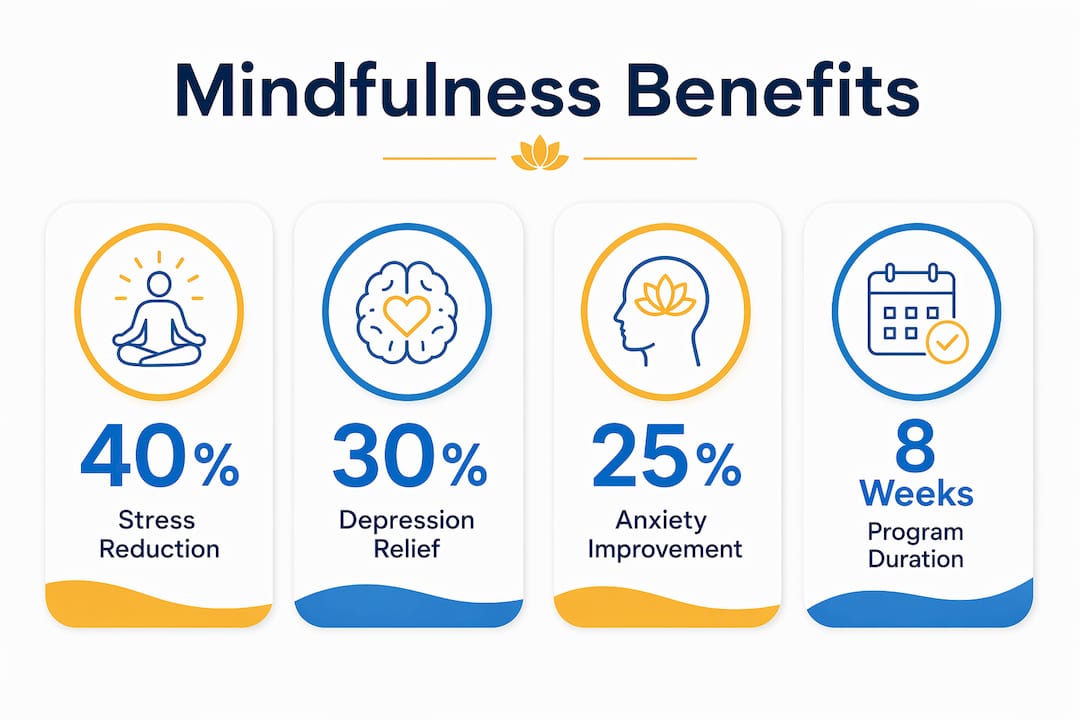
The most rigorous summary comes from a large meta-analysis covering mindfulness-based interventions across psychiatric conditions. Compared to no treatment, mindfulness interventions showed a moderate effect for depression. Against active treatments (other therapies), mindfulness was roughly comparable, not superior. The strongest evidence clusters around depression, chronic pain, smoking cessation, and addiction. Evidence for anxiety disorders is positive but more variable across studies.
| Outcome | Evidence strength | Notes |
|---|---|---|
| Depression (relapse prevention) | Strong | MBCT reduces relapse risk; comparable to antidepressants in some trials |
| Stress reduction | Strong | Consistent across clinical and nonclinical samples |
| Anxiety symptoms | Moderate | Positive effects; more variable across anxiety subtypes |
| Chronic pain | Moderate | Shifts relationship to pain; does not eliminate it |
| Sleep quality | Moderate | NIH-cited improvements in sleep outcomes |
| Addiction / smoking | Moderate | Urge-surfing techniques show consistent benefit |
On timelines: Most participants in 8-week MBSR or MBCT programs report noticeable changes in stress reactivity and mood by weeks 4–8. Longer-term maintenance depends heavily on continued practice after the program ends.
A few honest caveats. Many mindfulness studies have small samples, high dropout rates, and publication bias toward positive results. Effects in nonclinical (healthy adult) populations tend to be smaller than in clinical groups. And a key finding from broader empirical reviews is that increased trait mindfulness, the lasting disposition to be present and accepting, mediates most clinical outcomes. That means the practice has to stick, not just happen once.
For readers specifically interested in depression, the mindfulness and depression evidence is worth exploring in depth.
How does mindfulness actually change your brain and body?
Three mechanisms do most of the work.
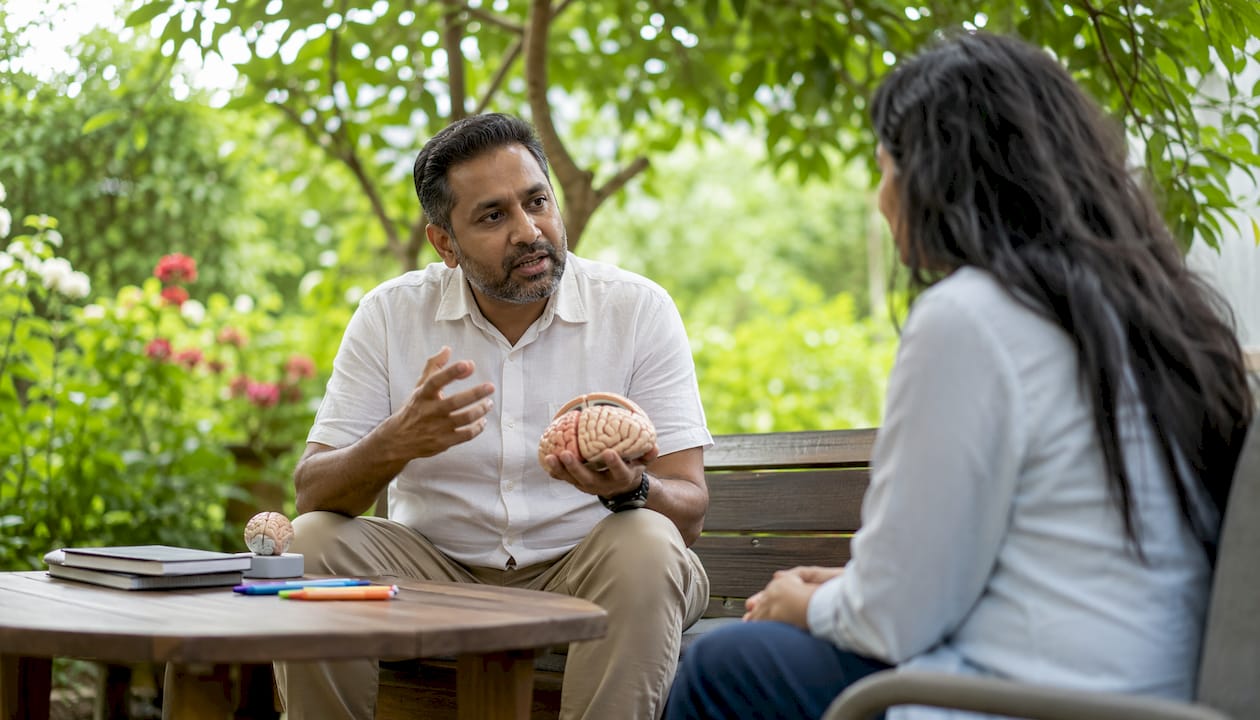
Attention training. Every time you notice your mind has wandered and redirect it, you are exercising the prefrontal circuits involved in cognitive control. Over weeks of practice, this reduces automatic reactivity: the hair-trigger stress response that turns a difficult email into a 20-minute spiral. Laboratory studies show that even brief mindfulness inductions reduce emotional reactivity to negative stimuli within a single session.
De-centering and reduced rumination. Rumination, replaying the same distressing thoughts on a loop, is one of the strongest predictors of depression and anxiety. De-centering interrupts that loop. Instead of “I am a failure,” the practiced observer notices “there is a thought that says I am a failure.” That one-step distance changes what happens next.
Physiological stress reduction. Mayo Clinic describes how mindfulness calms the autonomic nervous system, lowers cortisol output, and supports both sleep quality and pain tolerance. These are not subtle effects. Chronic stress keeps cortisol elevated, which disrupts sleep, impairs immune function, and worsens mood. Reducing that baseline physiological load has downstream benefits across multiple health domains.
The role of acceptance deserves its own mention. Trials that strip acceptance training out of mindfulness programs and keep only attention training show significantly weaker outcomes. Relaxation is a side effect of mindfulness, not the mechanism. The active ingredient is learning to be with difficult experience without fighting it.
Pro Tip: If you find mindfulness practice frustrating because your mind keeps wandering, that is not failure. Noticing the wander and returning is the practice. Each redirect is a repetition, like a bicep curl for attention.
For a deeper look at how these mechanisms connect to anxiety relief specifically, the evidence-based breakdown is worth reading.
Four clinic-tested exercises you can try today
These exercises come from MBSR and MBCT protocols. Each one targets a different aspect of mental health.
3-minute mindful breathing
Purpose: Interrupt stress reactivity; anchor attention to the present.
- Sit upright in a chair with feet flat on the floor.
- Set a timer for three minutes.
- Close your eyes or soften your gaze downward.
- Bring attention to the physical sensation of breathing: the rise of your chest, the air at your nostrils.
- When a thought appears, simply note “thinking” and return to the breath.
- At the end, take one slow breath and open your eyes.
Time: 3 minutes. Common beginner experience: mind wanders constantly. That is normal and expected.
10-minute body scan
Purpose: Build body awareness; reduce tension held unconsciously in the body.
- Lie down or sit comfortably.
- Start at the top of your head and slowly move attention down through your body: scalp, forehead, jaw, neck, shoulders, chest, arms, belly, lower back, hips, legs, feet.
- At each area, simply notice any sensation without trying to change it.
- If you find tension, breathe toward it and let it be there.
- Finish by noticing your whole body as one unit.
Time: 10 minutes. If you fall asleep, that is fine. If you feel anxious scanning inward, open your eyes and try a shorter version.
Mindful walking
Purpose: Bring mindfulness into movement; useful for people who find seated practice difficult.
- Walk slowly in a quiet space, indoors or outside.
- Focus on the sensation of each foot lifting, moving forward, and making contact with the ground.
- When your mind moves to a to-do list or worry, gently return to the feeling of walking.
Time: 5–10 minutes. Works well as a lunchtime reset.
Labeling thoughts (urge surfing)
Purpose: Reduce anxiety and cravings by observing them without acting on them.
- When you notice an anxious thought or urge, pause.
- Label it: “anxiety,” “worry,” “craving,” “judgment.”
- Imagine the thought as a wave: watch it rise, peak, and fall without riding it.
- Return attention to your breath or body.
Time: 1–3 minutes, used in the moment. Particularly effective for anxiety spirals and behavioral urges.
Pro Tip: Short daily practice beats long occasional sessions. Even five minutes every morning, before checking your phone, builds the habit faster than a 45-minute session twice a week. Consistency is the variable that predicts outcomes.
For a structured step-by-step anxiety workflow that builds on these exercises, Revivehealththerapy has a clinician-framed guide.
How to build a practice that actually lasts
Starting is easy. Continuing past week two is where most people struggle.
The research-backed sweet spot for a self-guided practice is 5–15 minutes daily. NIH guidance specifically notes that short, consistent daily practices embedded in routine tasks tend to produce more sustainable gains than infrequent long sessions. Attach practice to something you already do: three minutes of mindful breathing before your morning coffee, a body scan before sleep.
When to consider a structured program. If you are dealing with moderate-to-severe depression, an anxiety disorder, or chronic pain, a self-guided app is probably not enough. MBSR and MBCT are the right tools here: 8-week group programs, typically meeting once a week for two hours plus daily home practice. MBCT in particular is recommended by clinical guidelines for people with three or more depressive episodes.
Informal practice matters as much as formal sessions. Mindful eating means actually tasting your food instead of scrolling. Mindful commuting means noticing the sounds around you instead of catastrophizing about the day ahead. These micro-practices accumulate. They also make the formal sessions feel less like a chore and more like a natural extension of how you move through the day.
For readers who want to complement their practice with broader self-care strategies, pairing mindfulness with other evidence-based habits strengthens outcomes.
You can also explore spiritual tools for a restless mind as a nonclinical complement to formal practice, particularly if you are drawn to contemplative or meaning-based approaches.
Is mindfulness right for everyone?
No. This is one of the most underreported facts in popular mindfulness coverage.
For most adults, mindfulness is safe and beneficial. For some, it can make things worse, at least initially, and without proper support. Clinical guidance is clear that mindfulness is not universally appropriate, particularly for people with certain trauma histories or active severe symptoms.
Red flags: pause or stop self-guided practice if you notice:
- Increased dissociation or feeling detached from your body or surroundings
- Worsening PTSD symptoms, flashbacks, or intrusive memories triggered by inward focus
- Panic attacks that intensify during breathing exercises
- Severe suicidal ideation or self-harm urges
- A sense of unreality or depersonalization that does not resolve after the session
When to seek professional help before continuing:
- You have a diagnosed PTSD or complex trauma history and have not discussed mindfulness with your therapist.
- You experience psychosis or have a history of dissociative episodes.
- You have tried mindfulness twice and felt significantly worse both times.
- Your depression is severe enough that concentrating on the present moment feels impossible or distressing.
- You are in a mental health crisis right now.
The fix is not to avoid mindfulness entirely. It is to access it through a clinician who can screen for contraindications, modify the approach, and monitor your response. Trauma-informed mindfulness, delivered by a trained therapist, looks quite different from a generic app session. The pacing is slower, the exercises are shorter, and there is always an exit ramp.
How therapists integrate mindfulness into treatment
In a clinical setting, mindfulness is rarely the whole treatment. It is a tool within a broader approach.
At Revivehealththerapy, therapists trained in CBT and EMDR often introduce brief mindfulness exercises early in treatment, before moving into deeper trauma processing or cognitive restructuring. A typical in-session use might be two to three minutes of grounding breath work at the start of a session to help a client arrive present and regulated. For clients with depression, MBCT-informed skills, including de-centering and thought labeling, are woven into the cognitive work. For trauma clients, mindfulness is introduced carefully, with body-based grounding techniques that keep the nervous system within a manageable range.
The integration of mindfulness in therapy at Revivehealththerapy reflects the evidence: mindfulness amplifies the effects of CBT and EMDR rather than replacing them.
Access options at Revivehealththerapy include in-person sessions at Oakland, Walnut Creek, and San Francisco locations, plus secure telehealth therapy statewide for clients across California. Sliding-scale fees, insurance, and HSA/FSA plans are accepted, which removes a common barrier to consistent care. For clients who want to understand what mindfulness-informed therapy in California looks like in practice, the mindfulness therapy access guide walks through what sessions typically include.
Pro Tip: When you contact a therapist about starting mindfulness work, ask specifically: “Do you screen for trauma history before introducing mindfulness?” A yes is a good sign. It means they know the contraindications and will adapt accordingly.
Key Takeaways
Mindfulness reduces stress and depressive symptoms for most adults, with the strongest evidence coming from structured 8-week programs like MBSR and MBCT, and the key mechanism is learning to observe thoughts without fusing with them.
| Point | Details |
|---|---|
| Moderate, real effect size | Meta-analyses show a moderate effect compared to no treatment; strongest for depression, pain, and addiction. |
| De-centering is the core skill | Observing thoughts as passing events, not facts, is what cuts depressive relapse risk. |
| Consistency beats duration | Daily 5–15 minute practice produces more lasting gains than infrequent long sessions. |
| Not safe for everyone | People with trauma, PTSD, or severe symptoms should start with a clinician, not an app. |
| Revivehealththerapy | Offers mindfulness-informed CBT and EMDR therapy in-person in the Bay Area and via telehealth statewide. |
A clinician’s perspective on what mindfulness can and cannot do
Mindfulness gets oversold. Walk into any wellness space and you will hear it described as the answer to anxiety, burnout, chronic pain, and relationship conflict all at once. The research does not support that framing, and I think the overselling actually harms people who try it, feel only modest relief, and conclude they must be doing it wrong.
What mindfulness genuinely does is change your relationship to difficult experience. It does not make hard things disappear. A client managing grief does not stop feeling sad after eight weeks of MBCT. What often shifts is that the sadness stops feeling like a verdict. It becomes something that moves through, rather than something that defines.
The other thing I want to name directly: mindfulness is not a substitute for therapy when therapy is what someone needs. For people carrying unprocessed trauma, starting a solo meditation practice without clinical support can stir up material they are not equipped to handle alone. That is not a failure of the person or the practice. It is just the wrong sequence. The right sequence is: get stable, get supported, then deepen the practice.
What I find genuinely exciting about the current evidence is how well mindfulness pairs with other treatments. It amplifies CBT. It supports the window of tolerance work that makes EMDR more effective. Used as one tool among several, with realistic expectations, it is one of the most accessible and durable skills a person can build for their mental health.
Mindfulness-informed therapy at Revivehealththerapy
Reading about mindfulness is a good start. Practicing it with a trained clinician who can adapt the approach to your history is a different level of support entirely.
Revivehealththerapy offers individual therapy, trauma-informed care, and MBCT and MBSR-informed sessions for adults across California. If you are in the Bay Area, in-person sessions are available in Oakland, Walnut Creek, and San Francisco. If you prefer to work from home, secure telehealth sessions are available statewide. Sliding-scale fees, major insurance plans, and HSA/FSA payments are all accepted. If you have been reading this article because something in your mental health feels stuck, that is a reasonable signal to reach out. You can learn more about why therapy works and what to expect from an intake session, or contact the clinic directly to ask whether mindfulness-informed care is the right fit for where you are right now.
Useful sources and further reading
The sources below are worth bookmarking if you want to go deeper than a single article allows.
| Source | What it offers |
|---|---|
| NIH News in Health: Mindfulness for Your Health | Accessible NIH summary of mindfulness research, including sleep, pain, and behavioral benefits |
| NIH research | Earlier NIH feature on the clinical foundations of mindfulness and MBSR |
| PMC Meta-Analysis (PMC5741505) | Full systematic review with effect sizes across psychiatric conditions |
| PMC Empirical Review (PMC3679190) | Broad review of mindfulness and psychological health, including mechanisms |
| Mayo Clinic: Mindfulness Exercises | Practical, plain-language guide to starting a mindfulness practice |
| NCCIH: Meditation in Depth | National Center for Complementary and Integrative Health overview of meditation research |
For structured programs:
- Search for MBSR programs through the UMass Memorial Health Center for Mindfulness, the program Jon Kabat-Zinn founded.
- MBCT programs are often offered through hospital-based outpatient psychiatry departments and licensed therapists trained in the protocol.
- For a deeper healing practice that extends beyond clinical sessions, contemplative resources can complement formal mindfulness work.
If you are ready to work with a clinician rather than navigate this alone, Revivehealththerapy serves adults, couples, families, and teens across California, in person and via telehealth.
This article is general information, not professional mental health advice. For guidance specific to your situation, consult a licensed mental health professional or your primary care provider.
Recommended
- Role of Mindfulness in Therapy: Real Impact on Anxiety and Depression – ReviveHealthTherapy
- Real Benefits of Mindfulness in Depression: 2026 Guide – Revive Health Therapy
- How mindfulness eases anxiety: Evidence-based strategies – Revive Health Therapy
- What is mindfulness therapy? Techniques and access in CA – Revive Health Therapy
One Response