
TL;DR:
- Family therapy views sibling conflict as a changeable relationship pattern rather than a character flaw. Including siblings in therapy can lead to increased empathy, clearer boundaries, and less parental mediation. Short-term family work often improves communication and reduces conflict, with strategies families can implement immediately at home.
Family therapy reframes sibling conflict as a relationship pattern the whole family can change, not a personality flaw in any one child. The role of sibling relationships in family therapy is more central than most families realize: therapists treat the sibling bond as a live system with its own rules, roles, and pressure points, all of which can shift with the right clinical support.
Two things you can do right now:
- This week at home: Hold a 15-minute family meeting where each sibling names one thing they need from the others, without interruption. Keep it short and structured.
- Professional step: Search the Psychology Today therapist directory or contact a licensed marriage and family therapist (LMFT) in your state to schedule an initial family assessment.
Families who bring siblings into therapy typically see three early gains:
- Siblings develop genuine empathy by hearing each other’s perspectives in a neutral space
- Clearer personal boundaries replace the unspoken rules that fuel most recurring fights
- Parents carry less of the mediating burden once siblings have direct communication tools
Table of Contents
- Why sibling relationships shape who we become
- Common sibling problems clinicians see in family therapy
- How family therapy actually changes sibling dynamics
- What a course of family therapy typically looks like
- Strategies families can start using this week
- When sibling conflict signals a need for professional help
- Key Takeaways
- Why sibling work deserves more clinical attention
- Revivehealththerapy: family and sibling therapy across California
- Useful sources and further reading
Why sibling relationships shape who we become
Siblings are, for most people, the longest relationships of their lives, and sibling bonds shape social, emotional, and identity development from early childhood through late adulthood. One survey found that 64% of respondents said they were good friends with at least one sibling, and 45% called a sibling their best friend. Those numbers matter clinically because they tell you the relationship carries real weight, even when it is painful.
Family-systems therapists work from a principle that sounds simple but has deep implications: every sibling grows up with different parents. The same two adults parent differently depending on their own age, stress level, financial situation, and emotional availability at the time each child is born. A firstborn experiences parents who are anxious and attentive; a third child may experience parents who are exhausted and permissive. Same household, different childhoods. Therapy must bridge those divergent personal narratives before siblings can understand why they remember family events so differently.
| Developmental dimension | What sibling relationships contribute |
|---|---|
| Social skills | Practice in negotiation, conflict, and repair with a peer who cannot be avoided |
| Emotional regulation | Repeated exposure to frustration and reconciliation builds tolerance |
| Identity formation | Siblings define themselves partly in contrast to each other (“I’m the responsible one”) |
| Long-term support | Sibling bonds often outlast parental relationships and many friendships |
Roles harden over time. The “identified patient” carries the family’s distress. The “golden child” absorbs parental praise. The “caregiver sibling” manages everyone else’s emotions. These labels are not just descriptive; they become self-fulfilling scripts that siblings carry into adult relationships. Theoretical reviews of sibling development confirm that these role patterns are systemic, not individual, which is exactly why individual therapy alone rarely resolves them.
Common sibling problems clinicians see in family therapy
Therapists working with sibling dynamics encounter a predictable set of problems, most of which trace back to structural family conditions rather than individual character:
- Rivalry and jealousy rooted in perceived favoritism or unequal parental attention
- Differential parenting, where parents apply different rules by birth order, gender, or diagnosis
- Role crystallization, where a sibling’s early-assigned role (scapegoat, hero, lost child) becomes rigid and resistant to change
- Boundary violations, including emotional enmeshment or chronic intrusion into personal space and decisions
- Caregiving disputes, especially when an adult sibling with a disability or mental-health condition creates unequal burdens
- Blended-family stress, where step-siblings or half-siblings navigate loyalty conflicts and unclear family hierarchies
- Trauma exposure, where one sibling’s abuse history or mental-health crisis affects the emotional safety of others
Systematic reviews show that siblings of children with mental-health conditions are themselves at higher risk for poorer mental health and often report less warm family relationships when they are left out of treatment. Estrangement is also more common than most families expect: one study found 28% of adult siblings had experienced at least one episode of estrangement.
A common pattern: a teenager is referred for anxiety, and the parents bring her alone. Her older brother, who has been managing his own stress by becoming the “family peacekeeper,” never gets assessed. Six months later, the brother is the one in crisis. Leaving siblings out of the clinical picture is one of the most consistent gaps in family mental-health care.
How family therapy actually changes sibling dynamics
The primary goal in sibling-focused family therapy is not to make siblings like each other. For children, the aim is building respectful, cooperative interaction. For adults, the clinical target shifts further: creating competent, functional adult-to-adult relationships rather than forcing reconciliation or friendship. That reframe alone relieves enormous pressure from families who walk in expecting therapy to manufacture warmth.

Therapists draw from several overlapping approaches depending on the family’s age range and presenting issues:
Family systems therapy maps the relational patterns, roles, and feedback loops that keep the sibling conflict stable. It treats the system, not the symptom.
Structural family therapy examines boundaries between subsystems (parents, siblings, individuals) and works to clarify who is responsible for what.
CBT-based skill work teaches concrete communication and conflict-resolution skills. CBT for families is particularly useful when siblings need a shared vocabulary for expressing needs and setting limits.
Trauma-informed care applies when sibling conflict is entangled with a history of abuse, neglect, or parental mental illness. Siblings who witnessed the same traumatic events often need separate space to process before they can work together.
Play therapy is the primary modality for younger children, allowing them to express sibling dynamics through structured play rather than verbal discussion.
Multi-family therapy (MFT) brings multiple families together so siblings can meet peers in similar situations. Research on MFT programs shows siblings gain knowledge, reduce guilt, and benefit from vicarious learning when they see other families navigating the same challenges.
Specific techniques include mapping sibling roles on a genogram, structured boundary-setting exercises, communication scripts practiced in session, role reversal (where siblings temporarily take each other’s perspective), and sibling support groups for ongoing peer connection.
Families can realistically expect improved communication, clearer personal limits, and less parental mediation within a short-term course of work. What therapy does not do is change personalities overnight. Patterns that took a decade to form take more than a few sessions to shift.
Pro Tip: Before the first session, give each sibling a clear, neutral reason for attending (“We’re going to learn how to talk to each other better”) and assign them an active role (“You’ll each get to share one thing that matters to you”). Siblings who feel blamed or bored in early sessions disengage fast. A clear ‘why’ and a valued role reduce resistance significantly, which is consistent with clinical implementation guidance on sibling engagement.
What a course of family therapy typically looks like
Family therapy for sibling issues follows a recognizable arc, even though the specifics vary by therapist and family.
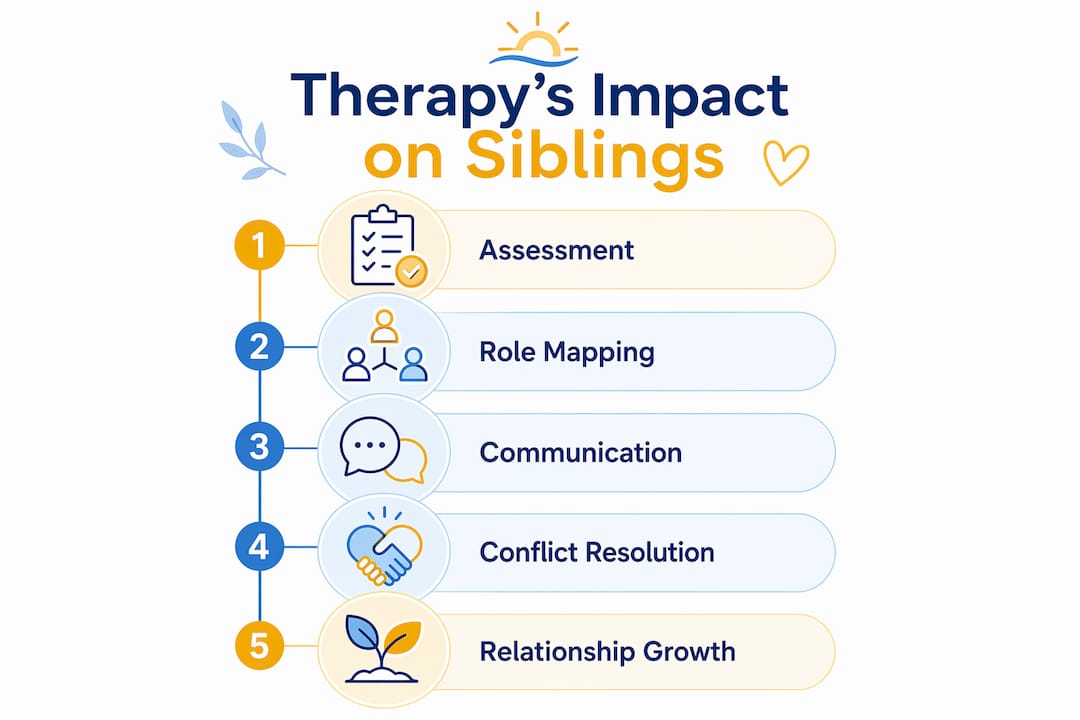
- Initial assessment — The therapist meets with parents and, often, siblings separately to gather each person’s account of the problem without anyone feeling monitored.
- Who attends — Sibling sessions may include all children, a subset, or rotate based on age and relevance. Parents usually attend some sessions for coaching and some are sibling-only.
- Confidentiality boundaries — The therapist clarifies early what stays private and what gets shared with parents, which is especially important for teens.
- Skill-building modules — Middle sessions focus on specific skills: active listening, conflict de-escalation, boundary language, and repair after arguments.
- Parent coaching — Parents learn to step back from refereeing and instead prompt siblings to use the skills they are practicing in sessions.
- Sibling-focused work — Dedicated sessions let siblings address grievances directly, with the therapist managing the process and preventing escalation.
- Maintenance and closure — Final sessions review progress, identify remaining triggers, and build a plan for handling future conflicts without a therapist present.
Historic case record data shows siblings participated in two-thirds of family therapy cases, though 76% attended only one or two sessions. Even limited attendance produced measurable symptom improvement in some subgroups, which suggests that even brief sibling inclusion has clinical value.
A realistic short-term course runs 6–12 sessions. Longer work is common when trauma, estrangement, or a sibling’s ongoing mental-health condition is part of the picture. Sample goals families often set: reduce weekly conflict triggers by identifying the top two recurring flashpoints, establish a caregiving schedule that distributes responsibility fairly among adult siblings, and build a repair script both siblings agree to use after arguments.
Strategies families can start using this week
Three approaches tend to produce the fastest early change, and none of them require a therapist to implement; learn more about how to start mental health treatment at home to support these strategies here.
Structured turn-taking eliminates the “whoever talks loudest wins” dynamic. Set a timer for two minutes per person during any conflict discussion. No interruptions. This one rule alone shifts the power balance in most sibling arguments.

Role-naming conversations involve parents naming the roles they see (“I’ve been treating you as the responsible one and that’s not fair to you”) rather than waiting for therapy to surface them. Naming a role out loud begins to loosen it.
Fairness versus equality coaching means parents stop trying to treat every child identically and start explaining why different children get different things at different times. “Equal” often feels unfair; “fair” requires explanation.
Three short communication scripts worth keeping on hand:
- After a fight: “I got heated earlier. Can we try that conversation again? I want to actually hear what you were saying.”
- Setting a caregiving limit: “I can help with [specific task] on [specific days], but I can’t be the only one managing this. Can we divide it up?”
- Asking for space: “I need about an hour to myself before I can talk about this. I’m not shutting you out, I just need to reset.”
For a simple family action plan: assign each sibling one household role they own fully, hold a 20-minute weekly check-in with a rotating facilitator, agree on two shared rules for conflict (no name-calling, no walking out mid-conversation), and review the plan monthly.
Age matters in how you apply these. Young children respond to visual charts and simple, concrete rules. Teens need autonomy built into the structure, so give them input on the rules rather than handing them down. Adult siblings often need the conversation reframed entirely around current adult needs rather than childhood grievances.
For parents navigating teen therapy alongside sibling work, the same principles apply: structure, clarity, and giving each person a defined role in the process.
When sibling conflict signals a need for professional help
Self-help strategies work for ordinary friction. Several situations call for a licensed therapist rather than a family meeting.
Seek professional help when conflict has escalated to physical aggression, when one sibling is disclosing abuse or trauma for the first time, or when a sibling’s mental-health symptoms (severe depression, self-harm, disordered eating) are affecting the whole family’s functioning. Siblings of children with serious mental-health conditions are at elevated risk themselves, and leaving them out of treatment is a clinical mistake the research is clear about.
Estrangement that disrupts caregiving for aging parents is another clear referral point. When adult siblings cannot coordinate basic decisions about a parent’s health or housing because of unresolved conflict, the stakes are high enough to warrant structured professional support.
For urgent situations, including any risk of harm, contact emergency services or a crisis line immediately. The 988 Suicide and Crisis Lifeline is available 24/7. For non-urgent but serious concerns, a pediatric mental-health consultation or a licensed family therapist is the right next step. Guidance on finding a therapist for accessible care can help families navigate the search.
Routine referral signs include: repeated conflict cycles that reset within days of resolution, a child who has taken on a parentified caregiver role, or any sibling who consistently withdraws from family contact without explanation.
Key Takeaways
Sibling relationships are one of the most clinically underused levers in family therapy, and addressing them directly produces changes that individual treatment alone rarely achieves.
| Point | Details |
|---|---|
| Siblings shape development | Sibling bonds influence social skills, emotional regulation, and identity from childhood through adulthood. |
| Therapy targets patterns, not personalities | Family therapy changes relational roles and communication habits, not fixed character traits. |
| Brief inclusion still helps | Even limited sibling attendance in therapy sessions has produced measurable symptom improvement in clinical studies. |
| Start with structure at home | Structured turn-taking, role-naming conversations, and fairness coaching are three strategies families can use immediately. |
| Revivehealththerapy offers sibling-inclusive care | Family therapy, teen therapy, and trauma-informed approaches are available in-person in Oakland and Walnut Creek, and via telehealth across California. |
Next steps: Use the repair script (“Can we try that conversation again?”) this week, then contact a licensed family therapist for an initial assessment if conflict is recurring or escalating.
Why sibling work deserves more clinical attention
Most families arrive at therapy focused on one child. The anxious teenager, the defiant eight-year-old, the adult sibling who stopped returning calls. What the research keeps showing, and what I find most striking, is how often the sibling relationship is the actual site of the problem, not just a side effect of it.
The conventional approach treats siblings as background characters in someone else’s treatment. But siblings are not bystanders. They absorb the same family stress, construct their own narratives about what happened and why, and carry those narratives into every adult relationship they form. Leaving them out of the clinical conversation does not protect them. It just means their version of the story never gets examined.
What I think families underestimate is how quickly sibling dynamics can shift once there is a structured space to address them. The goal is not harmony. It is function. Two adult siblings who can coordinate a parent’s care without a blowup, or two teenagers who can disagree without one of them shutting down for a week, have made real progress. That is worth the work.
Revivehealththerapy: family and sibling therapy across California
Families dealing with sibling conflict, role rigidity, or the fallout from a family member’s mental-health crisis get something specific from Revivehealththerapy: a clinician who treats the sibling relationship as part of the clinical picture from the first session, not an afterthought.

Revivehealththerapy offers family therapy for children, teens, and adults, with in-person sessions in Oakland and Walnut Creek and secure telehealth available statewide. When trauma is part of the sibling dynamic, EMDR therapy and trauma-informed care are integrated directly into the family work. CBT-based skill building, sliding-scale fees, and insurance and HSA/FSA acceptance make consistent attendance realistic for families across income levels.
To get started, visit the Oakland therapy page to book an in-person session, or explore online therapy in California for a telehealth option that works around your schedule. An initial family assessment is the first step, and it gives every sibling a voice in how the work begins.
Useful sources and further reading
The sources below informed this article. They were selected for peer-review quality, clinical relevance, and authority within family therapy research.
- Adult siblings tackle their complicated, lifelong relationships in therapy — NPR Health Shots, 2024. Journalism covering adult sibling therapy, estrangement prevalence, and the “different parents” concept from clinician interviews.
- Theoretical Perspectives on Sibling Relationships — PMC/NIH. Peer-reviewed theoretical review of sibling development across the lifespan, including role formation and systemic patterns.
- The experience of siblings attending multi-family therapy for adolescent eating disorders — PMC. Mixed-methods study on sibling outcomes in MFT programs, including reduced guilt and increased knowledge.
- Interventions for siblings of children and young people with mental health conditions: A systematic review — Peer-reviewed systematic review on sibling mental-health risk and the evidence for sibling-inclusive interventions.
- Siblings in family therapy — Wiley/Journal of Family Therapy. Historic case record study on sibling attendance rates and symptom outcomes in family therapy.
- Understanding adult sibling therapy — Psychology Today. Clinical commentary on goal-setting in adult sibling work and the shift from reconciliation to functional interaction.
- Sibling involvement in family-based interventions — Peer-reviewed clinical guidance on preparing siblings for sessions and giving them active roles to reduce resistance.
- Sisterhood-Brotherhood is Powerful: Sibling Sub-Systems and Family Therapy — Family Process. Foundational paper on sibling subsystems and how including siblings can destabilize and ultimately rebalance family systems.
This article is general educational information, not professional mental-health advice. For guidance specific to your family’s situation, consult a licensed therapist or qualified mental-health professional.