
TL;DR:
- Self-compassion involves treating oneself with kindness during times of struggle. It is a measurable process linked to lower anxiety, depression, and better healing outcomes. Practicing self-kindness, common humanity, and mindfulness daily supports emotional resilience and trauma recovery.
Self-compassion is defined as the practice of treating yourself with the same kindness you would offer a close friend during moments of pain, failure, or struggle. Psychologist Dr. Kristin Neff identifies three core pillars: self-kindness, common humanity, and mindfulness. A 2026 systematic review of 85 studies involving over 26,000 participants confirmed that self-compassion is a robust predictor of well-being and is directly linked to lower anxiety and depression. The role of self-compassion in healing is not a soft concept. It is a measurable, neurophysiologically grounded process that changes how your brain and body respond to suffering.
What does the evidence say about self-compassion and healing?
Research on self-compassion and emotional healing has grown sharply in the past two years. The 2026 systematic review analyzed 85 studies across more than 26,000 participants and found consistent links between self-compassion and reduced psychopathology. That scale of evidence places self-compassion alongside established therapeutic tools like Cognitive Behavioral Therapy (CBT) and mindfulness-based interventions.
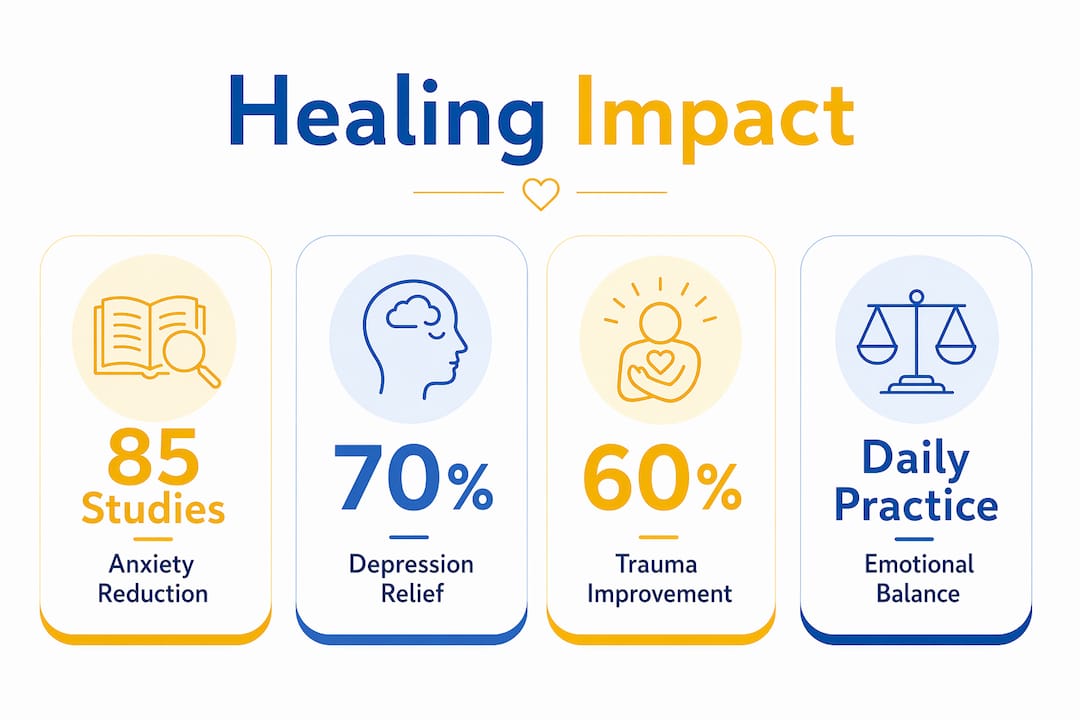
Self-compassion also outperforms self-esteem as a predictor of psychological well-being. Unlike self-esteem, which depends on external success and comparison, self-compassion predicts well-being without the risks of narcissism or contingent self-worth. That distinction matters because self-esteem can collapse under failure, while self-compassion remains stable precisely when things go wrong.
The neurophysiological mechanism is equally important. Compassionate self-talk and gentle physical gestures activate the parasympathetic nervous system, which reduces physiological arousal and creates the internal safety needed for trauma processing. This is why trauma-informed therapists increasingly incorporate self-compassion techniques alongside EMDR and CBT.
“Self-compassion gives people the emotional safety to look at their own mistakes and pain without being destroyed by them.” — Harvard psychologist Christopher Germer
| Outcome | Effect of self-compassion |
|---|---|
| Anxiety and depression | Significantly reduced across 85 studies |
| Psychological well-being | More reliably predicted than by self-esteem |
| Trauma processing | Supported through parasympathetic activation |
| Motivation and accountability | Increased, not decreased |
What are the three pillars of self-compassion, and why do they matter?
Dr. Kristin Neff’s framework identifies three learnable skills that together produce self-compassion. Each pillar addresses a different way people typically make suffering worse.
- Self-kindness replaces harsh self-criticism with warmth and understanding. A 2026 longitudinal study found that self-kindness sequentially improves mental health outcomes over time, making it the most foundational of the three pillars. When you stop attacking yourself for struggling, your nervous system can begin to settle.
- Common humanity is the recognition that suffering and imperfection are universal human experiences, not personal failures. Isolation, the belief that you alone are broken or flawed, predicts poorer mental health outcomes in longitudinal research. Connecting your pain to the broader human experience reduces shame and increases resilience.
- Mindfulness means holding painful thoughts and feelings in balanced awareness without suppressing or over-identifying with them. Over-identification, where you become completely absorbed in your suffering, amplifies distress and blocks healing. Mindfulness creates the psychological distance needed to respond to pain rather than react to it.
These three pillars work together. Practicing only one in isolation produces weaker results. Longitudinal data shows that self-kindness and common humanity improve mental health sequentially, meaning the order and consistency of practice matters.
Pro Tip: Start with self-kindness before working on common humanity. Research shows that building warmth toward yourself first creates the psychological safety needed to genuinely connect your pain to shared human experience.
How can you practice self-compassion daily to support healing?
Consistent daily practice produces stronger results than occasional intensive effort. The brain learns self-compassion through repetition, not through single dramatic breakthroughs. Harvard psychologist Christopher Germer notes that multiple entry points exist for cultivating self-compassion, including physical, mental, and relational strategies, so you can start wherever feels most accessible.
Here are four research-supported practices you can build into your daily routine:
- Compassionate self-talk. When you notice self-criticism, pause and ask: “What would I say to a good friend in this situation?” Then say that to yourself. This simple reframe activates the same neural pathways involved in receiving care from others.
- Mindful awareness of pain. Name what you are feeling without judgment. “I am feeling anxious right now” is more effective than “I am a mess.” Labeling emotions reduces their intensity by engaging the prefrontal cortex rather than the amygdala.
- Self-soothing physical gestures. Placing a hand on your heart or gently crossing your arms over your chest directly engages the parasympathetic nervous system. This is not symbolic. It is a physiological intervention that supports trauma processing in therapy and at home.
- Loving-kindness meditation and reflective writing. Spending five minutes writing about a difficult experience from a compassionate perspective, or silently repeating phrases like “May I be kind to myself,” builds the neural habit of self-compassion over weeks of practice.
Pairing these practices with mindfulness for depression amplifies their effect, particularly for people managing chronic low mood.
Pro Tip: If sitting meditation feels too abstract, start with the physical gesture. Placing a hand on your heart for 30 seconds while breathing slowly is enough to begin shifting your nervous system’s baseline response to stress.

How is self-compassion different from self-esteem or positive affirmations?
Self-compassion, self-esteem, and positive affirmations are often grouped together, but they work through fundamentally different mechanisms. Knowing the difference helps you choose the right tool for sustainable healing.
| Concept | Core mechanism | Risk | Stability under failure |
|---|---|---|---|
| Self-compassion | Acknowledges pain with kindness | Very low | High |
| Self-esteem | Evaluates self-worth based on performance | Narcissism, defensiveness | Low |
| Positive affirmations | Replaces negative thoughts with positive ones | Suppression, inauthenticity | Variable |
Self-esteem requires you to feel good about yourself, which means it collapses when you fail or receive criticism. Self-compassion does not require you to feel good. It requires you to be kind to yourself precisely because you feel bad. That distinction makes self-compassion far more stable and useful during recovery from anxiety, depression, or trauma.
Positive affirmations carry a different problem. Telling yourself “I am strong and capable” when you feel broken does not acknowledge the real pain. Self-compassion acknowledges the pain first, which is why it does not produce the emotional suppression that affirmations sometimes create. Research confirms that self-compassion increases motivation and accountability rather than encouraging avoidance. People with higher self-compassion are more willing to acknowledge their mistakes and try again, not less.
Self-compassion also enables accountability by reducing the paralyzing shame that drives avoidance. When you are not terrified of your own self-judgment, you can look honestly at what went wrong and make a different choice. That is the opposite of complacency. Therapists working with self-discovery and growth consistently find that clients who develop self-compassion take more risks, not fewer.
Key Takeaways
Self-compassion is the most stable and evidence-backed foundation for healing anxiety, depression, and trauma because it works with pain rather than against it.
| Point | Details |
|---|---|
| Defined by three pillars | Self-kindness, common humanity, and mindfulness are learnable skills, not fixed traits. |
| Stronger than self-esteem | Self-compassion predicts well-being more reliably and stays stable when you fail. |
| Neurophysiologically grounded | Physical self-soothing gestures activate the parasympathetic nervous system and support trauma processing. |
| Daily practice beats intensity | Small, repeated exercises build lasting neural change more effectively than occasional effort. |
| Increases motivation | Higher self-compassion is linked to greater accountability and willingness to face mistakes. |
What I have learned watching self-compassion change people’s lives
After years of observing clients work through anxiety, trauma, and depression, the pattern I see most clearly is this: the people who heal fastest are not the ones who push hardest. They are the ones who learn to stop fighting themselves.
The most persistent myth I encounter is that self-compassion is a form of weakness or self-indulgence. Clients who believe this often arrive exhausted from years of relentless self-criticism, convinced that being hard on themselves is what keeps them functional. What the research shows, and what I see in practice, is the opposite. Self-criticism narrows your thinking and keeps your nervous system in a threat state. Self-compassion opens it back up.
The other thing I have noticed is that small physical practices often work faster than cognitive ones for people recovering from trauma. Placing a hand on the heart, slowing the breath, speaking gently to yourself out loud. These are not metaphors. They are direct inputs to a nervous system that has been running on high alert. Clients who start there often find that the more abstract work of changing thought patterns becomes much easier afterward.
The most honest thing I can say is this: self-compassion is not the easy path. It requires you to sit with pain instead of running from it. But it is the path that actually leads somewhere.
— Amy
How Revivehealththerapy supports your self-compassion practice
Self-compassion practices are most effective when they are integrated into a broader therapeutic framework guided by a trained professional. Revivehealththerapy offers evidence-based psychotherapy in California that weaves self-compassion techniques directly into trauma-informed care, CBT, and EMDR treatment.
Whether you are managing anxiety, processing trauma, or working through depression, Revivehealththerapy’s clinicians in Walnut Creek and Oakland, and via secure telehealth statewide, can help you build self-compassion as a clinical skill, not just a concept. Sliding-scale fees and insurance acceptance, including HSA and FSA plans, make care accessible regardless of income. If you are ready to move from understanding self-compassion to practicing it with expert support, explore your options at Revivehealththerapy.
FAQ
What is self-compassion in mental health?
Self-compassion is the practice of responding to your own pain and failure with kindness, recognizing shared human experience, and maintaining mindful awareness rather than harsh self-judgment. Dr. Kristin Neff’s research identifies it as a three-part skill set that is directly linked to lower anxiety and depression.
How does self-compassion aid healing from trauma?
Self-compassion activates the parasympathetic nervous system through compassionate self-talk and physical self-soothing gestures, which reduces physiological arousal and creates the internal safety needed for trauma processing. It also reduces shame-driven avoidance, allowing people to engage more fully in therapeutic work.
Is self-compassion the same as self-pity?
Self-compassion is not self-pity. Self-pity amplifies suffering by focusing inward and reinforcing isolation, while self-compassion connects your pain to shared human experience and motivates constructive action. Research shows that higher self-compassion is linked to greater resilience and accountability, not passivity.
How long does it take to develop self-compassion?
There is no fixed timeline, but research confirms that consistent small daily practices produce stronger neurological change than rare intensive efforts. Most people notice a meaningful shift in their self-talk patterns within several weeks of daily practice.
Can self-compassion replace therapy for anxiety or depression?
Self-compassion practices are a powerful complement to therapy but are not a substitute for professional care when managing clinical anxiety, depression, or trauma. Integrating self-compassion with approaches like CBT or EMDR, as offered through trauma-informed therapy, produces the strongest outcomes.
Recommended
- Healing Trauma Process 2026: Step-by-Step Recovery Guide – ReviveHealthTherapy
- How therapists guide self-discovery for growth in California – Revive Health Therapy
- Why seek holistic therapy? Your guide to whole-person healing – Revive Health Therapy
- How boundaries in therapy unlock emotional healing – Revive Health Therapy