
If you’re choosing between a therapist and a counselor, the short answer is this: “therapist” is the umbrella term for anyone providing psychotherapy, while “counselor” more often signals shorter-term, goal-focused work on a specific problem. But that’s a generalization, not a rule, because state licensing boards use these titles inconsistently, and plenty of “counselors” hold the exact same graduate training as “therapists.” The label matters far less than what the person is actually trained and licensed to do.
Before you book anything, here’s what to check:
- Training level: Most therapists and counselors hold a master’s degree; some therapists hold a doctorate (PhD or PsyD).
- Problem focus: Counselors often address a defined issue (grief, career stress, adjustment); therapists more often work with longer-term or layered concerns (trauma, chronic depression, relational patterns).
- When to prefer each: Pick a counselor for a bounded, situational problem; pick a therapist if you’re dealing with something deeper or longer-standing, or you’re not sure yet.
Your first move isn’t picking a title. It’s asking about the clinician’s license, specialty, and treatment approach before you commit to a session.
Key Takeaways
The clearest way to choose between a therapist and a counselor is to evaluate the clinician’s license, specialty, and treatment approach rather than their job title alone.
| Point | Details |
|---|---|
| Titles overlap heavily | “Therapist” and “counselor” are used inconsistently across states, so the label alone tells you little. |
| Focus differs more than training | Counselors often work short-term on defined problems; therapists often handle longer, layered concerns. |
| Supervised hours matter, but quality matters more | Roughly 2,000–3,000 hours is typical, but what the supervision covered counts for more than the total. |
| Match the provider to the problem | Psychiatrists prescribe, psychologists test, therapists and counselors provide psychotherapy. |
| Revive Health Therapy applies this directly | It offers EMDR, CBT, and trauma-informed care across Oakland, Walnut Creek, and statewide telehealth, with sliding-scale and insurance options. |
Where to verify these details further
- Psychology Today for role definitions and licensing distinctions.
- BLS for counselor job data and typical work settings.
- Healthline for licensure pathways and supervised-hours ranges.
- Your state licensing board, whenever you want to confirm a specific clinician’s credentials.
Table of Contents
- What does ‘therapist’ mean, and who uses the title?
- What does ‘counselor’ mean, and where do they typically work?
- How do education and licensure actually differ?
- What treatment approaches do therapists and counselors use?
- How do therapists and counselors relate to psychologists and psychiatrists?
- How do you choose between a therapist and a counselor?
- How one California clinic applies these distinctions
- What actually matters when you’re picking one over the other
- Get matched with the right kind of care in California
- Frequently asked questions about therapists and counselors
- Sources
What does ‘therapist’ mean, and who uses the title?
“Therapist” works as a catch-all for clinicians who provide psychotherapy, whether they hold a master’s degree or a doctorate. It’s not a protected license title on its own; it describes a function.
You’ll typically see the term attached to specific credentials: a Licensed Clinical Social Worker (LCSW), a Licensed Marriage and Family Therapist (LMFT), a Licensed Mental Health Counselor (LMHC), or a psychologist with a PsyD or PhD who also does clinical work. Therapists commonly treat depression, trauma, and entrenched behavioral patterns, drawing on modalities like CBT, DBT, EMDR, and psychodynamic approaches.
- Master’s-level or doctoral-level training is standard.
- Credentials vary by state: LCSW, LMFT, LMHC, PsyD, PhD all show up under the “therapist” umbrella.
- Common focus areas include trauma, depression, anxiety, and long-term relational patterns.
- Always confirm the specific license and specialty since titles vary by state and setting.
What does ‘counselor’ mean, and where do they typically work?
A counselor is a licensed clinician, usually oriented toward solving a defined life problem within a defined timeframe rather than open-ended psychological exploration. Think career transitions, grief, adjustment to a diagnosis, or acute stress.
Common counselor credentials include Licensed Professional Counselor (LPC), Licensed Mental Health Counselor (LMHC) in some states, and school counseling certifications. You’ll find counselors in schools, employee assistance programs, community mental health clinics, and private practice. Many use the same evidence-based tools therapists do, including CBT and solution-focused techniques, just aimed at a narrower goal.
- Typical credentials: LPC, LMHC, school counselor certifications.
- Common settings: schools, EAPs, community clinics, private practice.
- Frequent issues: career changes, grief, stress management, life adjustment.
- Some counselors carry the same graduate training as therapists. Ask about their specialty and supervision, not just their title.
How do education and licensure actually differ?
Here’s where the real distinctions live, not in the word on the door but in the paperwork behind it.
| Path | Typical degree | Example licenses | Supervised hours |
|---|---|---|---|
| Counselor | Master’s | LPC, LMHC | Commonly 2,000–3,000 |
| Therapist (master’s-level) | Master’s | LCSW, LMFT | Commonly 2,000–3,000 |
| Therapist (doctoral) | PhD or PsyD | Psychologist license | Includes doctoral internship + postdoc hours |
| Psychiatrist | MD or DO | Medical license | Residency in psychiatry |
Supervised clinical hours for licensure often land somewhere around 2,000 to 3,000, though exact requirements shift by state.
Pro Tip: The number of supervised hours matters less than what happened during them. A clinician who spent 2,500 hours working almost exclusively with trauma survivors is a stronger fit for trauma work than one who logged 3,000 hours across general caseloads.
Before your first appointment, ask for the clinician’s license number and check it against your state licensing board. It takes five minutes and confirms they’re actually credentialed to practice.
What treatment approaches do therapists and counselors use?
Both groups draw from a shared toolbox. Cognitive behavioral therapy (CBT), EMDR, psychodynamic work, and family systems approaches show up across therapists and counselors alike; the difference is usually depth and duration, not the technique itself.

A counselor working with someone through a job loss might run six to ten sessions, weekly, with concrete goals and between-session homework. A therapist treating complex trauma might work with a client for a year or longer, moving at a slower pace through phases of stabilization, processing, and integration using EMDR or similar trauma-focused modalities.
Depression and anxiety remain among the most commonly treated conditions in outpatient mental health care, according to ADAA statistics, which is exactly why both counselors and therapists build their core skill sets around these two issues even when their specialties diverge elsewhere.
- CBT: used by both, for restructuring unhelpful thought patterns.
- EMDR: used mostly by trauma-trained therapists for processing traumatic memories.
- Psychodynamic therapy: more common among therapists doing longer-term work.
- Family systems approaches: used by both, depending on training and setting.
The session structure itself tends to reveal more about fit than the job title does. Overlap is common; the deciding factor is the clinician’s actual scope, training, and clinical focus, not the word on their business card.
How do therapists and counselors relate to psychologists and psychiatrists?
Four different roles, four different training paths, and understanding the split saves you time.
A psychologist (PhD or PsyD) is trained in psychological testing and formal assessment on top of psychotherapy, useful when you need a diagnosis clarified or cognitive testing done. A psychiatrist (MD or DO) attends medical school and can prescribe medication, the right call when symptoms are severe, acute, or medication might help. A therapist or counselor (usually master’s-level, sometimes doctoral) provides the psychotherapy itself, whether that’s short-term counseling or long-term depth work.
- Psychiatrists: hospitals, psychiatric clinics, private practice with prescribing authority.
- Psychologists: testing centers, hospitals, private practice, academic settings.
- Therapists and counselors: private practice, community clinics, schools, telehealth platforms.
If you’re only navigating everyday stress, relationship strain, or a specific life transition, a therapist or counselor is almost always the right starting point.
How do you choose between a therapist and a counselor?
Run through this before you book:
- Define your problem. Is it a specific, bounded issue (a counselor’s strength) or something layered and ongoing (a therapist’s strength)?
- Decide your timeline. Want quick, structured sessions, or are you open to longer-term work?
- Ask about modalities. Do they use evidence-based approaches like CBT or EMDR relevant to your concern?
- Verify license and hours. Confirm their credential and how their supervised training matched your specific issue.
- Check experience with your issue. A generalist and a trauma specialist are not interchangeable.
Ask directly in a first call: What’s your typical treatment plan for someone with my concern? Do you offer telehealth? Do you work on a sliding scale, and do you accept insurance?
Watch for red flags:
- No clear license number or vague answers about credentials.
- Guarantees of a quick fix for a complex issue.
- Reluctance to explain their treatment approach in plain language.
On cost: many providers now accept insurance, HSA/FSA funds, or offer sliding-scale fees, and out-of-network options with superbills are common if your preferred provider isn’t in-network. Telehealth has widened access considerably, though it’s worth confirming a provider’s telehealth setup meets your state’s requirements before scheduling.
How one California clinic applies these distinctions
Revive Health Therapy operates as a working example of how these categories play out in practice rather than on paper. The clinic offers EMDR, CBT, trauma-informed care, and family, child, and teen services, with in-person locations in Oakland and Walnut Creek and telehealth available statewide across California.
- In-person sessions at Oakland and Walnut Creek locations.
- Secure telehealth available anywhere in California.
- Sliding-scale fees for income-based affordability.
- Insurance, HSA, and FSA accepted.
That combination, evidence-based modalities plus flexible access, is what the checklist above is actually asking you to look for.
What actually matters when you’re picking one over the other
Most guides on this topic treat “therapist vs counselor” like a vocabulary quiz, as if learning the right definition solves your problem. It doesn’t. The research on this is fairly consistent: outcomes track more closely with the fit between your needs and the clinician’s specialty than with which word is printed on their license.
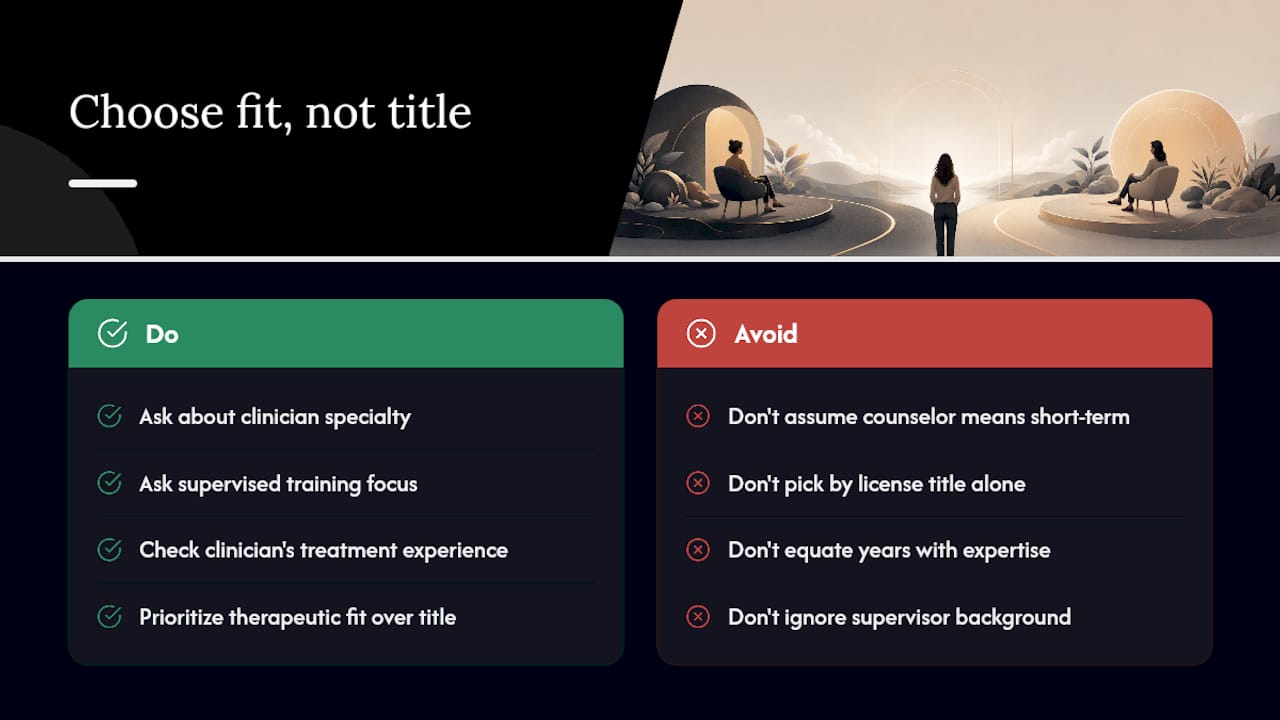
Where conventional advice falls short is in treating “counselor equals short-term” and “therapist equals long-term” as fixed categories. In practice, a licensed professional counselor with fifteen years treating complex trauma can be a far better fit than a general-practice therapist who’s never worked outside of mild anxiety cases. The title tells you almost nothing about that.
What I’d prioritize first: ask about supervised training focus, not just years of experience. A clinician’s effective expertise often comes down to which populations they trained with and what their supervisors emphasized, not how many total hours they logged. That’s the question most people never think to ask, and it’s the one that tells you the most.
Get matched with the right kind of care in California
Revive Health Therapy gives you a way to skip the title confusion altogether. Instead of guessing whether you need a “therapist” or a “counselor,” you work with licensed clinicians trained in evidence-based methods, EMDR, CBT, and trauma-informed care, who tailor the approach to your specific concern rather than forcing you into a generic label.

That means whether you need short-term support through a life transition or longer-term work on trauma, depression, or relationship patterns, the clinical fit comes first. Sessions are available in person in Oakland and Walnut Creek, or by secure telehealth anywhere in California, with sliding-scale pricing and insurance, HSA, and FSA options to keep cost from being the barrier. If you’re ready to stop guessing about titles and start with an actual assessment of what you need, explore psychotherapy options at Revive Health Therapy and book a first session.
Frequently asked questions about therapists and counselors
Is a therapist better than a counselor for depression?
Not inherently. For mild to moderate depression tied to a specific situation, a counselor trained in CBT can be highly effective. For recurrent or severe depression, a therapist with deeper training in longer-term modalities, or a psychiatrist if medication is needed, may be a better fit.
Can a counselor diagnose a mental health condition?
Licensed counselors can typically diagnose within their scope of practice, though this varies by state. Formal psychological testing and complex differential diagnosis usually fall to psychologists.
Do therapists and counselors have the same training?
Sometimes. Many hold identical master’s degrees and completed similar supervised hours. The differences are usually in specialty focus and the setting they chose to practice in, not the underlying degree.
Should I ask about a provider’s license before booking?
Yes. Asking for a license number and checking it with your state board takes a few minutes and confirms the clinician is actually credentialed to treat your concern.
What’s the difference between seeing a therapist and seeing a psychiatrist?
Therapists provide psychotherapy through conversation and structured techniques. Psychiatrists are medical doctors who can prescribe and manage medication, usually alongside or instead of talk therapy for more severe symptoms.
This article is general information, not a substitute for advice from a qualified doctor. Consult a qualified healthcare professional about your own circumstances before acting on anything here.
Sources
- Psychologist vs Therapist vs Counselor: What Are the Differences? | Psychology Today
- Occupational Outlook: Substance Abuse, Behavioral Disorder, and Mental Health Counselors | BLS
- Counselor vs. Therapist: How to Choose & More | Healthline