
A therapy superbill is an itemized receipt from your out-of-network therapist that carries the codes insurers require to evaluate a reimbursement claim: CPT, ICD-10, and your provider’s NPI. It lets you file for reimbursement. It doesn’t guarantee you’ll get any money back, since payout depends entirely on your plan’s deductible, allowed amount, and coinsurance.
TL;DR:
- Ensuring all fields are complete on the superbill, including provider and patient identifiers, service details, and diagnosis codes, prevents common claim denials.
- CPT codes like 90834 or 90837 correspond to specific session lengths, and accurate ICD-10 diagnosis codes are essential to match the billed service.
- Submitting through the correct insurer channels, attaching supporting documents, and keeping records streamline reimbursement and help contest delays or denials.
- Reimbursements depend heavily on meeting the deductible and allowable amounts, with paid percentages varying based on your plan and whether the deductible is fulfilled.
- Telehealth superbills must include specific modifiers and accurate service times to avoid downcoding or rejection by insurers.
Table of Contents
- What Belongs on a Therapy Superbill: The Field-by-Field Checklist
- What CPT and ICD-10 Codes Show Up on a Therapy Superbill?
- How Do You Submit a Superbill to Insurance?
- How Insurers Calculate Your Therapy Reimbursement
- Why Was Your Superbill Denied, and How Do You Fix It?
- How Revivehealththerapy Supports Out-of-Network Clients
- How to Read Your EOB After You Submit a Superbill
- Using a Therapy Superbill for HSA or FSA Reimbursement
- What to Do When Reimbursement Is Delayed or Disputed
- Keeping Your Superbill Information Private and HIPAA-Compliant
- A Clinician’s Quick Checklist Before You File
- Get Superbill Support Built Into Your Therapy Care
- Sources
What Belongs on a Therapy Superbill: The Field-by-Field Checklist
Before you leave your therapist’s office, or before you open that emailed PDF, scan it against this list. A missing field is one of the fastest ways to trigger a denial, and you won’t find out until weeks later.
Every legitimate superbill needs:
- Provider identifiers: the therapist’s legal name, license type, National Provider Identifier (NPI), EIN or tax ID, practice address, phone number, and a signature (physical or electronic).
- Patient identifiers: your name exactly as it appears on your insurance card, date of birth, and member ID or group number.
- Service line details: date of service, CPT code, any modifiers, session length or units, the fee charged, the amount you paid, and the place-of-service code.
- Diagnosis codes: at least one ICD-10 code, matched to the correct CPT line.
The GoodRx breakdown of superbill requirements lays out this exact field list. It’s worth keeping as your personal checklist for every session. Insurers cross-reference these fields against your plan file, and a mismatched name or blank NPI field is often enough to bounce the whole claim back unprocessed.
What CPT and ICD-10 Codes Show Up on a Therapy Superbill?
The codes on your superbill tell your insurer what happened in the room and why. Getting familiar with them helps you spot an error before you mail anything.
Common CPT codes for outpatient therapy include:
- 90791/90792: initial psychiatric diagnostic evaluation (with or without medical services).
- 90832, 90834, 90837: individual psychotherapy, billed by session length (roughly 30, 45, and 60 minutes).
- 90846/90847: family or couples therapy, without or with the patient present.
- 90853: group therapy.
- Crisis intervention codes for urgent same-day sessions.
Diagnosis codes typically fall under F32.x (depressive disorders), F33.x (recurrent depression), F41.x (anxiety disorders), and F43.x (trauma and stressor-related disorders). Specificity matters. A vague or mismatched ICD-10 code paired with a 90837 session is a common flag, and insurers sometimes push back on the 60-minute code specifically if session-length documentation looks thin. Ask your therapist how they document time if you’re ever billed under 90837.
How Do You Submit a Superbill to Insurance?
Filing a claim is a paperwork process, and it goes faster when you front-load the right questions instead of guessing.
- Call Member Services first. Use the number on the back of your insurance card and ask four things: do you have out-of-network mental health benefits, what’s the accepted submission method, what’s your timely filing deadline, and does the plan require a separate claim form like a CMS-1500. Confirming whether an additional claim form is required up front avoids a second round of paperwork later.
- Submit through the right channel. Most insurers now accept portal uploads, which give you an instant confirmation number. Mailing works too, but send it certified so you have proof of delivery. Fax is still common with older plans; always request a transmission confirmation.
- Attach supporting documents. If your plan requires a CMS-1500 form alongside the superbill, fill it out completely rather than leaving it to the claims department to interpret.
- Keep records. Save copies of every superbill, the date you submitted it, and any confirmation numbers or fax receipts. If a claim gets lost in processing, this is the paper trail that gets it resolved.
How Insurers Calculate Your Therapy Reimbursement
This is where expectations and reality often diverge. Even a flawless superbill can produce a $0 reimbursement check if you haven’t met your out-of-network deductible yet, and that deductible can range from a few hundred dollars to several thousand depending on the plan.
Once you’ve met it, your insurer pays a percentage of the “allowed amount” or usual, customary, and reasonable (UCR) rate, not your therapist’s full fee. Say your therapist charges $180 per session, but your insurer’s allowed amount for that CPT code is $140. Understanding this math before you submit anything keeps the out-of-network reimbursement process from feeling like a bait-and-switch. Processing typically runs 30 to 45 days once the claim is filed correctly.
Why Was Your Superbill Denied, and How Do You Fix It?
Denials almost always trace back to one of a few repeat offenders, and most are fixable without starting over.
- Administrative errors: a wrong or missing NPI, a name that doesn’t match your insurance card, or a claim mailed to the wrong address. Ask your therapist’s office to reissue the superbill with the correction.
- Coding errors: a missing diagnosis code, an incorrect CPT code, or a missing telehealth modifier. These usually require your provider’s billing contact to amend the document, since you can’t self-correct clinical codes.
- Timely filing denials: your claim arrived after the plan’s deadline, which commonly ranges from 90 days to a full year depending on the insurer and state. If you have proof you submitted on time (a portal confirmation or certified mail receipt), you can appeal with that documentation attached.
Pro Tip: When you resubmit a corrected superbill, attach a short cover note listing exactly what changed and why. Claims reviewers move corrected resubmissions faster when they don’t have to hunt for the fix themselves.
Telehealth Superbills: Modifiers and Documentation That Prevent Denials
Remote sessions need extra precision. Most insurers require a modifier, typically 95 or GT, appended to the CPT code to flag that the session happened via telehealth. Skipping this modifier is a frequent cause of denials or downcoding. You’ll also need the correct place-of-service code, and some payers ask for exact start and stop times in the clinical note. When in doubt, ask your insurer directly whether their telehealth policy requires anything beyond the standard modifier.

Are Therapists Required to Give You a Superbill?
No. Therapists aren’t legally obligated to provide superbills; it’s a professional courtesy many offer but not all do. Before booking, ask directly: How often will I get one? Is it a PDF I can download myself? Does it need a signature? Is there a fee? Can your office submit it on my behalf? If a therapist won’t provide superbills at all, ask for their policy in writing, look for a provider who does, or consider a third-party submission service.
How Revivehealththerapy Supports Out-of-Network Clients
Revivehealththerapy sees out-of-network and self-pay clients across telehealth statewide and in-person at Walnut Creek and Oakland, with sliding-scale fees for clients who need them. Our intake process collects your insurance card details up front, so nothing is missing later. Superbills are generated monthly with electronically signed PDFs delivered through a secure client portal, matching the documentation practices EHR systems use to avoid the transcription errors that cause denials. We also walk new clients through what to expect from their insurance coverage for therapy before their first session.
How to Read Your EOB After You Submit a Superbill
An Explanation of Benefits (EOB) is not a bill. It’s the insurer’s breakdown of what happened to your claim, and it lands in your mailbox or portal a few weeks after submission. Confusing it with an invoice is the single most common misread, and it causes a lot of unnecessary panic.
Look for these fields on every EOB:
- Claim number: your reference for any follow-up call. Write it down.
- Billed amount: what your therapist charged.
- Allowed amount: what the insurer recognizes as the reasonable rate for that CPT code, usually lower than the billed amount.
- Deductible applied: how much of the allowed amount went toward your remaining deductible instead of being reimbursed.
- Coinsurance: your percentage share of the allowed amount after the deductible is met.
- Amount paid to you: the actual reimbursement check or deposit.
- Patient responsibility: what you still owe, which is the gap between the billed and allowed amounts plus your coinsurance share.
If the EOB shows $0 paid and you expected reimbursement, check the deductible line first. Most $0 EOBs mean the deductible hasn’t been met yet, not that the claim was denied outright. If it says “denied,” there’s a reason code printed somewhere on the form, usually in small print near the claim line, and that code tells you exactly what to fix before resubmitting.
Using a Therapy Superbill for HSA or FSA Reimbursement
If you have a Health Savings Account or Flexible Spending Account, a superbill does double duty. You can submit it to your insurance for standard out-of-network reimbursement, and separately, you can use the same document (or your payment receipt) to draw funds from your HSA or FSA to cover the session cost.
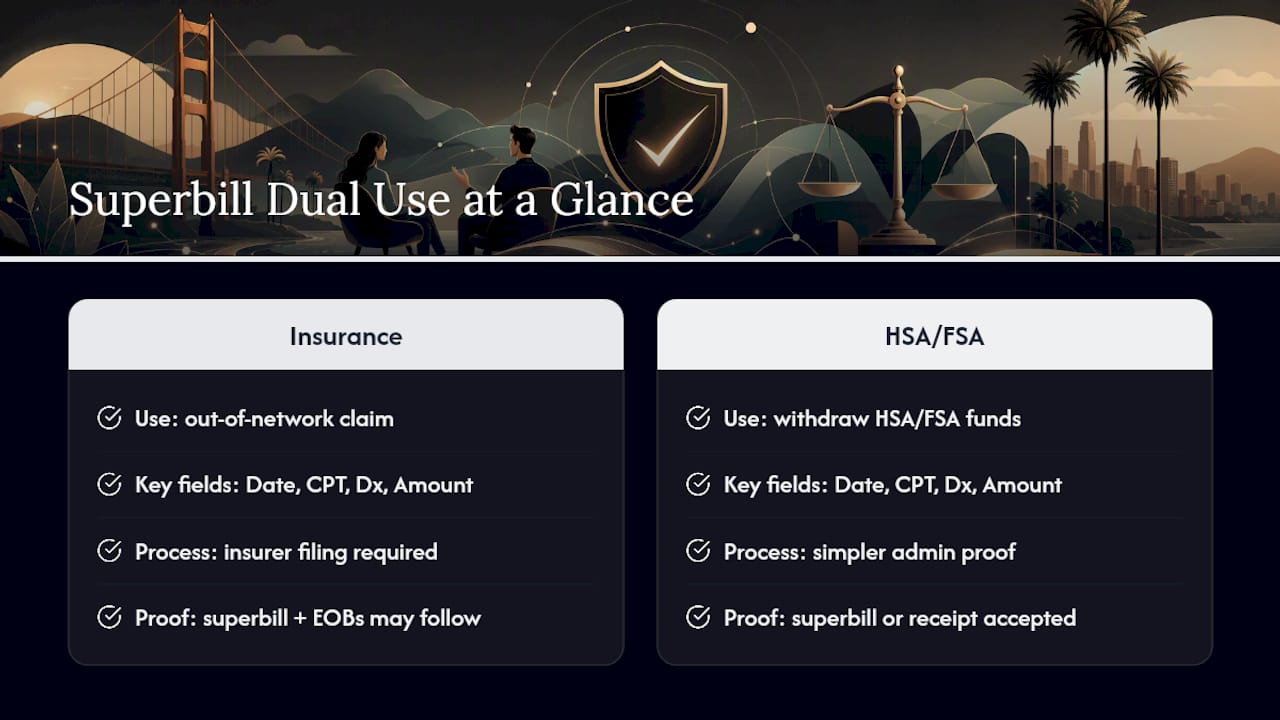
The process is more straightforward than filing with an insurer. Most HSA/FSA administrators just need proof that the expense was a qualified medical service. A superbill works well here because it already lists the date of service, the CPT code, the diagnosis, and the amount paid, everything an administrator needs to verify the claim meets IRS rules for a qualified medical expense.
One thing to watch: if your insurance later reimburses you for a session you already paid using HSA/FSA funds, that creates a double-dip situation the IRS doesn’t allow. Keep a simple log of which sessions you’ve claimed through insurance and which you’ve claimed through your HSA/FSA administrator, so you’re not accidentally submitting the same expense twice. If you’re paying out of pocket entirely, with no plan to file for insurance reimbursement, a superbill can still be worth requesting purely for your HSA/FSA records, since it documents medical necessity better than a generic payment receipt. Revivehealththerapy accepts HSA/FSA payment directly, and our superbills are formatted to include everything most account administrators require.
What to Do When Reimbursement Is Delayed or Disputed
Claims sometimes stall for reasons that have nothing to do with your paperwork. Insurers lose faxes. Reviewers apply the wrong allowed-amount schedule. Systems glitch. When that happens, a phone call is usually faster than waiting.
Start by calling Member Services with your claim number in hand and ask for a status update in plain terms: has the claim been received, is it in processing, or has a decision already been made that hasn’t reached you yet. If it’s been longer than the insurer’s stated processing window (typically 30 to 45 days), say so directly and ask for a supervisor if the first representative can’t give you a timeline.
If the dispute is about the amount rather than the timing, such as your insurer applying a lower allowed amount than you expected, ask them to walk you through exactly how they calculated it. Request the specific fee schedule or UCR data source they used. You’re entitled to that explanation, and insurers are required to provide a reason when a payment differs from what a plan document implies you should receive.
Document every call: date, representative name, and what they told you. If a dispute drags on, formal written appeals carry more weight than phone calls alone, and having a call log makes your appeal letter far more credible. Attach your original superbill, the EOB, and any prior correspondence to the appeal. Most plans give you a defined appeal window, often 180 days from the denial date, so don’t let it sit.
Keeping Your Superbill Information Private and HIPAA-Compliant
A superbill contains protected health information (PHI): your diagnosis, treatment dates, and provider details. Anyone handling it, your therapist’s office, you, and your insurer, has obligations or should have habits that keep that information secure.
Your therapist’s practice is bound by HIPAA to transmit superbills securely, which is why secure client portals or encrypted PDF delivery have largely replaced emailing documents as plain attachments. If your provider is still emailing unencrypted PDFs with your diagnosis code sitting in the file name, that’s worth asking about.
On your end, a few habits go a long way: don’t forward superbills over unsecured email if you can avoid it, store digital copies in a password-protected folder, and shred paper copies once you no longer need them for appeals or tax records. When you submit a superbill through an insurer’s online portal, confirm the portal uses secure login credentials rather than a simple emailed link.
Diagnosis codes are the most sensitive line on the document. Some clients ask their therapist whether a less specific but still accurate code can be used, and that’s a fair conversation to have, though your therapist has to code what’s clinically accurate. If you’re ever unsure whether a party requesting your superbill (an employer’s HR department, for instance) has a legitimate need to see it, you’re allowed to ask what they intend to do with it before handing it over.
A Clinician’s Quick Checklist Before You File
[Author credentials and clinical background: Amy]
Before you submit anything, run this short list: call your insurer to verify out-of-network benefits, request a superbill every month rather than letting them pile up, keep copies of everything you send, and call Member Services the moment something looks off rather than guessing. Most reimbursement headaches come from small gaps, not big mistakes, and they’re almost always fixable if you catch them early.
— Amy
Get Superbill Support Built Into Your Therapy Care
Revivehealththerapy is the option for California clients who want specialized, evidence-based care, EMDR, CBT, trauma-informed therapy, without navigating out-of-network paperwork alone. Where many out-of-network providers hand you a blank template and wish you luck, our intake and billing workflow builds the superbill process into your care from day one, with monthly PDFs, sliding-scale pricing, and HSA/FSA-ready documentation.

Whether you need telehealth sessions from anywhere in the state or prefer in-person visits in Walnut Creek or Oakland, our team can walk you through what your plan is likely to cover before you book your first session. If cost has been the barrier, our pricing page breaks down sliding-scale options, and you can also check how out-of-network reimbursement works with our team directly. Ready to start? Reach out and book a session with a Revivehealththerapy therapist today.
Where to Verify Codes and Check Your Benefits
For coding lookups, confirm CPT and ICD-10 details through your provider’s billing office. To check your specific out-of-network benefits before booking, a partner resource like Prism Counseling’s benefits guide walks through what to ask. This article draws on field requirements from GoodRx and submission mechanics from LegalClarity.
This article is general information, not a substitute for advice from a qualified doctor. Consult a qualified healthcare professional about your own circumstances before acting on anything here.
Sources
- What Is a Superbill for Therapy? — GoodRx
- How to Fill Out and Submit a Superbill Template — LegalClarity
- What Is a Superbill? A Therapist’s Guide — PIMSY
- How to submit a superbill — Superbilled
- Adding modifiers to claims and superbills — SimplePractice support
2 Responses