
TL;DR:
- Grief counseling offers a structured, compassionate support process helping individuals manage the natural emotions of loss. It is most beneficial for those with complicated, prolonged grief, or limited social support, and differs from grief therapy which treats clinical disorders. Sessions focus on understanding, meaning-making, and rebuilding, with tailored approaches for families and children.
Grief counseling is defined as a structured support process in which trained professionals help individuals cope with loss by providing a safe, compassionate space to process emotions. The formal clinical term is bereavement counseling, and both names describe the same practice. Unlike grief therapy, which targets clinical disorders, grief counseling supports the natural emotional experience of loss. Research confirms that grief counseling most benefits people experiencing complicated or prolonged grief, or those without strong social support. Revivehealththerapy offers evidence-based grief counseling in California, using approaches like Cognitive Behavioral Therapy (CBT), EMDR, and mindfulness to meet people where they are.
What is grief counseling, and how does it differ from grief therapy?
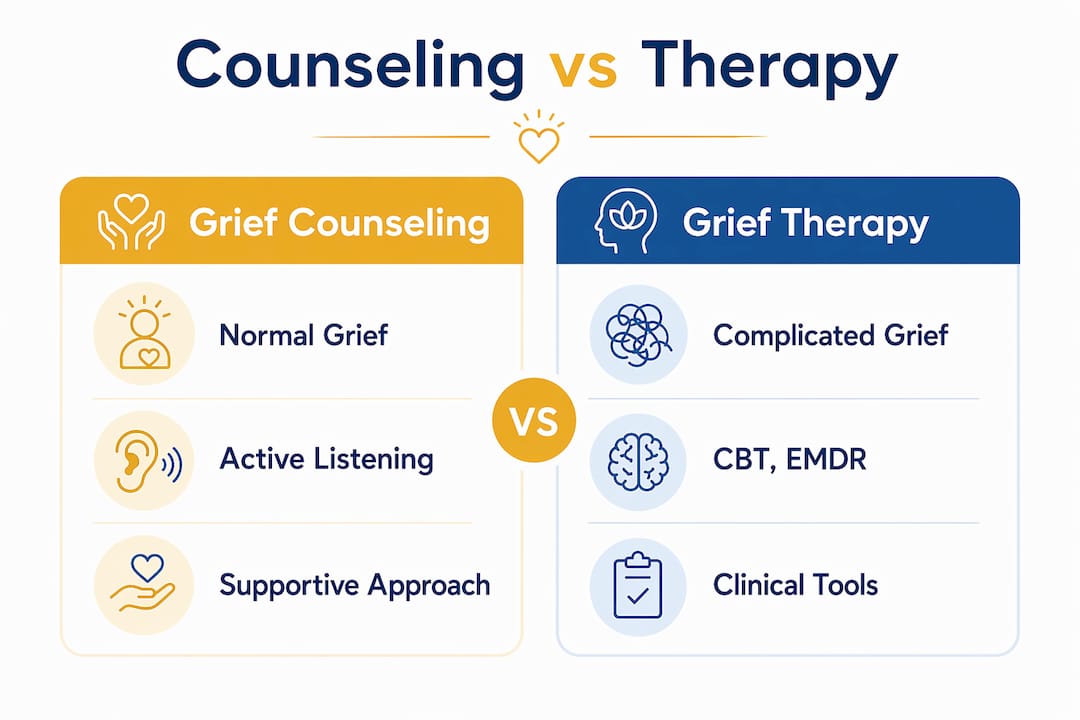
Grief counseling and grief therapy are related but distinct. Grief counseling supports normal grief through companioning, while grief therapy addresses clinical cases using specific diagnostic tools and interventions. That distinction matters because choosing the wrong level of support can slow recovery rather than speed it.
Grief counseling is appropriate when someone experiences the expected emotional weight of loss: sadness, anger, confusion, or numbness. A counselor does not diagnose or treat a disorder. Instead, they walk alongside you, helping you name feelings and find meaning at your own pace.
Grief therapy steps in when grief becomes prolonged or complicated. Prolonged grief disorder, recognized in the DSM-5, involves intense grief lasting more than 12 months after a loss that significantly impairs daily functioning. In these cases, clinicians use structured tools like CBT, EMDR, or narrative therapy to address the underlying disruption.
Natural social support, such as family, friends, or community, often meets the needs of uncomplicated grief. Professional intervention becomes valuable when that support is absent, insufficient, or when grief intersects with trauma, depression, or PTSD.
Pro Tip: If you are unsure whether you need counseling or therapy, start with a counselor. They are trained to recognize when a clinical referral is the right next step.
| Type | Best for | Key tools |
|---|---|---|
| Grief counseling | Normal, uncomplicated grief | Active listening, narrative, psychoeducation |
| Grief therapy | Complicated or prolonged grief | CBT, EMDR, structured clinical protocols |
| Natural support | Mild grief with strong social network | Community, family, peer connection |
Who benefits most from grief counseling?
Universal grief counseling is not consistently more beneficial than natural support for everyone who experiences loss. This is one of the most important findings in bereavement research. It means grief counseling is not a requirement after every loss. It is a targeted resource for those who genuinely need it.
People who benefit most include:
- Those experiencing complicated or prolonged grief, where emotions remain intense and disabling well beyond the expected timeframe
- People with limited social support, such as those who are isolated, recently relocated, or estranged from family
- Individuals whose grief co-occurs with depression, anxiety, or PTSD, which requires professional guidance to untangle
- People navigating traumatic loss, such as sudden death, suicide, or violent circumstances
- Those who feel stuck in guilt, anger, or denial and cannot move through the grief process without structured help
Grief counseling helps people process the loss itself, rebuild a sense of identity and daily routine, and reduce the risk of long-term mental health complications. It also addresses the social dimension of grief: many people feel pressure to “move on” quickly, and counseling provides a space where your timeline is respected. You can learn more about how therapy supports grief recovery and what the evidence says about different intervention types.
How does grief counseling work? What to expect in sessions
Grief counseling does not aim to fix grief but to accompany you through it. That framing changes everything about how sessions feel. You are not broken. You are grieving, and the counselor’s role is to make that process safer and less isolating.
A typical grief counseling process looks like this:
- Initial assessment. The counselor gathers your history, the nature of the loss, your current support system, and any co-occurring concerns like sleep disruption or depression.
- Building the therapeutic relationship. Early sessions focus on trust. You set the pace. Nothing is forced.
- Exploring the loss. You discuss memories, feelings of guilt or anger, the meaning the relationship held, and how life has changed.
- Working with grief models. The Dual Process Model validates the normal oscillation between loss-oriented grief and restoration-oriented life management. Knowing this oscillation is healthy, not a sign of weakness, brings real relief to many people.
- Building forward. Later sessions focus on meaning-making, identity reconstruction, and reconnecting with life without abandoning the memory of who was lost.
Common techniques include narrative therapy (telling the story of the loss to integrate it), psychoeducation about grief stages, mindfulness practices, and CBT-based thought restructuring for guilt or catastrophic thinking.
Pro Tip: Write down what you want to say before your first session. Grief can make it hard to find words in the moment. A few notes help you feel prepared rather than caught off guard.

Sessions typically run 50 minutes and occur weekly, though frequency adjusts to your needs. Grief counseling is not indefinite. Most people see meaningful progress within 8–16 sessions, though complicated grief may require longer engagement.
What is grief counseling for families and kids?
Family grief counseling recognizes that loss does not happen to one person in isolation. It ripples through every relationship in a household. Family grief counseling fosters communication, empathy, and shared healing to prevent emotional isolation from taking hold within the family system.
How family grief counseling works
A trained counselor observes how family members interact during early sessions. First sessions often reveal communication patterns that block grief processing, such as one member shutting down while another escalates. Identifying these patterns early guides the entire intervention.
Hybrid models for family grief counseling combine whole-family sessions with individual sessions for specific members. Not every family member attends every session. The format adapts to who needs what, and when.
Goals in family grief counseling include:
- Rebuilding open, honest communication about the loss
- Preventing one member from carrying the emotional weight for everyone
- Helping family members understand each other’s grief styles without judgment
- Addressing role shifts that occur after a loss, such as a child taking on adult responsibilities
Grief counseling for kids and teens
Children are often disenfranchised grievers, meaning their grief is minimized or overlooked because adults assume they do not fully understand death. That assumption causes real harm. Children grieve differently, not less.
Effective grief counseling for kids uses developmentally appropriate methods:
- Play therapy for younger children who express emotion through action and imagination rather than words
- Art therapy to externalize feelings that are too large or confusing to name directly
- CBT-based approaches for older children and teens to address distorted thinking like self-blame or magical thinking about the loss
Cultural competence is non-negotiable in child grief counseling. A child’s understanding of death, the afterlife, and mourning rituals is shaped by family culture and religion. Counselors must work within that framework, not around it. Revivehealththerapy’s children’s therapy services address grief using these developmentally sensitive methods.
| Age group | Recommended approach | Key focus |
|---|---|---|
| Ages 3–6 | Play therapy, storytelling | Understanding permanence of death |
| Ages 7–12 | Art therapy, CBT basics | Naming emotions, reducing self-blame |
| Ages 13–18 | CBT, narrative therapy, group support | Identity, peer relationships, meaning-making |
How to find the right grief counseling support
Finding the right counselor is as important as deciding to seek help. A poor fit slows progress. A strong fit accelerates it.
Steps to find qualified grief support:
- Check credentials. Look for licensed clinical social workers (LCSWs), licensed professional counselors (LPCs), or licensed marriage and family therapists (LMFTs) with specific bereavement training.
- Ask about their approach. A good counselor will explain their model clearly. Ask whether they use CBT, narrative therapy, or the Dual Process Model.
- Assess trauma-informed care. If your loss involved trauma, confirm the counselor is trained in trauma-informed practice. This is not optional for traumatic bereavement.
- Consider logistics. Telehealth grief counseling removes geographic barriers and is equally effective for most people. Revivehealththerapy offers secure telehealth sessions statewide across California.
- Trust your instincts. If you feel judged, rushed, or unheard after two or three sessions, it is appropriate to seek a different counselor.
Grief counseling works best alongside, not instead of, social support. Maintaining connections with trusted people in your life reinforces the work done in sessions.
Key Takeaways
Grief counseling is most effective when matched to the type and severity of grief, with professional support reserved for complicated grief, traumatic loss, or inadequate social support.
| Point | Details |
|---|---|
| Counseling vs. therapy | Grief counseling supports normal grief; grief therapy treats clinical disorders like prolonged grief disorder. |
| Who benefits most | People with complicated grief, limited social support, or co-occurring depression gain the most from professional counseling. |
| Session process | Sessions follow a structured arc from assessment to meaning-making, using tools like CBT, narrative therapy, and the Dual Process Model. |
| Family and child approaches | Family counseling uses hybrid formats; child counseling uses play, art, and CBT adapted to developmental stage. |
| Finding support | Match counselor credentials and approach to your specific grief type, and consider telehealth for flexible access. |
What I’ve learned about grief counseling after years in this field
People often arrive at grief counseling expecting to be told how to feel better faster. That expectation is understandable, and it is also the first thing worth examining together.
The most consistent observation I have made is that grief does not follow a schedule. The Kübler-Ross stages are widely known, but they were never meant to be a checklist. Real grief moves in circles, not lines. Clients who understand this early tend to be kinder to themselves, and that self-compassion is genuinely therapeutic.
Family grief is where I see the most underestimated complexity. One family member’s silence reads as indifference to another who expresses grief loudly. Neither is wrong. Both are grieving. The counselor’s job is to make that visible before it becomes a permanent fracture in the relationship.
Children surprise me most. Given the right tools and a safe space, kids process loss with a directness that adults often lose. The mistake adults make is protecting children from grief rather than guiding them through it. A child who is included in mourning, at an age-appropriate level, develops resilience. A child who is shielded from it often carries unresolved grief into adulthood.
The one thing I would tell anyone considering grief counseling: you do not need to be in crisis to benefit. You just need to feel like you are carrying something too heavy to carry alone.
— Amy
Grief counseling support at Revivehealththerapy
Revivehealththerapy provides grief counseling and bereavement support as part of its evidence-based psychotherapy services across California. Sessions are available in person at Walnut Creek and Oakland, or via secure telehealth statewide.

Clinicians at Revivehealththerapy use CBT, EMDR, and mindfulness-based approaches to support individuals, families, and children through loss. Sliding-scale fees and insurance acceptance, including HSA and FSA plans, make care accessible regardless of income. If you are ready to take the next step, explore psychotherapy options or contact Revivehealththerapy directly to schedule a consultation.
FAQ
What is grief counseling in simple terms?
Grief counseling is a professional support process where a trained counselor helps you cope with loss by providing a safe space to express and process your emotions. It does not aim to eliminate grief but to make it more manageable.
How is grief counseling different from grief therapy?
Grief counseling supports normal grief through companioning, while grief therapy uses clinical tools like CBT or EMDR to treat complicated or prolonged grief disorder. The distinction guides which level of support is appropriate.
What is grief counseling for kids?
Grief counseling for children uses developmentally appropriate methods such as play therapy, art therapy, and CBT to help kids process loss. Children are often disenfranchised grievers, so culturally sensitive, age-matched support is critical.
What should I expect in my first grief counseling session?
Your first session typically involves an assessment of your loss, your current emotional state, and your support system. The counselor will explain their approach and give you space to share at whatever pace feels right.
Does grief counseling actually work?
Grief counseling produces the strongest outcomes for people with complicated grief, traumatic loss, or limited social support. For those with mild grief and strong natural support, counseling may be less necessary but still beneficial for processing difficult emotions.