
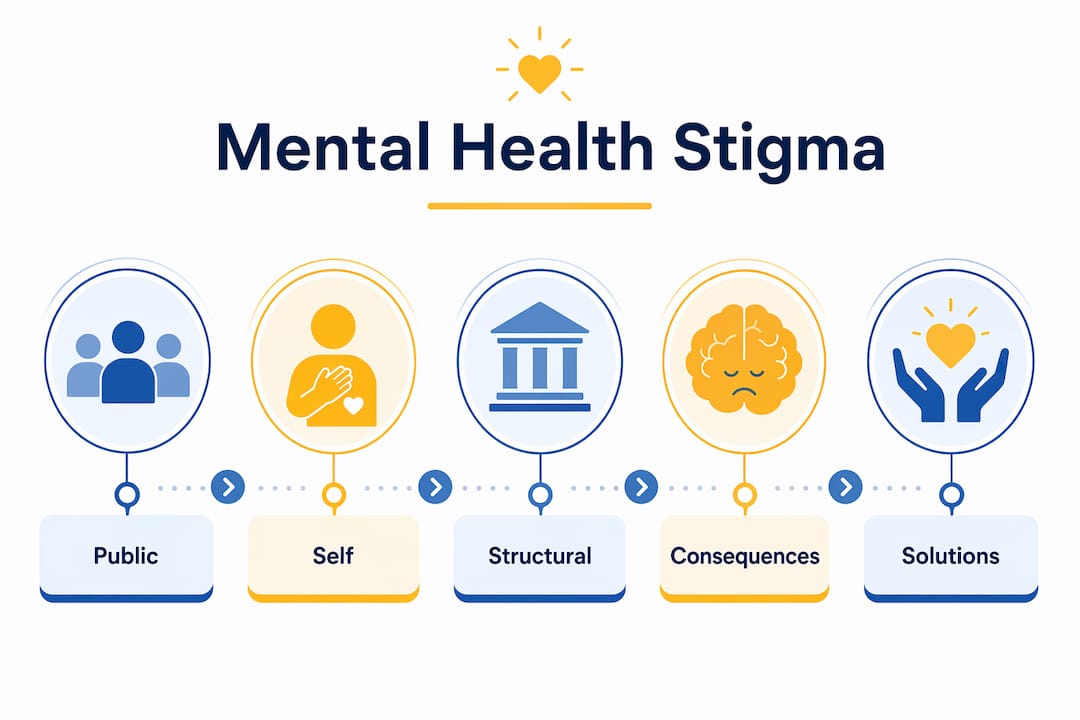
Mental health stigma is the collection of negative attitudes, stereotypes, and discriminatory behaviors directed at people living with mental health conditions. The CDC defines stigma as the negative beliefs and judgments people hold toward those experiencing mental health challenges, driven largely by fear and misunderstanding. It shows up in three distinct forms: public stigma (how society treats people with mental health conditions), self-stigma (when a person internalizes those negative beliefs about themselves), and structural stigma (laws, policies, and institutional practices that limit rights and access). Understanding these three types is the starting point for anyone who wants to recognize stigma when it happens, whether in a conversation, a workplace policy, or their own inner voice.
- Public stigma: Negative attitudes held by communities, coworkers, or the general public toward people with mental health conditions
- Self-stigma: A person with a mental health condition absorbs societal bias and begins to believe they are flawed or to blame
- Structural stigma: Institutional and policy-level discrimination, such as underfunded mental health services or laws that restrict the rights of people with mental illness
Organizations including the CDC, the American Psychiatric Association, and Mental Health America all recognize stigma as one of the most significant barriers to mental health care in the United States.
Table of Contents
- How stigma harms people with mental health conditions
- Practical ways to reduce mental health stigma
- What self-stigma and structural stigma actually look like
- Mental health stigma examples in real settings
- Key Takeaways
- Ready to take the next step?
How stigma harms people with mental health conditions
The damage stigma causes goes well beyond hurt feelings. Stigma can prevent or delay people from seeking care, cause them to stop treatment early, and push them toward social isolation. The consequences stack up fast.
- Avoiding treatment: Fear of being judged or treated differently at work or in social circles keeps many people from ever calling a therapist or psychiatrist
- Social exclusion: People with mental health conditions are often excluded from social groups, sometimes overtly and sometimes under the guise of “concern” for them
- Employment and housing challenges: Stigma shapes hiring decisions, housing applications, and professional relationships in ways that are rarely acknowledged openly
- Shame and distress: Being labeled or stereotyped causes real psychological harm, compounding the original condition
- Family impact: Family members and friends of people with mental illness also absorb stigma, which can reduce their capacity to provide emotional support and may cause them to withdraw
More than half of people with mental illness do not receive help, partly because stigma creates fear about the consequences of being known to have a mental health condition. That fear is not irrational. People lose jobs. Relationships fracture. Housing gets denied. The stigma is not just a social discomfort; it produces concrete, measurable harm in people’s daily lives.
Negative media portrayals make this worse. When news coverage or entertainment frames people with mental illness as dangerous or unpredictable, public fear increases and stereotypes harden. That cycle feeds back into self-stigma, making it even harder for someone already struggling to reach out for help.

Practical ways to reduce mental health stigma
Stigma is not inevitable. Education, language, and direct human contact all chip away at it, and the research is clear about which approaches work best.
- Learn and share accurate information: Stigma thrives on ignorance. Reading from credible sources like Mental Health America or the CDC, and sharing what you learn, counters misinformation at the source
- Watch your language: Shifting from “mental illness” to “mental health condition” signals that a condition is manageable, not a permanent character flaw. Saying “a person with depression” rather than “a depressed person” keeps the human front and center
- Talk openly: Conversations about mental health, even brief ones, normalize the topic and reduce the shame people feel about their own experiences
- Challenge stereotypes when you hear them: Whether it is a joke at work or a dismissive comment from a family member, a calm, factual response plants a seed of doubt in the stereotype
- Advocate for better policy: Structural stigma requires structural solutions. Supporting legislation that funds mental health services equally to physical health services addresses the problem at its root
- Be mindful of media consumption: Social media can amplify stigmatizing content. Understanding how social media shapes mental health perceptions is a useful step toward consuming it more critically
Pro Tip: The single most effective way to dismantle stigma, according to both the CDC and the American Psychiatric Association, is direct personal contact with someone living with a mental health condition. Hearing a real person’s story cuts through abstract fear faster than any pamphlet or awareness campaign.
Revivehealththerapy has published a practical resource on addressing therapy stigma that walks through evidence-based approaches for both individuals and communities.

What self-stigma and structural stigma actually look like
These two forms of stigma are less visible than public discrimination, but they do just as much damage, sometimes more.
Self-stigma happens when a person with a mental health condition starts to believe the negative things society says about people like them. Mental Health America describes self-stigma as an internalization of broader societal biases that frames mental health struggles as personal moral failures. The person stops seeing their condition as something to treat and starts seeing it as proof of their own inadequacy. That shift kills motivation. Research from the NCBI describes this as the “why try” effect: if a person believes they are fundamentally flawed, why would they pursue work, relationships, or recovery?
- Self-stigma reduces self-esteem and self-efficacy
- It increases social withdrawal, often framed internally as protecting others from having to deal with them
- It creates a direct barrier to help-seeking and community integration
Structural stigma operates at the system level. Laws, policies, and institutional practices embed discrimination into the structures people rely on, including healthcare systems, legal frameworks, and employers. Mental health services have historically received less funding than physical health services. Discriminatory legal frameworks have restricted the rights of people with psychiatric diagnoses. These are not accidents; they reflect and reinforce the same biases that drive public and self-stigma.
Structural stigma does not require a single prejudiced person to cause harm. It operates through systems, and it sustains individual-level prejudice by appearing to endorse it.
The two forms reinforce each other. When a person sees that institutions treat mental illness as less worthy of resources, it confirms the internalized belief that their condition makes them less worthy as a person. Breaking that cycle requires addressing stigma’s impact on treatment decisions at both the individual and policy level.
Mental health stigma examples in real settings
Stigma does not live only in extreme cases. It shows up in ordinary places, often in ways that go unquestioned.
In the workplace
An employee discloses anxiety to their manager and is quietly passed over for a promotion. A colleague makes an offhand comment about someone being “crazy” after a difficult meeting. A company’s health insurance plan covers three therapy sessions per year but unlimited physical therapy. Each of these is a form of stigma, ranging from interpersonal bias to structural inequality baked into benefits packages.
In healthcare settings
A patient with a history of depression visits an emergency room for chest pain and finds that the provider spends more time questioning their mental state than investigating the physical symptom. Physicians sometimes attribute physical complaints to psychiatric causes in patients with mental health histories, a pattern called “diagnostic overshadowing.” The result is that people with mental health conditions receive worse physical healthcare, not because of their condition, but because of how providers perceive them.
In schools
A teenager struggling with anxiety is told to “just relax” or “try harder.” A student with ADHD is labeled as lazy or disruptive rather than referred for evaluation. School counselors, when they exist, are often stretched across hundreds of students and lack the training to identify and respond to mental health needs without stigmatizing language. For teens, trauma-informed care in schools represents one of the most direct ways to counter stigma before it becomes self-stigma.
In families and social circles
A parent tells their child to “push through it” rather than seek therapy, because therapy means something is seriously wrong. A friend stops inviting someone to social events after learning they take medication for depression. These responses come from discomfort and misinformation, not malice, but the effect on the person with the mental health condition is the same: isolation and shame.
Key Takeaways
Mental health stigma causes real, documented harm to individuals and communities, and reducing it requires action at the personal, cultural, and policy level.
| Point | Details |
|---|---|
| Three types of stigma | Public, self, and structural stigma each operate differently but reinforce one another. |
| Treatment barrier | More than half of people with mental illness do not receive help, partly due to stigma-driven fear. |
| Language matters | Saying “mental health condition” instead of “mental illness” reduces perceived permanence and shame. |
| Most effective intervention | Direct personal contact with someone living with a mental health condition reduces stigma faster than education alone. |
| Structural change is required | Underfunded services and discriminatory policies sustain stigma at the system level, not just the individual level. |
Ready to take the next step?
Stigma loses its power when people have access to real support. Revivehealththerapy offers evidence-based therapy for adults, teens, families, and children across California, with both in-person sessions in Walnut Creek and Oakland and secure telehealth statewide. Sliding-scale fees and insurance acceptance, including HSA/FSA plans, keep care accessible regardless of income. If stigma has been the thing standing between you and getting help, that barrier is worth examining with a trained therapist. Explore mental health services for adults and find the right fit for where you are right now.
Recommended
- Why Address Therapy Stigma: A Guide to Change – Revive Health Therapy
- Mental health self-care ideas for anxiety and depression – Revive Health Therapy
- Peptides for Mental Health: What the Science Really Says – Revive Health Therapy
- Affordable Mental Health Care – Why It Changes Lives – ReviveHealthTherapy