
Feeling anxious or depressed can make even simple decisions stressful, especially when therapy costs seem out of reach in California. Accessing affordable mental health care isn’t just about finding a lower price—it means the service fits your budget and real-life circumstances. Financial barriers prevent people from getting mental health support they desperately need, but sliding-scale fees and telehealth are changing what’s possible. This guide clarifies what affordable care really means and how you can find trauma-informed options without financial strain.
Table of Contents
- Defining Affordable Mental Health Care Access
- How Costs Impact Mental Health Outcomes
- Barriers Low-Income Californians Face
- Long-Term Benefits For Individuals And Communities
- Solutions Improving Affordability And Access
Key Takeaways
| Point | Details |
|---|---|
| Affordable Care Definition | Affordable mental health care means access to services without financial hardship, encompassing need, demand, and supply dynamics. |
| Importance of Transparency | Understanding provider definitions of affordability prevents surprises and helps align services with personal budgets. |
| Impact of Costs on Health | Financial barriers delay treatment, worsening mental health and leading to increased long-term costs. |
| Community Benefits | Investing in affordable mental health results in improved community well-being, reducing social issues and enhancing overall health. |
Defining Affordable Mental Health Care Access
Affordable mental health care access means you can get therapy without financial hardship. It’s not just about low prices—it’s about whether care fits your actual budget and circumstances.
Access to mental health services depends on three core factors working together:
- Need: Your actual mental health condition or concern requiring treatment
- Demand: Your willingness and ability to seek care
- Supply: Available services in your area or through telehealth
When these three align properly, you gain real access. But when one breaks down—say, therapy exists but costs exceed your income—access disappears, even if services are technically available.
What Makes Care Truly Affordable
True affordability means more than just a lower price tag. The WHO emphasizes that health financing systems protecting people from financial hardship are essential for expanding access. This includes:
- Sliding-scale fees based on your income
- Insurance acceptance and HSA/FSA compatibility
- No hidden charges or surprise costs
- Telehealth options reducing transportation expenses
- Community-based services near where you live
For Californians aged 25-40, affordability often comes down to practical concerns. Can you afford the initial consultation? Will your insurance cover it? Can you pay if you lose your job next month?
Real affordability means care remains accessible even when your circumstances change unexpectedly.
Why Definitions Matter for Your Search
Understanding what “affordable” actually means helps you identify which services will genuinely work for your situation. Different providers define it differently—and those definitions shape what you’ll actually pay.
When you’re comparing therapy options, ask directly: How does this provider define affordability? What income levels qualify for reduced fees? This prevents surprises and helps you find care aligned with your financial reality.
Many people think affordable mental health care is out of reach, but clear definitions and transparent pricing models change that equation. Knowing these definitions empowers you to advocate for yourself and find services matching both your needs and budget.
Pro tip: When calling therapy providers, specifically ask about sliding-scale rates and income thresholds before scheduling—this upfront conversation saves time and prevents uncomfortable financial discussions during your first session.
How Costs Impact Mental Health Outcomes
When therapy feels too expensive, people delay getting help. That delay costs them far more than the therapy would have—in suffering, lost productivity, and worsening symptoms.
Here’s the hard truth: financial barriers prevent people from accessing mental health care they desperately need. High out-of-pocket costs, copayments, and gaps in insurance coverage don’t just inconvenience you. They actively worsen your mental health.

The Delay Effect
When therapy feels unaffordable, you don’t just postpone treatment. You tend to skip it entirely. That gap between when symptoms start and when you finally get help can be months or years.
During that time, anxiety spirals. Depression deepens. Untreated trauma accumulates. Your nervous system stays stuck in stress mode, affecting everything from sleep to relationships to job performance.
Early intervention changes this trajectory completely. Therapy works better when you access it sooner, not later.
Beyond the Office Visit
The cost problem extends beyond the therapist’s fee. Consider what affordability barriers actually include:
- Initial consultation costs
- Ongoing session fees or copayments
- Time off work (lost income)
- Childcare while attending appointments
- Transportation to and from sessions
- Medication costs for psychiatric management
Even if one therapy session costs $80, the real expense might be $150 when you factor in lost wages and travel time. For someone living paycheck to paycheck in California, that’s insurmountable.
When people avoid therapy due to cost, their symptoms worsen and other health problems emerge—making treatment ultimately more expensive.
How Treatment Adherence Breaks Down
Affordability affects not just whether you start therapy, but whether you stick with it. Healthcare costs function as a social determinant shaping mental health outcomes across populations.
If you’re worried about affording next month’s session, you can’t fully focus on healing. That anxiety about payment becomes part of your therapy session itself, taking time away from addressing your actual concerns.
Many people drop out of therapy after 2-3 sessions not because it isn’t working, but because they can’t afford to continue. This creates a cruel cycle: symptoms remain untreated, functioning deteriorates, and the person feels like therapy failed them when the real issue was cost.
The Ripple Effect on Your Life
Untreated mental health conditions don’t stay contained. They spread into every area of your life—work performance, relationships, physical health, financial stability.
Someone with untreated anxiety might miss promotions due to avoidance behaviors. Untreated depression leads to absenteeism and job loss. These outcomes then create new financial stress, making therapy even harder to access.
Affordable mental health care breaks this cycle before it spirals.
Below is a summary of how untreated mental health challenges can affect various life areas:
| Life Area | Short-Term Effect | Long-Term Consequence |
|---|---|---|
| Employment | Missed days, stress | Job loss, lower earnings |
| Relationships | Distance, conflict | Isolation, weakened support network |
| Physical Health | Fatigue, poor sleep | Chronic illness, higher healthcare use |
| Financial Status | Missed opportunities | Persistent debt, instability |
Pro tip: When depression or anxiety costs you a job opportunity or relationship, that’s actually more expensive than the therapy that could have prevented it—ask providers directly about sliding-scale rates and whether they offer reduced fees for people between jobs.
Barriers Low-Income Californians Face
Being low-income in California and struggling with anxiety or depression doesn’t just mean therapy feels expensive. It means facing a layered set of obstacles that make getting help feel nearly impossible.
These aren’t abstract problems. They’re real friction points that prevent you from accessing care you need right now.
The Cost Reality
Even with insurance, therapy remains out of reach for many Californians. High deductibles, limited coverage for mental health visits, and copayments add up quickly.
Without insurance, a single therapy session costs $100-250. For someone earning $35,000 annually, that’s weeks of groceries. Multiple barriers including affordability create compounding obstacles to care.
Some people choose between medication refills and rent. That’s the reality.
Transportation and Time Barriers
Finding a therapist near you requires time and resources. In rural California areas, mental health providers might be 30-60 minutes away.
Getting there requires:
- Gas money or public transit fare
- Time off work (unpaid for many)
- Childcare arrangements
- Multiple trips monthly to maintain treatment
Telehealth options can help bridge this gap, but internet reliability and privacy at home create their own challenges for low-income households.
Systemic Disparities and Stigma
The mental health system wasn’t built equally. Low-income Californians—particularly people of color and immigrant communities—experience limited availability of culturally appropriate care.
Finding a therapist who understands your background, speaks your language, or gets your specific struggles takes additional legwork. Many providers don’t specialize in trauma-informed care for marginalized communities.
Beyond access, stigma remains powerful. In tight-knit communities, seeing a therapist might feel like a public admission of failure.
Systemic barriers don’t just delay treatment—they convince people that help isn’t meant for them.
Long Wait Times and Availability
When you finally find an affordable provider, the wait list might be months long. Three-month waits aren’t unusual in California.
During that waiting period, your symptoms worsen. You might lose motivation to pursue care. Or your circumstances change—you lose the job that gave you health insurance, making therapy suddenly unaffordable anyway.
Urgency meets scarcity, and you lose.
Insurance Coverage Gaps
Having insurance doesn’t guarantee mental health coverage. Many low-income Californians qualify for Medi-Cal, which does cover therapy, but finding providers who accept it proves difficult.
Some therapists don’t accept insurance at all, citing administrative burden. Others have stopped accepting Medi-Cal due to low reimbursement rates. This leaves you with theoretical coverage and no actual providers.
The system says you’re covered. Reality says otherwise.
Pro tip: Before searching for any therapist, verify whether they accept your specific insurance plan or offer sliding-scale rates—call directly rather than relying on online directories, which are often outdated.
Long-Term Benefits for Individuals and Communities
Affordable mental health care isn’t just about feeling better this month. It’s about building a life where anxiety and depression don’t control your future.
When you access care early and consistently, the ripple effects spread far beyond your therapy sessions. They reshape your relationships, career trajectory, and financial stability.
Personal Transformation
Treated anxiety and depression look like concrete changes. You show up to work consistently instead of calling in sick. You rebuild relationships that deteriorated during untreated illness.
You make better decisions because your brain isn’t stuck in survival mode. Creativity returns. Sleep improves. Energy increases. These aren’t small shifts—they’re foundational changes that enable everything else.
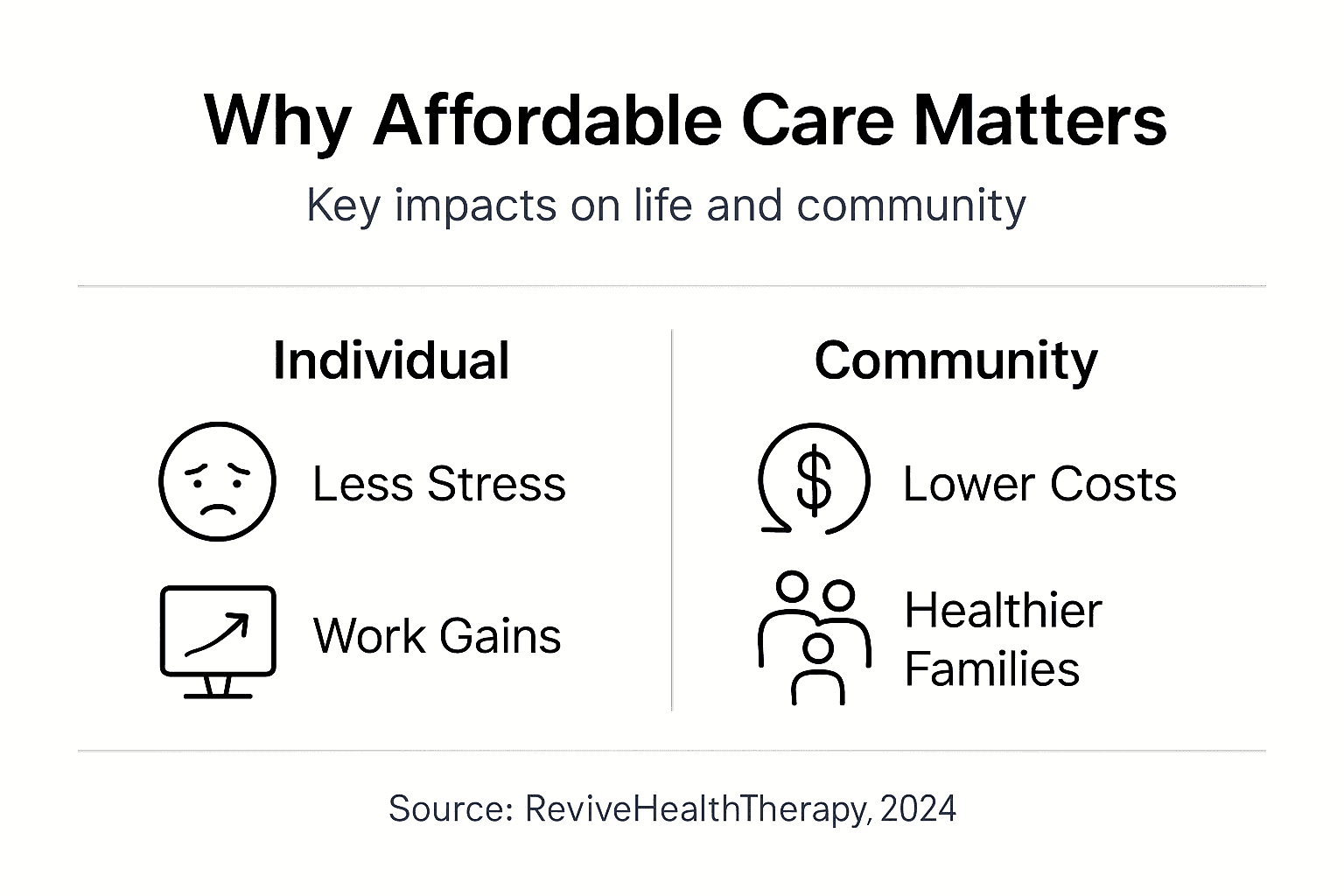
Affordable mental health services enhance employment outcomes and reduce social isolation. People who access therapy build stronger professional networks and maintain healthier personal relationships.
Economic Benefits That Compound
Therapy that costs $80 per session often prevents job loss that would cost $40,000 in lost income. Treated anxiety allows you to pursue promotions you’ve been avoiding.
Over ten years, the economic impact becomes staggering:
- Increased earning potential from career advancement
- Reduced emergency room visits for crisis situations
- Lower medication costs through better mental health management
- Decreased absenteeism expenses for employers
- Reduced substance use complications
The individual investment in therapy returns itself many times over through prevented crises and enhanced functioning.
Community-Level Impact
When communities invest in affordable mental health care, entire neighborhoods transform. Improved quality of life strengthens community resilience and reduces social fragmentation.
Schools see improved student performance when anxiety is treated. Workplaces see decreased turnover. Neighborhoods experience reduced crime and increased social cohesion when mental health isn’t a crisis-driven emergency.
When people get mental health support early, entire communities benefit—not just individuals.
Breaking Cycles of Trauma
Parents who receive therapy break generational patterns. They model emotional regulation for their children instead of passing down untreated trauma.
This creates lasting change. A child raised by a parent in therapy grows up understanding emotions differently. They’re more likely to seek help themselves. They don’t normalize suffering as inevitable.
One person’s healing becomes a family’s healing.
Systemic Health Improvements
Communities with better mental health care access experience downstream improvements across healthcare systems. Patients with managed anxiety have fewer cardiac events. Depression treatment reduces metabolic complications.
Physical and mental health aren’t separate. Affordable mental health care improves overall population health metrics while reducing the total burden on healthcare systems.
Pro tip: View therapy not as an expense but as an investment in your future earning potential and relationship quality—this mindset shift makes affording care feel less like sacrifice and more like strategic planning.
Solutions Improving Affordability and Access
The barriers to affordable mental health care aren’t insurmountable. Proven solutions already exist, and they’re being implemented across California right now.
These aren’t theoretical fixes. They’re practical strategies that directly increase your ability to access therapy without financial devastation.
Sliding-Scale and Flexible Pricing Models
One of the most accessible solutions is sliding-scale therapy. Your fee adjusts based on your actual income, not a fixed rate.
Earn $25,000 annually? You might pay $30 per session. Earn $60,000? You pay $70. This model removes the guesswork and makes therapy proportional to what you can actually afford.
Flexible payment plans extend access further. Some providers allow monthly payment arrangements instead of requiring full payment at each visit.
Integrating Mental Health Into Primary Care
System-strengthening approaches include integrating mental health services into primary care settings. Instead of separate therapy appointments, your regular doctor screens for anxiety and depression.
This reduces appointment barriers and travel time. It normalizes mental health as part of overall wellness. Primary care integration also reduces costs through streamlined referrals and coordinated care.
Technology and Telehealth Expansion
Telehealth removes transportation barriers and increases provider availability. You access therapy from home using secure video sessions.
Benefits include:
- No commute costs or time
- Access to specialists regardless of location
- Greater scheduling flexibility
- Reduced office overhead costs passed to clients
- Privacy for those living in close quarters
California has expanded telehealth coverage significantly, making remote therapy increasingly affordable and accessible.
Workforce Development
More therapists mean shorter wait times and increased competition driving prices down. Solutions focus on expanding mental health workforce capacity through loan forgiveness programs, training subsidies, and recruitment incentives.
States investing in therapist training create pipelines of culturally diverse providers, improving access for communities previously underserved.
Insurance Reform and Subsidy Programs
Better insurance coverage means lower out-of-pocket costs. Expanded Medi-Cal coverage in California now includes more mental health visits annually.
Subsidy programs help uninsured Californians access care at reduced rates. Some employers offer mental health benefits through employee assistance programs.
Real affordability requires multiple solutions working together, not single interventions.
Community-Based Mental Health Services
Community health centers provide therapy at dramatically reduced costs. These nonprofit organizations operate on sliding-scale models and accept most insurance plans.
They reduce waiting periods by distributing demand across multiple providers and locations.
Here’s how common affordability solutions directly address different barriers to mental health care:
| Affordability Solution | Barrier Addressed | What It Changes for Clients |
|---|---|---|
| Sliding-scale fees | High session costs | Makes care accessible by income |
| Telehealth services | Transportation/time hurdles | Enables remote access and flexibility |
| Integrated primary care | Appointment scarcity | Combines mental and medical visits |
| Insurance reform/subsidies | Uncovered out-of-pockets | Lowers personal financial burden |
Pro tip: Contact your local community health center directly to ask about sliding-scale rates and current wait times—they often have appointments available within 2-3 weeks, much faster than private therapy practices.
Take Control of Your Mental Health with Affordable Care at ReviveHealthTherapy
The article highlights the real challenge many Californians face today: therapy can feel out of reach due to cost and systemic barriers preventing consistent, affordable care. If you worry about high session fees, insurance coverage gaps, or long wait times limiting your ability to heal from anxiety, depression, or trauma, you are not alone. At ReviveHealthTherapy, we understand that affordable mental health care means more than just low prices. It means care tailored to your financial reality without sacrificing quality or access.
Discover our sliding-scale fee options and flexible payment plans designed to fit diverse income levels. Whether you prefer in-person sessions in Walnut Creek and Oakland or secure telehealth appointments statewide, our trauma-informed, evidence-based therapies like EMDR and CBT make healing accessible. Don’t wait for circumstances to worsen or opportunities lost. Take the first step toward lasting change today by visiting our Uncategorized – ReviveHealthTherapy page to explore services and then reach out directly through our contact page to discuss your options with a caring professional who prioritizes your mental wellness and financial ease.
Frequently Asked Questions
What is considered affordable mental health care?
Affordable mental health care refers to access to therapy that fits within your budget, ensuring that services do not cause financial hardship. This includes sliding-scale fees, insurance acceptance, and avoiding hidden costs.
How can I find sliding-scale therapy options?
You can find sliding-scale therapy options by directly contacting mental health providers and asking about their fee structures. Many therapists offer reduced rates based on income, making care more accessible.
What factors contribute to mental health care affordability?
Affordability in mental health care depends on several factors, including your financial capacity and willingness to seek care, the availability of local mental health services, and the costs associated with therapy sessions.
Why is early access to mental health care important?
Early access to mental health care can significantly improve treatment outcomes. Delaying therapy often leads to worsening symptoms and can result in higher long-term costs, both financially and personally.
One Response