
Relational therapy is a form of psychotherapy that uses the relationship between therapist and client as the main tool for identifying harmful relationship patterns and building healthier ones. Instead of treating your relationships as a topic to discuss from a distance, relational therapy treats the therapy relationship itself as a live example of how you connect, disconnect, and repair with people.
Most people come to relational therapy stuck in a pattern they can name but can’t seem to break: pulling away right when someone gets close, picking partners who confirm an old wound, or feeling perpetually unseen in relationships that look fine from the outside. Here’s what tends to shift for people who stick with it:
- A clearer read on their own relational patterns, including the ones that formed in childhood and now show up with a partner, boss, or friend.
- A felt experience, not just an intellectual one, of what trust and repair actually feel like after conflict.
- More capacity to stay present and vulnerable instead of defaulting to old strategies of disconnection.
The approach traces back to relational-cultural theory, developed in the 1970s, which reframed emotional health as a byproduct of connection rather than individual willpower. The core goal has stayed consistent since then: help people build the kind of relationships where they feel both authentic and accepted.
Key Takeaways
Relational therapy works by using the therapist-client relationship itself as a live model for building trust, repairing rupture, and changing relational patterns over time.
| Point | Details |
|---|---|
| Core definition | Relational therapy treats the therapeutic relationship as the primary tool for identifying and shifting harmful relational patterns. |
| Best fit | People with chronic relationship conflict, attachment struggles, or “strategies of disconnection” tend to benefit most. |
| How change happens | Rupture-and-repair moments with the therapist become rehearsal for handling real-world trust breaks. |
| Choosing a therapist | Look for a licensed clinician trained specifically in relational or psychodynamic approaches who discusses self-disclosure openly. |
| Next step | Revivehealththerapy offers trauma-informed, relational-aware therapy across California through in-person and telehealth sessions. |
Table of Contents
- What Is Relational Therapy Used For, and Who Benefits Most?
- How Relational Therapy Works in Practice
- What to Expect in Relational Therapy Sessions
- How to Choose a Relational Therapist
- Relational Therapy vs. CBT and Classical Psychodynamic Therapy
- Does Relational Therapy Actually Work? Evidence and Limits
- What Relational Therapy Actually Feels Like From the Clinician’s Chair
- Getting Started With Relational Therapy at Revive Health Therapy
- Sources
What Is Relational Therapy Used For, and Who Benefits Most?
Relational therapy tends to work best for people whose struggles show up between them and other people, not just inside their own heads. That’s a meaningful distinction. Someone dealing with a specific phobia or a discrete habit they want to break might get faster results from a more structured approach. Someone who keeps ending up in the same painful relationship dynamic, over and over, with different people, is often describing exactly the kind of problem this therapy was built for.
Common reasons people seek it out include chronic conflict in a marriage or partnership, a pattern of friendships that fizzle out at the same stage every time, difficulty trusting after betrayal, and the lingering relational aftershocks of trauma, where a person learned early on that closeness wasn’t safe. It’s also well suited to people who use “strategies of disconnection,” a term for the often unconscious ways someone pushes others away to avoid the risk of being hurt again. Think of the person who picks fights right before things get too intimate, or who goes silent the moment a conversation turns emotionally honest.
Couples benefit from it too, particularly when the issue isn’t a single fixable behavior but an ongoing cycle of misattunement. So do individuals processing relational trauma, whether from a difficult family system, a past abusive relationship, or complex childhood attachment disruptions.
Pro Tip: If you notice the same conflict playing out with multiple people in your life, whether that’s romantic partners, coworkers, or friends, that repetition is often the clearest sign relational therapy is worth exploring, since it points to a pattern rather than a person.
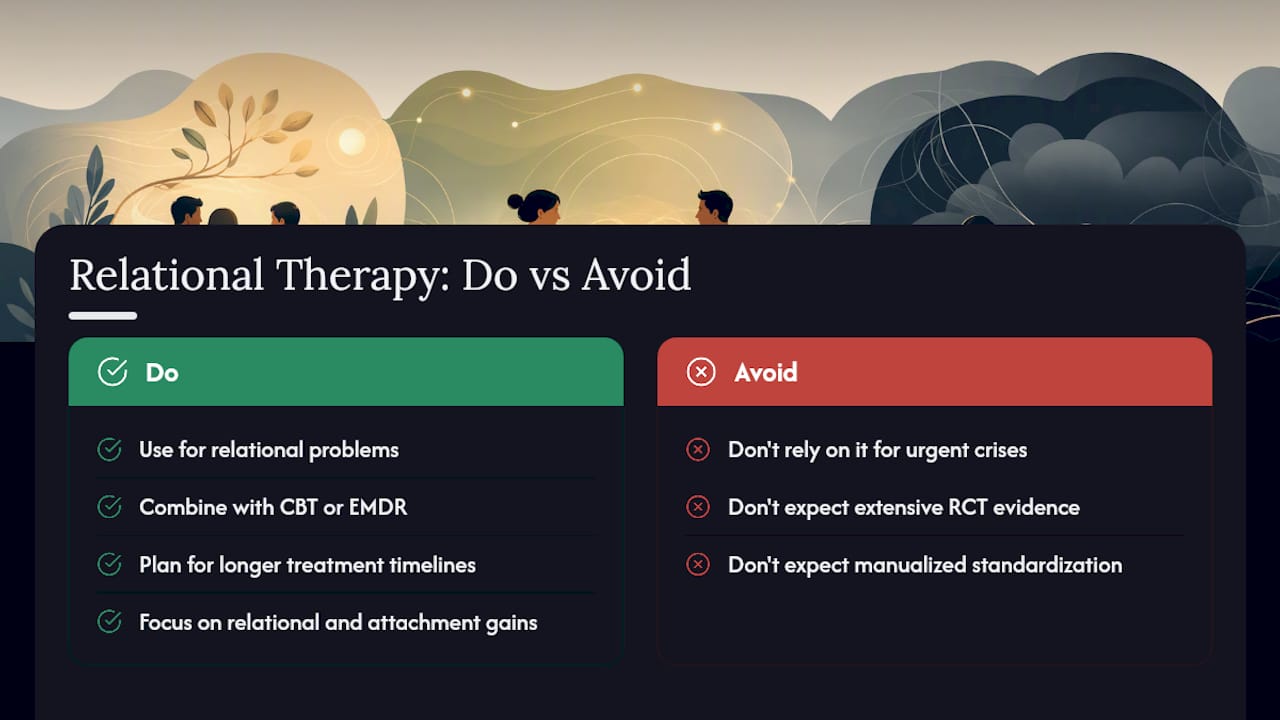
One caveat that matters here: if you’re dealing with active suicidal ideation, ongoing abuse, or any immediate safety risk, that calls for urgent, specialized intervention first, not a standard outpatient relational therapy intake.
How Relational Therapy Works in Practice
The mechanics of relational therapy look different from what a lot of people picture when they imagine “going to therapy.” There’s no lying on a couch while a silent therapist takes notes. The therapist is an active participant, and your relationship with them becomes one of the primary sources of information in the room.
A few principles anchor the approach:
- The relational focus stays central. Sessions keep circling back to how you relate to others and, notably, how you relate to the therapist in real time.
- The here-and-now matters as much as the past. A therapist will often ask what you’re feeling toward them in the moment, not just what happened with your mother twenty years ago.
- Mutual recognition replaces one-sided analysis. The therapist isn’t a neutral observer diagnosing you from behind a curtain. They bring genuine reactions, calibrated and professional, but real.
- Therapists move away from the old “blank screen” stance. Many relational therapists will share limited personal reactions when it serves the work, using measured self-disclosure to model what mutual, honest connection looks like.
- Rupture-and-repair becomes an explicit technique, not an accident. When tension arises between you and the therapist, that moment is treated as valuable material, not a problem to smooth over quickly.
Here’s a composite illustration of how that last point plays out. Imagine a client who starts arriving five minutes late to every session, and, when asked about it gently, gets irritated and dismissive. A relational therapist won’t just note the lateness and move on. They’ll explore what’s happening between the two of them right then: is the client testing whether the therapist will give up on them the way others have? That “rupture” in the relationship becomes a live rehearsal for how the client can repair conflict elsewhere, since rupture-and-repair moments are considered some of the most clinically productive material in the entire approach, not signs that therapy has gone off track.
Psychodynamic exploration of attachment history often runs alongside this, connecting a client’s present-day reactions to earlier experiences with caregivers. And practical, interpersonal skill-building gets folded in too, particularly when a client needs concrete tools alongside the deeper relational work.
What to Expect in Relational Therapy Sessions
A typical session usually opens with a brief check-in on what’s come up since the last visit and lasts for a standard therapy duration. From there, the conversation tends to move toward whatever relational material feels most alive that week, sometimes a conflict with a partner, sometimes a reaction the client had to the therapist that they want to understand.
Frequency commonly starts as weekly sessions to build trust, with some clients moving to less frequent meetings as progress is made. Timelines vary quite a bit and depend on what brought someone in. A person working through specific communication issues might see progress over a few months, while processing long-term relational trauma typically involves a longer timeframe, because the goal isn’t just symptom relief but a genuinely different way of relating.
One thing that surprises new clients: strong emotional reactions during sessions, including toward the therapist, aren’t a sign that something’s wrong. Frustration, disappointment, even attraction or resentment toward the therapist can surface, and a skilled relational therapist treats these as data rather than a distraction. Progress usually gets tracked less through a checklist of symptoms and more through changes in how a client describes their relationships outside the office: more directness, less avoidance, quicker repair after an argument.

For readers who want a practical framework on getting more out of any therapy relationship, these session preparation strategies apply directly to relational work, where showing up honestly matters more than showing up with a perfect agenda.
How to Choose a Relational Therapist
Not every licensed therapist practices relational therapy, even if their website uses the word “relational” somewhere on the page. Finding the right fit takes a bit of vetting.
- Check the license and training. Look for a licensed clinician (LCSW, LMFT, PhD, PsyD, or similar) with specific training in relational or psychodynamic approaches, not just a general talk-therapy background.
- Ask how they use themselves in the room. A therapist practicing this model should be comfortable explaining how they use self-disclosure and here-and-now feedback, since that’s central to the method.
- Ask about their experience with attachment and trauma. Relational work frequently intersects with attachment histories, so direct experience here matters.
- Ask about telehealth and insurance logistics upfront. Confirm whether they offer virtual sessions, accept your insurance, or work on a sliding scale, since access issues derail more people than mismatched approach ever does.
- Pay attention to how they discuss your identity and context. A therapist should treat social determinants such as race, gender, class, and culture as central to your relational patterns, not as side notes.
A few red flags worth taking seriously: a therapist who stays rigidly neutral and withholds any personal reaction when you’re specifically seeking relational modeling, one who brushes past cultural or social context as irrelevant, or one who seems more invested in diagnosing you than understanding the relationship dynamics in the room. If a first consultation call feels clinical and impersonal, that’s often a preview of what the actual therapy will feel like.
Relational Therapy vs. CBT and Classical Psychodynamic Therapy
The three approaches share some psychological DNA but diverge sharply on emphasis, technique, and what a session actually feels like.
| Feature | Relational Therapy | Cognitive Behavioral Therapy (CBT) | Classical Psychodynamic Therapy |
|---|---|---|---|
| Primary focus | Interpersonal patterns and connection | Identifying and changing distorted thoughts and behaviors | Unconscious conflict and early developmental history |
| Therapist stance | Active, warm, calibrated self-disclosure | Directive, coach-like, structured | Traditionally neutral, “blank screen” |
| Core technique | Here-and-now relational exploration, rupture-and-repair | Structured exercises, thought records, homework | Free association, interpretation of the unconscious |
| Session emphasis | The relationship itself as the change agent | Skill acquisition and symptom reduction | Insight into origins of internal conflict |
| Best fit for | Relationship patterns, attachment struggles, chronic disconnection | Specific symptoms like anxiety, panic, or phobias | Long-standing personality patterns, deep insight-seeking work |
The practical guidance is fairly simple: if your struggle is fundamentally relational, meaning it shows up between you and other people rather than as an isolated symptom, relational therapy usually fits better. If you’re dealing with a discrete, well-defined problem such as panic attacks or a specific phobia, CBT’s structured methods often produce faster, more measurable results. Many clinicians don’t treat these as mutually exclusive, either. It’s common to blend relational depth with CBT’s concrete skill-building when a client needs both insight and tools.
Does Relational Therapy Actually Work? Evidence and Limits
The honest answer is that relational therapy has a real theoretical foundation and a growing base of clinical support, but it doesn’t have the same volume of randomized controlled trials that manualized treatments like CBT have accumulated. That’s not a knock on its effectiveness so much as a reflection of how hard it is to standardize a therapy that leans on the individual, in-the-moment dynamic between two people.
Clinical literature consistently points to a few outcomes: improved relational satisfaction, stronger self-understanding, and better repair skills after conflict, since the therapeutic mechanism itself is the empathic connection clients build with the therapist. Attachment research gives this a biological backbone too, showing that early relational patterns genuinely shape adult behavior in ways that talk therapy focused purely on cognition can miss.
The limits are worth stating plainly. The evidence base is more heterogeneous than what you’d find for a manualized protocol, partly because the approach flexes to each client rather than following a fixed script. It also tends to unfold over a longer timeline than skills-based therapies designed for faster symptom relief. When someone needs urgent, concrete coping tools, say, for panic attacks or trauma flashbacks that disrupt daily function, combining relational work with structured approaches like CBT or EMDR often serves the client better than either approach alone.
What Relational Therapy Actually Feels Like From the Clinician’s Chair
There’s a moment that happens in almost every relational therapy relationship, usually somewhere around the third or fourth month, where a client says something sharp or withdrawn toward me directly, then immediately apologizes and tries to take it back. That moment is the whole therapy, compressed into fifteen seconds. What I prioritize in that instant isn’t smoothing things over. It’s staying present, naming what just happened between us, and letting the client discover that the relationship survives honesty. That’s the piece conventional wisdom about therapy often misses: people don’t usually change because a therapist explains their patterns to them. They change because they get to practice something different, in real time, with a person who doesn’t disappear or retaliate. Safety, mutual recognition, and the willingness to sit inside an uncomfortable rupture rather than rush past it are the actual engine of this work, far more than any single insight or interpretation.
Getting Started With Relational Therapy at Revive Health Therapy
Revive Health Therapy gives California residents a genuinely accessible path into relational, trauma-informed care, without the months-long waitlists and rigid intake processes common at larger group practices. The approach blends relational awareness with evidence-based methods like EMDR and CBT, so sessions can flex between deep relational repair work and concrete skill-building depending on what you actually need that week.
Care is available in person at the Oakland and Walnut Creek offices, or through secure telehealth sessions available statewide, which matters if you live somewhere without easy access to therapists trained in this specific approach. Sliding-scale fees and acceptance of insurance, including HSA and FSA plans, keep the door open for people who might otherwise assume quality relational therapy is out of reach financially.
If any of this sounds like the kind of support you’ve been circling for a while, the next step is straightforward: book an initial consultation with a licensed clinician and talk through what’s actually been happening in your relationships. That first conversation alone tends to clarify a lot.
This article is general information, not a substitute for advice from a qualified doctor. Consult a qualified healthcare professional about your own circumstances before acting on anything here.
Sources
For readers who want to go deeper, a few sources stand out for their reliability and depth. The relational-cultural therapy origins page traces the model back to Jean Baker Miller’s foundational work in the 1970s, which reframed disconnection, rather than individual pathology, as the root of much emotional suffering. For a more accessible overview aimed at people considering the approach for themselves, Verywell Mind’s breakdown covers technique and fit in plain language.
Readers interested in the attachment science underneath all of this might find Attached: The New Science of Adult Attachment genuinely useful, since it translates research on adult attachment styles into everyday relationship language. And for ongoing reading on relational dynamics in families, the Parenting and Connection blog offers practical perspectives worth bookmarking.
- Relational Therapy | Healthline
- Relational Psychotherapy: Benefits, Techniques & How It Works | GoodTherapy
- Relational Therapy: How to Know If It’s Right For You | Verywell Mind