
Systemic therapy is a form of psychotherapy that treats problems by changing patterns of interaction across relationships and social contexts, rather than focusing solely on one person’s internal experience. If someone in your family is struggling with anxiety, depression, or a relationship conflict, systemic therapy looks at the whole picture: who says what to whom, how each person’s response shapes the next, and what patterns have quietly taken hold over time. According to a PMC academic review, systemic therapy is recognized for all age groups and targets the interactions and narratives that keep symptoms in place, not just the symptoms themselves.
A quick note on terminology: “systemic therapy” in this article refers to systemic psychotherapy. It has no connection to systemic cancer therapy, which is an entirely separate medical field.
Three things to know right away:
- Systemic therapy works with families, couples, groups, and individuals using a relational lens.
- It addresses anxiety, depression, substance use, eating disorders, OCD, and relationship problems.
- Research supports its effectiveness across age groups, with growing recognition in clinical guidelines.
Table of Contents
- How systemic therapy explains problems and creates change
- Common techniques used in systemic therapy
- What are the main types of systemic therapy?
- Who does systemic therapy actually help?
- What to expect in your first few sessions
- What does the research say about effectiveness?
- Benefits and limitations: an honest look
- How to find a qualified systemic therapist in the U.S.
- Key Takeaways
- Why systemic therapy deserves more credit than it gets
- Systemic-informed therapy at Revivehealththerapy
- Useful sources and further reading
How systemic therapy explains problems and creates change
Most therapy models ask: What is wrong with this person? Systemic therapy asks a different question: What patterns in this person’s relationships are keeping the problem alive?
The core mechanism is circular causality. Linear thinking says A causes B: one parent’s anger causes a child’s withdrawal. Circular thinking says A and B reinforce each other in a loop: the child’s withdrawal triggers more parental frustration, which deepens the withdrawal. Neither person is the villain. The pattern is the problem. Systemic therapy intervenes in the pattern rather than assigning a root cause.

This approach draws on systems theory, communication theory, constructivism, attachment ideas, and the biopsychosocial model. In practice, that means a therapist tracks who speaks first, who goes quiet, who steps in to rescue, and what happens next. Change happens in the room, in real time, not by excavating childhood history.
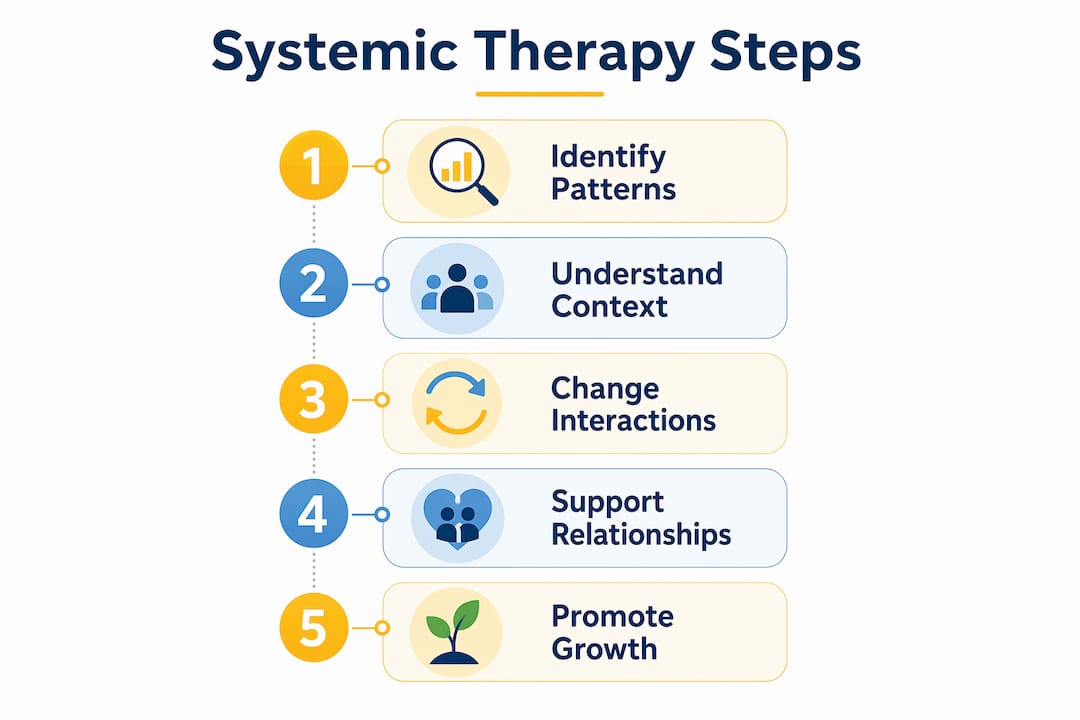
The therapist’s stance matters here. Skilled systemic practitioners often take a ‘one-down’ position, acting as a curious learner rather than an authority handing down diagnoses. This posture encourages families and individuals to generate their own solutions, which tends to produce better follow-through than advice given from above.
What drives a systemic session:
- Hypothesizing: The therapist forms a working theory about the relational pattern and tests it through questions and observations.
- Circularity: Questions and interventions loop back to relationships, not individual deficits.
- Neutrality: The therapist avoids taking sides, which keeps all members engaged.
- Here-and-now focus: Change is generated through what happens in the session, not through insight about the past.
Pro Tip: Before your first session, jot down a rough timeline of when the problem started, who was involved, and what changed in the family or relationship around that time. A brief family timeline speeds up the assessment phase considerably.
Common techniques used in systemic therapy
Systemic therapy is primarily practical, focused on changing how people communicate and behave with each other right now. These are the tools therapists use most often:
-
Circular questioning: The therapist asks each person how they think another person experiences the problem. A parent might be asked, “When your teenager shuts down, what do you think your partner is feeling?” This shifts perspective and reveals hidden relational assumptions.
-
Genogram: A visual map of three or four generations of a family, showing relationships, significant events, and recurring patterns. Therapists use it in early sessions to spot multigenerational dynamics quickly.
-
Positive reframing: A behavior that looks like defiance gets reframed as protectiveness, or anxiety gets reframed as caring deeply. This isn’t spin; it opens new ways for family members to respond to each other.
-
Enactment: The therapist asks family members to have a typical conversation in the room, live. Watching the pattern unfold in real time is far more useful than hearing a description of it.
-
Scaling questions: “On a scale of 1 to 10, how connected do you feel to your partner right now?” Simple, but it tracks change across sessions and gives everyone a shared language.
-
Homework and behavioral experiments: Between sessions, families try a small, specific change: one parent steps back during an argument, a couple eats dinner without phones for a week. The experiment tests whether the pattern can shift outside the therapy room.
“Systemic therapy does not attempt to determine past causes, such as subconscious impulses or childhood trauma. Instead, it gives living systems nudges that help them develop new patterns together.” — Wikipedia, Systemic therapy
What are the main types of systemic therapy?
Systemic therapy is not one fixed format. It adapts to the setting and the people involved.
-
Family therapy: The most recognized form. Parents, children, and sometimes extended family members attend together. Used most often for child or adolescent behavior problems, family conflict, and communication breakdowns. Sessions typically run 50–90 minutes and may be short-term (8–20 sessions) or longer.
-
Couples therapy: Two partners work with a systemic therapist to identify the interactional loops driving conflict, distance, or repeated arguments. The focus is on the dynamic between partners, not on who is “right.”
-
Multi-family and group systemic work: Several families meet together with one or two therapists. Common in eating disorder programs and some adolescent mental health services. Families learn from watching each other’s patterns as much as from direct intervention.
-
Systemic-integrative individual therapy: One person attends, but the therapist uses circular questioning and hypothesizing to shift how that individual understands and responds to their relationships. No one else needs to be in the room for systemic work to happen.
-
Organizational and systemic consultation: Applied in workplaces, schools, and healthcare teams. The same principles, different system. A consultant maps communication patterns in a team the same way a therapist maps them in a family.
For family therapy options in California, the format you choose depends on who is available, what the presenting problem is, and how much flexibility the system has.
Who does systemic therapy actually help?
Systemic therapy is used across the full age range, from young children to older adults, and it addresses a wider set of problems than most people expect.

Research confirms it is effective for anxiety, depression, substance use, OCD, and eating disorders, and it is often used alongside other treatments like CBT rather than as a standalone replacement. For anxiety treatment, a systemic lens adds something individual CBT alone cannot: it addresses the relational context that maintains the anxiety.
| Condition | Typical role of systemic therapy |
|---|---|
| Anxiety | Addresses family or partner patterns that reinforce avoidance |
| Depression | Reduces isolation by improving relational support and communication |
| Substance use | Engages family members to shift enabling or conflict patterns |
| Eating disorders | Used in multi-family formats; strong evidence in adolescents |
| Relationship conflict | Primary modality; targets interactional loops directly |
| Child/adolescent behavior | Family therapy as first-line; parents are active participants |
| OCD | Adjunct to CBT; reduces family accommodation behaviors |
Who benefits most:
- Families where one member’s symptoms affect everyone else.
- Couples stuck in the same argument on repeat.
- Individuals whose anxiety or depression is clearly tied to a relationship context.
- Parents of children or teens whose behavior has shifted after a family change (divorce, loss, a new sibling).
What to expect in your first few sessions
The first session is mostly assessment. The therapist wants to understand who is in the system, what the presenting problem looks like from each person’s perspective, and what has already been tried.
A typical early-session sequence:
- Session 1: Introductions, consent, and confidentiality discussion. Each person describes the problem in their own words. The therapist listens for patterns, not just content.
- Sessions 2–3: Genogram or relationship mapping. The therapist and family build a picture of key relationships, significant events, and recurring dynamics. Homework may be assigned.
- Sessions 3–4: Active intervention begins. Enactments, circular questioning, and reframing are introduced. The therapist tests hypotheses about the pattern.
- Sessions 5–6: Review of progress. What has shifted? What hasn’t? The treatment plan is adjusted based on what the family reports and what the therapist observes.
For a deeper look at how evidence-based session structures work in practice, the logistics matter as much as the model.
Practical details to know:
- Sessions typically run up to an hour or longer, with family formats often being somewhat longer.
- Frequency is usually weekly or biweekly, especially early in treatment.
- Confidentiality in family sessions works differently than in individual therapy. The therapist should clarify at the outset what can be shared outside the room and how notes are kept.
- Homework is normal and expected. Small behavioral experiments between sessions are where much of the change actually happens.
- Duration varies widely: some couples or families resolve a specific issue in a limited number of sessions; more complex situations may require several months.
What does the research say about effectiveness?
The evidence base for systemic therapy is solid and growing, though not without caveats.
A PMC review of systemic psychotherapy confirms recognition across all age groups and documents its effectiveness for the range of conditions listed above. A BMC Psychiatry systematic review and meta-analysis focused specifically on children and adolescents found promising results, particularly for eating disorders and behavioral problems, though the authors noted limitations including study heterogeneity and risk of bias in some trials. Larger, higher-quality randomized controlled trials are still needed for several diagnostic categories.
What the evidence supports most clearly: Systemic therapy shows consistent benefit for relationship problems, family conflict, adolescent eating disorders, and substance use when family members are involved in treatment. Evidence is more mixed for severe individual disorders where it is used as a standalone approach.
Key evidence points:
- Recognized by German expert bodies for all age groups, a signal of integration into clinical guidelines.
- Effective as an add-on to CBT for conditions like OCD and depression, where relational patterns maintain symptoms.
- Multi-family formats show particular strength in eating disorder treatment.
- Evidence quality varies; some areas need larger RCTs before firm conclusions can be drawn.
For readers interested in the broader case for evidence-based therapy, the systemic approach fits squarely within that framework, even as the research continues to develop.
Benefits and limitations: an honest look
Systemic therapy offers real advantages over purely individual approaches, and it also comes with genuine practical constraints.
| Benefits | Limitations |
|---|---|
| Addresses the relational patterns that maintain symptoms | Requires scheduling multiple people, which is logistically harder |
| Reduces blame by focusing on circular patterns | Not all family members may be willing to participate |
| Builds mutual understanding across the whole system | Confidentiality is more complex in multi-person sessions |
| Can produce sustained change by shifting the system, not just one person | Evidence is stronger for some conditions than others |
| Applicable even in individual sessions using systemic techniques | May not be the primary modality for severe individual disorders |
Two common fears, addressed directly:
“Will I be blamed in family therapy?” No. Systemic therapy uses circular causality to move groups away from blame toward shared understanding. The therapist is not looking for the person who caused the problem.
“Is systemic therapy just family therapy?” No. It is a broader framework applied in family, couples, group, and individual settings. You can receive systemic-informed therapy entirely on your own.
The biggest practical limitation is participation. Getting everyone in the room is genuinely hard. Skilled therapists work around this: even with one person present, systemic techniques can shift relational patterns indirectly. Telehealth has also made multi-person sessions more feasible, since family members in different locations can join the same session.
How to find a qualified systemic therapist in the U.S.
Start with professional directories and your insurance panel, and look for specific credentials and training rather than just a general “family therapist” label.
Credentials to look for:
- LMFT (Licensed Marriage and Family Therapist): the most direct credential for systemic and relational work.
- LCSW (Licensed Clinical Social Worker) with documented systemic or family systems training.
- PsyD or PhD in clinical or counseling psychology with a systemic or family therapy specialization.
Step-by-step checklist:
- Search Psychology Today, TherapyDen, or your insurer’s provider directory and filter by “family therapy” or “systems therapy.”
- Check the therapist’s profile for specific training in systemic models (Milan, structural, narrative, or collaborative approaches).
- Ask directly: “Do you use systemic or relational approaches? What does a typical session look like when working with families?”
- Confirm insurance, sliding-scale availability, and whether telehealth is offered.
- Ask about confidentiality policies for family sessions before the first appointment.
Questions worth asking a prospective therapist:
- What systemic models inform your practice?
- How do you handle it when one family member refuses to attend?
- How do you manage confidentiality when multiple people are in the room?
Considering telehealth vs. in-person care is worth thinking through before you book. Telehealth makes multi-person systemic sessions far more practical for families spread across different locations.
Pro Tip: Ask any prospective therapist whether they have received post-graduate training in a named systemic model. A general “I do family therapy” answer is less reassuring than “I trained in the Milan approach” or “I use a structural family therapy framework.”
Revivehealththerapy offers family therapy services in California, with in-person locations in Oakland, Walnut Creek, and San Francisco, plus secure telehealth statewide. Sliding-scale fees, insurance, and HSA/FSA are all accepted, which removes some of the most common access barriers.
Key Takeaways
Systemic therapy changes relationship patterns, not just individual symptoms, making it one of the most practical tools available for families, couples, and individuals whose problems are rooted in how they interact with the people around them.
| Point | Details |
|---|---|
| Core definition | Systemic therapy targets interaction patterns and relational context, not only individual symptoms. |
| Main techniques | Circular questioning, genograms, enactment, reframing, and behavioral experiments are the primary tools. |
| Who it helps | Effective for anxiety, depression, substance use, eating disorders, OCD, and relationship conflict across all ages. |
| Evidence base | Supported by PMC and BMC Psychiatry reviews; strongest for relational problems, adolescent eating disorders, and family conflict. |
| Revivehealththerapy | Offers systemic-informed family, couples, individual, child, and teen therapy in California, in-person and via telehealth. |
Why systemic therapy deserves more credit than it gets
The most underrated thing about systemic therapy is what it does to the concept of blame. Most people walk into a first family session braced for a verdict: who caused this? The systemic model makes that question irrelevant almost immediately. When a therapist maps a circular pattern, everyone in the room can see that the problem is the loop, not the person. That shift alone can change the temperature of a family session within the first hour.
What people also underestimate is how much can change when only one person shows up. The assumption that systemic therapy requires everyone to participate is one of the most persistent myths in mental health. A single person who understands their relational patterns and experiments with small changes in how they respond can shift a system meaningfully. The other people in the system respond differently because the pattern has changed, even if they never set foot in a therapy room.
The honest caveat: systemic therapy is not a universal first-line treatment for every condition. For severe OCD or major depression, it works best alongside a structured individual approach like CBT, not as a replacement. The research is clear that the relational frame adds value; it is less clear that it works alone for every presentation. Knowing that distinction helps you ask better questions when you are choosing a therapist.
What I find most compelling about this approach is that it treats the family or relationship as a resource, not a problem to be managed. That framing changes what therapy feels like from the inside.
Systemic-informed therapy at Revivehealththerapy
Revivehealththerapy brings systemic-informed psychotherapy to individuals, couples, families, children, and teens across California, with a concrete access advantage: you do not have to choose between quality care and affordability. In-person sessions are available in Oakland, Walnut Creek, and San Francisco. Secure online therapy in California covers the whole state, so a family spread across the Bay Area and Sacramento can join the same session from wherever they are.

Services directly relevant to systemic work include family therapy, couples therapy, child and teen therapy, and individual therapy with a relational lens. Insurance is accepted, sliding-scale fees are available, and HSA/FSA plans are welcome. If you are ready to take the next step, start here to learn more about the services available and how to book a session.
This article is general information, not professional advice. Please consult a licensed mental health professional for guidance specific to your situation.
Useful sources and further reading
- Systemic Psychotherapy: An Introduction to Its Theoretical Foundations and Clinical Practice (PMC) — Peer-reviewed academic overview; the strongest single reference for definitions, mechanisms, and evidence.
- Systemic therapy in children and adolescents with mental disorders: a systematic review and meta-analysis (BMC Psychiatry) — Most recent meta-analysis; covers comparative outcomes and research limitations.
- What is systemic therapy? (BACP) — Clear practitioner-facing explainer from the British Association for Counselling and Psychotherapy.
- What Is Systemic Therapy? (Verywell Mind) — Accessible lay overview covering session expectations and common uses.
- Systems therapy explained (PositivePsychology.com) — Covers therapist stance, one-down posture, and session dynamics in plain language.
- Systemic Family Therapy (AACAP training resource) — Clinical training document from the American Academy of Child and Adolescent Psychiatry; useful for practitioners and informed readers.