
Teen stress management means learning habits and tools that calm your body’s alarm system so you can think clearly and feel more in control. If you’re a teen reading this right now, here are three things you can do in the next five minutes.
Right now, try one of these:
- Belly breathing (60 seconds): Put one hand on your stomach. Breathe in for 4 counts, hold for 4, breathe out for 6. Feel your hand rise and fall. Repeat four times.
- 5-4-3-2-1 grounding: Name 5 things you can see, 4 you can touch, 3 you can hear, 2 you can smell, 1 you can taste. This pulls your brain back to the present.
- Quick movement: Do 10 jumping jacks or walk briskly for two minutes. Physical movement helps discharge the stress response in your body.
Crisis note: If a teen is talking about self-harm or feels completely overwhelmed, contact a health care provider and call or text 988 (Suicide and Crisis Lifeline) immediately. Parents: if you are unsure whether it is an emergency, call 988 anyway. They will help you decide.
Table of Contents
- What is teen stress management, and why does it hit so hard?
- Ten evidence-based strategies teens can use right now
- How do you build a personal stress-management plan?
- How can parents support teen stress management?
- When should a teen get professional help?
- Key Takeaways
- What clinicians actually see: a note on stress and skill-building
- Revivehealththerapy’s teen therapy services in California
- Useful sources and further reading
What is teen stress management, and why does it hit so hard?
Stress is the body’s natural fight-or-flight response, a surge of adrenaline and cortisol that prepares you to face a threat. Your heart races, your muscles tighten, your thoughts speed up. That response was designed for physical danger, but a failing grade, a fight with a friend, or a college application triggers the exact same chemistry.
Teens feel this more intensely than adults for a real biological reason. The prefrontal cortex, the part of the brain that regulates emotion and impulse, is still developing well into the mid-twenties. So the emotional gas pedal fires hard, and the brakes are still being installed.
Common teen stress triggers include:
- School and exams: A single test can feel like it defines your entire future.
- Peer conflict: A falling-out with a close friend can feel as destabilizing as a family crisis.
- Family changes: Divorce, a move, or financial strain creates background anxiety that never fully turns off.
- Social media: Constant comparison and the pressure to respond immediately keeps the nervous system in a low-level alert state.
- Sleep loss: Even one night of poor sleep amplifies emotional reactivity significantly.
“Stress management” does not mean eliminating stress. It means building habits that regulate the response and help you recover faster. Think of it as skill-building, not fixing something broken. The three quick techniques at the top of this article are a good starting point.
Ten evidence-based strategies teens can use right now
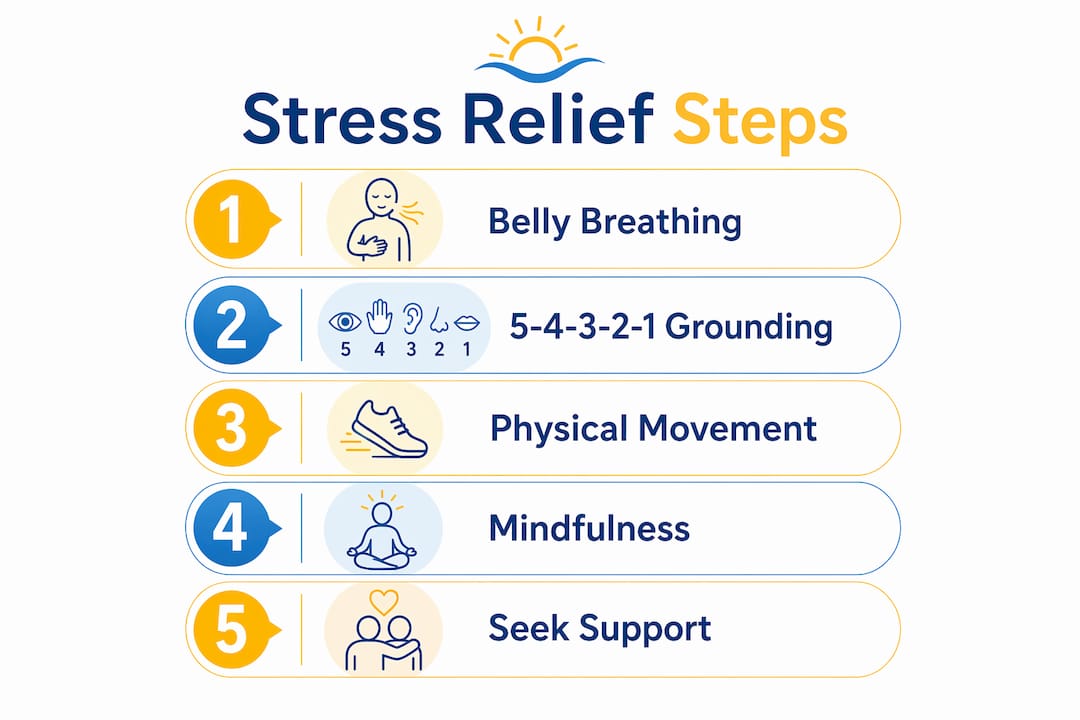
These strategies are drawn from youth-focused stress research and clinical practice. Some give fast relief; others build resilience over weeks. Both matter.
Short-term relief (use when stress spikes):
-
Belly breathing. Slow, deep breaths activate the parasympathetic nervous system. Script: Inhale 4 counts, hold 4, exhale 6. Repeat until your shoulders drop.
-
Progressive muscle relaxation. Tense each muscle group for 5 seconds, then release. Start at your feet and work up. Script: “Squeeze your feet tight… hold… let go. Feel the difference.” This works well before bed.
-
5-4-3-2-1 grounding. Described above. Use it mid-panic when breathing alone does not cut through.
-
Quick movement. A 10-minute walk, a short run, or even dancing to one song helps complete the stress cycle and return your nervous system to baseline.
-
Worry chair. Pick one chair in your home as the “worry chair.” When anxious thoughts spiral, sit there for 10 minutes and let yourself worry fully. Then get up and leave the worry there. This contains rumination instead of letting it follow you everywhere.
Longer-term resilience (build these into your week):
-
Sleep hygiene. Sleep and regular physical activity are the two most consistently recommended strategies by pediatric authorities. Aim for adequate sleep duration recommended for teens. Cut screens 30 minutes before bed. A consistent wake time matters more than a consistent bedtime.
-
Routine and planning. Predictability calms the nervous system. A simple morning routine, even just 10 minutes of the same sequence, signals safety to your brain.
-
Time management and task-breaking. Large assignments feel threatening because the brain reads “overwhelming task” as danger. Break any project into steps small enough to complete in 20 minutes. Write them down. Cross them off.
-
Mindfulness. A 5-week mindfulness program for teens aged 13–18 produced measurable reductions in mental distress in published trials. You do not need a program. Start with two minutes of focused attention on your breath each morning.
-
Journaling. Writing about feelings like gratitude or pride reduces distress and improves well-being in adolescents. Three sentences before bed is enough. You can also use mindfulness practices for adolescents to complement journaling with structured attention exercises.
Pro Tips for choosing where to start:
Pro Tip: If you are high-energy and restless when stressed, start with movement and breathing. If you go quiet and withdraw, journaling and a worry chair tend to work better. Tailored plans that match your preferences consistently outperform one-size-fits-all approaches.

Pro Tip: Pick one strategy and practice it daily for a week before adding another. Stacking too many new habits at once usually means none of them stick.
How do you build a personal stress-management plan?
A plan does not need to be complicated. The goal is to know your triggers, have your go-to tools ready, and build a daily structure that keeps stress from accumulating.
One-page personal plan template
| Field | What to write |
|---|---|
| My top 3 stress triggers | (e.g., Sunday night before school, big tests, conflict with friends) |
| My go-to short-term strategies | (e.g., belly breathing, 5-4-3-2-1, a 10-minute walk) |
| My go-to longer-term habits | (e.g., journaling before bed, consistent wake time, weekly movement) |
| My daily check-in time | (e.g., rate stress 1–10, note what helped) |
| My emergency steps | (e.g., call a trusted adult, text 988, use belly breathing first) |
7-day sample schedule
| Day | Morning (5 min) | After school (10 min) | Evening (10 min) |
|---|---|---|---|
| Monday | Breathing + set daily goal | Walk or movement | Journal 3 sentences |
| Tuesday | Breathing | Break one task into steps | Progressive muscle relaxation |
| Wednesday | Breathing + mindfulness | Social time (no phones) | Journal |
| Thursday | Breathing | Movement | Worry chair if needed |
| Friday | Breathing | Free creative outlet | Wind-down screen-free |
| Saturday | Sleep in, then movement | Unstructured time | Journal |
| Sunday | Breathing | Plan the week | Early bedtime |
Weekly review checklist
- What stress level did I average this week (1–10)?
- Which strategy helped most?
- What triggered the worst moments?
- What will I keep, and what will I swap out?
Test one new strategy per week. Rate your stress before and after using it on a simple 1–10 scale. If a strategy does not move the needle after five consistent tries, replace it. The plan is a working document, not a contract.
How can parents support teen stress management?
When parents model healthy coping, teens are significantly more likely to adopt those same behaviors. Co-regulation is not a buzzword. It is the mechanism by which a calm parent literally helps a teen’s nervous system settle.

What to do and what to avoid
Do:
- Listen without immediately offering solutions. “That sounds really hard” goes further than “Here’s what you should do.”
- Ask open questions: “What’s the hardest part right now?” rather than “Did you try breathing?”
- Shift from problem-solver to coach: brainstorm options together and let your teen choose.
- Model your own stress management out loud: “I’m feeling overwhelmed, so I’m going for a walk.”
- Set consistent evening screen limits for the whole household, not just your teen.
Avoid:
- Dismissing stress (“You have nothing to worry about”).
- Catastrophizing alongside your teen (“This will ruin your GPA”).
- Solving the problem before your teen has finished describing it.
- Checking in so frequently that it signals you do not trust them to cope.
Three conversation scripts
- “I noticed you seemed tense tonight. I’m not going to push, but I’m here if you want to talk or just sit together.”
- “What’s one thing that would make tomorrow feel a little easier? Let’s figure it out together.”
- “I’ve been stressed too lately. Here’s what I tried. Did anything like that ever work for you?”
When to notify school or a health provider
Contact your teen’s school counselor or doctor when you see:
- A drop in grades or attendance that lasts more than two weeks.
- Withdrawal from friends, family, or activities they used to enjoy.
- Physical complaints (headaches, stomachaches) with no medical cause.
- Any mention of self-harm or hopelessness.
Teaching media literacy and setting clear evening screen boundaries are low-cost, high-impact moves parents can make this week, before any of those warning signs appear.
When should a teen get professional help?
Most stress is normal and responds to the strategies above. But some stress crosses into territory where self-help is not enough.
Seek professional support when stress has lasted more than a few weeks and is affecting daily life: grades are slipping, friendships are fraying, sleep is consistently disrupted, or your teen has stopped doing things they used to enjoy. Everyday strategies help most teens, but professional help is recommended when symptoms include agitation, depressed mood, or functional impairment lasting more than a few days.
The clearest red flags are any talk of self-harm, hopelessness, or feeling like a burden to others. Those require immediate action, not a wait-and-see approach.
Therapy options that work for teens
Cognitive Behavioral Therapy (CBT) is the most researched approach for teen anxiety and stress. It teaches teens to identify distorted thinking patterns and replace them with accurate ones. Sessions are structured and skill-focused, which many teens find easier to engage with than open-ended talk therapy. CBT for adolescents is a practical starting point for families researching this approach.
EMDR (Eye Movement Desensitization and Reprocessing) is particularly effective when stress is rooted in a traumatic experience. It helps the brain reprocess distressing memories so they lose their emotional charge. EMDR therapy benefits for teens explains what the process looks like and what to expect.
Family therapy brings parents and teens into sessions together, which is especially useful when family conflict is a primary stressor.
Skills groups teach coping techniques in a peer setting, which can reduce the isolation teens often feel around mental health struggles.
Telehealth makes all of these options more accessible. A teen can attend a session from their bedroom, which removes the barrier of transportation and reduces the stigma of walking into a clinic.
“When you contact a therapist, ask these questions: Do you have experience working with adolescents? What evidence-based approaches do you use? Do you offer telehealth? Do you accept my insurance or offer a sliding scale? Those four questions will tell you almost everything you need to know about fit before the first session.” — Clinician guidance from starting teen counseling in California
Immediate crisis resources
- 988 Suicide and Crisis Lifeline: Call or text 988 (available 24/7).
- Crisis Text Line: Text HOME to 741741.
- SAMHSA National Helpline: 1-800-662-4357 (free, confidential, 24/7).
- Emergency: Call 911 if there is immediate danger.
Key Takeaways
Teen stress management works best when short-term relief techniques, consistent daily habits, and a clear plan for seeking professional help are combined into one practical approach.
| Point | Details |
|---|---|
| Start with three quick techniques | Belly breathing, 5-4-3-2-1 grounding, and brief movement can reduce acute stress in under five minutes. |
| Build a personal plan | Match strategies to your own triggers and energy style; tailored plans outperform generic ones. |
| Parents co-regulate | When parents model healthy coping, teens are more likely to adopt those same behaviors. |
| Know the red flags | Seek professional help when stress causes functional impairment lasting more than a few days, or when self-harm is mentioned. |
| Revivehealththerapy for teens | Revivehealththerapy offers CBT, EMDR, and telehealth teen therapy in California with sliding-scale fees and insurance acceptance. |
What clinicians actually see: a note on stress and skill-building
The framing that matters most is this: stress management is not about fixing something wrong with you. Every teen who walks through a therapy door is already doing something right by showing up. The nervous system is not broken; it is doing exactly what it was designed to do. The work is teaching it when to stand down.
One thing that gets underestimated is how much avoidance masquerades as coping. Skipping school, isolating, scrolling for hours — these feel like relief because they are, briefly. But they keep the stress cycle open. The strategies in this article, especially the worry chair and task-breaking, work precisely because they replace avoidance with something that actually closes the loop.
For parents, the hardest shift is from rescuer to coach. Solving your teen’s problems for them communicates, unintentionally, that you do not believe they can handle it. Sitting with them while they figure it out communicates the opposite. That distinction shapes resilience more than any single technique.
And for teens: the goal is not a stress-free life. The goal is a life where stress does not run the show.
Revivehealththerapy’s teen therapy services in California
Teens dealing with stress that has moved beyond what self-help can address have a clear next step available. Revivehealththerapy provides evidence-based teen therapy in California, including CBT for anxiety and stress, EMDR for trauma-related concerns, and family therapy for situations where the whole household is affected. In-person sessions are available in Oakland, Walnut Creek, and San Francisco; secure telehealth sessions are available statewide for teens who prefer to meet from home.
Affordability is built into the model: sliding-scale fees, insurance accepted, and HSA/FSA plans honored. Confidentiality for teens is taken seriously, and the intake team can walk you through what that means for your specific situation before the first session. To get started, visit the teen therapy page or reach out directly through the contact page to ask about availability and fit.
Useful sources and further reading
- MedlinePlus: Help your teen cope with stress — Practical guidance on when to seek professional help and what everyday strategies work.
- Nemours KidsHealth: What Is Stress? — Teen-friendly explanation of the biology of stress and how to manage it.
- Nemours KidsHealth: 10 Ways to Manage Everyday Stress — Concrete techniques written directly for teens.
- APA: How to help children and teens manage their stress — Research-backed strategies including mindfulness trial data and journaling evidence.
- Mayo Clinic: 5 ways to help your stressed-out teen — Parent-focused guidance on co-regulation and modeling.
- NIMH: So Stressed Out? — Federal fact sheet on stress in young people.
- 988 Suicide and Crisis Lifeline — Call or text 988, available 24/7.
- SAMHSA National Helpline — 1-800-662-4357, free and confidential.
- Revivehealththerapy: Teen Therapy — Booking and service information for teens in California.
Recommended
- Mindfulness Practices for Adolescents: 2026 Guide – Revive Health Therapy
- How to manage teen anxiety with proven therapies in CA – Revive Health Therapy
- Emotional regulation steps for teens and families – Revive Health Therapy
- Role of Family Therapy for Teens: Enhancing Communication and Wellbeing – ReviveHealthTherapy