
Processing childhood trauma measurably reduces anxiety, depression, and PTSD symptoms while restoring the sense of agency that early adversity often takes away. This isn’t a vague wellness promise. A 2026 study on trauma memory processing found that symptom severity depends less on what happened to someone and more on how that memory gets stored and integrated afterward. Therapies that directly target that integration process reduce distress in ways that talking about the past casually never quite manages.
Here’s what the evidence actually shows about why this work matters:
- Roughly 70% of people experience at least one traumatic event in their lifetime, and about 10% go on to develop PTSD — meaning most people carry some trauma, but processing determines who gets stuck with it.
- The brain retains the capacity to reorganize itself well into adulthood, so therapeutic work isn’t fighting biology, it’s working with it.
- Adverse Childhood Experiences (ACEs) correlate with higher rates of adult mental and physical illness, but that risk is not a life sentence when addressed early.
This guide walks through what childhood trauma actually is, how it shows up in adult bodies and relationships, what happens when it goes unaddressed, and which treatments actually move the needle. It also covers safety and pacing, what a first therapy appointment looks like, and where to find real help if you’re ready to start.
Key Takeaways
Processing childhood trauma works because it changes how memories are stored and integrated, which directly reduces symptoms while restoring a person’s sense of control over their own life.
| Point | Details |
|---|---|
| Processing changes outcomes | Symptom severity depends more on how a memory is processed than on the event itself, per recent research. |
| Trauma affects the whole system | Unprocessed trauma impacts mental health, physical health, and relationship patterns, not just mood. |
| Readiness matters before memory work | Build stabilization skills like grounding and social support before diving into memory-focused processing. |
| EMDR, TF-CBT, and CPT lead the evidence | Look for a clinician trained in these specific, research-backed methods rather than general talk therapy alone. |
| Revivehealththerapy offers accessible entry points | EMDR and CBT are available in-person in Oakland and Walnut Creek or via telehealth statewide, with sliding-scale fees. |
Table of Contents
- Why Process Childhood Trauma in the First Place?
- What Counts as Childhood Trauma?
- How Does Childhood Trauma Affect Adults?
- What Happens When Childhood Trauma Goes Unprocessed?
- What Are the Real Benefits of Processing Childhood Trauma?
- What Are the Evidence-Based Methods for Processing Trauma?
- Is It Safe to Start Processing Trauma Right Now?
- What Should You Expect From Trauma Therapy?
- How Do You Start Processing Trauma Right Now?
- Where Can You Find Trusted Trauma Resources?
- What Do Therapists Wish Clients Understood About This Work?
- If You’re Ready for Professional Help
- Frequently Asked Questions
- Sources
Why Process Childhood Trauma in the First Place?
The short answer: unprocessed trauma keeps running in the background, shaping decisions, relationships, and health outcomes long after the original danger has passed. Processing it interrupts that pattern. It’s the difference between a memory that fires your nervous system every time something resembles the original threat, and a memory that’s simply part of your history without commanding your present.
Trauma, defined clinically, involves exposure to actual or threatened death, serious injury, or sexual violence. But perception matters here — two people can experience the same adverse event and walk away with very different psychological imprints, depending on their support systems, prior experiences, and developmental stage at the time. That’s why childhood trauma gets special attention: children have fewer coping resources and depend entirely on caregivers for a sense of safety.
What Counts as Childhood Trauma?
Childhood trauma covers a wider range of experiences than most people assume. It includes obvious events like physical or sexual abuse, but it also includes chronic neglect, witnessing domestic violence, parental substance abuse, and emotional invalidation that never rises to the level of a single dramatic incident.
The CDC’s ACEs framework categorizes ten common adverse experiences, from abuse and neglect to household dysfunction like divorce or a parent’s incarceration. Clinicians use the ACE score, essentially a tally of how many categories a person experienced before age 18, as a screening tool to flag elevated risk for later health problems. It’s not a diagnosis. It’s a signal that invites a closer look.
There’s an important distinction between single-incident trauma and complex or relational trauma:
- Single-incident trauma stems from one identifiable event, like a car accident or a natural disaster, and often responds well to focused, time-limited treatment.
- Complex trauma develops from repeated exposure, usually within a caregiving relationship, and shapes a person’s core beliefs about safety, trust, and their own worth.
- Relational trauma specifically involves harm from the people a child depended on for protection, which complicates the nervous system’s basic template for what relationships are supposed to feel like.
About 70% of people will experience a traumatic event in their lifetime, according to research published on NCBI’s StatPearls resource. Among children specifically, exposure to at least one adverse experience is common enough that trauma-informed practices have become standard in pediatric and family-focused care settings.
How Does Childhood Trauma Affect Adults?
Childhood trauma rarely stays contained to one area of life. It tends to show up in the mind, the body, and every close relationship a person builds, often in ways that don’t look obviously connected to the original experience.

On the mental health side, unresolved trauma frequently drives anxiety, depression, and PTSD symptoms like intrusive memories, avoidance, and a persistently activated threat response. It also shapes core beliefs, things like “I can’t trust anyone” or “I’m fundamentally unsafe,” that then influence decision-making for decades. Many adults develop coping strategies in childhood that made sense at the time (people-pleasing, emotional shutdown, hypervigilance) but that create real problems once the original danger is gone.
The physical toll is just as real. Childhood trauma can alter the brain’s salience network and stress-response systems, and those biological shifts are linked to compromised immune function and elevated cardiovascular risk later in life. This isn’t a metaphor. Chronic activation of stress hormones has measurable downstream effects on the body’s inflammatory and cardiovascular systems.
Relationally, trauma reshapes how people attach to others:
- Difficulty trusting partners or friends, even when there’s no concrete reason for suspicion.
- Patterns of either avoiding intimacy or becoming anxiously dependent on it.
- Parenting patterns that unconsciously repeat, or overcorrect against, what a person experienced as a child.
- Trouble reading or expressing emotional needs clearly in close relationships.
Developmental research shows that children who experienced danger without protection or comfort from a caregiver often develop cognitive-processing shortcuts that increase vulnerability to chronic PTSD in adulthood. Attachment relationships aren’t just emotionally important. They shape how the nervous system learns to interpret threat for the rest of a person’s life.
The encouraging piece of this: the same neuroplasticity that allowed trauma to reshape the brain also allows healing to reshape it again. Adult brains remain capable of forming new neural pathways with consistent, repeated therapeutic experience, which is part of why attachment wounds can be reworked later in life even without a redo of childhood itself.
What Happens When Childhood Trauma Goes Unprocessed?
Avoidance feels protective in the short term. Long term, it tends to compound the problem rather than resolve it. Unprocessed trauma doesn’t fade quietly. It typically finds other outlets.
Common patterns that show up when trauma stays unaddressed:
- Chronic hypervigilance that makes relaxation feel unsafe, even in genuinely low-risk situations.
- Recurring relationship problems, including difficulty sustaining intimacy or a pattern of choosing unavailable partners.
- Increased risk behaviors, including substance use, that function as a way to manage unprocessed distress.
- Physical health consequences tied to sustained stress activation, including sleep disruption and cardiovascular strain.
- Emotional numbing or dissociation that limits a person’s capacity for joy, connection, or spontaneity.
For a subset of people, unprocessed trauma progresses into diagnosable conditions, most commonly PTSD, but also complex depression or anxiety disorders that resist standard treatment because the underlying trauma was never addressed directly. SAMHSA’s guidance on childhood trauma notes that unprocessed experiences increase risk behaviors and long-term health problems, while early, trauma-informed intervention consistently improves outcomes.
It’s worth separating normal coping from maladaptive patterns here. Taking time to process grief, leaning on friends after a hard week, or needing space after conflict are healthy responses. The concerning pattern is rigidity: the same avoidance strategy deployed automatically, in every context, regardless of whether it’s actually helping.
What Are the Real Benefits of Processing Childhood Trauma?
The gains from doing this work show up across nearly every domain researchers have studied, and they tend to compound over time rather than plateau.
On the mental health front, people who process trauma through evidence-based treatment typically see meaningful reductions in PTSD symptoms, anxiety, and depression, alongside improved capacity to regulate strong emotions without being hijacked by them. That regulation piece matters more than it sounds. It’s the difference between a triggered nervous system taking over a conversation and being able to notice activation, name it, and choose a response.
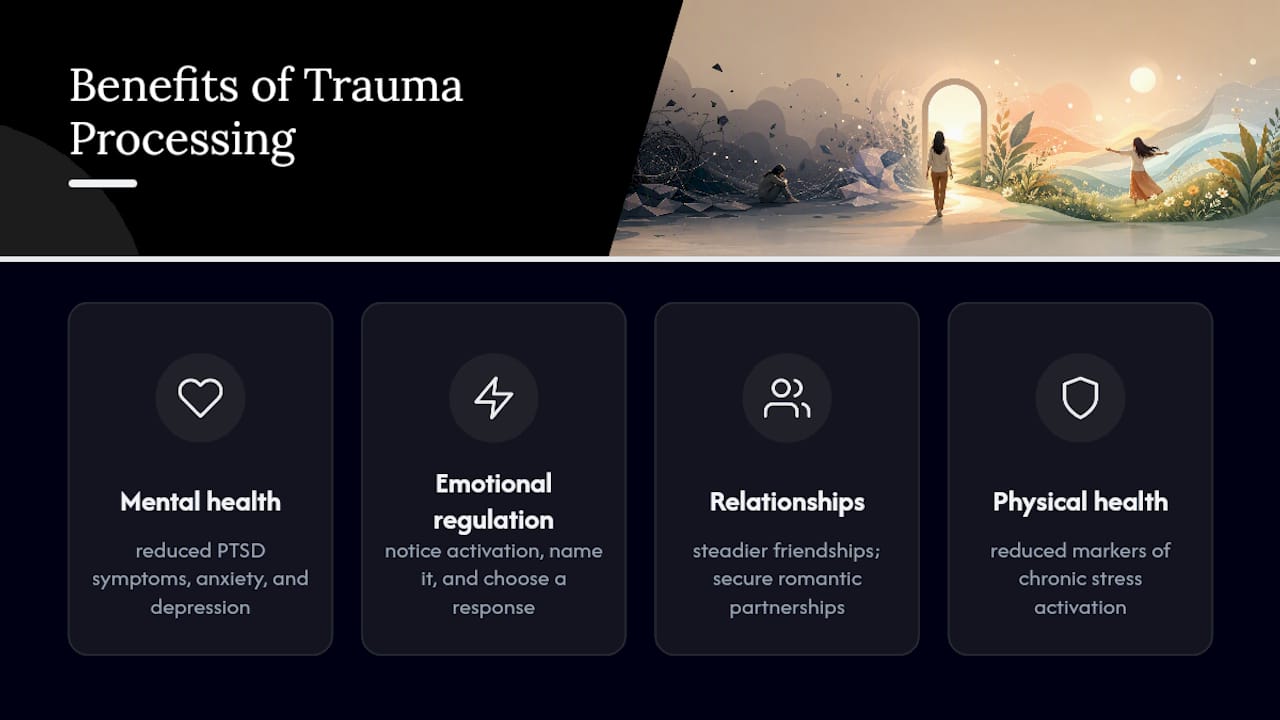
Relationships tend to improve too, particularly for people whose original wounds were relational. Reworking attachment patterns in therapy often translates directly into steadier friendships, more secure romantic partnerships, and parenting that breaks rather than repeats old cycles.
Physical health benefits, while harder to feel day to day, show up in the research: reduced markers of chronic stress activation and improved immune function have both been documented in people who’ve engaged in sustained trauma treatment. The body, it turns out, keeps a fairly accurate record of psychological healing.
Beyond symptom reduction, many people describe something closer to post-traumatic growth: a rewritten personal narrative, a renewed sense of agency, and the experience of choosing their life rather than reacting to their past.
Pro Tip: Healing isn’t linear. Expect good weeks followed by harder ones, especially around anniversaries or life transitions. That’s not a sign the work is failing. It’s usually a sign you’re processing at a deeper layer than before.
What Are the Evidence-Based Methods for Processing Trauma?
Several treatment approaches have strong research support, and most trauma-informed clinicians draw from more than one depending on what a client needs.
EMDR (Eye Movement Desensitization and Reprocessing) uses bilateral stimulation, typically guided eye movements, while a client briefly recalls a distressing memory, as described in detail by EMDR Therapy – Prism Counseling & Coaching. The mechanism isn’t fully understood, but the effect is well-documented: it helps the brain reprocess stuck memories so they stop triggering the same intensity of reaction. EMDR therapy often runs for 6 to 12 sessions for single-incident trauma, though complex trauma frequently requires a longer course.
Trauma-focused cognitive behavioral therapy (TF-CBT) and Cognitive Processing Therapy (CPT) both work by identifying and shifting the distorted beliefs trauma tends to leave behind, thoughts like “it was my fault” or “I can never be safe.” These approaches combine cognitive restructuring with gradual, controlled exposure to trauma-related material.
Other approaches play supporting roles:
- Somatic approaches address trauma stored in the body, useful when talk-based methods alone don’t reach the physical activation.
- Internal Family Systems (IFS) works with different internal “parts” that developed to protect a person during difficult experiences.
- DBT skills (distress tolerance, emotion regulation) build the stabilization foundation many people need before memory-focused work begins.
- Mindfulness-based techniques help build the present-moment awareness that makes noticing and managing triggers possible.
The evidence base for EMDR, TF-CBT, and CPT is strong enough that most major clinical guidelines list them as first-line treatments for trauma. A comparison of evidence-based options often works best when a clinician combines stabilization skills with one of these memory-processing approaches, rather than relying on either alone.
Is It Safe to Start Processing Trauma Right Now?
Timing matters more than most people expect. Diving into memory-focused trauma work before you’re ready can backfire, sometimes intensifying symptoms rather than resolving them.
Signs you’re likely ready for direct trauma processing:
- You have a stable living situation and reasonably consistent daily routine.
- You’ve built at least basic emotion-regulation skills, like being able to calm down after distress without turning to self-harm or substances.
- You have some level of social support, even if it’s just one or two people you trust.
- You’re not currently in crisis or facing an acute safety threat.
Red flags that suggest stabilization should come first:
- Active, uncontrolled substance misuse.
- Recent or ongoing suicidal ideation without a safety plan in place.
- An unsafe living situation, including ongoing exposure to the person or circumstance that caused the original harm.
Before memory processing begins, most trauma-informed clinicians spend time building stabilization skills like grounding techniques, DBT-based distress tolerance, sleep hygiene, and reliable social connection. Guidance from the University of Utah Health system reinforces this: restoring safety and building regulation skills has to come before diving into the harder memory work, or the work risks doing more harm than good.
Pro Tip: A good trauma therapist will never push you to recall details you’re not ready to share. Processing works through pacing and consent, not force. If a provider pressures you to “just get it out,” that’s a signal to find someone else.
What Should You Expect From Trauma Therapy?
A first appointment usually starts with an assessment, not treatment. Expect a clinician to ask about your history, current symptoms, and possibly administer a screening tool like an ACE questionnaire or a standardized symptom inventory to get a clearer picture of what’s going on.
From there, session frequency and length follow fairly standard patterns: weekly 50 to 60 minute sessions are typical, though some approaches, EMDR in particular, occasionally use longer sessions to allow a full reprocessing cycle. Treatment length varies considerably based on severity and complexity. Single-incident trauma might resolve in a matter of months; complex, relational trauma developed over years of childhood often takes proportionally longer.
Cost and access are real considerations, and providers vary widely here. Many practices, including Revivehealththerapy, offer sliding-scale fees based on income and accept insurance along with HSA and FSA funds, and telehealth has expanded access considerably for people who can’t easily get to an in-person office.
One overlooked factor: the therapeutic relationship itself functions as part of the treatment mechanism, not just a delivery vehicle for techniques. Feeling genuinely safe with your clinician, and being able to say when something isn’t working, tends to predict outcomes as much as the specific method used.
How Do You Start Processing Trauma Right Now?
You don’t need a therapy appointment to begin building the foundation for healing. Several steps are available immediately.
Start with basic self-regulation practices:
- Practice a grounding technique, like naming five things you can see and four things you can hear, when you notice activation.
- Build a consistent sleep and daily routine, since dysregulated sleep amplifies nearly every trauma symptom.
- Identify one or two people you can reach out to when things feel hard, even if you don’t share details right away.
If you’re ready to look for professional support, use this checklist when evaluating a therapist:
- Ask directly about training in trauma-specific methods like EMDR, CPT, or TF-CBT.
- Confirm whether they offer telehealth, sliding-scale fees, or insurance billing that fits your situation.
- Ask how they approach pacing, and whether they check in about readiness before diving into memory work.
- Notice how you feel talking to them during a consultation call. Comfort and trust matter clinically, not just personally.
Before a first appointment, it helps to jot down your main concerns, any patterns you’ve noticed, and specific questions about their approach. A step-by-step guide to finding a trauma-informed therapist can help you narrow down providers before you ever pick up the phone.
Pro Tip: Match the method to your current goal. If you’re in crisis or feel constantly overwhelmed, look for stabilization-focused work first. If you already feel grounded but keep getting stuck on the same painful memories, you may be ready for direct memory reprocessing like EMDR.
Where Can You Find Trusted Trauma Resources?
Several federal and clinical organizations maintain reliable, free information for people trying to understand trauma or find care.
- SAMHSA provides guidance on childhood trauma, treatment options, and how trauma-informed care improves outcomes across age groups.
- NIMH publishes research-backed overviews of PTSD, anxiety, and depression that help clarify how trauma symptoms are diagnosed and treated.
- NCTSN (National Child Traumatic Stress Network) focuses specifically on childhood trauma and family-centered interventions.
- VA PTSD resources offer free, evidence-based tools and mobile apps for symptom management, useful for anyone processing trauma regardless of military background.
- CDC’s ACEs pages explain the adverse childhood experiences framework and its connection to long-term health risk.
For readers in California looking for direct care, Revivehealththerapy offers trauma-informed services built around EMDR and CBT, with both in-person appointments in Oakland and Walnut Creek and secure telehealth available statewide. Sliding-scale pricing and insurance acceptance, including HSA and FSA plans, are built into the practice specifically to reduce the access barriers that keep people from starting treatment. When you use any directory or referral source, verify that the clinician you’re considering actually has documented training in trauma-specific methods. Not every general therapist has this training, and it makes a real difference in outcomes.
What Do Therapists Wish Clients Understood About This Work?
Clients often walk in believing healing follows a straight line: process the trauma, feel better, done. It rarely works that way. Progress tends to spiral rather than march forward, and a setback after a good stretch of weeks doesn’t mean the work has failed. It usually means the nervous system is safe enough now to process something it couldn’t handle earlier.
Two misconceptions come up constantly. The first: “I have to remember everything for this to work.” Memory reprocessing doesn’t require a complete, detailed narrative. Plenty of effective EMDR and CPT work happens with fragmented or incomplete memories. The brain doesn’t need every detail to reorganize how it holds the experience. The second misconception: “processing trauma means re-experiencing it at full intensity.” Good trauma therapy is built specifically to avoid retraumatization. Clinicians titrate exposure carefully, checking in constantly about window of tolerance, rather than flooding a client with the full emotional weight of the original event.
What actually drives lasting change tends to be less about technique and more about repetition: repeated experiences of safety within the therapeutic relationship itself, over enough sessions, slowly recalibrate a nervous system that learned the world was unsafe. Agency matters here too. A client who feels like they’re choosing the pace of this work, rather than being dragged through it, generally does better than one who feels like treatment is happening to them.
The pro tip clinicians repeat most often: build a personal grounding practice before deep processing work begins, and keep using it. A go-to grounding technique, whether that’s a specific breathing pattern, a physical object you can hold, or a phrase you say to yourself, gives you something reliable to return to when a session or a memory stirs up more than expected.
If You’re Ready for Professional Help
Revivehealththerapy gives you a faster path to trauma-informed care than the usual runaround of general therapy directories and long waitlists, with sliding-scale pricing that adjusts to what you can actually afford. Clinicians here specialize in EMDR, CBT, and mindfulness-based approaches specifically for trauma, meaning you’re not explaining your history to someone learning trauma work on the job.
Reaching out starts with a straightforward intake process: a brief conversation about what’s bringing you in, followed by matching to a clinician whose training fits your specific needs, whether that’s EMDR for a specific memory or a longer course of trauma-focused CBT for complex, relational wounds. Appointments are available in person in Oakland, Walnut Creek, and San Francisco, or through secure telehealth anywhere in California, and the practice accepts insurance, HSA and FSA funds, along with out-of-network superbills for reimbursement. If unprocessed trauma is interfering with your relationships, sleep, or ability to function day to day, that’s reason enough to reach out. Visit the adult mental health services page to see current offerings, or start with a direct contact form to schedule an initial conversation.
Frequently Asked Questions
Why is it important to process childhood trauma instead of just moving on?
Trauma that isn’t processed doesn’t disappear. It tends to resurface as anxiety, relationship difficulty, or physical health problems, often disconnected from its original source. Processing interrupts that pattern directly rather than managing its downstream symptoms indefinitely.
Can childhood trauma really affect physical health as an adult?
Yes. Childhood trauma can alter stress-response systems in ways linked to compromised immune function and elevated cardiovascular risk, according to research from the University of Rochester Medical Center. The connection between early adversity and later physical illness is well documented, not speculative.
What’s the difference between EMDR and trauma-focused CBT?
EMDR uses bilateral stimulation to help the brain reprocess stuck memories, typically over 6 to 12 sessions for single-incident trauma. TF-CBT and CPT work by directly restructuring the distorted beliefs trauma leaves behind, combined with gradual exposure. Many clinicians use both, depending on what a client needs.
How do I know if I’m ready to start processing trauma?
Basic readiness signs include a stable living situation, at least some emotion-regulation skills, and access to social support. If you’re facing active substance misuse, an unsafe living situation, or uncontrolled suicidal thoughts, stabilization work should come first.
Is childhood trauma the same as having a diagnosable disorder like PTSD?
No. About 70% of people experience a traumatic event, but only about 10% develop PTSD. Childhood trauma raises risk for various mental and physical health conditions, but it doesn’t automatically mean someone meets criteria for a specific diagnosis.
This article is general information, not a substitute for advice from a qualified doctor. Consult a qualified healthcare professional about your own circumstances before acting on anything here.
Sources
- Trauma-Informed Therapy – StatPearls (NCBI Bookshelf)
- The roots of chronic PTSD: childhood trauma and self-protective strategies (PMC)
- Child trauma guidance — SAMHSA
- How childhood trauma may impact adults — URMC Health Matters
Use these sources to verify any claim a prospective therapist makes about their methods, and to double-check that the treatment approach they’re proposing actually has research behind it before you commit to a course of care.