
TL;DR:
- Therapy stigma discourages many people from seeking or continuing mental health care. Addressing it improves early treatment, reduces suffering, and promotes community wellbeing. Personal stories, strategic sharing, and education are key strategies to fight stigma effectively.
Therapy stigma is defined as the social and internalized negative attitudes that discourage people from seeking or continuing mental health care. These attitudes cause real harm. Only 44% of adults with mental illness receive treatment each year, and stigma is the leading driver of that gap. Understanding why address therapy stigma matters is not an abstract question. It is a public health priority with direct consequences for millions of people. Revivehealththerapy works with individuals across California who face these exact barriers every day, and the pattern is consistent: stigma delays care, and delayed care costs people years of unnecessary suffering.
Why address therapy stigma: the case for change
Therapy stigma operates at three levels simultaneously: public perception, personal belief, and institutional practice. Each level reinforces the others. When workplaces reward “pushing through” and media frames therapy as a last resort, individuals absorb those messages and begin to believe them. That belief then becomes a wall between a person and the help they need.
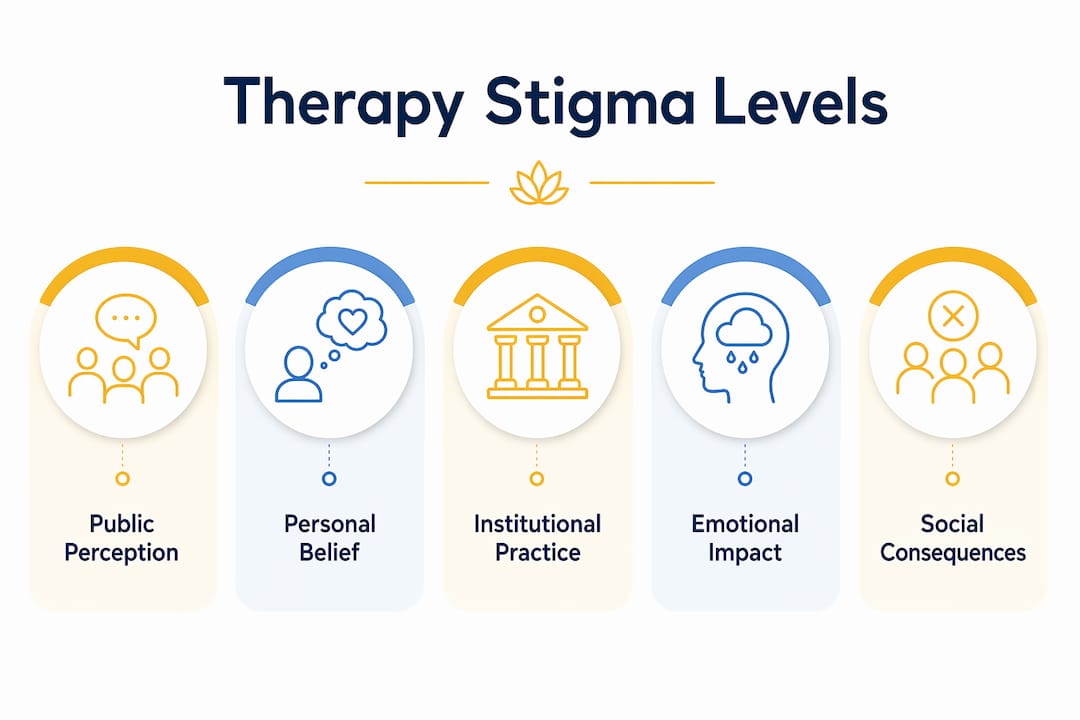
The numbers confirm the scale of the problem. Mental health stigma operates across public, individual, and institutional levels, creating a treatment gap that leaves the majority of people with mental illness without support. That is not a personal failure. It is a structural one, built from years of cultural messaging that treats emotional struggles as weakness.
Addressing mental health stigma matters because the alternative is a system where shame does the gatekeeping. When stigma goes unchallenged, people delay care until a crisis forces their hand. Earlier treatment consistently produces better outcomes across anxiety, depression, trauma, and relationship challenges. The goal of reducing stigma is not to make therapy trendy. It is to make it accessible.
What are the social and psychological impacts of therapy stigma?
The damage stigma causes is not limited to the decision to avoid therapy. It reaches into daily life, relationships, and a person’s sense of self.

Internalized stigma and emotional suffering
Internalized stigma occurs when a person absorbs society’s negative views and applies them to themselves. This is more than low self-esteem. Internalized stigma is predicted 44% by psychological pain, known clinically as psychache, in people with mental disorders. Psychache arises from unmet basic needs: love, acceptance, and safety. When stigma blocks access to therapy, those needs go unmet longer, deepening the pain that drove the person to need help in the first place.
Up to 40% of people with serious mental illness report high levels of self-stigma. That self-stigma directly hinders treatment engagement and daily functioning. The person who believes they are broken or weak for needing help is far less likely to show up consistently to therapy, even when they start.
Social and relational consequences
The impact of therapy stigma extends well beyond the individual. Stigma-related discrimination causes real social harm:
- Relationship damage: Discrimination in intimate relationships and friendships affected about 41% of respondents in a nationally representative survey.
- Employment and education: Stigma-related discrimination causes social exclusion and denial of employment and educational opportunities.
- Compounded suffering: 67.7% of surveyed individuals report that stigma and discrimination feel worse than their mental health condition itself.
That last finding is striking. For most people, the social wound of stigma cuts deeper than the original diagnosis. This means that why stigma affects therapy is not just a question of access. It is a question of dignity.
Why is addressing therapy stigma important for individuals and communities?
Reducing stigma produces benefits that ripple outward from the individual into the broader community. The importance of therapy acceptance is not sentimental. It is practical and measurable.
For individuals, overcoming therapy stigma means earlier treatment engagement. Earlier engagement means shorter recovery timelines, lower risk of crisis, and stronger long-term outcomes. Reframing therapy as a strength rather than a weakness encourages people to seek help before problems become severe. That shift in framing is not just motivational. It changes the actual trajectory of a person’s mental health.
For communities, the benefits are equally concrete:
- Reduced discrimination in workplaces, schools, and social settings
- Greater peer support networks that normalize mental health conversations
- Protection of human rights for people living with mental health conditions
- Environments where mental health is treated with the same seriousness as physical health
“When a community stops treating mental health struggles as shameful secrets, it becomes a place where people can actually heal.”
Social engagement also plays a meaningful role in mental health recovery. Reducing stigma creates the conditions for stronger social connection, which research consistently links to improved wellbeing and resilience. A person who feels accepted is far more likely to stay in treatment and build the support systems that sustain recovery.
What evidence-based strategies effectively reduce therapy stigma?
Research points to specific approaches that actually change attitudes, not just raise awareness. Education alone is not enough.
-
Contact with people in recovery. Personal interaction with individuals in stable recovery produces more attitude change than factual information alone. Hearing a real person describe their therapy experience dismantles stereotypes in a way that statistics cannot.
-
First-person narratives. When people share their own mental health stories, listeners update their beliefs. This is why public figures speaking openly about therapy has measurable cultural impact. The story humanizes the experience.
-
Cognitive restructuring. This is a core technique in Cognitive Behavioral Therapy (CBT) that helps people identify and challenge distorted beliefs. Applied to self-stigma, cognitive restructuring helps a person replace “I am weak for needing help” with “I am taking care of myself.” Revivehealththerapy uses CBT as a primary tool for exactly this kind of belief work.
-
Strategic disclosure. Full disclosure of mental health challenges is not necessary or always safe. Strategic disclosure means choosing carefully when, to whom, and how much to share. This approach reduces self-stigma while protecting the person from discrimination.
-
Language awareness. Words like “crazy,” “psycho,” or “attention-seeking” reinforce stigma. Choosing person-first language (“a person living with depression” rather than “a depressed person”) signals respect and shifts cultural norms over time.
Pro Tip: If you are working through self-stigma in therapy, ask your therapist to use cognitive restructuring specifically around your beliefs about seeking help. Many people find that the stigma itself becomes a target of treatment.
How can individuals and communities take practical action to overcome therapy stigma?
Knowing the strategies is one thing. Applying them in daily life is another. Here is what actually moves the needle.
For individuals
- Have one honest conversation. You do not need to broadcast your therapy experience. Sharing with one trusted person reduces your own shame and often opens a door for them too.
- Share selectively and strategically. Strategic disclosure to trusted individuals reduces self-stigma without exposing you to unnecessary judgment. Choose your audience carefully.
- Reframe your own story. Therapy stigma is often learned through culture, family, and workplaces. Recognizing that the shame was taught, not earned, is the first step to releasing it.
- Seek peer support. Connecting with others who have positive therapy experiences normalizes the process. This is the “contact” effect in everyday life.
- Use self-care practices alongside therapy. Building a broader mental health routine reduces the pressure on therapy to be the only lifeline and makes the whole process feel less stigmatized.
For communities, workplaces, and schools
Institutions carry significant responsibility for the persistence of stigma. Workplaces that celebrate “grinding through” without breaks send a clear message that emotional needs are inconvenient. Schools that lack counselors or treat mental health referrals as punishments do the same.
Practical community actions include training managers and teachers to respond to mental health disclosures with compassion rather than alarm. Media representation matters too. Stories that show therapy as a normal part of life, not a dramatic last resort, shift public perception over time. Communities that invest in mental health accessibility create environments where people seek help earlier and recover more fully.
Pro Tip: If you are in a position of influence at work or school, normalizing mental health days and speaking openly about your own self-care sets a tone that gives others permission to do the same.
Key takeaways
Addressing therapy stigma is the single most effective step communities and individuals can take to close the mental health treatment gap and improve long-term outcomes.
| Point | Details |
|---|---|
| Stigma blocks treatment | Only 44% of adults with mental illness receive care annually, with stigma as the primary barrier. |
| Internalized stigma causes real harm | Up to 40% of people with serious mental illness report self-stigma that directly reduces treatment engagement. |
| Contact beats education | Personal interaction with people in stable recovery changes attitudes more effectively than facts alone. |
| Strategic disclosure protects and heals | Sharing selectively with trusted people reduces self-stigma without exposing you to discrimination. |
| Communities shape outcomes | Workplaces, schools, and media that normalize therapy create conditions for earlier help-seeking and stronger recovery. |
What I have learned from watching stigma up close
I have spent years watching people arrive at therapy carrying two burdens: the original pain that brought them there, and the shame of needing help at all. The second burden is often heavier. That tells me something important about where the real work lies.
The conventional wisdom says we need more mental health education. More awareness campaigns. More statistics shared on social media. I think that is mostly wrong, or at least incomplete. Facts do not dissolve shame. Connection does. The most powerful stigma-reduction moment I have ever witnessed was not a public health poster. It was one person telling another, quietly and without drama, “I go to therapy too. It changed my life.”
What I have also learned is that shame around therapy functions as a survival mechanism. It developed for a reason, usually because vulnerability was genuinely unsafe in a person’s family, culture, or community. Telling someone to “just get over it” misses that entirely. The path forward is not to shame people out of their shame. It is to build enough safety that the armor becomes unnecessary.
Small, consistent actions matter more than grand gestures. One honest conversation. One workplace policy that treats mental health days as legitimate. One school counselor who responds without alarm. These are the things that actually shift culture, slowly and permanently. The strengths-based approach to therapy reflects this exactly: you build on what is already working, rather than cataloging what is broken.
Therapy is not a confession of failure. It is a decision to take your inner life seriously. The sooner we treat it that way, the sooner the people who need help will actually reach for it.
— Amy
Mental wellness support at Revivehealththerapy
Revivehealththerapy offers evidence-based psychotherapy in California with a clear commitment to reducing the barriers that stigma creates. Every session, whether in person in Walnut Creek or Oakland, or via secure telehealth statewide, is built on confidentiality, respect, and the understanding that seeking help is a sign of strength.
Sliding-scale fees and insurance acceptance, including HSA and FSA plans, make care accessible across income levels. If you are ready to take the step that stigma has been delaying, explore what therapy can do for your mental wellness. Revivehealththerapy also provides psychotherapy options for 2026 that match current evidence and your specific needs.
FAQ
What is therapy stigma?
Therapy stigma is the collection of negative social attitudes and internalized beliefs that discourage people from seeking mental health care. It operates at the public, personal, and institutional level simultaneously.
Why does stigma prevent people from getting therapy?
Stigma creates shame around needing help, which causes people to delay or avoid treatment entirely. Research shows only 44% of adults with mental illness receive care annually, with stigma as the primary driver of that gap.
What is the most effective way to reduce therapy stigma?
Contact with people in stable recovery produces more attitude change than education alone. Hearing first-person narratives from people who have benefited from therapy is the single most powerful tool for shifting beliefs.
Is it safe to tell people I am in therapy?
Full disclosure is not required. Strategic disclosure, sharing selectively with trusted individuals, reduces self-stigma effectively while protecting you from potential discrimination in less safe relationships or settings.
How does addressing mental health stigma benefit communities?
Communities that reduce stigma see earlier treatment engagement, stronger peer support networks, and lower rates of discrimination. These outcomes improve collective wellbeing and reduce the long-term social costs of untreated mental illness.
Recommended
- Why Seek Psychotherapy: Transforming Mental Wellness – ReviveHealthTherapy
- What is ACT therapy? A guide to acceptance and commitment therapy – Revive Health Therapy
- How therapists guide self-discovery for growth in California – Revive Health Therapy
- Behavioral Health Strategies That Actually Change Your Life – Revive Health Therapy