
TL;DR:
- EMDR therapy targets the root memories and physiological patterns driving anxiety, offering lasting relief. It is a structured, evidence-based approach that often requires fewer sessions, especially when trauma is involved. Proper preparation and finding a trained therapist enhance its effectiveness for adults and teens dealing with trauma-related anxiety.
If you’ve spent hours searching for a way to actually address anxiety at its root rather than just managing symptoms day to day, you’re not alone. Many Californians, whether adults carrying years of unprocessed stress or parents watching a teenager struggle, reach a point where standard advice stops being enough. EMDR therapy (Eye Movement Desensitization and Reprocessing) offers something different: a structured, evidence-based process that targets the underlying memories and physiological patterns driving your anxiety, not just the surface-level worry. This guide walks you through everything you need to know, from how it works to what your first session looks like.
Table of Contents
- What is EMDR therapy and how does it help with anxiety?
- Preparing for EMDR therapy: what you need to know before you start
- How is EMDR therapy delivered? The process from first to last session
- Is EMDR effective for anxiety? What the evidence says for adults and teens
- Troubleshooting and tips: how to get the most from EMDR therapy
- Why EMDR effectiveness depends on the right fit and adaptation
- Explore California’s leading EMDR and trauma therapy options
- Frequently asked questions
Key Takeaways
| Point | Details |
|---|---|
| EMDR targets trauma-driven anxiety | It works by processing distressing memories linked to anxiety through structured sessions. |
| Preparation is key | Choose the right therapist and understand what to expect in EMDR, especially for teens. |
| Research supports EMDR effectiveness | Studies show meaningful improvement in trauma-related anxiety for adults and youth. |
| Personal fit matters | Best results come when EMDR is tailored to the individual and delivered by experienced providers. |
| California offers flexible options | Telehealth and in-person EMDR services are widely available for both adults and teens. |
What is EMDR therapy and how does it help with anxiety?
EMDR stands for Eye Movement Desensitization and Reprocessing. The name sounds technical, but the core idea is straightforward. The approach focuses on the memories and stored experiences that fuel anxious feelings, rather than training you to cope with anxiety after it appears. That distinction matters enormously for anyone who has tried other approaches and found themselves managing symptoms on repeat without lasting relief.
The American Psychological Association describes EMDR as a structured treatment where clients briefly focus on a distressing memory while experiencing bilateral stimulation, typically eye movements, with the goal of reducing the vividness and emotional intensity of that memory. In plain terms, you hold a troubling memory in mind while your therapist guides your eyes back and forth, or uses alternating taps or sounds, and your brain begins to process that memory differently. Over time, the memory loses its emotional charge.
What makes EMDR stand out from other therapy approaches for anxiety is that it does not require you to talk through every detail of what happened. You do not need to describe your trauma in full sentences. The processing happens through the bilateral stimulation itself, which is one reason many people find EMDR more accessible than traditional talk therapy for traumatic material.
The APA’s own PTSD treatment guidelines classify EMDR as one of several evidence-based trauma-focused psychotherapies recommended for adults with PTSD, placing it alongside trauma-focused cognitive behavioral therapy (CBT) as a front-line option.
How EMDR compares to other anxiety treatments
| Feature | EMDR | Trauma-focused CBT | Standard talk therapy |
|---|---|---|---|
| Targets memory root | Yes | Yes | Sometimes |
| Requires detailed verbal retelling | No | Often | Yes |
| Bilateral stimulation used | Yes | No | No |
| APA-recommended for PTSD | Yes | Yes | Not specifically |
| Typical session range | 6–12 sessions | 12–20 sessions | Open-ended |
Key benefits of EMDR for anxiety include:
- Addresses root causes rather than managing surface symptoms
- Structured and time-limited, which makes planning easier for busy adults and families
- Adaptable for teens, with protocols designed specifically for younger clients
- Compatible with telehealth, making it accessible throughout California
- Can be combined with psychotherapy for anxiety approaches like CBT or mindfulness for comprehensive care
“EMDR does not erase memories. It changes how those memories feel when you recall them, removing the spike of panic or dread and leaving the factual memory intact.”
Preparing for EMDR therapy: what you need to know before you start
Knowing what EMDR is prepares your mind. Knowing how to set yourself up before the first session prepares everything else. The preparation phase is genuinely one of the most important parts of EMDR, and starting with realistic expectations sets the tone for better outcomes.
Before you begin any EMDR course of treatment, expect your therapist to spend one to three sessions gathering a clear picture of your history, current symptoms, and specific targets for processing. The APA guideline on EMDR emphasizes that a structured approach means identifying distressing targets first, then building stabilization skills before active reprocessing begins. Skipping that foundation often leads to stalled progress later.
Here is a practical checklist for finding the right EMDR therapist in California:
- Verify EMDR training: Look for certification or formal training through EMDRIA (the EMDR International Association)
- Ask about experience with your concern: Therapists who regularly treat trauma-driven anxiety will handle emotionally intense sessions more skillfully
- Confirm insurance and payment options: Many California providers accept insurance, HSA/FSA plans, and sliding-scale fees
- Check telehealth setup: If you plan on remote sessions, ask how they manage bilateral stimulation digitally
- For parents of teens: Ask specifically about the therapist’s experience with EMDR for teens, since adolescent protocols differ from adult ones in meaningful ways
For parents, preparing your teenager matters just as much as choosing the right therapist. Teenagers often feel more resistant to therapy if they don’t understand what is about to happen. Explain that EMDR is not about being forced to relive traumatic events, and that they will have control over the pace of the sessions.
Logistically, think about privacy if you are using telehealth. A quiet room, headphones, and a stable internet connection make a significant difference. California’s telehealth laws protect your privacy, but you need to create the conditions that allow you to open up fully.
Pro Tip: Write down the three to five memories or situations that trigger your anxiety most strongly before your intake session. Arriving with that list gives your therapist a concrete starting point and saves valuable session time in the preparation phase.
“Understanding the therapy session structure before your first appointment reduces the anxiety of not knowing what’s coming—which, for many people, is half the battle.”
For Californians managing access challenges, including geographic distance or schedule constraints, working with a provider offering both in-person and secure telehealth options is often the most practical path. Reviewing proven anxiety therapies in California can help you compare your options across the state.
How is EMDR therapy delivered? The process from first to last session

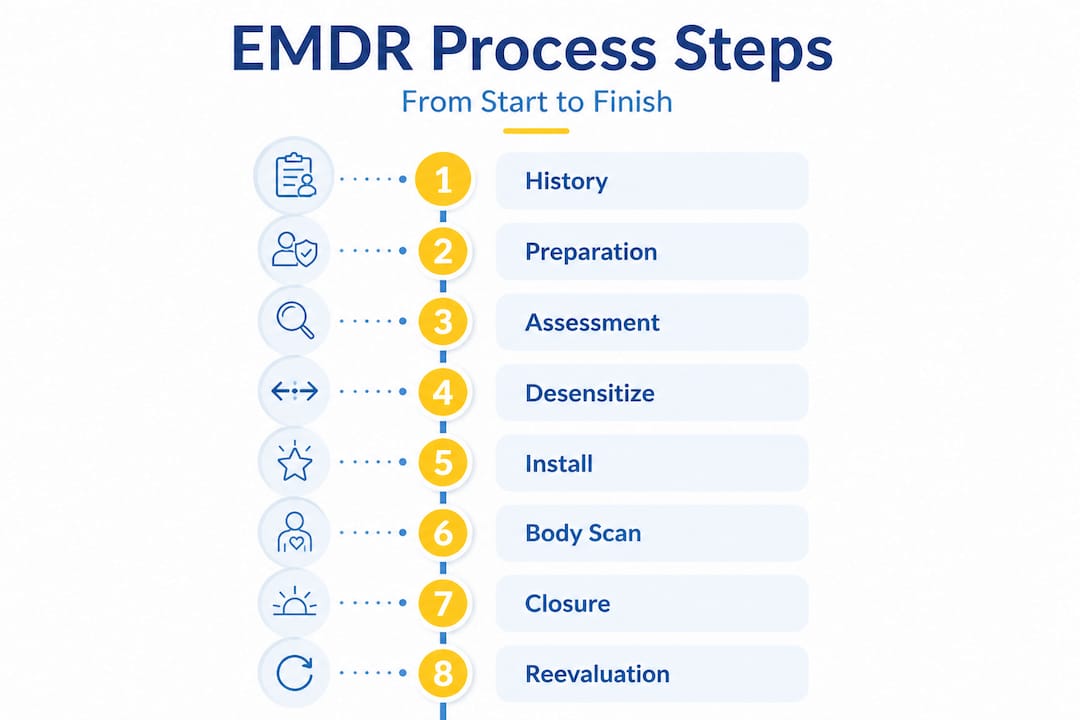
EMDR follows a defined eight-phase protocol. Knowing the phases takes the mystery out of the process and, for many people, reduces the anxiety that comes with starting something unfamiliar. Every phase has a purpose, and none of them are filler.
The eight phases of EMDR therapy
- History taking: Your therapist maps your history, symptoms, and target memories
- Preparation: You learn stabilization skills, including grounding and distress tolerance, to handle emotional activation between sessions
- Assessment: A specific memory is selected and its components are rated, including the distress level (called a SUDS score, from 0 to 10)
- Desensitization: Bilateral stimulation begins while you focus on the target memory; sets repeat until distress drops
- Installation: A positive belief is strengthened to replace the negative one linked to the memory
- Body scan: You check for any remaining physical tension or distress held in the body
- Closure: The session ends with a return to baseline; incomplete processing is contained safely
- Reevaluation: At the start of each new session, the therapist checks what has changed and identifies next targets
According to the APA PTSD guideline, EMDR is typically delivered one to two times per week for approximately 6 to 12 sessions, making it one of the more time-efficient structured therapy options available for trauma-related anxiety.
Session-to-session changes you can track
| Session range | What to expect |
|---|---|
| Sessions 1–3 | History gathering, skill building, no active reprocessing |
| Sessions 4–6 | Active reprocessing begins; distress may spike before it drops |
| Sessions 7–9 | Noticeable reduction in distress ratings for processed memories |
| Sessions 10–12 | Consolidation, future template work, closure planning |
The EMDR therapy process at a well-structured practice follows this arc closely, with regular check-ins so you always know where you are in the course of treatment.
For teens, the timeline can flex. Some adolescents move through phases faster once trust is established. Others need more time in the preparation phase building stabilization skills. Parents should expect some variability and avoid treating a fixed session count as a rigid goal. Therapy for teen anxiety typically builds in more flexibility around pacing than adult protocols.
Pro Tip: After each processing session, rate your distress on a simple 0 to 10 scale and note what memories or thoughts feel different. Sharing those notes with your therapist at the start of the next session speeds up the reevaluation phase significantly. Review a step-by-step EMDR guide for teens with your child before they begin so they know what tracking their progress looks like in practice.
Is EMDR effective for anxiety? What the evidence says for adults and teens
EMDR’s reputation is well-earned, but understanding exactly where the evidence is strongest helps you make a genuinely informed decision rather than relying on enthusiasm alone.
For adults, the case is clearest when anxiety is connected to trauma or distressing experiences. When anxiety stems from specific traumatic events, EMDR consistently reduces comorbid anxiety symptoms alongside PTSD, rather than treating them as separate problems. That insight is important: if your anxiety is rooted in what happened to you, EMDR targets that root directly rather than addressing anxiety as an isolated symptom.
For teenagers and children, the most rigorous recent data comes from a 2025 systematic review comparing EMDR to waitlist and standard care in children and adolescents. The review found a significant, large treatment effect, with an SMD of 1.57 (95% CrI 0.07 to 3.21). In non-statistical terms, that means participants showed substantially greater improvement compared to those who received no active treatment. The review also noted limitations, including a relatively small number of studies and some risk of bias, so parents should discuss findings with their child’s clinician rather than treating numbers as guarantees.
EMDR evidence at a glance
| Population | Evidence strength | Best fit |
|---|---|---|
| Adults with trauma-related anxiety | Strong (APA-recommended) | Anxiety tied to specific memories or events |
| Adolescents with PTSD/trauma | Moderate to strong (2025 meta-analysis) | Trauma-driven anxiety, with individualized pacing |
| Generalized anxiety without trauma link | Limited | May be better served by CBT or combined approaches |
Key takeaways for parents and adults reviewing the evidence:
- EMDR’s benefits for teens are supported by current research, but individualized assessment matters
- Results are strongest when the anxiety has identifiable memory-based triggers
- EMDR often performs comparably to trauma-focused CBT, giving families a genuine choice between evidence-based approaches
- For teen trauma recovery, early intervention tends to produce better long-term outcomes
Troubleshooting and tips: how to get the most from EMDR therapy
Even with strong evidence and a skilled therapist, EMDR can hit practical bumps. Knowing how to handle them in advance keeps you moving forward rather than dropping out before the real progress begins.
Common challenges and how to handle them:
- Emotional discomfort between sessions: This is normal, especially in the early desensitization phase. Your therapist will teach stabilization techniques in the preparation phase specifically to manage this
- Stalled progress: If distress ratings stop changing, discuss it openly with your therapist. Sometimes a different target memory is the real root, or an additional skill-building session is needed
- Misunderstanding EMDR’s scope: Some people expect EMDR to resolve all anxiety regardless of its source. Research comparing EMDR to other therapies consistently shows it works best when families evaluate fit, risk, and the specific anxiety concern rather than applying it universally
- Telehealth logistics: California providers offering remote EMDR use digital bilateral stimulation tools, including screen-based eye movement programs and audio tones. Test your setup in the preparation phase before active processing begins
For parents specifically, verifying that your teen’s therapist has pediatric EMDR training is non-negotiable. Adult and teen protocols differ in how memories are targeted, how sessions are paced, and how therapists handle developmental factors. Reviewing other evidence-based anxiety therapies alongside EMDR gives you a complete picture for making the best decision.
Pro Tip: Track your teen’s mood and sleep patterns between sessions using a simple journal or app. Shifts in sleep quality are often the first sign that EMDR processing is working, even before they can articulate feeling better. Share this data with the therapist when considering anxiety support options in California for your family.
Why EMDR effectiveness depends on the right fit and adaptation
Here is the perspective that most EMDR articles skip over: the therapy itself is not magic. The results depend entirely on whether EMDR is matched to the right person, trauma, and therapist. Telling someone that EMDR will fix their anxiety without asking where that anxiety comes from is like handing someone a specialized surgical tool and skipping the diagnosis.
From what we see in real clinical practice, the adults and teens who benefit most from EMDR share a few things. They have anxiety that is clearly connected to past experiences, even if those connections are not obvious at first. They work with therapists who prioritize the preparation phase rather than rushing into reprocessing. And they stay engaged between sessions rather than treating therapy as something that happens to them in a room once a week.
The uncomfortable truth is that EMDR can also produce temporary increases in distress before it reduces it. Some people interpret that discomfort as the therapy failing and stop too soon. Understanding that activation is part of the process, not a sign something is wrong, is often the difference between completing a course of therapy and dropping out at session five.
For telehealth users and families managing geography across California, session structure matters even more than it does in person. A clear framework and regular distress monitoring keep the process on track when you can’t rely on the physical cues of an in-office environment. Adaptability and trauma-specific targeting are not optional features of good EMDR. They are the entire foundation of why it works.
Explore California’s leading EMDR and trauma therapy options
If this guide has made you feel more confident about starting EMDR, the natural next step is finding the right provider in California who can personalize the approach for your needs or your teen’s needs.

At Revive Health Therapy, we offer trauma-informed EMDR therapy both in-person in Walnut Creek and Oakland and through secure telehealth for clients statewide. Our team specializes in trauma recovery therapy for adults, teens, and families, with a strong foundation in evidence-based care. We accept insurance and HSA/FSA plans, and offer sliding-scale fees to make quality care accessible regardless of income level. Explore the benefits of trauma-informed therapy or learn about our telehealth options for EMDR to find the setup that works best for you.
Frequently asked questions
Can EMDR therapy help with anxiety not related to trauma?
EMDR is most effective when anxiety is connected to specific distressing memories, but therapists may adapt it for generalized anxiety in some cases. Evidence is strongest when a clear trauma or memory-based trigger is present.
How quickly do people notice improvements with EMDR for anxiety?
Most people see meaningful progress within the standard 6 to 12 sessions recommended by the APA, though the timeline varies based on trauma complexity and individual history.
Is EMDR recommended for teenagers with anxiety?
Yes, current research supports EMDR for teens with trauma-driven anxiety. A 2025 systematic review found large treatment effects in children and adolescents, and parents should work with clinicians to confirm the best fit.
Can I do EMDR remotely through telehealth in California?
Yes. Many California EMDR providers offer secure telehealth sessions with digital bilateral stimulation tools, making the therapy accessible across the entire state.
Are there side effects or risks to EMDR therapy?
EMDR is generally safe when delivered by a trained clinician. Some people experience temporary emotional discomfort or heightened distress when accessing traumatic memories, which typically resolves within sessions with proper stabilization support.