
TL;DR:
- Therapy fosters self-discovery through structured reflection on thoughts, emotions, and behaviors.
- Therapist techniques like self-involving statements and appropriate self-disclosure support client growth.
- Trauma-informed care and telehealth expand access to effective, personalized therapy in California.
Many people walk into therapy unsure what they’re even looking for. They know something feels off, but they can’t name it. What’s surprising is that this uncertainty is exactly where meaningful growth begins. Research confirms that guided self-discovery in therapy predicts lasting emotional growth, better regulation, and deeper self-understanding. Therapy isn’t reserved for crisis moments. For Californians exploring personal growth, emotional health, or trauma recovery, working with the right therapist can be the clearest path to finally understanding yourself and building a life that actually fits who you are.
Table of Contents
- How therapists spark self-discovery: Foundational approaches
- Therapist self-disclosure: A balance between guidance and client focus
- Special considerations: Trauma-informed therapy and therapist expertise in California
- Agency and depth: How therapists empower lasting change
- A perspective: What most guides miss about the journey to self-discovery
- Start your self-discovery journey with expert guidance
- Frequently asked questions
Key Takeaways
| Point | Details |
|---|---|
| Therapists guide reflection | Therapists use proven methods to spark self-awareness and lasting change in clients. |
| Client focus is key | The best outcomes happen when therapy centers your experiences, not just therapist input. |
| Trauma expertise matters | Credentialed, trauma-informed therapists offer approaches tailored for deep self-discovery. |
| California access is broad | Telehealth and flexible care options make specialist support widely available statewide. |
How therapists spark self-discovery: Foundational approaches
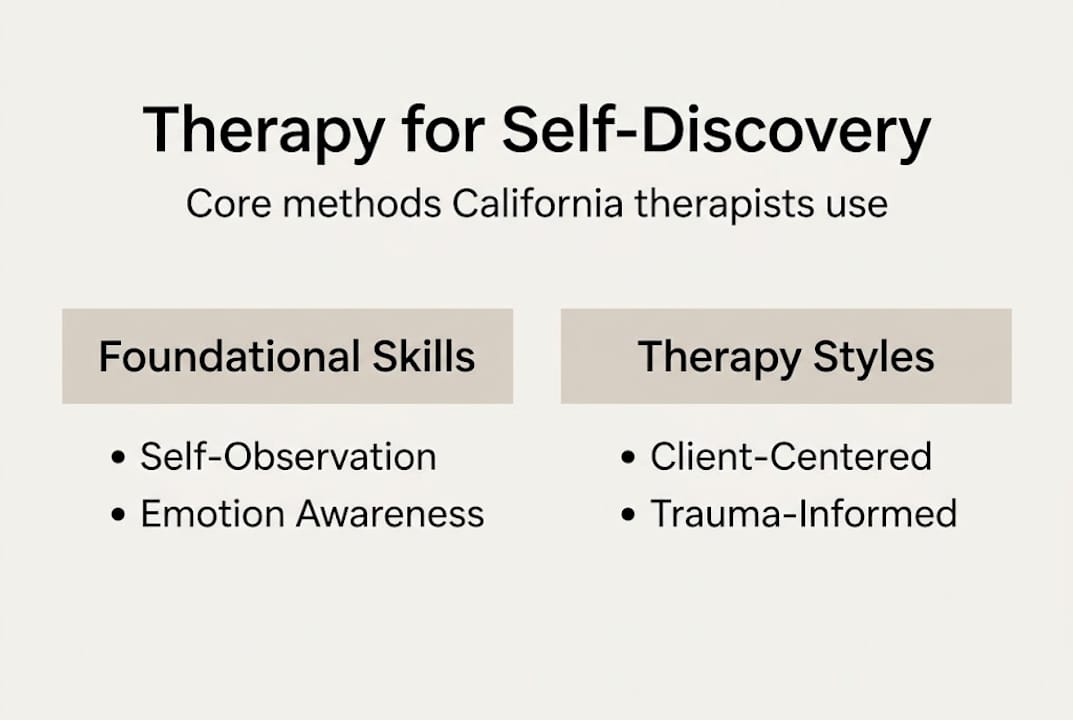
Therapy works because it creates a structured space for you to notice yourself. Not just your thoughts, but your patterns, your emotional reactions, and the defenses you’ve built without realizing it. Therapists trained in psychodynamic and trauma-informed methods use specific tools to help you do exactly that.
One of the most studied frameworks is iPDT (intensive psychodynamic therapy), which focuses on three core skills: self-observation (watching your own thoughts and feelings without judgment), emotion acceptance (sitting with difficult feelings instead of pushing them away), and defense recognition (spotting the habits you use to avoid emotional pain). Empirical data shows that iPDT leads to measurable gains in all three areas, and that higher depth of experiencing in sessions correlates directly with better emotional regulation.
But not all therapist interventions are equal. A key distinction in research is between TSI (therapist self-involving statements, where a therapist shares their in-the-moment reaction to you) and TSD (therapist self-disclosure, where they share personal stories from their own life). TSI interventions improve cooperation and metacognition more than TSD, meaning they help you think about your own thinking more effectively.
Here’s a quick comparison of outcomes:
| Intervention type | Effect on cooperation | Effect on metacognition | Client focus |
|---|---|---|---|
| TSI (self-involving) | High | High | Stays on client |
| TSD (self-disclosing) | Moderate | Moderate | Can shift to therapist |
What this means for you practically:
- A therapist reflecting “I notice you seem to pull back when we discuss your family” keeps the focus on your patterns.
- A therapist sharing a personal story may feel connecting but can occasionally shift attention away from your growth.
- Depth of experiencing research shows that the more actively engaged you are in sessions, the better your outcomes.
“The goal of therapy isn’t to hand you answers. It’s to help you develop the internal capacity to find them yourself.”
If you’re exploring therapy options in California, understanding these foundational methods helps you recognize what good therapy actually looks like in practice.
Therapist self-disclosure: A balance between guidance and client focus
Having outlined foundational techniques, it’s essential to clear up a common question: Should therapists share about themselves when supporting your self-discovery?
The short answer is yes, sometimes, but with real care. Therapist self-disclosure (TSD) means your therapist shares something personal, like a past struggle or a relevant life experience. Done well, it can normalize your feelings or model vulnerability. Done poorly, it can make you feel like you’re suddenly the one listening.
Research on self-disclosure shows it can be beneficial when used to model healthy behavior or reduce shame, but becomes risky when it’s excessive, poorly timed, or shifts the session’s emotional weight onto the therapist.
Here’s a practical breakdown of the risks and benefits:
- Benefit: Normalizing your experience. Hearing “many people feel that way” from someone who’s been through it can reduce isolation.
- Benefit: Building authentic connection. Appropriate disclosure can make the therapeutic relationship feel more human.
- Risk: Overloading the session. If a therapist shares too much, you may feel obligated to manage their feelings.
- Risk: Losing focus. The session should center on your patterns and growth, not your therapist’s history.
Pro Tip: If you’re unsure how your therapist approaches disclosure, just ask. Something like “How do you decide when to share about yourself?” is a completely reasonable question and a good therapist will welcome it.
Here’s how TSD and TSI compare in practical terms:
| Factor | TSD (self-disclosing) | TSI (self-involving) |
|---|---|---|
| Focus | Therapist’s past experience | Therapist’s present reaction to you |
| Best use | Normalizing, modeling | Deepening your self-awareness |
| Risk level | Higher if overused | Lower, stays client-centered |
| Effect on growth | Indirect | Direct |
For people working through trauma, the trauma-informed therapy benefits of a client-centered approach are especially significant. Keeping the focus on your experience, not your therapist’s, protects the emotional safety that trauma recovery requires.

Special considerations: Trauma-informed therapy and therapist expertise in California
While style and communication are essential, expertise in trauma care and access options is critical in California.
Not every licensed therapist is trained in trauma-informed care. When you’re working through deep emotional patterns or past experiences that shaped who you are, you need someone with specific skills. In California, licensed therapists carry credentials like LMFT (Licensed Marriage and Family Therapist) or LPCC (Licensed Professional Clinical Counselor). But credentials alone aren’t enough. You want someone who also has training in evidence-based trauma modalities.
Two of the most effective are:
- EMDR (Eye Movement Desensitization and Reprocessing): Proven to reduce the emotional charge of traumatic memories so they no longer hijack your present.
- IFS (Internal Family Systems): Helps you understand the different “parts” of yourself, including protective parts that may be holding you back.
APA guidelines recommend evidence-based trauma treatments delivered by licensed providers, particularly for adults with complex trauma histories. These aren’t optional extras. They’re the standard of care.
Access is also a real issue in California. The state is large, and many people live far from urban therapy centers. Telehealth has changed this significantly. Telehealth access statewide now means you can connect with a trauma-informed therapist from anywhere in California, whether you’re in the Bay Area or a rural county.
Key benefits of trauma-informed approaches for emotional health:
- Reduces hypervigilance and emotional reactivity over time
- Builds a felt sense of safety in your own body
- Helps you recognize how past experiences shape present behavior
- Supports lasting emotional regulation, not just symptom relief
- Treats the whole person, not just the diagnosis
Pro Tip: Before your first session, ask a potential therapist two questions: “Are you licensed in California?” and “What trauma-specific training do you have?” Their answers will tell you a lot about whether they’re the right fit.
APA trauma care guidelines continue to evolve, and working with a therapist who stays current with best practices matters for your outcomes.
Agency and depth: How therapists empower lasting change
With the right therapist providing trauma-informed care and flexible access, how does therapy create real, lasting self-discovery?
The answer comes down to agency, which means your sense of being the author of your own inner life. Therapy that builds agency doesn’t just give you insights. It shifts how you relate to your own experience so that growth continues long after sessions end.
Research on agency-enhancing therapy shows that the most effective approaches focus on your contributions to the session, help you recognize holistic patterns across your life, and draw attention to silent or overlooked experiences rather than pushing therapist-led interpretations.
Here’s how skilled therapists deepen your self-awareness step by step:
- Slow down reactions. They help you pause between stimulus and response so you can observe what’s actually happening inside you.
- Name what’s unnamed. They reflect back patterns you haven’t put into words yet, which makes them workable.
- Connect present to past. Without blame or over-analysis, they help you see how old experiences shape current choices.
- Celebrate small shifts. They notice and validate subtle changes in how you think or feel, building your confidence in your own growth.
- Step back when needed. Rather than directing you, they create space for your own insights to emerge.
It’s also worth knowing that not everyone enters therapy from the same starting point. Clients with low personality integration may need a more empathic, mindful approach before deeper self-exploration feels safe. A good therapist adjusts their style to where you actually are, not where they think you should be.
“Lasting change doesn’t come from being told who you are. It comes from discovering it yourself, with someone skilled enough to guide without controlling.”
Exploring trauma therapy options or learning about evidence-based trauma recovery can help you understand which approach fits your specific needs.
A perspective: What most guides miss about the journey to self-discovery
Most articles about therapy promise transformation. Big breakthroughs. The moment everything clicks. But in our experience, that framing sets people up for disappointment.
Real self-discovery is quieter than that. It’s noticing, mid-conversation, that you didn’t shrink the way you used to. It’s realizing you made a different choice without even thinking about it. These small shifts are the actual work. They’re also easy to dismiss because they don’t feel dramatic enough.
The therapists who support the deepest growth tend to do less, not more. They resist the urge to explain you to yourself. They hold space for you to arrive at your own understanding, even when it takes longer. That restraint is a skill, and it’s harder than giving advice.
If you’ve ever left a session feeling like nothing happened, consider that something might have. The quietest sessions are sometimes the ones where the most important work is taking root. Why accessibility matters in this context is real. When therapy is easy to access and affordable, you can show up consistently, and consistency is where the quiet shifts accumulate into lasting change.
Start your self-discovery journey with expert guidance
If you’re ready to step into your own journey of healing and understanding with proper support, here is how to start.
At ReviveHealthTherapy, we work with Californians who are ready to understand themselves more deeply, whether that means processing past trauma, improving emotional regulation, or simply feeling more at home in their own lives.

Our therapists are trained in trauma-informed therapy approaches including EMDR, IFS, and CBT, and offer both in-person sessions in Walnut Creek and Oakland, as well as secure telehealth statewide. Sliding-scale fees and insurance acceptance make care accessible regardless of your income. If you’re curious about what seeking psychotherapy in California could look like for you, we’d love to be part of that conversation. Reach out to schedule a consultation and take the first step.
Frequently asked questions
How do therapists help with self-discovery?
Therapists use guided techniques to foster self-observation, emotion acceptance, and help you recognize and shift unhelpful patterns. Therapy enhances self-discovery through structured approaches that build your capacity to understand yourself from the inside out.
Is therapist self-disclosure always helpful?
Self-disclosure can build trust and empathy but should be used sparingly and in ways that center your growth. Excessive self-disclosure can shift focus away from the client and create unhelpful ruptures in the therapeutic relationship.
What should I look for in a California therapist for self-discovery?
Seek licensed therapists with trauma-informed credentials like EMDR or IFS training and statewide telehealth access. APA guidelines recommend evidence-based trauma interventions delivered by licensed providers as the standard of care.
Can therapy actually change how I feel about myself?
Yes. Depth of experiencing in therapy correlates with better emotional regulation and greater satisfaction in relationships, showing that active engagement in sessions produces real, measurable change.
Do telehealth therapy options in California support self-discovery?
Absolutely. Telehealth expands access to trauma-informed therapists so you can explore personal growth from anywhere in the state, removing geographic barriers that might otherwise prevent consistent care.
Recommended
- How to Start Therapy for Emotional Growth in California – ReviveHealthTherapy
- How to Choose a Therapist in California for Lasting Change – ReviveHealthTherapy
- 7 Essential Tips for Choosing a Therapist in California – ReviveHealthTherapy
- Aidan Purdy, AMFT | Therapist in Walnut Creek – Revive Health Therapy
- Why Naming Your Feelings Helps — The Caia Journal