
TL;DR:
- Understanding your insurance benefits helps ensure coverage for your child’s therapy sessions and avoids unexpected costs. Verifying plan details, confirming in-network providers, and carefully saving documentation empower parents to navigate claims successfully and maximize benefits.
Understanding your insurance plan is the single most effective step you can take before booking your child’s first therapy appointment. Navigating insurance for child therapy means knowing your plan’s mental health benefits, confirming provider networks, and understanding exactly what you will pay at each session. Parents who skip this step often face surprise bills, denied claims, or delayed care. The core terms to master are deductible, copay, coinsurance, and medical necessity. Federal law, state programs like Medicaid and CHIP, and the Mental Health Parity and Addiction Equity Act all shape what your plan must cover and how much it can charge you.
What key insurance terms do parents need to know before starting child therapy?
Your deductible is the amount you pay out of pocket before insurance starts sharing costs. Your copay is a flat fee per session, often $20–$50, paid regardless of whether you have met your deductible. Coinsurance is the percentage you pay after the deductible is met. Parents must differentiate these three costs clearly to avoid surprise bills when using insurance for child therapy.
The Mental Health Parity and Addiction Equity Act requires insurance plans to cover mental health benefits on the same terms as medical benefits. That means your plan cannot impose stricter session limits or higher copays for therapy than it does for a primary care visit. Actual covered services and provider types still vary, so verification remains critical.
ACA-compliant private insurance plans cannot impose annual or lifetime dollar limits on essential mental health benefits. This protection applies to most employer-sponsored and marketplace plans. Grandfathered plans and short-term health plans may not carry the same guarantee.
Medicaid and CHIP extend meaningful coverage to children from lower-income families. Nearly two-thirds of all U.S. states cover behavioral health therapy for children under Medicaid or CHIP without requiring a formal diagnosis. That removes a significant barrier for families whose children are struggling but have not yet received a clinical label.
Pro Tip: Before your child’s first appointment, pull out your insurance card and look up your plan’s Summary of Benefits and Coverage document. It lists your deductible, copay, and coinsurance for outpatient mental health visits in plain language.
How do you verify insurance coverage and find a therapist who accepts your plan?
Verification is a two-step process: call your insurer, then call the therapist’s office directly. Start by dialing the member services number on the back of your insurance card. Ask specifically about outpatient mental health benefits for a minor, whether a referral or prior authorization is required, and what your copay or coinsurance will be after the deductible.
- Ask for your specific plan product name. A therapist may be in-network for one plan but not another, even within the same insurer. Saying “Blue Shield” is not enough. You need the exact product, such as “Blue Shield PPO Silver 70.”
- Use the insurer directory as a starting point only. Insurance directories are often out of date. Call the therapist’s office directly and confirm they are in-network for your exact plan before scheduling.
- Ask about telehealth coverage. Telehealth sessions with licensed, in-network therapists are typically covered similarly to in-person sessions. Verify this with both your insurer and the therapist’s billing team.
- Confirm session limits and prior authorization rules. Some plans cap annual sessions at 20 or 30. Others require prior authorization after a set number of visits. Get this in writing or note the representative’s name and the date of the call.
- Check therapist credentials. Coverage depends on therapist licensing. A licensed clinical social worker, licensed marriage and family therapist, and licensed psychologist are typically covered, but confirm your plan’s list of covered provider types.
Pro Tip: When you call the therapist’s office, ask: “Do you bill insurance directly, and are you in-network for [plan name]?” A yes to both means your billing process will be straightforward.
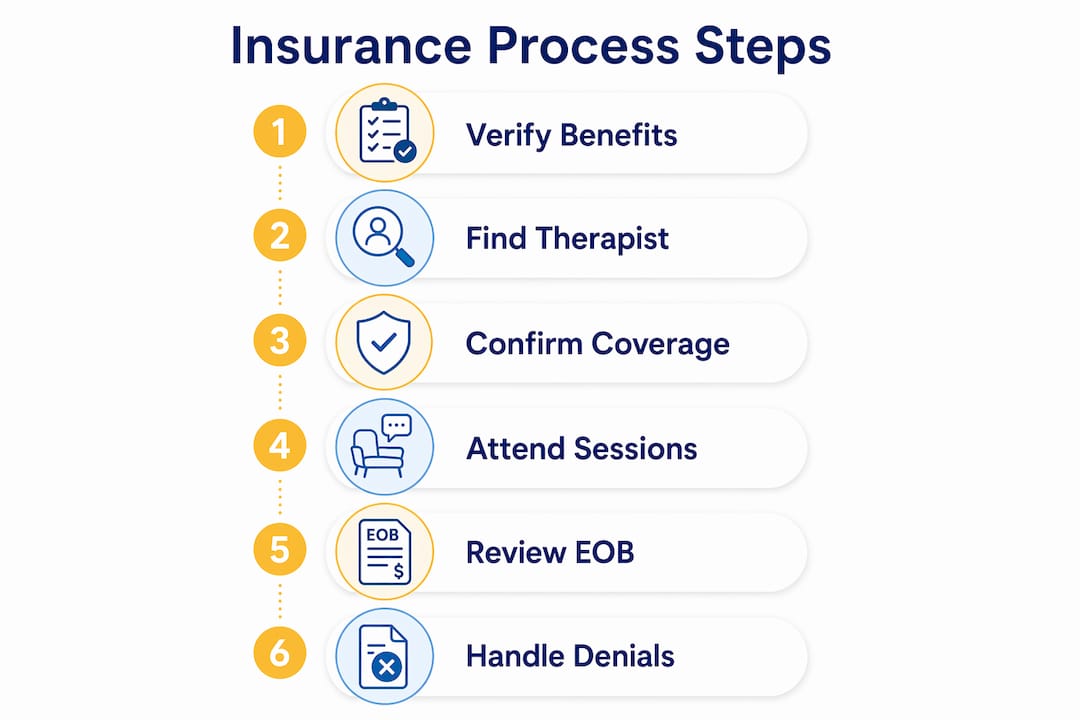
What is the step-by-step process for using insurance during therapy sessions?
Managing insurance during active therapy requires attention at three points: before the first session, during ongoing sessions, and when reviewing billing statements.
Before the first session
Confirm your benefits in writing by requesting a benefits verification letter from your insurer. Bring your insurance card to the first appointment. The therapist’s office will typically run an eligibility check, but having your card prevents delays. Ask the front desk what your expected copay will be and whether any deductible applies.

During ongoing sessions
Pay your copay or coinsurance at each visit. Keep a simple log of session dates, amounts paid, and the therapist’s name. Insurance companies focus on documented medical necessity rather than session caps for ongoing coverage. Your therapist submits a diagnosis code and treatment notes to support each claim.
Reviewing your Explanation of Benefits
Your insurer sends an Explanation of Benefits, or EOB, after each claim. The EOB shows what the therapist billed, what insurance paid, and what you owe. Save every EOB. EOB documents are key for appeals or disputes if a claim is later denied or adjusted.
Handling out-of-network visits
If your child sees an out-of-network therapist, ask for a superbill after each session. A superbill is an itemized receipt with diagnosis codes and service codes that you submit directly to your insurer for reimbursement. Superbill reimbursement typically takes 2–6 weeks for insurance processing. Out-of-network reimbursement rates are lower, so expect to pay a larger share.
| Step | Action | Key document |
|---|---|---|
| Before first session | Verify benefits and copay | Benefits verification letter |
| At each session | Pay copay, log the visit | Payment receipt |
| After each session | Review insurer’s statement | Explanation of Benefits (EOB) |
| Out-of-network visit | Request itemized receipt | Superbill |
| Claim dispute | Gather EOBs and appeal | Appeal letter with supporting notes |
What should you do when insurance denies a child therapy claim?
Claim denials are common and often reversible. The most frequent reasons for denial are lack of a formal diagnosis, insufficient medical necessity documentation, or a therapist whose credentials are not covered under the plan.
- Lack of diagnosis. Therapy billed without a formal diagnosis is often treated as elective and will not be covered. Confirm how your therapist codes visits and what documentation is submitted with each claim.
- Medical necessity disputes. Insurers may argue that the frequency or type of therapy is not medically necessary. Your therapist can write a letter of medical necessity explaining the clinical rationale for the treatment plan.
- Credential mismatches. Coverage varies by provider credentials. If your therapist’s license type is not on your plan’s covered provider list, the claim will be denied regardless of the service provided.
- Prior authorization lapses. Some plans require reauthorization after a set number of sessions. Missing this window causes automatic denials. Ask your therapist’s office to track authorization expiration dates.
“Parents who document every call, save every EOB, and submit appeals with clinical notes from the therapist win a significant share of denials on the first appeal. Persistence and paperwork are the two most effective tools available.”
To appeal a denial, write a formal appeal letter, attach the EOB showing the denial, include your therapist’s letter of medical necessity, and reference the Mental Health Parity and Addiction Equity Act if the denial appears to apply stricter standards than medical claims. Most insurers must respond to appeals within 30–60 days.
Pro Tip: Ask your therapist’s office if they handle appeals on your behalf. Many practices do this routinely and know exactly what language insurers respond to.
How do you evaluate affordability and maximize therapy benefits over the year?
Understanding your annual deductible and out-of-pocket maximum is the foundation of financial planning for child therapy. Once you meet your out-of-pocket maximum, insurance covers 100% of covered services for the rest of the plan year. Families who start therapy early in the calendar year often reach this threshold faster and pay less overall.
Balancing in-network and out-of-network costs
Most health insurance plans cover child therapy sessions to some extent, but savings depend heavily on in-network status, deductibles met, copays, and coinsurance rates. Out-of-network therapy can cost two to three times more per session after accounting for lower reimbursement rates and higher coinsurance.
| Cost factor | In-network | Out-of-network |
|---|---|---|
| Copay per session | Fixed, lower amount | Not applicable |
| Coinsurance | Lower percentage | Higher percentage |
| Deductible applies | Yes | Yes, often separate |
| Reimbursement process | Automatic | Submit superbill manually |
| Annual session limits | Per plan terms | Per plan terms |
Using public programs when applicable
Families who qualify for Medicaid or CHIP gain access to behavioral health therapy coverage that often requires no prior authorization and imposes no strict session limits before medical necessity is reviewed. Check your state’s Medicaid portal or call 1-800-318-2596 to screen for eligibility. Revivehealththerapy accepts several insurance plans and can help you confirm whether your coverage applies to child and teen therapy services.
Pro Tip: Ask your therapist’s billing team to run a benefits check at the start of each new plan year. Deductibles reset on January 1 for most plans, and your copay or coinsurance rate may change with a new plan year.
Key Takeaways
Verifying your insurance benefits before the first appointment, understanding your deductible and copay, and saving every EOB are the three actions that most reliably reduce out-of-pocket costs for child therapy.
| Point | Details |
|---|---|
| Verify before booking | Call member services and the therapist’s office to confirm in-network status for your exact plan. |
| Know your cost structure | Deductible, copay, and coinsurance each affect what you pay per session in different ways. |
| Save all EOB documents | EOBs are required for appeals and are the primary record of what insurance paid. |
| Appeal denied claims | Submit a formal appeal with a letter of medical necessity and reference the Mental Health Parity Act. |
| Use Medicaid or CHIP | Qualifying families can access behavioral health therapy with fewer restrictions and lower costs. |
What I have learned after years of watching families fight for coverage
Parents consistently underestimate how much leverage they have with insurance companies. The system is designed to be confusing, but it is not designed to be impenetrable. The families who get the most out of their coverage are the ones who ask specific questions, write things down, and refuse to accept the first denial as final.
The single biggest mistake I see is parents choosing a therapist based on a recommendation and assuming the insurance piece will sort itself out. It rarely does without active effort. The insurance and therapy relationship in California is particularly layered, with plan products varying significantly even within the same insurer.
The second mistake is treating a denial as a verdict. A denial is an opening position. An appeal with a therapist’s clinical notes and a reference to the Mental Health Parity and Addiction Equity Act changes the conversation entirely. I have seen families recover thousands of dollars in reimbursements through a single well-written appeal letter.
Therapy works. The evidence for CBT, EMDR, and mindfulness-based approaches with children is strong. The administrative work of understanding child therapy insurance is genuinely worth doing. Your child’s access to consistent, quality care depends on it.
— Amy
How Revivehealththerapy supports families through the insurance process
Revivehealththerapy works with insurance plans and offers transparent billing support so parents can focus on their child’s care rather than paperwork. The team at Revivehealththerapy verifies benefits before the first session, explains your financial responsibility in plain terms, and handles claims directly with insurers.

Revivehealththerapy provides child and teen therapy at locations in Walnut Creek and Oakland, as well as secure telehealth sessions across California. Sliding-scale fees and HSA/FSA plan acceptance make care accessible at multiple income levels. If you are ready to confirm your coverage and get your child started with evidence-based therapy, contact Revivehealththerapy to take the next step.
FAQ
What does insurance typically cover for child therapy?
Most health insurance plans cover outpatient child therapy sessions, but the amount depends on your deductible, copay, coinsurance, and whether the therapist is in-network. ACA-compliant plans cannot impose annual dollar limits on mental health benefits.
Does my child need a diagnosis for insurance to cover therapy?
Therapy billed without a formal diagnosis is typically treated as elective and will not be covered. Confirm with your therapist how visits are coded and what documentation is submitted to your insurer with each claim.
How do I know if a therapist is in-network for my plan?
Call the therapist’s office directly and provide your exact plan product name. Insurance directories are frequently outdated, so direct confirmation is the only reliable method.
What can I do if my child’s therapy claim is denied?
Submit a formal appeal with your therapist’s letter of medical necessity and your EOB showing the denial. Reference the Mental Health Parity and Addiction Equity Act if the denial appears to apply stricter standards than medical claims.
Does Medicaid cover child therapy without a formal diagnosis?
Nearly two-thirds of U.S. states cover behavioral health therapy for children under Medicaid or CHIP without requiring a formal diagnosis, making it one of the most accessible options for qualifying families.
Recommended
- How to Prepare for Child’s First Therapy Session Effectively – ReviveHealthTherapy
- Child therapy guide: what parents need to know – Revive Health Therapy
- Why Seek Child-Inclusive Therapy: A Parent’s Guide – Revive Health Therapy
- How to Support Kids in Therapy for Effective Results – ReviveHealthTherapy