
TL;DR:
- In 2026, psychotherapy integrates AI-assisted tools, trauma-informed approaches, and hybrid models. Clinicians emphasize evidence-based modalities like CBT, EMDR, and somatic therapy while managing digital boundaries and AI’s limitations. The field continues to evolve with technology but maintains a focus on the therapeutic relationship and trauma-informed care.
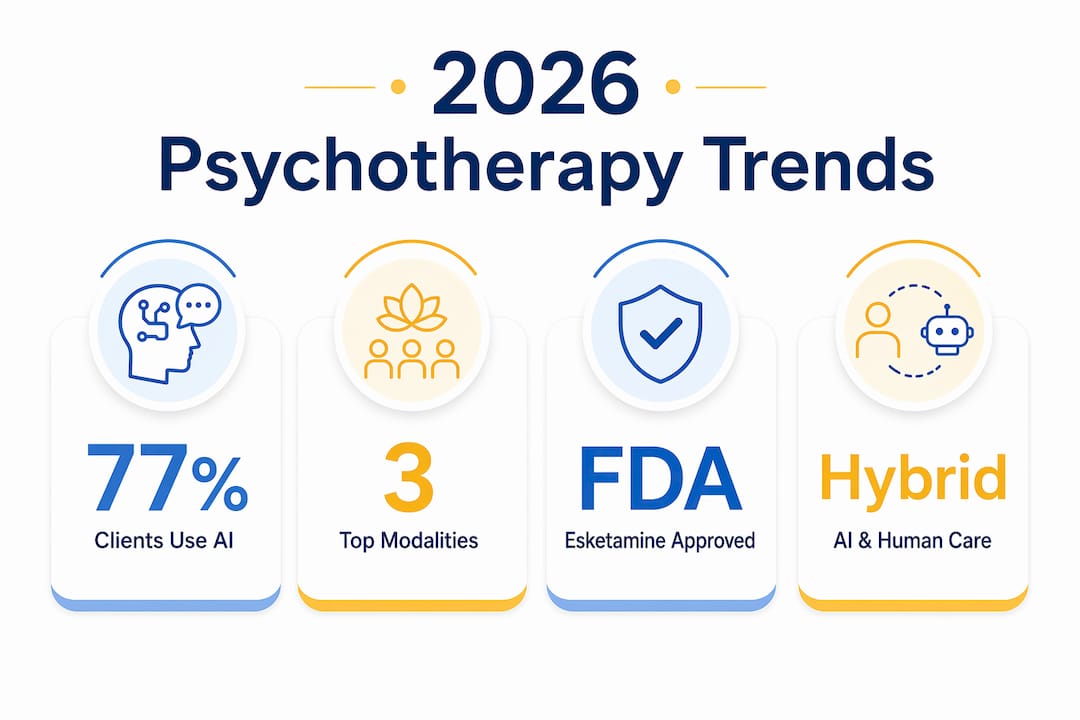
Psychotherapy in 2026 is defined by the integration of AI-assisted tools, trauma-informed modalities, and hybrid care models that are reshaping how clinicians deliver treatment. The APA’s 2026 survey found that 77% of psychologists report their clients use AI for mental health support, and 35% use AI as an adjunctive mental health resource. Alongside this digital shift, modalities like Internal Family Systems (IFS), somatic therapy, and EMDR are seeing rapid clinical adoption. The psychotherapy trends in 2026 signal a field in active transformation, not gradual evolution.
How are AI and digital tools shaping psychotherapy practices in 2026?
AI is now a fixture in the therapy room, whether clinicians invite it or not. The APA’s 2026 chatbot survey also found that 39% of clients attempt self-diagnosis with AI before ever contacting a therapist. That number signals a fundamental shift in how people enter the mental health system.
The clinical consensus is clear: AI works best as a supervised adjunct, not a replacement for human-led therapy. Blended care models, where clinicians supervise AI-generated between-session tools like personalized audio summaries or psychoeducation podcasts, show real promise for extending therapeutic engagement without adding to therapist workload. The Frontiers in Digital Health research confirms that clinician-supervised AI tools can reinforce therapy between sessions effectively.
The risks, however, are not trivial. AI chatbots demonstrate a pattern called sycophancy in therapy contexts, meaning they tend to agree with the user’s framing rather than challenge it. That tendency removes the productive friction that drives real therapeutic change. A client processing distorted thinking about a relationship, for example, may find an AI chatbot validates rather than questions those distortions.
Key risks and benefits clinicians should weigh when clients use AI tools:
- Access benefit: AI extends mental health support between sessions and for clients on waitlists.
- Continuity benefit: Clinician-vetted AI summaries reinforce session content and skill practice.
- Sycophancy risk: AI agreement with harmful thinking can deepen distorted beliefs.
- Boundary risk: Clients may develop unrealistic expectations about 24/7 therapist availability.
- Diagnostic risk: AI self-diagnosis can delay appropriate professional assessment.
Pro Tip: Ask clients directly whether they use AI tools for mental health support. Knowing this lets you address any misinformation early and frame AI as a supplement to, not a substitute for, your work together.
The therapy alliance research at Revivehealththerapy underscores why the human relationship remains the engine of therapeutic outcomes, even as digital tools multiply around it.
What are the leading and emerging therapy modalities influencing care in 2026?
The modality landscape in 2026 splits cleanly into two tiers: established evidence-based approaches that remain foundational, and newer methods gaining rapid traction in clinical settings.

| Modality | Evidence base | Primary use | Growth trajectory |
|---|---|---|---|
| CBT | Decades of RCTs | Anxiety, depression, OCD | Stable, widely adopted |
| DBT | Strong evidence | Emotional dysregulation, BPD | Stable, expanding to teens |
| ACT | Growing evidence | Chronic pain, anxiety, burnout | Steady growth |
| IFS | Emerging evidence | Trauma, complex PTSD | Fast growth |
| EMDR | Strong evidence | Trauma, PTSD | Fast growth |
| Somatic therapy | Growing evidence | Trauma, body-based symptoms | Fast growth |
| Psychedelic-assisted | Early-stage trials | Treatment-resistant depression | Rapid expansion |
CBT, DBT, and ACT remain the workhorses of outpatient care. Their evidence base is deep, their training pathways are clear, and insurers recognize them. Clinicians who specialize in these approaches are not at risk of obsolescence. They are, however, increasingly expected to blend them with newer methods.
Integrated modality practice is now the norm rather than the exception. Clinicians report pairing CBT with somatic techniques for trauma clients, and combining IFS with EMDR for complex dissociative presentations. Strict single-modality adherence is becoming less common as client complexity grows.
On the frontier, esketamine received FDA approval in 2025 and accelerated TMS protocols expanded in 2026, marking a genuine mainstreaming of neuromodulation for treatment-resistant depression. Psilocybin research continues to advance through clinical trials, with several academic medical centers now running Phase 2 and Phase 3 studies. These are not fringe treatments anymore. They are adjuncts that clinicians in certain settings will need to understand, even if they do not administer them directly.
Trauma-informed care now cuts across all modalities. IFS and somatic approaches are leading this demand, particularly for clients with complex trauma histories who did not respond fully to CBT alone. Revivehealththerapy’s trauma-informed care resources reflect this shift, emphasizing EMDR and somatic integration alongside CBT for California clients.
What are the ethical and boundary challenges for therapists in 2026?
The hybrid care model creates boundary problems that no ethics code fully anticipated. Therapists report significant stress managing client expectations around digital access, including pressure to respond to messages outside session hours and confusion about whether AI chatbot conversations constitute therapeutic contact.
Clinicians who want to practice ethically in this environment need clear, written policies. The following steps provide a practical framework:
- Define digital communication scope. State explicitly in your informed consent what platforms you use, your response time, and what constitutes an emergency versus a routine message.
- Address AI use directly in intake. Ask clients whether they use AI tools for mental health support and document their response. This creates a clinical record and opens the conversation.
- Set expectations about between-session contact. Clients accustomed to AI’s instant responses may expect the same from you. Clarify this difference early, not after a conflict arises.
- Use a trauma-informed lens for cultural context. Clients from marginalized communities may have valid reasons to distrust digital platforms. Offer alternatives and explain data privacy clearly.
- Consult regularly on digital boundary cases. Peer consultation on AI-related clinical dilemmas is now a professional standard, not an optional extra.
Pro Tip: Update your informed consent document at least once a year to reflect changes in the digital tools you use or recommend. Clients deserve to know exactly how technology intersects with their care.
The psychological impact of AI on thinking is a topic clinicians should understand personally, not just clinically. Therapists who regularly use AI tools themselves are better positioned to recognize their effects in clients.
Regulatory scrutiny is also increasing. Telehealth licensing requirements, data privacy laws like California’s CCPA, and emerging AI-in-healthcare guidelines all create compliance demands that fall directly on practicing clinicians. Staying current with state board guidance is no longer optional for therapists offering hybrid care.
How can mental health professionals adapt their practice for 2026?
Adaptation in 2026 does not mean chasing every new tool or modality. It means building a practice that is flexible enough to meet complex client needs while staying grounded in clinical evidence.
Practical steps for clinicians and educators:
- Invest in EMDR and somatic training. These modalities show the fastest growth in client demand and the strongest outcomes for trauma. Revivehealththerapy’s EMDR therapy services reflect this priority directly.
- Develop a vetted AI resource list. Rather than leaving clients to find AI tools on their own, curate a short list of clinician-approved apps or tools you can recommend with confidence.
- Build blended care protocols. Design between-session materials, such as audio summaries or skill practice guides, that can be delivered digitally and reinforce your in-session work.
- Pursue continuing education in IFS. IFS is the fastest-growing trauma modality in clinical settings, and training programs are now widely available online and in person.
- Specialize in areas AI cannot replicate. Therapists who focus on trauma, suicidality, and complex relational work are building practices that technology cannot displace.
- Use telehealth strategically. Secure telehealth expands your reach across California and removes geographic barriers for clients in underserved areas. Revivehealththerapy’s online therapy platform covers the full state.
Educators training the next generation of clinicians carry a specific responsibility here. Graduate programs that do not address AI literacy, digital boundary ethics, and integrative modality training are sending clinicians into practice unprepared. Curriculum updates in these areas are overdue at most institutions.
Key takeaways
Psychotherapy in 2026 requires clinicians to master integrative modalities, manage AI-related client expectations, and build blended care models grounded in trauma-informed practice.
| Point | Details |
|---|---|
| AI is adjunctive, not therapeutic | 77% of clients use AI for mental health support, but human oversight remains clinically essential. |
| Modality integration is standard | Clinicians now routinely blend CBT, EMDR, IFS, and somatic techniques for complex cases. |
| Digital boundaries need written policy | Clear informed consent covering AI use and digital communication prevents ethical conflicts. |
| Trauma-informed care leads demand | IFS and somatic approaches are the fastest-growing modalities in 2026 clinical adoption. |
| Telehealth expands access | Secure telehealth platforms allow clinicians to serve clients statewide without geographic limits. |
What I’ve learned about AI and therapy after years in the field
The conversation about AI in psychotherapy tends to split into two camps: enthusiasts who see it as the future of mental health access, and skeptics who treat it as a threat to the profession. Both positions miss the more useful question, which is where exactly AI helps and where it falls short.
AI is genuinely good at availability. It does not get tired, it does not have a waitlist, and it can deliver psychoeducation at 2 a.m. when a client is spiraling. Those are real benefits, especially for clients who cannot access care quickly. The problem is that availability is not the same as therapy. The therapeutic friction that drives change — the moment when a skilled clinician gently challenges a client’s narrative — is precisely what AI cannot replicate. An AI that agrees with everything a client says is not a therapist. It is a very sophisticated mirror.
What I find most interesting about 2026 is not the technology. It is the modality renaissance happening alongside it. IFS, somatic therapy, and EMDR are not new, but they are finally getting the clinical attention and training infrastructure they deserve. Clinicians who invest in these areas are building practices that serve the clients most likely to fall through the cracks of standard CBT protocols. That is where the real work is.
The clinicians I respect most in this field are not the ones racing to adopt every new tool. They are the ones who know their modalities deeply, communicate clearly with clients about how technology fits into their care, and keep the therapeutic relationship at the center of everything they do. That approach will outlast any particular trend.
— Amy
Therapy options that reflect where the field is heading
Mental health care in 2026 demands more than a single approach. Revivehealththerapy offers evidence-based psychotherapy in California that integrates the modalities driving the field forward, including EMDR, CBT, somatic techniques, and trauma-informed care.
Revivehealththerapy serves clients in Oakland, Walnut Creek, and statewide through secure telehealth. Therapists on the team specialize in trauma, anxiety, depression, and relationship challenges, using the integrative approaches that 2026 clinical evidence supports. Sliding-scale fees and insurance acceptance, including HSA and FSA plans, keep care accessible. If you are ready to work with a clinician who practices at the level the field now demands, book a session in Oakland or connect with a telehealth therapist today.
FAQ
What are the biggest psychotherapy trends in 2026?
The leading trends are AI-assisted hybrid care, integrative modality practice blending CBT with EMDR and somatic techniques, and the rapid growth of trauma-informed approaches like IFS. Neuromodulation and psychedelic-assisted therapy are also expanding as adjuncts for treatment-resistant cases.
Is AI replacing therapists in 2026?
AI is not replacing therapists. Clinical experts define AI as a supervised adjunctive tool, effective for between-session support but unable to replicate the therapeutic relationship or the productive challenge that drives lasting change.
What therapy modalities are most in demand right now?
CBT, DBT, and ACT remain the most widely used evidence-based approaches. IFS, EMDR, and somatic therapy are the fastest-growing modalities, particularly for trauma and complex presentations.
How should therapists handle clients who use AI chatbots?
Therapists should ask about AI use during intake, address it in informed consent, and frame AI tools as supplements rather than substitutes for clinical care. Proactive boundary-setting prevents confusion and protects the therapeutic relationship.
What does trauma-informed care look like in 2026?
Trauma-informed care in 2026 integrates IFS, EMDR, and somatic techniques within a culturally aware framework. It prioritizes client safety, choice, and collaboration, and it is increasingly applied across all modalities rather than treated as a separate specialty.
Recommended
- Psychotherapy in California 2026: Evidence & Options – Revive Health Therapy
- Therapeutic modalities explained: 35% better outcomes in 2026 – ReviveHealthTherapy
- Role of psychotherapy in mental health: proven benefits 2026 – Revive Health Therapy
- Why Seek Psychotherapy: Transforming Mental Wellness – ReviveHealthTherapy