
TL;DR:
- Assessment in psychotherapy gathers detailed information to guide treatment and improve outcomes. It enhances diagnostic clarity, validates client experiences, and fosters collaboration between therapist and client. Ongoing assessment allows therapists to monitor progress, tailor interventions, and strengthen the therapeutic relationship effectively.
Assessment in psychotherapy is the structured process of gathering detailed information about a client’s psychological functioning to guide treatment decisions and improve outcomes. Without this foundation, therapy risks becoming a series of educated guesses rather than targeted, evidence-based care. The role of assessment in psychotherapy extends far beyond diagnosis. It validates client experiences, sharpens clinical focus, and creates a shared language between therapist and client. Revivehealththerapy builds every treatment plan on this foundation, using structured evaluation to personalize care for clients across California.
What are the core purposes of assessment in psychotherapy?
Assessment in psychotherapy serves four primary functions: identifying problems, planning interventions, monitoring progress, and informing clients about their own mental health. Each function builds on the last. A therapist who skips any one of them is working with incomplete information.
The most underappreciated purpose is diagnostic clarity. Therapists who use routine outcome monitoring and structured assessments achieve measurably better clinical outcomes, with higher diagnostic clarity scores (3.89 vs. 3.21 on a 5-point scale). That gap represents the difference between a therapist who knows what they are treating and one who is still guessing three sessions in.
Assessment also serves a validating function that clients rarely expect. When a therapist reflects objective findings back to a client, it reduces self-doubt and shame. Many clients arrive in therapy wondering if their struggles are real or if they are overreacting. A structured assessment answers that question with data, not reassurance alone.
The core purposes of psychotherapy assessment include:
- Problem identification: Pinpointing specific symptoms, patterns, and severity levels using tools like the PHQ-9 for depression or the GAD-7 for anxiety.
- Intervention planning: Matching treatment approaches such as CBT, EMDR, or mindfulness to the client’s specific profile rather than applying a one-size approach.
- Progress monitoring: Tracking symptom change over time so both therapist and client can see what is working.
- Client education: Sharing results collaboratively so clients understand their own patterns and become active participants in their care.
Pro Tip: Ask your therapist which specific tools they use and what each one measures. Understanding the purpose of an assessment makes it far easier to engage with honestly.
How do assessment techniques influence therapy outcomes?
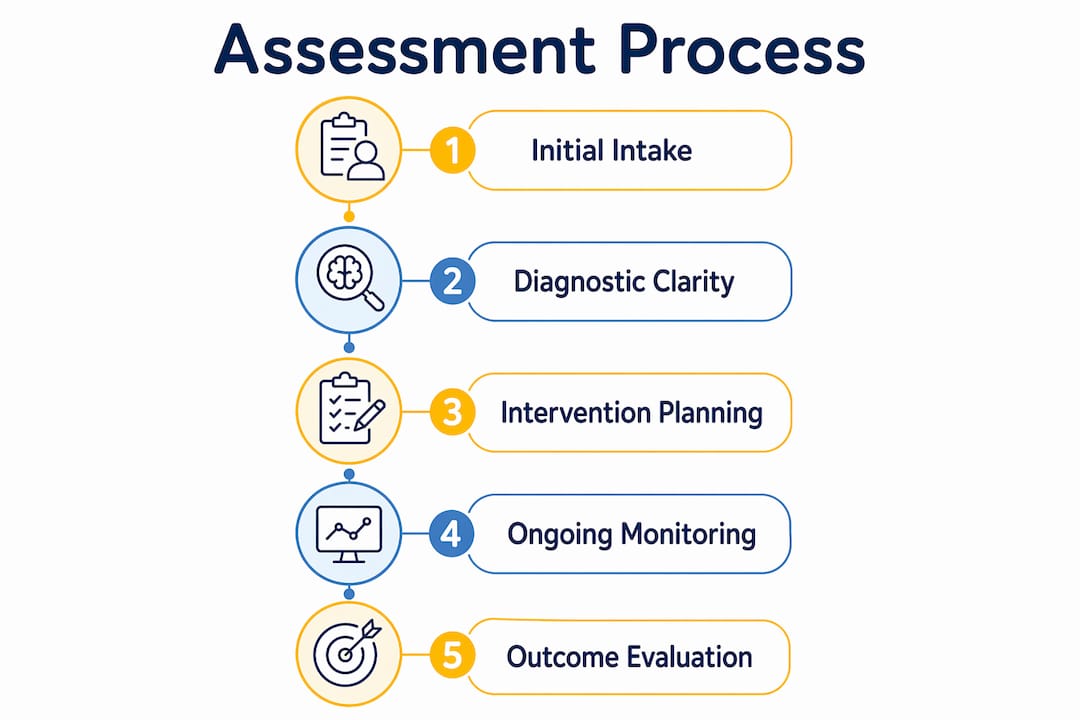
Specific assessment methods shape the entire direction of treatment. The choice between a standardized symptom scale, a structured diagnostic interview, and an open-ended clinical conversation produces very different clinical pictures, and very different treatment paths.

In the U.S., 84.2% of mental health professionals use standardized symptom scales, and 61.7% use structured or semi-structured diagnostic interviews for objective treatment planning. That leaves 38.3% still relying on unstructured interviews alone. Unstructured interviews depend entirely on a clinician’s memory and intuition, which introduces bias and inconsistency that structured tools are designed to remove.
The contrast between subjective judgment and data-driven decisions becomes clearest in complex cases. A client presenting with fatigue, low motivation, and sleep disruption could be experiencing depression, burnout, a trauma response, or a combination of all three. A standardized battery of assessments separates these possibilities in a way that conversation alone cannot.
Multimodal assessment takes this further by determining whether a client needs neurostructural trauma processing (what researchers call “hardware” interventions like EMDR) or metacognitive habit regulation (“software” interventions like CBT). This distinction transforms assessment from a general intake step into a precise targeting system for treatment.
| Assessment approach | Primary strength | Best clinical use |
|---|---|---|
| Standardized symptom scales | Objective, repeatable measurement | Tracking symptom severity over time |
| Structured diagnostic interviews | Reduces clinician bias | Clarifying diagnosis in complex presentations |
| Unstructured clinical interviews | Flexible, relationship-building | Early rapport and initial exploration |
| Multimodal assessment | Identifies intervention type needed | Trauma, mixed presentations, treatment-resistant cases |
Selecting the right measure for the right clinical goal is not optional. A trauma-focused scale used with a client presenting primarily with relationship conflict will produce misleading data. Measure selection must match the clinical question being asked.
Why is assessment an ongoing process, not a one-time event?
Assessment is a dynamic, ongoing process throughout therapy, not a single intake event. Therapists continuously update their understanding as clients share more, as symptoms shift, and as the therapeutic relationship deepens. Assessment never truly ends until therapy concludes.
This matters because clients change. A client who scores in the moderate range for anxiety at intake may show very different patterns by session six. Without repeated measurement, a therapist cannot tell whether the treatment is working, whether the original diagnosis was accurate, or whether a new issue has emerged.
The ongoing nature of evaluation in counseling follows a clear cycle:
- Initial assessment: Establish a baseline using standardized tools and clinical interview at the start of therapy.
- Session-by-session check-ins: Use brief measures (5 to 15 items) to track symptom fluctuation without overwhelming the client.
- Formulation updates: Revise the clinical picture when new information contradicts or expands the original understanding.
- Discrepancy review: When a client’s self-report scores and observed behavior do not match, treat that gap as clinically significant data, not noise.
- Planned debriefing: After any assessment that touches on trauma or painful history, schedule time immediately after to process the client’s emotional response.
Scores on assessment questionnaires are meaningless without clinical context. The real therapeutic work happens in the conversation about what those scores reveal, and in noticing when a client’s behavior tells a different story than their answers.
Pro Tip: If your therapist gives you a questionnaire, ask about the results in your next session. That conversation is often where the most useful insights emerge.
Ethical gaps arise when assessments trigger painful memories without a clinical debrief plan in place. A responsible therapist always builds time and support into the session following any sensitive assessment. If that debrief never happens, the assessment has done potential harm without delivering its benefit.
How does assessment strengthen the therapeutic relationship?
Assessment strengthens the therapeutic relationship when it is presented as a collaborative dialogue rather than a test. Clients often fear assessments as judgment. When a therapist shares results transparently and invites the client into the interpretation, that fear shifts into self-awareness and engagement.
Assessment primarily serves to validate client experiences through objective reflection. Seeing one’s own struggles reflected in a structured tool reduces the shame that keeps many clients from speaking openly. A client who has been told for years that they are “too sensitive” responds very differently to therapy when a validated scale confirms that their anxiety is real and measurable.
Assessment also clarifies the distinction between what is happening and why, while psychotherapy focuses on living better with what is happening. Both are necessary. Assessment without therapy leaves a client with a diagnosis but no path forward. Therapy without assessment risks treating the wrong problem.
Ways assessment builds the therapeutic alliance include:
- Transparency: Sharing results in plain language so clients understand what the data means for their care.
- Collaboration: Inviting clients to agree or disagree with findings, which deepens trust and accuracy.
- Normalization: Framing scores within population norms so clients see they are not alone in their experience.
- Empowerment: Giving clients a concrete picture of their own patterns, which increases their sense of agency in the therapy process.
Clients who understand their own assessment results engage more actively in treatment. That engagement is one of the strongest predictors of positive therapy outcomes.
What should clients know before their psychotherapy assessment?
Clients who understand what to expect from assessment get more out of it. The most common mistake is treating an assessment like a test with right and wrong answers. There are none. Honest answers produce useful data. Socially desirable answers produce a misleading clinical picture that slows treatment.
Practical guidance for clients entering a psychotherapy assessment:
- View it as a tool, not a verdict. Assessment results describe patterns, not permanent labels. They are a starting point, not a sentence.
- Ask about the purpose. Before completing any measure, ask your therapist what it measures and how the results will shape your treatment plan.
- Watch for fatigue. Short-to-medium length measures of 5 to 15 items balance data quality with client burden. If an assessment feels exhausting, that is worth mentioning.
- Expect a follow-up conversation. Results should always be discussed, not just filed. If your therapist does not review findings with you, ask directly.
- Know your rights. You can ask how your data is stored, who has access to it, and how long it is retained.
Pro Tip: Write down any reactions you have while completing an assessment, including what felt confusing, uncomfortable, or surprisingly accurate. Bringing those notes to your next session gives your therapist richer material to work with.
Ongoing assessment facilitates measurement-based care, enabling timely adjustments and better clinical outcomes compared to relying solely on subjective clinical judgment. Clients who actively participate in that process see faster progress.
Key Takeaways
Assessment is the clinical foundation that separates effective, targeted psychotherapy from generalized support, and its value compounds when it is ongoing, collaborative, and transparently shared with the client.
| Point | Details |
|---|---|
| Assessment drives diagnostic clarity | Structured tools produce measurably higher diagnostic accuracy than unstructured interviews alone. |
| Ongoing evaluation improves outcomes | Continuous monitoring allows therapists to adjust treatment before problems compound. |
| Assessment validates client experience | Objective reflection of symptoms reduces shame and builds therapeutic trust. |
| Measure selection must match clinical goals | Using the wrong tool for the wrong problem produces misleading data and misdirected treatment. |
| Client participation strengthens results | Clients who understand and engage with their assessment results progress faster in therapy. |
What I’ve learned about assessment that most articles miss
Working closely with the mental health field, I have noticed that assessment gets treated as a bureaucratic intake step rather than a clinical intervention in its own right. That framing does real harm. When a therapist rushes through a questionnaire at the first session and never mentions it again, they have wasted one of the most powerful tools in their kit.
The most meaningful shift I have seen in clinical practice is the move toward measurement-based care, where brief assessments become a regular part of every session rather than a one-time formality. Clients who experience this approach often describe a feeling of being genuinely seen. The numbers give language to experiences they struggled to articulate.
What surprises people is that assessment is not primarily about the therapist gathering data. It is about the client gaining self-knowledge. When a therapist says, “Your scores here suggest your nervous system is working very hard even when you feel calm,” that single sentence can reframe years of self-criticism into something a client can actually work with.
The uncomfortable truth is that therapy without structured assessment is slower, less targeted, and more dependent on a single clinician’s intuition. That is a lot to ask of any one person. Good assessment distributes that responsibility across validated tools, clinical observation, and the client’s own voice. All three together produce something none of them can produce alone.
— Amy
Revivehealththerapy’s approach to assessment-driven care
Revivehealththerapy integrates structured assessment into every stage of the therapy process, from the first session through ongoing progress monitoring. Clinicians use validated standardized tools alongside clinical interviews to build a clear, personalized picture of each client’s needs.
That picture shapes every treatment decision, whether a client is working through trauma, anxiety, depression, or relationship challenges. Assessment results are always shared and discussed collaboratively, so clients understand their own patterns and stay active in their care. Revivehealththerapy serves individuals, couples, families, and teens across California through in-person sessions in Walnut Creek and Oakland, and secure telehealth statewide. If you are ready to start with a structured, evidence-based approach, Revivehealththerapy is accepting new clients now.
FAQ
What is the role of assessment in psychotherapy?
Assessment in psychotherapy is the structured process of gathering objective information about a client’s symptoms, strengths, and history to guide diagnosis, treatment planning, and progress monitoring. It serves as the clinical foundation for all subsequent therapy decisions.
How does assessment influence therapy outcomes?
Therapists who use routine outcome monitoring achieve higher diagnostic clarity scores and better clinical results than those relying on unstructured interviews alone. Structured assessment reduces guesswork and allows treatment to be adjusted before problems worsen.
How often should assessments happen in therapy?
Assessment is an ongoing process throughout therapy, not a one-time intake event. Brief measures of 5 to 15 items used regularly balance data quality with client comfort and support timely treatment adjustments.
Can assessment improve the client-therapist relationship?
Yes. When therapists share assessment results transparently and invite clients into the interpretation, it builds trust, reduces shame, and increases client engagement. Collaborative assessment turns data into a shared language for the therapeutic work.
What should I do if an assessment brings up difficult feelings?
Tell your therapist immediately. Ethical practice requires a planned debrief after any assessment that touches on trauma or painful history. If that conversation does not happen automatically, ask for it directly in your next session.
Recommended
- Psychotherapy Trends in 2026: What Clinicians Must Know – Revive Health Therapy
- Psychotherapy in California 2026: Evidence & Options – Revive Health Therapy
- Role of psychotherapy in mental health: proven benefits 2026 – Revive Health Therapy
- Why Seek Psychotherapy: Transforming Mental Wellness – ReviveHealthTherapy