
TL;DR:
- Trauma-informed care emphasizes safety, trust, empowerment, and cultural humility in therapy.
- Recognizing signs like mood changes and sleep issues helps identify teens needing trauma support.
- Access options include school-based programs, legal rights for minors, insurance coverage, and crisis lines.
When your teenager starts pulling away, snapping at small things, or lying awake most nights, it’s easy to wonder if you’re missing something bigger. Many California parents find themselves caught between wanting to help and not knowing which type of care actually works. Trauma-informed care is not just a buzzword. It is a structured, evidence-based approach that reshapes how therapists engage with teens, prioritizing safety and trust over symptom management alone. Key methodologies for teens include TF-CBT, EMDR, DBT, family therapy, and holistic practices like mindfulness and art therapy. This guide walks you through what it all means and how to access it.
Table of Contents
- What is trauma-informed care and why does it matter for teens?
- How to recognize when your teen may need trauma-informed care
- Choosing the right trauma-informed therapies: evidence-based options
- Understanding access: laws, school-based supports, and finding care in California
- Why trauma-informed care in California needs to go beyond checklists
- Expert trauma-informed care is within reach for California families
- Frequently asked questions
Key Takeaways
| Point | Details |
|---|---|
| Early action matters | Watching for early signs and responding promptly can greatly improve outcomes for teens. |
| Choose evidence-based therapy | TF-CBT, EMDR, and family therapy have the strongest evidence for helping traumatized teens recover. |
| Teens can access care | California law allows minors 12 and older to seek outpatient mental health treatment on their own. |
| Cultural fit is crucial | Programs that respect cultural diversity and systemic trauma deliver better support for California families. |
| Assess program commitment | True trauma-informed providers go beyond checklists, investing in ongoing training and inclusive support. |
What is trauma-informed care and why does it matter for teens?
Trauma-informed care, often called TIC, is a framework that shapes every interaction between a provider and a young person. It is not a single therapy technique. Instead, it is a set of guiding principles that change how care is delivered at every level, from how a receptionist greets a family to how a therapist structures a session.
The six core principles are safety, trustworthiness, peer support, collaboration, empowerment, and cultural humility. Each one matters. Safety means the teen feels physically and emotionally secure. Trustworthiness means the provider is transparent and consistent. Empowerment means the teen has a voice in their own care. Cultural humility means the provider actively works to understand and respect a teen’s background, including the impact of racism, immigration stress, and other sociocultural pressures.
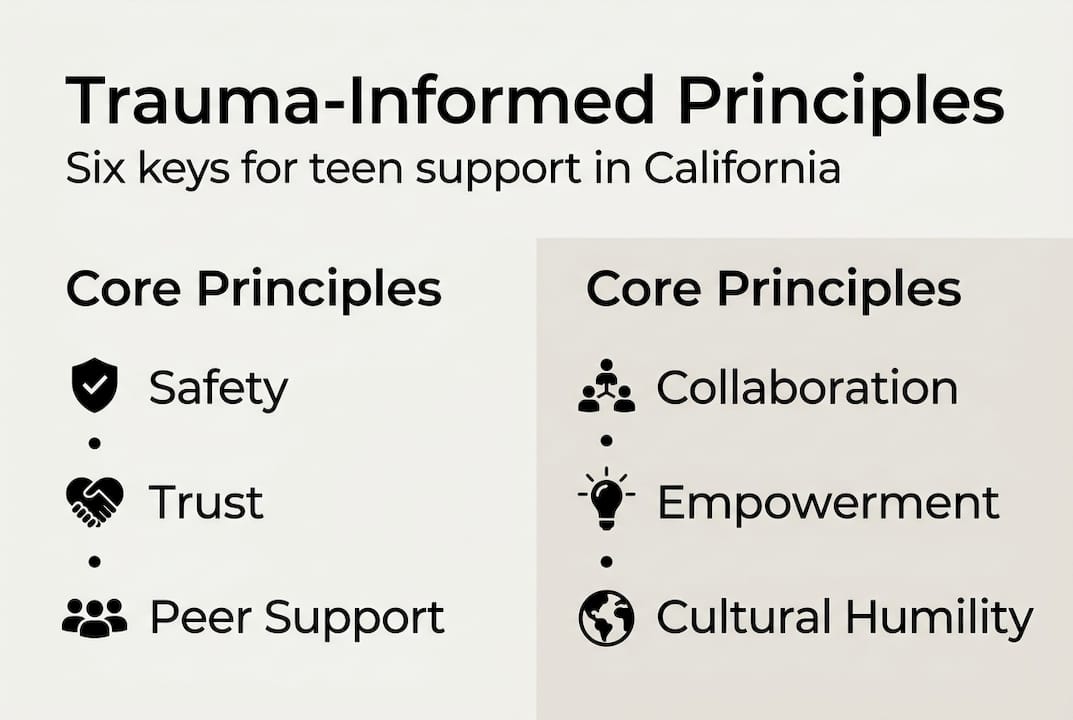
That last principle is especially important in California. The state is one of the most culturally diverse in the country, and cultural humility is key for diverse populations. Addressing sociocultural trauma, including racism and structural inequity, must be part of any real care plan.
Here is how trauma-informed care compares to traditional therapy:
| Feature | Traditional therapy | Trauma-informed care |
|---|---|---|
| Focus | Symptom reduction | Root causes and safety |
| Teen’s role | Passive recipient | Active collaborator |
| Cultural context | Often minimal | Central to care |
| Family involvement | Varies | Strongly encouraged |
| Risk of retraumatization | Higher | Actively minimized |
Why does this matter for teens specifically? Adolescents are in a critical window of brain development. Trauma during these years can disrupt emotional regulation, learning, and relationships in lasting ways. Trauma-informed care improves resilience, increases treatment engagement, and reduces the risk of retraumatization. Teens who feel safe and respected in therapy are far more likely to stay in it.
The trauma-informed therapy benefits go beyond the therapy room. When teens feel genuinely seen, they carry that sense of safety into their families and schools.
How to recognize when your teen may need trauma-informed care
Not every difficult phase in adolescence signals trauma. But some patterns go beyond typical teenage stress and point toward something that needs real clinical attention.
Here are seven signs worth watching closely:
- Sudden or persistent mood changes that seem disconnected from obvious causes
- Sleep disruptions, including nightmares, insomnia, or sleeping far too much
- Social withdrawal from friends, family, or activities they used to enjoy
- Increased anger or irritability, especially reactions that seem disproportionate
- Risk-taking behaviors like substance use, reckless driving, or self-harm
- Academic decline that is not explained by learning difficulties
- Physical complaints like headaches or stomachaches without a medical cause
The tricky part is that teens often mask distress. They may look fine at school and fall apart at home, or vice versa. Supporting child recovery starts with parents learning to read between the lines, not just react to surface behavior.

Do not wait for a crisis to act. Early intervention consistently leads to better outcomes. The longer trauma symptoms go unaddressed, the more they become woven into a teen’s coping patterns and sense of self.
Pro Tip: Pay attention to changes in your teen’s relationship with food, sleep, and physical activity. These three areas often shift before emotional distress becomes visible. If all three are changing at once, it is worth a conversation with a professional.
Parents also benefit from understanding that systemic buy-in drives success in trauma-informed programs. This means that when you are looking for a provider, you want to see leadership commitment, not just a single well-meaning therapist. Ask about the whole team’s training.
If you are unsure where to start, exploring types of teen therapy can help you get oriented before your first call to a provider.
Choosing the right trauma-informed therapies: evidence-based options
Once you recognize the signs, the next challenge is understanding what the therapy options actually involve. The landscape can feel overwhelming, but a few key approaches stand out for teens.
TF-CBT (Trauma-Focused Cognitive Behavioral Therapy) is the most widely researched option for adolescents. It involves psychoeducation, relaxation techniques, cognitive processing, gradual exposure to trauma memories, and dedicated family sessions. The family component is a major strength. Parents learn to support their teen’s progress between sessions, which accelerates recovery.
EMDR (Eye Movement Desensitization and Reprocessing) uses guided bilateral stimulation, often eye movements, to help the brain reprocess distressing memories. It is particularly effective for single-incident trauma and has growing support for complex trauma in teens. A detailed EMDR guide for teens can help you understand what sessions actually look like before committing.
DBT (Dialectical Behavior Therapy) is best suited for teens who struggle with intense emotional swings, self-harm, or suicidal thinking. It teaches concrete skills in distress tolerance, emotional regulation, and interpersonal effectiveness.
| Therapy | Best for | Family involvement | Session structure |
|---|---|---|---|
| TF-CBT | Most trauma types | High | Structured, phased |
| EMDR | Specific trauma memories | Moderate | Bilateral stimulation |
| DBT | Emotional dysregulation | Moderate | Skills-based groups |
| Holistic (mindfulness, art) | Complement to above | Varies | Flexible |
Holistic approaches like mindfulness, yoga, and art therapy work best as complements to structured therapy, not replacements.
One important note: evidence is promising but still early-stage for some modalities. TF-CBT is often the first-line recommendation over EMDR per several clinical guidelines, though both show comparable efficacy in many studies. More rigorous randomized controlled trials are still needed across the board.
Pro Tip: Before your teen’s first session, ask the therapist directly about their specific training in the approach they plan to use. A therapist certified in TF-CBT or trained in EMDR through an accredited program is a very different thing from one who has simply read about it.
For a broader view of evidence-based trauma options and how CBT for teens fits into a larger treatment picture, your research does not have to stop here.
Understanding access: laws, school-based supports, and finding care in California
Knowing which therapy works is only half the equation. The other half is understanding how to actually access it, especially in a state as large and varied as California.
Here is a practical step-by-step approach for California families:
- Know your teen’s legal rights. In California, minors 12 and older can consent to outpatient mental health treatment without parental consent in most cases. This matters because some teens will engage more honestly when they feel in control of their care.
- Start with your teen’s school. California has invested in school-based health centers that integrate trauma-informed practices. These are often free, accessible during school hours, and staffed by trained counselors.
- Check insurance coverage. Mental health parity laws in California require most insurance plans to cover therapy at the same level as physical health care. HSA and FSA funds can also be used for therapy services.
- Ask about sliding-scale fees. Many community-based providers and private practices, including telehealth options, offer fees based on income. Do not assume therapy is out of reach financially.
- Prioritize evidence-based therapies with family involvement when reviewing programs. SAMHSA guidance specifically highlights TF-CBT with family components and insurance-covered outpatient care as the most accessible and effective combination for California families.
If your teen is in immediate distress, do not wait for a scheduled appointment.
California Youth Crisis Line: 800-843-5200
CalHOPE: 1-833-317-4673
Both lines are available around the clock and can connect families to local resources quickly.
Understanding the trauma therapy benefits available in California, including family therapy for teens and programs that support self-growth for teens, gives you real leverage when advocating for your child.
Why trauma-informed care in California needs to go beyond checklists
Here is something most guides will not tell you: a program can technically check every box on a trauma-informed care list and still fail your teenager.
Real trauma-informed care shows up in staff culture, not just program descriptions. It is visible in how a front desk staff member responds when a teen is dysregulated in the waiting room. It is in whether a therapist acknowledges the weight of structural racism on a Black or Latino teen’s mental health, or whether they treat every client as if their life context is identical.
Staff training and systemic buy-in are what separate programs that genuinely help from ones that simply market well. When vetting a provider, ask how often staff receive training updates. Ask for a real example of how they adapted care for a teen from a specific cultural background. Vague answers are a red flag.
Youth from marginalized communities carry both personal trauma and systemic trauma. A provider who only addresses the personal layer is working with half the picture. Programs that invest in teen self-growth as a long-term goal, rather than just symptom relief, are the ones worth your time and trust.
Expert trauma-informed care is within reach for California families
Finding the right support for your teen should not feel like navigating a maze alone. At Revive Health Therapy, we specialize in trauma-informed therapy for teens across California, with in-person options in Walnut Creek and Oakland, plus secure telehealth sessions statewide.

Our teen therapy services are built around the evidence-based approaches covered in this guide, including TF-CBT, EMDR, and DBT, delivered by therapists with specialized training and genuine cultural competence. We accept insurance, offer sliding-scale fees, and work closely with families throughout the process. When you are ready to take the next step, our team can help you find a trauma therapist who is the right fit for your teen’s specific needs and background.
Frequently asked questions
What is the difference between trauma-informed care and regular therapy for teens?
Trauma-informed care is guided by principles of safety, trust, empowerment, and cultural respect, and it uses proven approaches like TF-CBT for deeper, more holistic recovery rather than focusing only on reducing surface-level symptoms.
Can my teen get trauma-informed therapy without my consent in California?
Yes. In California, teens age 12 and older can access outpatient mental health treatment, including trauma-informed care, without parental consent in most cases, which can make it easier for teens to seek help on their own terms.
Which therapy is best for trauma in teens: TF-CBT or EMDR?
TF-CBT is often the first-line recommendation, but both show comparable efficacy in many studies. A trained therapist can assess which approach fits your teen’s specific trauma history and needs.
What resources are available if my teen is in crisis?
Call the California Youth Crisis Line at 800-843-5200 or CalHOPE at 1-833-317-4673. Both lines are available around the clock and can connect your family to local support quickly.
How do I assess if a program is truly trauma-informed?
Look for providers with regular staff training and ask how they address cultural and sociocultural trauma. Leadership commitment to TIC is the clearest sign that a program’s values go beyond its marketing materials.
Recommended
- Why Choose Trauma-Informed Therapy? Key Benefits for CA – Revive Health Therapy
- CBT for adolescents: How therapy empowers California teens – Revive Health Therapy
- Teen Therapy: Key Benefits for California Families – ReviveHealthTherapy
- Therapy for Teens: Key Approaches and Real Impact – ReviveHealthTherapy
One Response