
Complex PTSD (CPTSD) is a trauma-related disorder defined by the World Health Organization’s ICD-11 as the full cluster of PTSD symptoms plus three additional disturbances in self-organization: difficulty regulating emotions, a persistently negative self-concept, and problems sustaining relationships. The National Center for PTSD and the Cleveland Clinic both recognize CPTSD as a clinically meaningful presentation, even though the American Psychiatric Association’s DSM-5 does not list it as a separate diagnosis. That gap matters practically: if you are seeking care in the United States, you may receive a PTSD diagnosis while still experiencing the full CPTSD picture.
Three things to do right now if any of this sounds familiar:
- Seek a trauma-informed assessment. Ask your provider specifically about ICD-11 CPTSD criteria or request screening with the International Trauma Questionnaire (ITQ).
- Use crisis resources if you are at risk. Call or text 988 (Suicide and Crisis Lifeline) or contact the Veterans Crisis Line at 988, then press 1. Both are free, confidential, and available 24/7.
- Prioritize safety and stabilization first. Before intensive trauma processing begins, most clinicians focus on building coping capacity and a stable environment.
Key Takeaways
Complex PTSD is a distinct trauma-related condition defined by PTSD symptoms plus disturbances in self-organization, and evidence-based treatment, including EMDR, CPT, and STAIR, produces meaningful recovery for most people who complete it.
| Point | Details |
|---|---|
| CPTSD definition | ICD-11 defines CPTSD as core PTSD symptoms plus affect dysregulation, negative self-concept, and relationship difficulties. |
| DSM-5 vs ICD-11 gap | DSM-5 has no separate CPTSD code; U.S. patients may be diagnosed with PTSD while carrying the full CPTSD picture. |
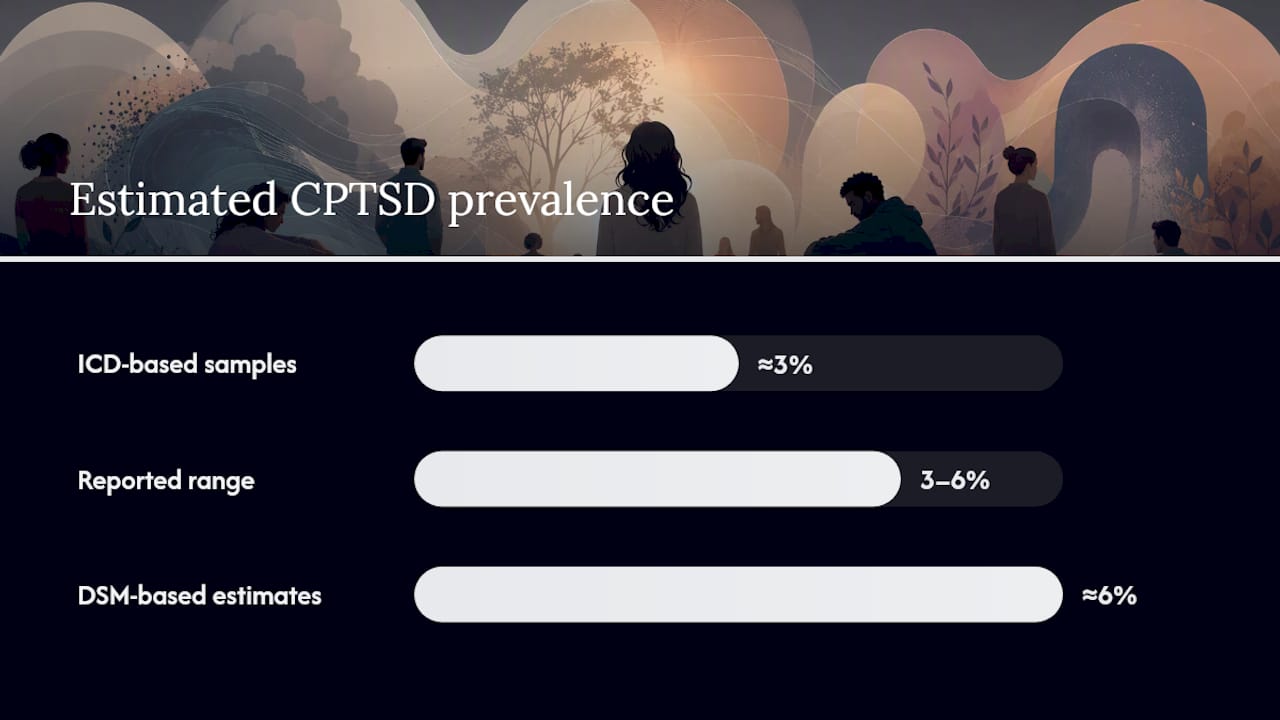
| Prevalence estimates | VA guidance cites prevalence estimates around 3–6% depending on criteria and study methodology. |
| Treatment approach | EMDR, CPT, PE, and STAIR all show benefit; stabilization typically precedes intensive trauma processing. |
| Prognosis | Recovery is gradual and nonlinear; DSO features (shame, relational difficulty) tend to improve more slowly than core PTSD symptoms. |
| Next step | Revivehealththerapy offers EMDR, trauma-focused CBT, and telehealth statewide in California with sliding-scale and insurance options. |
Table of Contents
- How did complex PTSD become a recognized diagnosis?
- What are the symptoms of complex PTSD?
- What causes CPTSD and who is at higher risk?
- How is CPTSD evaluated and diagnosed in clinical practice?
- What are the most effective treatments for CPTSD?
- What conditions commonly co-occur with CPTSD?
- Practical daily strategies for living with CPTSD
- How do clinicians actually approach CPTSD in practice?
- How to find trauma-informed care in the United States
- Trauma-informed CPTSD care at Revivehealththerapy
- Sources
How did complex PTSD become a recognized diagnosis?
Understanding complex PTSD means tracing a concept that took decades to earn its place in official diagnostic systems. The term itself grew out of clinical observations in the late 1980s and early 1990s, when researchers and clinicians noticed that survivors of prolonged, repeated trauma, especially childhood abuse, domestic violence, and captivity, often presented with symptoms that standard PTSD criteria did not fully capture.
Judith Herman’s 1992 work introduced the concept of “Disorders of Extreme Stress Not Otherwise Specified” (DESNOS), which described the emotional dysregulation, identity disruption, and relational damage that accompanied long-term trauma. The DSM-IV considered but ultimately did not adopt DESNOS as a standalone diagnosis. The DSM-5, published in 2013, expanded PTSD criteria and added a dissociative subtype, capturing some CPTSD features within the broader PTSD category, but still did not create a separate CPTSD code.
The ICD-11, which took effect in 2022, went further. It formally lists CPTSD as a distinct diagnosis, separate from PTSD, defined by PTSD’s core symptom clusters plus what the ICD-11 calls disturbances in self-organization (DSO). The American Psychological Association’s clinical commentary notes that clinical practice is still evolving around specialized approaches for CPTSD, reflecting how recently this diagnostic shift occurred.
What this means for U.S. patients: American clinicians primarily use DSM-5, which has no separate CPTSD code. Many providers will diagnose PTSD, sometimes with a dissociative specifier, when a patient presents with CPTSD features. That diagnosis is not wrong, but it may not capture the full picture. Discussing ICD-11 CPTSD criteria with your provider, or requesting an ITQ screening, can help ensure your treatment plan addresses all symptom clusters, not just the core PTSD ones.
What are the symptoms of complex PTSD?
CPTSD symptoms fall into two broad groups: the core PTSD symptoms that both disorders share, and the disturbances in self-organization that distinguish CPTSD from standard PTSD.
Core PTSD symptoms
- Re-experiencing: Intrusive memories, nightmares, or flashbacks that make past trauma feel present. In CPTSD, these often include emotional flashbacks, described below.
- Avoidance: Steering clear of people, places, thoughts, or feelings that trigger trauma-related distress. Someone might avoid entire neighborhoods, certain relationship dynamics, or any conversation about their past.
- Sense of current threat: Persistent hypervigilance, exaggerated startle responses, and difficulty feeling safe even in objectively low-risk situations.
Disturbances in self-organization (DSO)
These three clusters are what HelpGuide’s clinical summary identifies as the hallmark features that set CPTSD apart:
- Affect dysregulation: Intense emotional reactions that feel impossible to control, sudden shifts from calm to rage or despair, emotional numbness, or difficulty returning to baseline after being triggered. A person might describe feeling “hijacked” by emotions that seem disproportionate to what just happened.
- Negative self-concept: Deep, pervasive shame, guilt, or a sense of being fundamentally broken or worthless. This goes beyond low self-esteem; it often feels like a core identity rather than a mood.
- Relationship difficulties: Persistent trouble trusting others, fear of abandonment, cycles of idealization and withdrawal, or a feeling that close relationships are inherently dangerous.
Pro Tip: Emotional flashbacks are one of the most commonly missed CPTSD symptoms. Unlike visual flashbacks, which replay a scene, emotional flashbacks are sudden, overwhelming waves of shame, terror, helplessness, or rage with no accompanying visual memory. A person may not connect the feeling to trauma at all, which is why they often go unrecognized for years. According to WebMD’s clinical overview, recognizing emotional flashbacks is a key step toward tailoring grounding and stabilization techniques.
In daily life, these symptoms can look like chronic fatigue, difficulty concentrating at work, repeated relationship ruptures, physical symptoms without a clear medical cause, and a pervasive sense that something is fundamentally wrong with you as a person.

What causes CPTSD and who is at higher risk?
CPTSD most commonly develops after prolonged, repeated trauma, particularly when that trauma involves interpersonal harm and occurs in a context where escape is difficult or impossible. Common trauma types include:
- Childhood physical, emotional, or sexual abuse and neglect
- Prolonged domestic violence
- Captivity, torture, or political imprisonment
- Human trafficking
- Repeated community violence or war exposure over extended periods
One important clarification: single-event traumas can also produce complex reactions, particularly when they occur in childhood, involve a caregiver, or happen in a context of prior adversity. CPTSD is not determined solely by trauma type; individual biology, prior history, and available support all shape the outcome.
| Risk Factor | Protective Factor |
|---|---|
| Childhood onset of trauma | Stable, supportive caregiver relationships |
| Trauma perpetrated by a caregiver or trusted person | Early access to trauma-informed therapy |
| Prolonged or repeated exposure | Strong social support network |
| Lack of social support during or after trauma | Sense of personal agency and safety |
| Prior mental health history | Positive community or cultural connections |
| Dissociation during traumatic events | Consistent safe living environment |
Neurobiologically, chronic trauma exposure alters the stress-response systems of the brain, particularly the amygdala, prefrontal cortex, and hippocampus. These changes can make the nervous system persistently primed for threat, which helps explain why affect dysregulation and hypervigilance persist long after the trauma ends.
How is CPTSD evaluated and diagnosed in clinical practice?
Diagnosis in the United States involves a clinical interview, standardized assessment tools, and a careful review of trauma history and functional impairment. Because DSM-5 does not list CPTSD separately, the diagnostic path often starts with a PTSD evaluation and then broadens to assess DSO features.
- International Trauma Questionnaire (ITQ): A validated self-report tool that screens for both ICD-11 PTSD and CPTSD. It yields a provisional screening result and is widely used in research and increasingly in clinical settings. The National Center for PTSD’s assessment guidance identifies the ITQ as a prominent tool for CPTSD evaluation.
- International Trauma Interview (ITI): A clinician-administered structured interview used for formal ICD-11 CPTSD diagnosis. It covers both PTSD and DSO criteria in detail and is considered the gold standard for ICD-11 CPTSD assessment.
- Clinician-Administered PTSD Scale for DSM-5 (CAPS-5): The standard clinician interview for DSM-5 PTSD diagnosis. Widely used in U.S. VA settings and research.
- PTSD Checklist for DSM-5 (PCL-5): A 20-item self-report measure for DSM-5 PTSD symptoms. Often used for initial screening and tracking symptom change over time.
ICD-11 diagnostic rule: A formal ICD-11 CPTSD diagnosis requires meeting all PTSD criteria plus at least one symptom in each of the three DSO domains (affect dysregulation, negative self-concept, relationship difficulties), with evidence of functional impairment.
Prevalence context: The VA’s patient-facing guidance notes prevalence estimates around 3–6% depending on the criteria and study methodology used, with some ICD-based samples estimating approximately 3% and some DSM-based estimates reaching approximately 6%.
The absence of a separate CPTSD code in DSM-5 can create real access and recognition gaps in U.S. care. Patients are encouraged to discuss their full symptom picture with providers and, when appropriate, ask specifically about ITQ or ITI screening.
What are the most effective treatments for CPTSD?
Evidence-based treatment for CPTSD draws heavily from the PTSD treatment literature, with growing attention to the DSO features that require additional clinical focus. A BMJ review of CPTSD diagnosis and management found that trauma-focused PTSD treatments often produce meaningful improvements in CPTSD symptoms, while noting that CPTSD-specific comparative trials are still developing.
| Trauma-Focused Treatments | Phase-Based or Modular Approaches |
|---|---|
| Begin trauma processing relatively early | Prioritize stabilization and skills before processing |
| Strong evidence base from PTSD trials | Common in clinical practice for complex presentations |
| EMDR, Prolonged Exposure (PE), CPT | STAIR (Skills Training in Affective and Interpersonal Regulation) |
| May be adapted for CPTSD with skills components | Adds emotion regulation and relationship skills modules |
| Shorter treatment timelines in some cases | Often longer-term; suited to severe DSO features |
Evidence-based modalities
- EMDR (Eye Movement Desensitization and Reprocessing): Targets traumatic memories directly and has a strong evidence base for PTSD; increasingly used for CPTSD, sometimes combined with skills-focused preparation phases.
- Prolonged Exposure (PE): Systematic, gradual confrontation of trauma memories and avoided situations; well-supported for PTSD and often beneficial for CPTSD.
- Cognitive Processing Therapy (CPT): Addresses distorted trauma-related beliefs (about safety, trust, power, esteem, and intimacy) that are especially prominent in CPTSD’s negative self-concept cluster.
- STAIR (Skills Training in Affective and Interpersonal Regulation): A phase-based modular approach designed specifically for complex trauma presentations; builds emotion regulation and relationship skills before or alongside trauma processing.
- Medication: No medication treats CPTSD directly, but SSRIs and SNRIs are commonly used to manage depression, anxiety, and hyperarousal symptoms. Sleep aids and prazosin may be used for nightmares.
- Body-based practices: Somatic approaches, yoga, and mindfulness can support nervous system regulation as adjuncts to psychotherapy.
Pro Tip: Most clinicians treating CPTSD follow a stabilization-first sequence: build coping skills and a stable therapeutic relationship before moving into direct trauma processing. This does not mean delaying care indefinitely. For many people, stabilization and processing happen in parallel, with the balance shifting as capacity grows. Expect an initial phase of 8–16 weeks focused on safety, grounding, and affect regulation before intensive trauma work begins, though timelines vary considerably by individual presentation and severity.
The National Center for PTSD’s clinical guidance recommends starting with evidence-based PTSD treatments while assessing DSO needs and adding skills-focused modules when needed. For evidence-based trauma therapy options in California, a trauma-informed provider can help determine which combination fits your presentation.
What conditions commonly co-occur with CPTSD?
CPTSD rarely travels alone. Understanding the overlap between CPTSD and other diagnoses helps explain why some people spend years receiving treatment for one condition without addressing the underlying trauma picture.
Common co-occurring conditions include:
- Major depressive disorder: Persistent low mood, hopelessness, and anhedonia are frequent companions to CPTSD’s negative self-concept cluster.
- Generalized anxiety disorder: Chronic worry and tension can overlap significantly with CPTSD’s hypervigilance and sense of current threat.
- Substance use disorders: Alcohol and drug use often develop as attempts to manage overwhelming affect, numb emotional flashbacks, or achieve sleep.
- Dissociative disorders: Depersonalization, derealization, and dissociative amnesia occur more frequently in CPTSD than in single-event PTSD, particularly when trauma began in childhood.
- Somatic symptom presentations: Chronic pain, gastrointestinal problems, and other physical symptoms without clear medical cause are common in people with trauma histories.
CPTSD versus borderline personality disorder (BPD)
The overlap between CPTSD and BPD is clinically significant and frequently misunderstood. Both involve emotional dysregulation, unstable relationships, and a disrupted sense of self. The key distinction: BPD typically involves fear of abandonment driving impulsive behavior and identity diffusion, while CPTSD’s relational difficulties stem more directly from a learned expectation of harm and a shame-based self-concept rooted in trauma history.
Red flags that suggest a trauma-focused re-evaluation:
- A history of prolonged interpersonal trauma (especially childhood) that predates current symptoms
- Emotional flashbacks that were never identified as trauma responses
- Pervasive shame or self-blame that feels like a core identity rather than a mood
- Prior diagnoses of BPD, bipolar II, or treatment-resistant depression without a thorough trauma history
When raising these concerns with a provider, specific phrases help: “I’ve had a history of prolonged trauma that I don’t think has been fully addressed,” “I experience sudden overwhelming emotions that I can’t always connect to what’s happening around me,” and “I’d like to be screened specifically for complex PTSD using the ITQ.”
Practical daily strategies for living with CPTSD
Managing CPTSD between therapy sessions requires consistent, low-effort practices that support nervous system regulation without demanding more than you have on a hard day. These strategies work best as complements to formal care, not replacements.
- Ground yourself when triggered. The 5-4-3-2-1 technique (name five things you see, four you can touch, three you hear, two you smell, one you taste) interrupts a flashback state by anchoring attention to the present moment.
- Practice paced breathing. Slow exhales activate the parasympathetic nervous system. A simple pattern: inhale for 4 counts, hold for 2, exhale for 6. Even two minutes can shift a dysregulated state.
- Protect sleep. Trauma disrupts sleep architecture, and sleep deprivation worsens emotional dysregulation. A consistent sleep schedule, limiting screens an hour before bed, and keeping the bedroom cool and dark are low-cost starting points.
- Add gentle movement. Walking, stretching, or yoga can discharge physical tension without the overstimulation that high-intensity exercise sometimes triggers in trauma survivors.
- Schedule safe social contact. Isolation reinforces CPTSD’s relational avoidance. One brief, low-stakes social interaction per day, a text, a short walk with a neighbor, can gradually rebuild tolerance for connection.
- Track your window of tolerance. Notice when you are moving toward hyperarousal (agitation, panic) or hypoarousal (numbness, shutdown) and use a grounding or breathing technique before the state becomes overwhelming.
- Know when to reach out. If symptoms escalate to thoughts of self-harm or suicide, contact 988 (call or text) immediately. The Veterans Crisis Line is available at 988, press 1. If you are in immediate danger, call 911 or go to the nearest emergency room.
For peer support, the SAMHSA National Helpline (1-800-662-4357) connects people to local mental health resources. Trauma-focused workbooks, such as those based on STAIR or CPT, are available through VA resources and many public libraries.
Self-care strategies for anxiety and depression can also support day-to-day regulation while you build a formal care plan.
How do clinicians actually approach CPTSD in practice?
The phase-based versus trauma-focused debate is one of the most active in the CPTSD field. The BMJ’s 2024 review summarizes the current state clearly: phase-based approaches are common in clinical practice for complex presentations, but early comparative trials have not consistently shown them to be superior to trauma-focused treatments that begin processing sooner. The honest clinical answer is that sequencing should be individualized.
In practice, most experienced trauma clinicians assess three things before deciding where to start: the severity of DSO features (especially affect dysregulation), the client’s current safety and stability, and their capacity to tolerate distress during trauma processing. When DSO features are severe, a stabilization-first approach using STAIR or similar skills modules makes clinical sense. When DSO features are mild and the client has adequate coping resources, moving into EMDR or CPT earlier may be appropriate.
Common engagement barriers clinicians encounter with CPTSD include shame-driven avoidance of the therapeutic relationship itself, difficulty trusting the therapist, and fear that discussing trauma will make things worse. These are not resistance; they are symptoms. Skilled trauma therapists address them directly as part of treatment.
Assessment preferences in clinical practice tend toward the ITQ for initial screening and the ITI for formal ICD-11 diagnosis when available. Many U.S. clinicians use the CAPS-5 or PCL-5 for DSM-5 PTSD tracking and supplement with informal DSO assessment. Combining EMDR with STAIR-based skills training is a common approach for moderate-to-severe CPTSD presentations. For a broader look at how trauma recovery frameworks map onto clinical practice, evidence-based summaries can help orient both clients and providers.
Pro Tip: When interviewing a prospective therapist, ask these specific questions: “Do you have experience treating ICD-11 complex PTSD or complex trauma presentations?” “Do you use a phase-based or stabilization-first approach, and how do you decide?” “Are you trained in EMDR, CPT, or STAIR?” “Do you offer telehealth sessions?” A therapist who can answer these questions specifically, rather than generically, is more likely to have the training your presentation requires.
How to find trauma-informed care in the United States
Finding the right provider takes more than a Google search. These resources and steps make the process more direct.
Directories and crisis resources:
- 988 Suicide and Crisis Lifeline: Call or text 988 for immediate mental health crisis support, available 24/7.
- Veterans Crisis Line: Call 988 and press 1; text 838255; or chat at VeteransCrisisLine.net.
- SAMHSA National Helpline: 1-800-662-4357; free, confidential, 24/7 referrals to local treatment facilities and support groups.
- National Center for PTSD (VA): ptsd.va.gov offers a provider locator and evidence-based treatment information for veterans and civilians.
- Psychology Today therapist directory: Filter by “trauma” and “PTSD” specialties and by insurance accepted.
- Open Path Collective: Reduced-fee therapy for people who do not qualify for public insurance.
What to bring to your first appointment:
- A brief written summary of your trauma history (you do not need to share every detail; a timeline of major events is enough).
- A list of current symptoms with examples of how they affect daily functioning.
- Your current medication list, including supplements.
- Any prior mental health diagnoses or treatment records you can access.
- Questions about the therapist’s training in CPTSD, their treatment approach, and their telehealth availability.
Practical access considerations:
Telehealth has significantly expanded access to trauma-informed care, particularly in rural areas or for people whose symptoms make leaving home difficult. Many trauma-specialized therapists now offer secure video sessions. If cost is a barrier, ask directly about sliding-scale fees, out-of-network superbills for insurance reimbursement, and HSA/FSA payment options. For guidance on finding accessible trauma care, a step-by-step approach can reduce the friction of starting.
What recovery from CPTSD actually looks like
Recovery from CPTSD is real, and it is also slower and less linear than most people expect when they first start treatment. That gap between expectation and reality is worth naming directly.
The NHS inform guidance on CPTSD notes that some people need longer-term or more intensive support, and that framing matters. CPTSD did not develop overnight, and treatment is not a sprint. What most people experience is not a dramatic before-and-after transformation but a gradual expansion of what feels tolerable: fewer emotional flashbacks, a slightly less punishing inner voice, relationships that feel a little less dangerous. Those incremental shifts are the actual shape of recovery.
The evidence supports realistic optimism. Trauma-focused treatments produce meaningful symptom reduction for most people who complete them. The disturbances in self-organization, the shame, the relational wariness, tend to respond more slowly than the core PTSD symptoms, which is why treatment that addresses both clusters tends to produce more durable outcomes.
If you are in crisis right now, please contact 988 or the Veterans Crisis Line before anything else. If you are not in crisis but recognize yourself in this article, the most useful next step is a single phone call or email to a trauma-informed provider. You do not need to have everything figured out before you reach out.
Trauma-informed CPTSD care at Revivehealththerapy
Healing from CPTSD requires more than symptom management. It requires a therapist who understands the full picture: the emotional flashbacks, the shame, the relational wariness, and the specific sequencing that complex trauma demands.
Revivehealththerapy offers evidence-based trauma therapy in California including EMDR, trauma-focused CBT, and STAIR-informed skills work, delivered in person at Oakland, Walnut Creek, and San Francisco, or via secure telehealth statewide. Sliding-scale fees, insurance, HSA, and FSA options are available to make care accessible across income levels. Sessions are confidential and conducted by therapists trained in trauma-informed practice.
To take the next step, visit Revivehealththerapy’s psychotherapy services page or contact the practice directly to schedule an initial consultation.
Sources
These are the primary sources used throughout this article. Each covers a distinct aspect of CPTSD and is worth bookmarking for ongoing reference.
- Complex PTSD: Assessment and Treatment – PTSD: National Center for PTSD
- CPTSD (Complex PTSD): What It Is, Symptoms & Treatment
- What is Complex PTSD (CPTSD)? Understanding Symptoms, Causes and Healing
When evaluating online health information, prefer sources affiliated with government health agencies (VA, SAMHSA, NIH), major academic medical centers (Cleveland Clinic, Mayo Clinic), or peer-reviewed journals. Be cautious of sites that offer definitive diagnostic conclusions without recommending professional evaluation.
This article is general information, not a substitute for advice from a qualified doctor. Consult a qualified healthcare professional about your own circumstances before acting on anything here.