
TL;DR:
- Crisis intervention counseling provides brief, immediate support to stabilize individuals experiencing acute psychological distress. It aims to restore functioning, reduce risk, and connect people to longer-term care through structured models like SAFER-R and Psychological First Aid.
Crisis intervention counseling is defined as a brief, immediate form of support designed to stabilize individuals experiencing acute psychological distress. It is not traditional therapy. The goal is to restore a person’s ability to function, reduce immediate risk, and connect them to the right resources before a crisis deepens. Models like SAFER-R and Psychological First Aid guide this work, giving counselors a structured path through even the most intense moments. The 988 Suicide & Crisis Lifeline and the National Council for Mental Wellbeing both recognize crisis counseling as a front-line mental health tool, not a luxury or last resort.
What is crisis intervention counseling and what does it aim to do?
Crisis intervention counseling is a short-term, directive intervention typically lasting 1 to 3 sessions, each running anywhere from 15 minutes to 2 hours. That brevity is intentional. The aim is not to resolve every underlying issue but to stop the immediate psychological freefall and restore basic stability.

The primary goal is to return a person to their pre-crisis level of functioning. Secondary goals include preventing further deterioration, building a concrete safety plan, and connecting the person to longer-term support. The American Counseling Association frames crisis counseling as a distinct specialty, not a watered-down version of psychotherapy.
The 988 Suicide & Crisis Lifeline has responded to over 13 million calls and texts since its launch in july 2022. That number reflects how many people reach a breaking point without access to formal therapy. Crisis counseling fills that gap. It meets people where they are, often before they are ready or able to engage with longer-term care.
How does crisis intervention counseling work?
Crisis counselors take an active, directive role. Unlike traditional therapy, where the client often leads the session, a crisis counselor guides the conversation with purpose and urgency. The focus stays on the present moment, not on history or long-term patterns.
A typical session follows a clear sequence:
- Safety assessment. The counselor evaluates immediate risk, including thoughts of self-harm or harm to others.
- Emotional grounding. Techniques like controlled breathing or sensory anchoring help the person move from panic to a calmer state.
- Problem identification. The counselor helps the person name what triggered the crisis and what feels most unmanageable.
- Resource connection. The counselor identifies practical supports, whether a trusted person, a hotline, or a referral to ongoing care.
- Safety planning. The session ends with a collaborative safety plan that outlines coping steps and emergency contacts.
Roberts’ Seven-Stage crisis intervention model adds further structure, moving from rapport-building through problem assessment to follow-up. Psychological First Aid, developed for use in disaster and trauma settings, follows a similar logic: look, listen, and link.
Pro Tip: If you are supporting someone in crisis, do not try to solve the problem. Focus on staying present, asking direct questions about safety, and helping them contact a trained counselor or the 988 Lifeline.
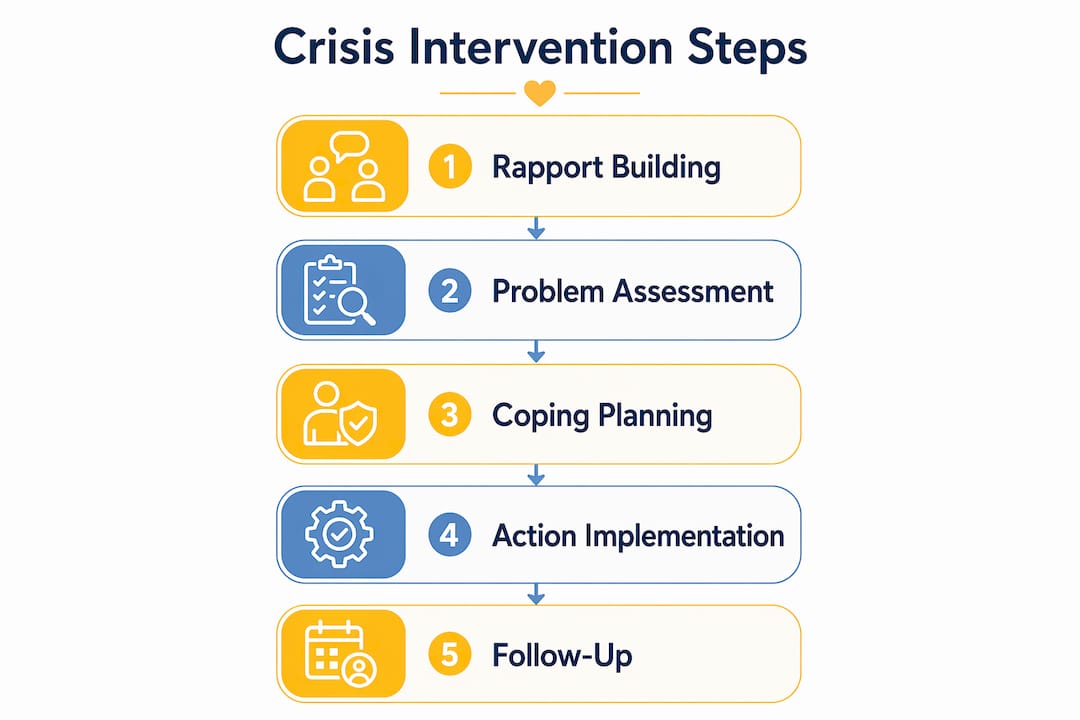
The counselor’s job is to move the person from overwhelmed to regulated. That shift, even a partial one, is what makes the next step possible.
How is crisis counseling different from traditional therapy?
The distinction matters because confusing the two leads to unmet expectations on both sides. Crisis counseling is not mini-therapy. It does not explore childhood patterns, relationship dynamics, or long-term behavioral change. Those are the goals of ongoing psychotherapy, which unfolds over weeks or months.
| Feature | Crisis counseling | Traditional therapy |
|---|---|---|
| Duration | 1–3 sessions | Weeks to months or longer |
| Counselor role | Active and directive | Collaborative and exploratory |
| Primary focus | Immediate stabilization | Long-term insight and growth |
| Depth of exploration | Surface-level, present-focused | Deep-seated patterns and history |
| Goal | Restore function and safety | Sustained behavioral and emotional change |
A few key distinctions worth understanding:
- Crisis counseling addresses the acute moment, not the root cause.
- Traditional therapy requires the client to be stable enough to reflect and engage over time.
- Crisis counseling is a bridge, not a destination. It creates the conditions for deeper work to happen later.
- Attempting deep exploration during a crisis can actually be counterproductive, overwhelming a person who is already at their limit.
The most useful way to think about it: crisis counseling gets you off the ledge. Therapy helps you understand why you were there and how to stay away from it.
Who benefits from crisis counseling and when should you seek it?
A crisis is defined not by the severity of an event but by a person’s perception that their coping abilities are overwhelmed. Two people can experience the same loss and respond completely differently. One may grieve and adapt. The other may enter a full psychological crisis. Neither response is wrong. The difference lies in internal resources, history, and support systems.
You may benefit from crisis counseling if you are experiencing:
- Thoughts of suicide or self-harm
- Overwhelming grief, shock, or panic following a traumatic event
- Inability to perform basic daily tasks due to emotional distress
- A sudden loss, such as a relationship ending, job loss, or death of a loved one
- Acute anxiety or dissociation that feels uncontrollable
Functioning does not disqualify you. Many people in crisis still go to work and meet their obligations. The internal experience of being unable to cope is enough. Clinical guidance from the University of Colorado Denver confirms that inability to function is a sufficient criterion, not a minimum threshold.
Crisis intervention reduces the risk of serious long-term disorders like PTSD when delivered promptly. Early support changes the trajectory. The emotional regulation strategies used in crisis counseling also help people build skills they carry forward into recovery.
The 988 Lifeline offers 24/7 support via call, text, and chat at no cost. The National Sexual Assault Hotline provides specialized crisis support for survivors of sexual violence. These resources exist precisely because crisis does not keep business hours.
What models and frameworks guide crisis intervention counseling?
Structured models make crisis intervention consistent and effective across different counselors and settings. Three frameworks dominate professional practice.
Psychological First Aid
Psychological First Aid, or PFA, was developed for use in disaster response and mass trauma settings. It focuses on three actions: look, listen, and link. Counselors observe the person’s state, listen without judgment, and link them to practical support. PFA does not require a clinical setting. It is designed to be delivered by trained responders in the immediate aftermath of a crisis event.
The SAFER-R model
SAFER-R stands for Stabilization, Acknowledgment, Facilitation, Education, Recovery, and Referral. Each stage builds on the last. Stabilization grounds the person physically and emotionally. Acknowledgment validates their experience without minimizing it. Facilitation helps them process what happened. Education provides information about normal stress responses. Recovery focuses on restoring function. Referral connects them to the next level of care.
Roberts’ Seven-Stage model
Roberts’ Seven-Stage model adds clinical depth. It begins with assessing lethality and safety, moves through rapport-building and problem exploration, and ends with a follow-up plan. This model is widely used in hospital emergency departments, community mental health centers, and school counseling programs.
Pro Tip: When researching crisis counseling providers, ask whether they use a structured model like SAFER-R or Roberts’ Seven-Stage. A structured approach signals training and consistency, not rigidity.
Structured crisis intervention reduces the risk of counselor error during high-stakes moments. These models also make it easier to document care and ensure smooth handoffs to ongoing therapy, which is where the real healing work begins. For those moving from crisis into longer-term support, psychotherapy in trauma recovery offers evidence-based options that build on the stability crisis counseling creates.
Key Takeaways
Crisis intervention counseling is the most effective first response to acute psychological distress because it stabilizes the person, reduces immediate risk, and creates a clear path to longer-term care.
| Point | Details |
|---|---|
| Crisis counseling is brief by design | Sessions run 15 minutes to 2 hours across 1 to 3 meetings, focused on immediate stabilization. |
| A crisis is defined by perception, not severity | Anyone whose coping capacity is overwhelmed qualifies, regardless of how serious the event appears to others. |
| Counselors take an active, directive role | Unlike traditional therapy, crisis counselors guide the session with urgency and focus on the present moment. |
| Structured models improve outcomes | Frameworks like SAFER-R and Roberts’ Seven-Stage give counselors a consistent, evidence-based path through acute distress. |
| Crisis counseling is a bridge, not a cure | It creates the safety and stability needed for deeper therapeutic work to follow. |
Why crisis counseling is more powerful than most people realize
People often come to crisis counseling expecting it to fix something. They leave surprised that it did not go deeper. That reaction is understandable, and it points to the most common misconception I see: that brevity means inadequacy.
Crisis counseling is not shallow because it is short. It is short because depth, during a crisis, is counterproductive. A person in acute distress cannot process insight. They need ground beneath their feet first. The counselor’s job is to provide that ground, not to excavate what lies beneath it.
What I find most striking is how often timely crisis support changes the entire arc of a person’s mental health. Someone who gets help within hours of a traumatic event is far less likely to develop chronic PTSD than someone who waits weeks. The window matters. The connection between trauma and long-term mental illness is well documented, and crisis counseling is one of the clearest ways to interrupt that connection early.
The other thing I want people to hear: you do not need to be at rock bottom to seek crisis support. If you cannot function, if you feel like you are drowning in something you cannot name, that is enough. The 988 Lifeline exists for exactly that moment. Use it.
— Amy
Revivehealththerapy: support from crisis through recovery
When the acute moment passes, the work of healing is just beginning. Revivehealththerapy provides evidence-based psychotherapy services across California, including trauma-informed care using EMDR, CBT, and mindfulness. Whether you are stepping out of a crisis or looking to address what brought you there, the team at Revivehealththerapy offers both in-person sessions in Walnut Creek and Oakland and secure telehealth appointments statewide.
Sliding-scale fees and insurance acceptance, including HSA and FSA plans, make ongoing care accessible regardless of income. If you are ready to move from stabilization into lasting change, explore psychotherapy services that meet you where you are and build from there.
FAQ
What is the crisis intervention definition in clinical terms?
Crisis intervention is a short-term, directive form of support that stabilizes individuals experiencing acute psychological distress. It uses structured models like SAFER-R and Psychological First Aid to restore function and prevent long-term harm.
How many sessions does crisis counseling typically involve?
Crisis counseling typically involves 1 to 3 sessions, each lasting between 15 minutes and 2 hours, depending on the severity of the situation and the person’s needs.
Is crisis counseling the same as therapy?
Crisis counseling is not therapy. It focuses on immediate stabilization and safety rather than long-term exploration, and it serves as a bridge to ongoing therapeutic care rather than a replacement for it.
When should I call the 988 Lifeline?
Call or text 988 any time you feel overwhelmed, unsafe, or unable to cope. The line is available 24 hours a day, 7 days a week, and connects you with a trained crisis counselor at no cost.
Can crisis counseling prevent PTSD?
Prompt crisis intervention reduces the risk of developing serious long-term disorders like PTSD by addressing acute distress before it becomes entrenched. Early support changes the psychological trajectory of a traumatic experience.
Recommended
- Why seek couples counseling in 2026: proven benefits – ReviveHealthTherapy
- What Is Relationship Counseling and How It Heals Couples – ReviveHealthTherapy
- Benefits of couples counseling for lasting connection – Revive Health Therapy
- What is premarital counseling: benefits and preparation – Revive Health Therapy