
TL;DR:
- Emotion-focused therapy is a short-term, evidence-based approach that uses experiential techniques to transform underlying emotional patterns. It effectively treats anxiety, depression, and relationship distress, with lasting benefits up to two years. Clients must Be willing to engage emotionally and work with skilled, trained therapists for best results.
Emotion-focused therapy (EFT) is defined as a structured, short-term psychotherapy that treats emotions as the primary agents of psychological change. Developed largely by psychologist Leslie S. Greenberg in the 1980s, EFT helps people recognize, accept, express, and transform their emotional experiences rather than suppress or avoid them. The approach draws on humanistic, experiential, and attachment theory traditions. Clinical research consistently supports EFT’s effectiveness for anxiety, depression, and relationship distress. If you have been searching for an evidence-based therapy that goes beyond surface-level coping strategies, EFT offers a structured path to lasting emotional change.
What is emotion-focused therapy and how does it work?

EFT treats emotions as vital messengers that signal underlying needs, not symptoms to suppress or manage away. This is the core philosophical shift that separates EFT from most traditional talk therapies. When you feel persistent shame, anxiety, or anger, EFT treats those feelings as information pointing toward unmet needs, not problems to eliminate.
The therapy is built on a critical distinction: primary versus secondary emotions. Primary adaptive emotions are direct, healthy responses to a situation. Grief after a loss and fear in the face of real danger are primary adaptive emotions. Secondary defensive emotions are reactions to those primary feelings. Anger that covers up deep hurt, or numbness that masks grief, are secondary emotions. EFT works by moving through the secondary layer to access and transform what lies beneath.
Therapists use a set of experiential techniques to do this. The most recognized is chair work, where a person speaks to an empty chair representing another person or an internal conflict. This technique intensifies emotional engagement far beyond what verbal discussion alone can achieve. Empathic attunement, where the therapist closely tracks and reflects the client’s emotional state, creates the safety needed for that depth of work.
A typical EFT process moves through these stages:
- Bond and assess. The therapist builds trust and identifies the client’s core emotional patterns and unmet needs.
- Evoke and explore. Emotional experiences are brought into the room through exercises, imagery, and chair work.
- Transform. Maladaptive emotional states are shifted by accessing primary adaptive emotions underneath them.
- Consolidate. New emotional narratives are integrated into the client’s sense of self and relationships.
Pro Tip: Many people assume EFT is simply “venting emotions.” It is not. EFT is a guided, evidence-based process with structured techniques designed to transform emotions, not just express them.
What are the benefits of emotion-focused therapy for anxiety, depression, and relationships?
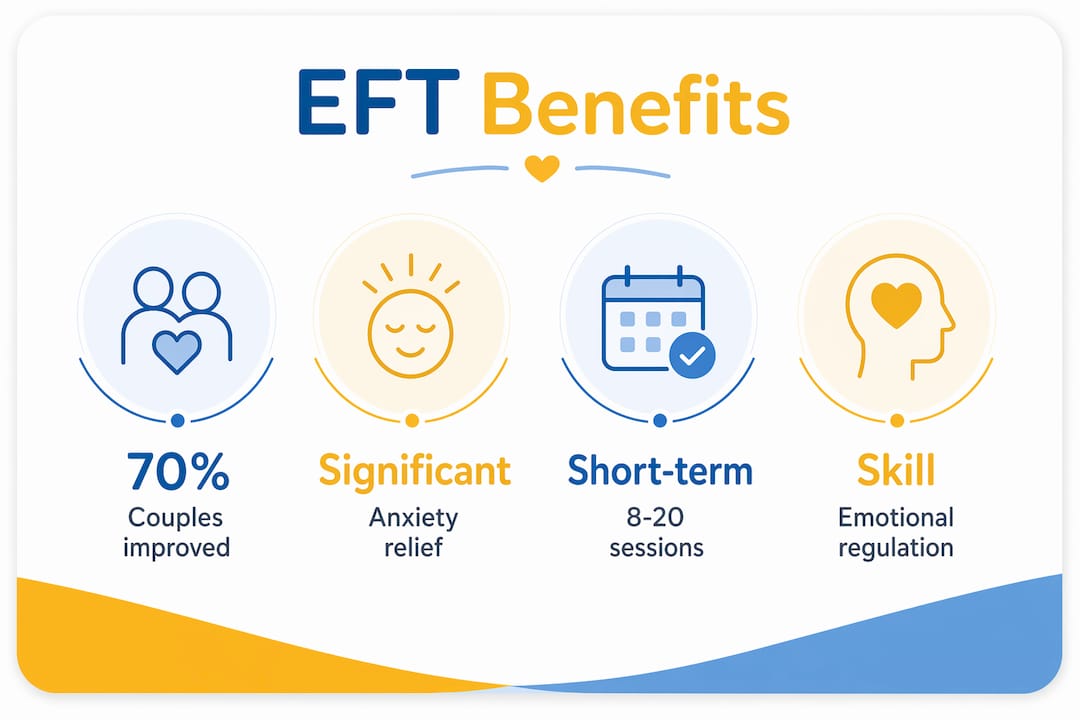
The clinical evidence for EFT is strong and growing. A 2026 systematic review found EFT significantly more effective than inactive controls for distress-based psychopathology, with an effect size of 1.39 across 13 trials involving 348 participants. An effect size above 1.0 is considered large in psychological research, meaning EFT produced meaningful, not marginal, improvements.
For couples, the results are equally compelling. A 2024 meta-analysis found that 70% of couples experienced significant relief from relationship distress after EFT, with benefits lasting up to two years post-therapy. That durability matters. Many therapeutic gains fade within months. EFT’s focus on transforming the emotional patterns driving conflict, rather than just teaching communication scripts, appears to create more lasting change.
The table below summarizes key clinical findings across the three areas where EFT is most studied.
| Condition | Key finding | Duration of benefit |
|---|---|---|
| Relationship distress | 70% of couples showed significant symptom relief | Up to 2 years post-therapy |
| Distress-based psychopathology (anxiety/depression) | Effect size of 1.39 vs. inactive controls | Measured at follow-up across 13 trials |
| Emotional regulation | Improved ability to recognize and shift maladaptive states | Ongoing with practice |
EFT also builds emotional regulation skills that extend well beyond the therapy room. Clients learn to identify what they feel, understand what those feelings signal, and respond in ways that serve their actual needs. That skill set reduces anxiety and depression symptoms over time because it addresses the emotional avoidance patterns that fuel both conditions.
Pro Tip: Therapist training matters more in EFT than in many other modalities. The experiential techniques require skilled navigation of primary versus secondary emotions. Research notes limitations in EFT studies including small sample sizes, which makes working with a well-trained, accredited EFT therapist especially important.
How is emotion-focused therapy different from other therapy approaches?
A frequent source of confusion is the relationship between EFT and Emotionally Focused Therapy for Couples, often abbreviated as EFCT. These are related but distinct models. EFT focuses on individual and family emotional processing. EFCT, developed by Sue Johnson, centers on attachment bonds and relational patterns between partners. Both use emotion as a change agent, but their targets and structures differ. If you are exploring therapy options for your relationship, understanding which model your therapist is trained in matters.
EFT also differs meaningfully from Cognitive Behavioral Therapy (CBT). CBT targets thought patterns and behavioral responses, working from the assumption that changing thoughts changes feelings. EFT inverts that logic. It works directly with emotional experience as the primary lever for change, treating emotion as the cause rather than the consequence of thought patterns. Neither approach is universally superior. They address different mechanisms, and some people respond better to one than the other.
The table below compares key features across therapy types to help you orient your choice.
| Feature | EFT (individual/family) | EFCT (couples) | CBT |
|---|---|---|---|
| Primary focus | Emotional transformation | Attachment and bonding | Thought and behavior patterns |
| Core technique | Chair work, empathic attunement | Attachment cycle de-escalation | Cognitive restructuring, behavioral activation |
| Theoretical roots | Humanistic, experiential | Attachment theory | Cognitive science, behaviorism |
| Session style | Experiential, emotion-forward | Relational, process-focused | Structured, skill-building |
| Best suited for | Anxiety, depression, trauma, grief | Couples in relational distress | Specific phobias, OCD, structured skill needs |
EFT’s experiential roots mean it asks more of clients emotionally than structured skill-based therapies do. That is not a weakness. It is the mechanism. Accessing and shifting core emotional states requires going toward feelings, not around them.
What to expect in an EFT session and how to know if it’s right for you
EFT is typically structured as a short-term treatment lasting 8–20 sessions, though complex presentations may require more time. Sessions are not passive. You will not simply recount your week and receive reflections. A skilled EFT therapist will actively guide you into emotional experiences, using exercises, imagery, and chair dialogues to access feelings that are difficult to reach through conversation alone.
Experiential methods in EFT often surprise clients who expect traditional talk therapy. Chair work, in particular, can feel unfamiliar at first. Most clients adjust quickly once they experience how effectively it accesses genuine emotional material. The discomfort of the unfamiliar is usually short-lived. The emotional clarity that follows is not.
EFT works best for people who meet these conditions:
- Willingness to engage with emotional vulnerability, not just describe feelings intellectually
- Motivation to understand the emotional patterns driving their distress
- Openness to experiential exercises that go beyond verbal discussion
- A presenting concern rooted in emotional avoidance, relational pain, anxiety, depression, or grief
- Readiness to work collaboratively with a therapist rather than receive prescriptive advice
Cultural and personal background shape how people experience emotional expression in therapy. A good EFT therapist adapts the approach to your communication style and cultural context. When selecting a therapist, ask these questions before committing:
- What is your specific training in emotion-focused therapy?
- How do you adapt EFT techniques for clients from diverse cultural backgrounds?
- What does a typical session look like in your practice?
- How do you measure progress in EFT?
- What happens if I find the experiential exercises uncomfortable?
EFT is not suited for everyone. Clients who are not yet ready to engage emotionally, or who need highly structured skill-building first, may benefit from a different starting point. A qualified therapist will assess fit honestly rather than apply EFT by default.
Key Takeaways
Emotion-focused therapy is a structured, evidence-based approach that treats emotional transformation as the primary mechanism of lasting psychological change.
| Point | Details |
|---|---|
| Core mechanism | EFT transforms maladaptive emotions by accessing primary adaptive feelings beneath defensive reactions. |
| Clinical effectiveness | A 2026 review found an effect size of 1.39 for EFT vs. inactive controls across anxiety and depression. |
| Couples outcomes | 70% of couples in a 2024 meta-analysis showed lasting relief from relationship distress for up to 2 years. |
| Key technique | Chair work and empathic attunement are EFT’s signature experiential tools, not just talking about feelings. |
| Therapist selection | Accredited EFT training is critical because the experiential methods require skilled emotional navigation. |
Why EFT changed how I think about emotional healing
I have worked alongside clients navigating anxiety, grief, and relational pain long enough to know that insight alone rarely heals. People can understand exactly why they feel the way they do and still feel stuck. That is the gap EFT fills. It does not just explain emotional patterns. It moves through them.
What consistently surprises clients is how quickly chair work accesses material that years of verbal therapy never reached. One person I worked with had discussed her relationship with her mother in therapy for three years. One chair dialogue session surfaced grief she had never been able to name. That is not magic. That is the difference between describing an emotion and actually experiencing it in a safe, guided context.
The challenge I see most often is that clients want to intellectualize their way through EFT. The mind reaches for analysis as a defense against feeling. A skilled therapist holds that tension without forcing it, creating enough safety that the client can move toward the feeling rather than away from it. That requires real clinical skill, which is why therapist training is not a minor detail.
EFT also builds something I think is undervalued in mental health conversations: emotional agility. The goal is not to feel good all the time. The goal is to recognize what you feel, understand what it signals, and respond in a way that actually serves you. That capacity changes everything, from how you manage anxiety to how you show up in your closest relationships.
— Amy
Emotion-focused therapy at Revivehealththerapy
Revivehealththerapy offers licensed therapists trained in evidence-based emotional healing approaches, including EFT, EMDR, CBT, and mindfulness, serving individuals, couples, and families across California. Sessions are available in person in Walnut Creek and Oakland, and via secure telehealth statewide.
Sliding-scale fees and insurance acceptance, including HSA and FSA plans, make care accessible regardless of income. If you are ready to work with a therapist who understands how to navigate emotional healing at a clinical level, Revivehealththerapy is a strong place to start. You can also review psychotherapy options in California to find the right fit for your specific needs and goals.
FAQ
What is emotion-focused therapy used to treat?
EFT is used to treat anxiety, depression, grief, trauma, and relationship distress. Clinical research supports its effectiveness for distress-based psychopathology with a large effect size of 1.39 compared to inactive controls.
How long does emotion-focused therapy take?
EFT is typically structured as a short-term treatment of 8–20 sessions, though more complex emotional histories may require additional time.
Is emotion-focused therapy the same as emotionally focused couples therapy?
No. EFT focuses on individual and family emotional processing, while Emotionally Focused Therapy for Couples (EFCT) targets attachment bonds and relational patterns between partners. They share theoretical roots but differ in structure and focus.
Who can benefit most from emotion-focused therapy?
People dealing with anxiety, depression, grief, or relational pain who are willing to engage emotionally benefit most. EFT requires openness to experiential exercises and emotional vulnerability, not just verbal discussion of problems.
What makes EFT different from standard talk therapy?
EFT uses active experiential techniques like chair work to access and transform core emotions, not just discuss them. Standard talk therapy typically stays at the level of verbal narrative, while EFT works directly with emotional experience as the change mechanism.
Recommended
- Marriage counseling modalities: Your guide to stronger bonds – Revive Health Therapy
- Child therapy guide: what parents need to know – Revive Health Therapy
- How to Prepare for EMDR: Your Session Readiness Guide – Revive Health Therapy
- Step-by-step EMDR guide for teens: trauma recovery made simple – Revive Health Therapy