
Talk therapy sounds simple enough: sit down, share feelings, and things improve. But family conflict, emotional dysregulation, and communication breakdowns rarely respond to conversation alone. Structured approaches like cognitive-behavioral therapy (CBT) give families concrete tools to change the patterns driving their struggles. CBT for families refers to structured cognitive-behavioral interventions adapted for family systems, such as AF-CBT and CPC-CBT. For California families navigating stress, trauma, or strained relationships, these models offer something talk therapy often cannot: a clear, skills-based roadmap.
Table of Contents
- Understanding cognitive-behavioral therapy for families
- Key models: AF-CBT and CPC-CBT
- CBT process: how therapy works for families
- Nuances: who benefits from family CBT and limitations
- California-specific access and resources
- Next steps: connect with California therapy services
- Frequently asked questions
Key Takeaways
| Point | Details |
|---|---|
| Family CBT targets dynamics | CBT for families improves communication and emotional regulation through skill-building and structured sessions. |
| AF-CBT and CPC-CBT lead results | These evidence-based models are recommended for trauma, abuse, and high-conflict families in California. |
| California provides support | State-funded resources make it easier for families to access CBT-trained specialists and ongoing education. |
| Caregiver involvement is essential | Successful outcomes depend on active participation from caregivers alongside children in therapy. |
| Online options are expanding | Virtual CBT sessions offer flexible access, although more research is needed for certain groups. |
Understanding cognitive-behavioral therapy for families
Most people think of CBT as a one-on-one process where a therapist helps an individual challenge negative thoughts. Family CBT keeps that core logic but expands it to the whole household. The idea is that thoughts, feelings, and behaviors do not exist in isolation. They ripple outward and shape how family members interact with each other every single day.
Family-focused CBT targets cognition-affect-behavior cycles within family units, adapted from standard individual CBT models. That means a parent’s anxious thinking can fuel a child’s avoidance, and a teenager’s emotional outbursts can reinforce a caregiver’s harsh responses. Therapy works on all of those loops at once.
The Beck Institute describes family CBT as integrating family systems with cognitive restructuring, emphasizing both intrapersonal and interpersonal skills. In plain terms, each person learns to manage their own reactions while also practicing healthier ways to connect with others in the family.
Here is what family CBT typically focuses on:
- Identifying distorted thinking patterns that fuel conflict or withdrawal
- Building emotional regulation skills so reactions do not escalate situations
- Improving communication through structured practice, not just conversation
- Developing problem-solving strategies families can use independently
- Strengthening caregiver-child relationships through shared skill-building
“The goal is not to assign blame but to interrupt the cycles that keep families stuck and replace them with patterns that actually work.”
If you are exploring psychotherapy options in California, understanding these foundations helps you ask better questions when choosing a provider.
Key models: AF-CBT and CPC-CBT
California families have access to two well-researched, structured CBT models designed specifically for family conflict, coercion, physical abuse, and trauma. Knowing the difference helps you find the right fit.
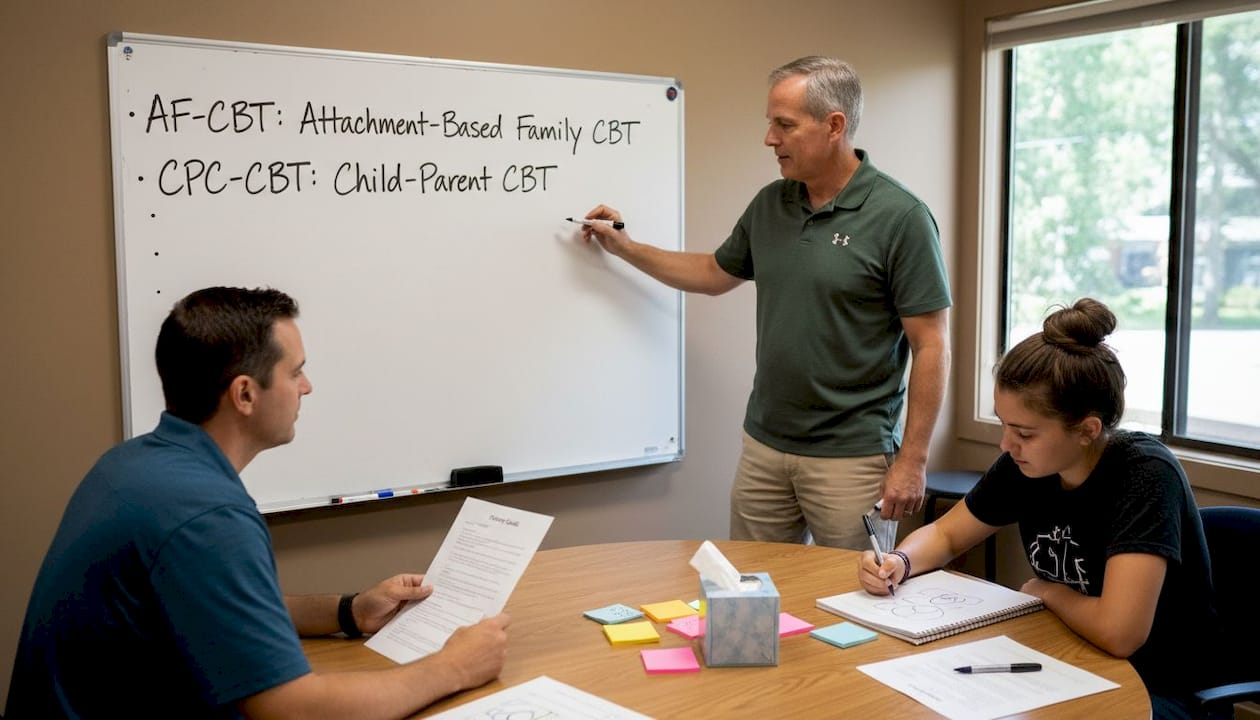
AF-CBT and CPC-CBT are structured interventions for families dealing with conflict, coercion, physical abuse, or trauma histories. Both are evidence-based and endorsed by California’s child welfare system.
| Feature | AF-CBT | CPC-CBT |
|---|---|---|
| Target ages | Children and teens | Ages 3 to 17 |
| Primary focus | Family conflict, coercion, abuse | Physical abuse, trauma, parenting stress |
| Session format | Individual, parent, joint | Individual child, parent, joint |
| Typical length | 12 to 26 sessions | 16 to 20 sessions |
| Best for | Families with ongoing conflict | Families with abuse or trauma history |
Here is how to think about which model fits your situation:
- AF-CBT works well when the main concern is ongoing family conflict, harsh discipline, or coercive dynamics between caregivers and children.
- CPC-CBT is the stronger choice when physical abuse or trauma is part of the picture, especially for younger children.
- Both models involve caregivers directly, which is a non-negotiable part of the process.
- Either model can be delivered in community settings, clinics, or via telehealth in California.
Families with teenagers may find family therapy for teens especially relevant, since adolescent development adds another layer of complexity to family dynamics. For younger children, reviewing child therapy steps in California can help you understand what to expect before the first session.
CBT process: how therapy works for families
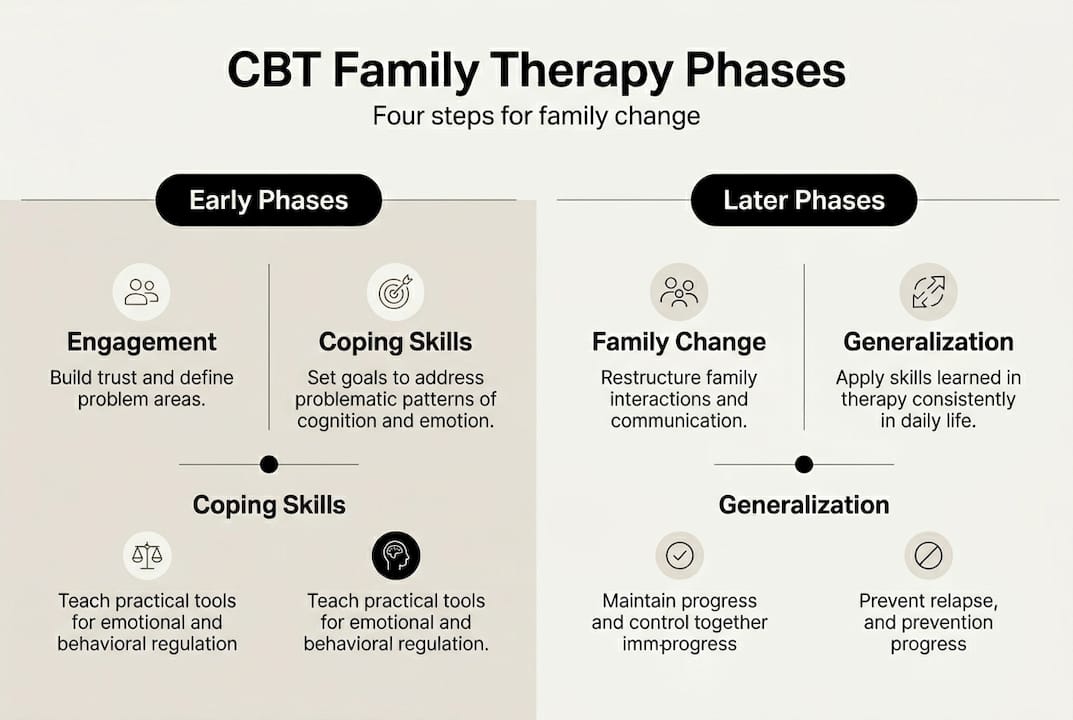
Once the right model is selected, what does the therapy journey actually look like? Most family CBT programs move through four distinct phases, each building on the last.
- Engagement and psychoeducation: The family learns how thoughts, feelings, and behaviors connect. Everyone gets on the same page about what therapy is trying to accomplish.
- Coping skills: Each family member practices tools like deep breathing, cognitive restructuring, and anger management. These are not abstract concepts. Families rehearse them in session.
- Safety and problem-solving: The family works on communication scripts, conflict de-escalation, and safety planning if needed.
- Abuse clarification or trauma processing: For families with trauma histories, this phase addresses what happened and rebuilds trust.
These four phases are the backbone of both AF-CBT and CPC-CBT, though the emphasis shifts depending on the family’s needs.
A meta-analysis on parental outcomes found a 64% success rate compared to waitlist controls, with optimal results often appearing within 6 to 8 weeks for some applications. That is a meaningful benchmark for families wondering whether the investment of time is worth it.
| Phase | Focus | Who attends |
|---|---|---|
| Engagement | Psychoeducation, goal-setting | Full family |
| Coping skills | Emotional regulation, thought patterns | Individual and parent sessions |
| Safety planning | Communication, conflict scripts | Joint sessions |
| Trauma processing | Clarification, rebuilding trust | Joint and individual |
Pro Tip: Keep a simple journal between sessions. Write down one moment each day when you noticed a thought triggering a strong emotion. Bringing those real examples to therapy accelerates progress faster than trying to recall them on the spot.
For additional support between sessions, mental health coping tips and family mental health strategies can reinforce what you are practicing in therapy.
Nuances: who benefits from family CBT and limitations
Knowing the process is one thing. Knowing whether it fits your family’s situation is another. Family CBT is not a universal solution, and being honest about that upfront saves time and frustration.
Research shows CBT is especially effective for families dealing with physical abuse histories, trauma, parental depression, and divorced family structures. These are situations where structured skill-building and clear communication frameworks make a measurable difference.
Families who tend to benefit most include:
- Two-parent and single-parent households where communication has broken down
- Blended families navigating loyalty conflicts and new relationship dynamics
- Families with anxious or depressed children who need both individual and systemic support
- Divorced co-parents who need structured tools to reduce conflict around children
- Caregivers managing their own trauma alongside their child’s needs
That said, caregiver involvement is essential to the model’s success. If a caregiver is actively abusive or unsafe, certain formats like TF-CBT are not appropriate until safety is established. The therapy requires a baseline of willingness from all participating adults.
Limitations worth knowing:
- CBT for families has not been well-studied for households where a family member has significant intellectual disabilities.
- Online formats are viable for many families but may require more structure and engagement to produce the same outcomes as in-person sessions.
- Families in acute crisis may need stabilization before structured CBT can begin.
Pro Tip: If you are unsure whether family CBT is the right starting point, a single consultation session with a licensed therapist can clarify the best path forward without committing to a full program.
For guidance on finding the right fit, choosing a child therapist and understanding teen therapy benefits are useful starting points. Couples navigating relationship strain alongside family stress may also want to explore marriage therapy options.
California-specific access and resources
For families ready to take action, California offers more support than most states when it comes to accessing structured family CBT.
California funds AF-CBT and CPC-CBT access through the California Evidence-Based Clearinghouse for Child Welfare (CEBC), the National Child Traumatic Stress Network (NCTSN), and regional providers in Southern California, Danville, and Silicon Valley. These are not obscure programs. They are actively supported and available to families across the state.
Here is where to start your search:
- CEBC (cebc4cw.org): Search for AF-CBT or CPC-CBT certified providers by county
- NCTSN provider directory: Lists trauma-specialized therapists trained in family CBT models
- Regional community mental health centers: Many offer sliding-scale fees and accept Medi-Cal
- Telehealth platforms: California-licensed therapists can deliver family CBT statewide via secure video
- School-based mental health programs: Some California districts partner with CBT-trained counselors
For families who are not sure where to begin, choosing a therapist in California walks through the key questions to ask before committing to a provider. If trauma is a central concern, trauma recovery options in California outlines the evidence-based approaches available statewide.
Cost is a real barrier for many families. Look for providers who accept insurance, HSA/FSA plans, or offer sliding-scale fees based on income. Many CEBC-listed providers have these options built in.
Next steps: connect with California therapy services
If your family has been struggling with communication breakdowns, emotional dysregulation, or unresolved conflict, structured CBT offers a clear path forward. The research is solid, the models are proven, and California has the infrastructure to support you.

At ReviveHealthTherapy, we work with families across California using evidence-based approaches including CBT, EMDR, and mindfulness. Whether you are in the Bay Area or connecting via telehealth from anywhere in the state, our therapists are trained to meet your family where it is. Our Oakland family therapy services offer in-person support, while our teen and child therapy services address the full range of developmental and emotional needs. We accept insurance and HSA/FSA plans, and sliding-scale fees are available. If you want to understand the full scope of psychotherapy evidence in California before your first session, we have resources ready for you. Reaching out is the first step.
Frequently asked questions
How is CBT for families different from individual CBT?
Family CBT adapts cognitive and behavioral techniques to the family system as a whole, involving joint sessions that target communication patterns and emotional dynamics between members, not just one person’s internal experience.
Can family CBT help with trauma and abuse recovery?
Yes. AF-CBT and CPC-CBT are specifically designed for families with trauma or abuse histories and are endorsed by California’s child welfare system as evidence-based options.
Does CBT for families require all members to attend every session?
Not always. Sessions are delivered in individual child, parent-only, and joint family formats depending on the phase of treatment, though consistent caregiver involvement throughout is essential.
Where can California families find CBT specialists?
California funds access to AF-CBT and CPC-CBT providers through CEBC and NCTSN, with regional specialists in Southern California, Danville, and Silicon Valley, plus statewide telehealth options.
Is online CBT for families effective?
Online CBT is a viable option for many California families, though outcomes may vary based on engagement level and the specific needs of the family, with more research still needed for certain populations.
Recommended
- Teen Therapy: Key Benefits for California Families – ReviveHealthTherapy
- Mental health tips for families in California 2026 – ReviveHealthTherapy
- 7 Key Benefits of Teen Counseling for California Families – ReviveHealthTherapy
- Role of Family Therapy for Teens: Enhancing Communication and Wellbeing – ReviveHealthTherapy
3 Responses