
TL;DR:
- Setting clear, SMART therapy goals improves engagement and treatment outcomes.
- Goals vary by therapy type, focusing on personal growth, relationship, or family dynamics.
- Progress review and goal adjustment every 4-6 sessions ensure responsive, effective therapy.
Many Californians walk into their first therapy session expecting to feel lost, unsure whether anything will actually change. That hesitation makes sense. Therapy can seem like an open-ended conversation with no clear destination. But here’s what changes everything: setting concrete, collaborative therapy goals. SMART goals in therapy improve engagement and outcomes by giving both you and your therapist a shared roadmap. This guide explains what therapy goals are, how they’re set, and how they apply to anxiety, depression, and trauma treatment across individual, couples, and family sessions in California.
Table of Contents
- What are therapy goals and why do they matter?
- How therapists in California explain and set goals with you
- Examples of therapy goals for anxiety, depression, and trauma
- How therapy goals differ in individual, couples, and family sessions
- Tracking progress and adjusting goals during therapy
- A therapist’s perspective: What most people misunderstand about therapy goals
- Get support with clear, actionable therapy goals
- Frequently asked questions
Key Takeaways
| Point | Details |
|---|---|
| Clear goals boost success | Defining what you want from therapy significantly improves satisfaction and results. |
| SMART goals help track progress | Specific and measurable goals help you and your therapist see real improvement. |
| Goals adapt to your needs | Therapy goals should evolve as you grow, face challenges, or shift direction. |
| Different therapy types, different goals | Individual, couples, and family therapy each use unique approaches to goal setting. |
| You don’t need all the answers | Not knowing your therapy goals at the start is normal—clarity comes with time. |
What are therapy goals and why do they matter?
Therapy goals are the specific outcomes you and your therapist agree to work toward together. They aren’t vague wishes like “I want to feel better.” They’re focused targets: reducing panic attacks by half over three months, rebuilding trust with a partner, or processing a traumatic memory without being overwhelmed by it. Think of them as the difference between driving somewhere with GPS versus just heading in a general direction and hoping for the best.
When goals are clear, therapy stays on track. You know what you’re working on each session, and your therapist can adjust techniques based on real feedback. Without goals, it’s easy for sessions to drift or for progress to go unnoticed even when it’s happening.
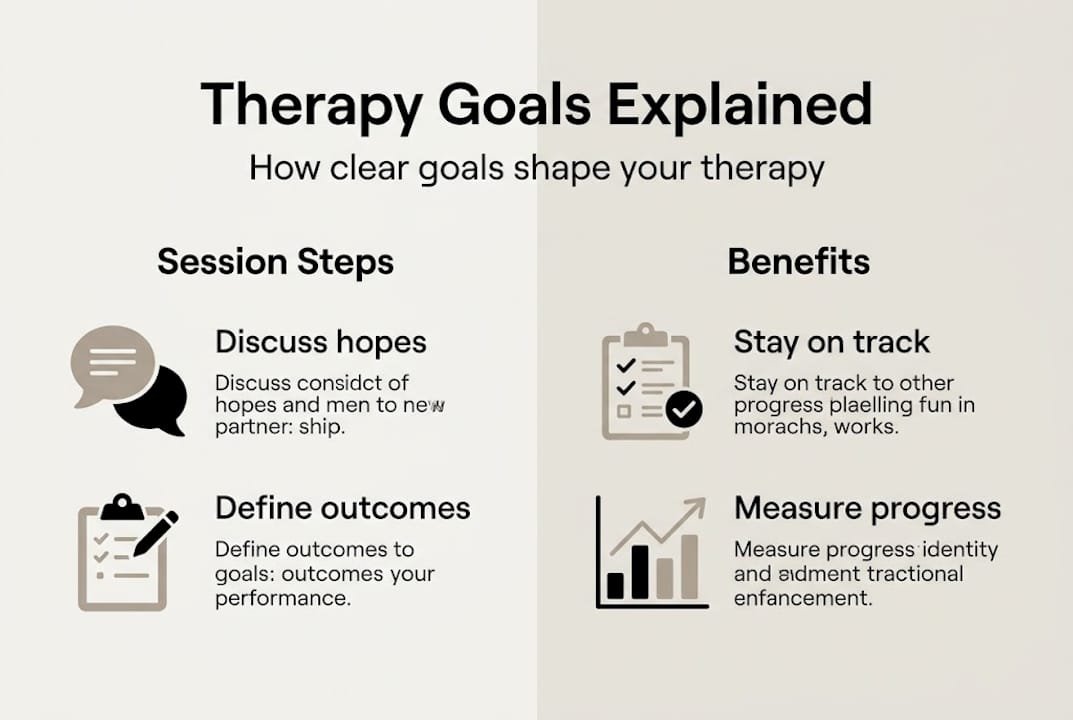
Research backs this up strongly. Personalized goals produce significantly larger effect sizes (ES=0.86) compared to generic symptom checklists (ES=0.32), and goal clarity directly boosts both engagement and satisfaction in therapy. That’s not a small difference. It means the way your goals are framed can nearly triple the measurable impact of your treatment.
Here’s what well-formed therapy goals typically address:
- Symptom relief: Reducing the frequency or intensity of anxiety, depression, or trauma responses
- Behavioral change: Building new habits like consistent sleep, social engagement, or healthy boundaries
- Emotional skills: Learning to identify, tolerate, and regulate difficult emotions
- Relationship improvement: Communicating more effectively with partners, family members, or coworkers
- Personal growth: Increasing self-awareness, confidence, or sense of purpose
| Goal type | Example | Why it matters |
|---|---|---|
| Symptom-focused | Reduce panic attacks to once per week | Measurable and motivating |
| Behavioral | Walk 20 minutes daily for mood support | Builds momentum |
| Relational | Practice one assertive conversation per week | Strengthens real-world skills |
| Trauma-focused | Process one memory using EMDR without dissociating | Paced and safe |
Goals are always discussed openly with your therapist. That transparency builds trust and ensures you’re genuinely invested in the process. You can find clear measures for progress to be one of the most empowering parts of starting therapy.
“The therapeutic relationship works best when both client and therapist understand where they’re headed and why.” This shared clarity is what separates effective therapy from an expensive venting session.
How therapists in California explain and set goals with you
Goal-setting doesn’t happen in a vacuum. It’s a conversation, and a good therapist makes it feel natural rather than clinical. During your first few sessions, expect open-ended questions like: What brought you here today? What would feel different if therapy worked? What does a good week look like for you?
These questions aren’t small talk. They’re designed to surface what actually matters to you, in your own words. From there, your therapist helps shape those answers into structured goals using the SMART framework: goals should be Specific, Measurable, Achievable, Relevant, and Time-bound.
Here’s how that process typically unfolds:
- Explore your concerns in the first 1-2 sessions through open conversation
- Identify priorities by narrowing down which issues feel most urgent or impactful
- Draft initial goals together using SMART criteria, written in your language
- Review progress every 4-6 sessions and adjust based on what’s working
- Celebrate milestones and set new goals as earlier ones are met
Therapists use open-ended questions and the SMART framework in early sessions, with goals reviewed every 4-6 sessions to keep therapy responsive and relevant. This isn’t a rigid checklist. It’s a living process.
For Californians using telehealth, which is increasingly common statewide, goal-setting takes on an extra layer of intentionality. Telehealth is common in California, and therapy goals should account for the virtual care context, including how you’ll practice skills between sessions and stay engaged without in-person cues.

If you’re still figuring out what kind of support you need, understanding choosing therapy type can help you arrive at your first session with more clarity. And if anxiety is your main concern, psychotherapy for anxiety offers targeted approaches that pair well with structured goal-setting.
Pro Tip: Write down two or three things you want to feel or do differently before your first session. You don’t need a polished list. Even rough notes give your therapist something concrete to build from.
“A goal without a plan is just a wish. In therapy, we turn wishes into workable steps you can actually take.”
Examples of therapy goals for anxiety, depression, and trauma
Abstract goals don’t move people forward. Concrete ones do. Here’s how therapy goals look in practice across three of the most common reasons Californians seek support.
For anxiety:
- Reduce panic attack frequency from three times per week to once or less within eight weeks
- Identify the top three personal anxiety triggers and develop a written coping plan
- Practice a grounding technique (like 5-4-3-2-1 sensory awareness) daily for 30 days
- Gradually face one avoided situation per week using exposure techniques
For depression:
- Schedule two enjoyable activities per week using behavioral activation principles
- Challenge one negative automatic thought per day using a CBT thought record
- Establish a consistent sleep and wake schedule within two weeks
- Reconnect with one supportive person per week to reduce isolation
For trauma:
- Build emotional safety and stabilization skills before processing traumatic memories
- Complete a structured EMDR protocol for a specific memory over 8-12 sessions
- Reduce avoidance of a previously triggering environment (like crowded spaces) within 10 weeks
- Develop a personal grounding toolkit to use when flashbacks or intrusive thoughts arise
CBT shows a 60-70% success rate for anxiety and depression within 12-16 sessions, and EMDR is highly effective for trauma. These aren’t just statistics. They reflect what’s possible when goals are matched to the right methods.
| Condition | Vague hope | Actionable goal |
|---|---|---|
| Anxiety | “I want to worry less” | Reduce daily worry time to 15 minutes using scheduled worry periods |
| Depression | “I want to feel motivated” | Complete one small task daily and log mood before and after |
| Trauma | “I want to stop being triggered” | Process one trauma memory using EMDR without dissociating |
For deeper reading, evidence-based trauma therapy and types of trauma therapy break down the specific methods used. You can also explore how mindfulness for anxiety and depression supports goal-oriented treatment.
Pro Tip: If a goal feels too big, cut it in half. A goal you can actually reach in four weeks builds more momentum than a perfect goal you never quite achieve.
How therapy goals differ in individual, couples, and family sessions
Therapy isn’t one-size-fits-all. The type of session you’re in shapes how goals are set and what success looks like.
In individual therapy, goals center on your personal growth, symptom relief, and internal patterns. You’re the focus. Goals might include managing your own anxiety, processing past trauma, or building self-esteem. The therapist’s job is to understand your unique history and help you move toward the life you want.
In couples therapy, goals shift to the relationship itself. Common targets include rebuilding trust after a betrayal, improving communication patterns, reducing conflict cycles, and reconnecting emotionally. Both partners contribute to goal-setting, which means the process requires extra care to ensure both voices are heard equally.
In family therapy, goals operate on two levels at once: individual needs and shared family dynamics. A teenager’s goal to feel less controlled and a parent’s goal to set healthy limits are both valid. The therapist helps the family find goals that honor each person while improving how the unit functions together.
Individual, couples, and family therapy each use the SMART framework, but the focus shifts from personal relief to trust and communication to relational dynamics and shared goals depending on the setting.
- Individual: Personal relief, self-awareness, symptom management
- Couples: Communication, trust, conflict resolution, shared vision
- Family: Relational patterns, parenting strategies, shared and individual goals
“The most effective family therapy goals are ones every member had a hand in creating. Buy-in isn’t optional. It’s the whole point.”
If you’re exploring options, CBT for families in California and individual therapy for trauma offer more detail on what each format looks like in practice.
Tracking progress and adjusting goals during therapy
Setting goals is the start, not the finish. Therapy goals are living documents that need regular attention.
Goals are reviewed every 4-6 sessions and adjusted as needed. Trauma recovery in particular may require a nonlinear approach, with stabilization coming before any deeper processing work.
- Check in regularly with your therapist about what’s working and what isn’t
- Expect setbacks as part of the process, not signs of failure
- Revise goals openly when life circumstances change or new challenges emerge
It’s valid to not know your goals at first. Therapists help clarify what matters over time as trust builds.
“Progress in therapy rarely looks like a straight line. It looks like a path with detours that still gets you somewhere meaningful.”
Pro Tip: Keep a simple weekly journal noting one thing that felt easier or different. Over time, this becomes your own evidence of progress, especially useful during sessions when you feel stuck.
For more on measuring what changes, tracking therapy outcomes offers practical tools.
A therapist’s perspective: What most people misunderstand about therapy goals
Most people come into therapy expecting goals to work like a to-do list. Check the box, move on. But that framing misses something important.
Effective therapy goals aren’t rigid checkpoints. They’re flexible anchors. They give direction without locking you into a path that no longer fits. Life changes. Grief shows up unexpectedly. A relationship ends. What felt urgent in January might feel irrelevant by March. A good therapist doesn’t hold you to outdated goals. They help you revise them without losing momentum.
Another thing most people miss: your language matters more than clinical language. When a therapist uses your exact words to describe a goal, you’re far more likely to stay committed to it. “I want to stop freezing up in meetings” is more motivating than “improve occupational functioning.”
Telehealth has actually made this clearer. Without the physical presence of a shared room, explicit goal clarity becomes the thread that holds the therapeutic relationship together. We’ve seen that when clients and therapists are fully aligned on goals in a virtual setting, engagement stays strong even across many months.
And if you walk in with no idea what you want? That’s not a problem. That’s actually a starting point. The evidence-based therapy outcomes we see consistently come from clients who were willing to stay curious about what they needed, even before they could name it.
Get support with clear, actionable therapy goals
Understanding therapy goals is one thing. Having an experienced therapist help you build and refine them is another. At Revive Health Therapy, we work with Californians navigating anxiety, depression, trauma, and relationship challenges using evidence-based approaches like CBT, EMDR, and mindfulness. Whether you’re seeking psychotherapy in California for the first time or returning after a break, we help you set goals that are practical, personal, and genuinely achievable.
We offer both in-person sessions in Walnut Creek and Oakland, plus secure telehealth statewide. Sliding-scale fees and insurance acceptance make care accessible at every income level. Explore our full range of psychotherapy options in California or connect with a therapist today to take the first real step.
Frequently asked questions
What if I don’t know what my therapy goals should be?
It’s perfectly okay. As the BBS confirms, therapists help clarify what matters over time through open discussion and gentle exploration, so you don’t need to arrive with a polished list.
How often are therapy goals reviewed and changed?
Goals are typically reviewed every 4-6 sessions and adjusted to reflect your progress or any new challenges that come up along the way.
Do goals differ between in-person and telehealth therapy?
The goals themselves are the same, but telehealth in California may require specific steps to ensure engagement and comfort in the online format.
Are there California laws about how therapy goals are set?
There are no strict California mandates for goal-setting. The BBS guidance focuses on ethical practice and informed consent rather than specific regulations around goal structure.
What are examples of good therapy goals for anxiety?
Strong examples include reducing panic attack frequency, identifying personal anxiety triggers, and learning grounding skills, as outlined in our step-by-step therapy guide for Californians.
Recommended
- Step by step therapy guide for Californians 2026 – ReviveHealthTherapy
- Defining therapy outcomes: clear measures for real progress – Revive Health Therapy
- How therapists guide self-discovery for growth in California – Revive Health Therapy
- How to Choose a Therapist in California for Lasting Change – ReviveHealthTherapy
- Why Naming Your Feelings Helps — The Caia Journal