
TL;DR:
- Group therapy is as effective as individual therapy and offers unique peer support benefits.
- It involves structured, therapist-led sessions typically with 5 to 10 members focused on shared goals.
- Suitable for motivated individuals with certain conditions, but less ideal during acute crises or instability.
Many people assume group therapy is a fallback when nothing else is available. That assumption is wrong. Group therapy is as effective as individual therapy for anxiety, depression, and trauma, and for some conditions it actually outperforms one-on-one work. Across California, more people are choosing group therapy as a primary path to healing, not because they can’t access anything else, but because the peer experience offers something individual sessions simply can’t replicate. This guide breaks down what group therapy is, which approaches exist, what the research says, and how to know if it’s right for you.
Table of Contents
- What is group therapy and how does it work?
- Types of group therapy: Approaches and methodologies
- How effective is group therapy? Evidence and real outcomes
- Who is group therapy for—and when is it not the best fit?
- The group therapy experience: Practical insights and what to expect
- Why group therapy deserves more recognition in California
- Take your next step: Explore group therapy in California
- Frequently asked questions
Key Takeaways
| Point | Details |
|---|---|
| Structured, evidence-based support | Group therapy provides structured, professional guidance for anxiety, depression, trauma, and relationship challenges. |
| Multiple therapeutic approaches | Different group methodologies fit varied needs, from CBT and psychodynamic to skills-focused and process-oriented groups. |
| Proven effectiveness | Research shows group therapy is as effective as individual therapy for key mental health conditions. |
| Accessibility and affordability | Group therapy increases access and lowers costs, making mental health care more attainable—especially in California. |
| Fit and screening matter | Proper screening ensures participants benefit and helps avoid situations where group therapy isn’t a match. |
What is group therapy and how does it work?
Group therapy is a structured, therapist-led format where a small number of people gather to work on shared mental health goals. Unlike a support group, which is typically peer-led and informal, group therapy is a clinical service. A licensed therapist guides the process, sets the framework, and ensures the environment stays safe and productive.
Group therapy typically includes 5 to 15 participants led by one or more therapists, with sessions lasting 60 to 120 minutes. The ideal size for most groups is 7 to 10 members, which creates enough diversity to generate meaningful interaction without making it hard for anyone to feel heard.
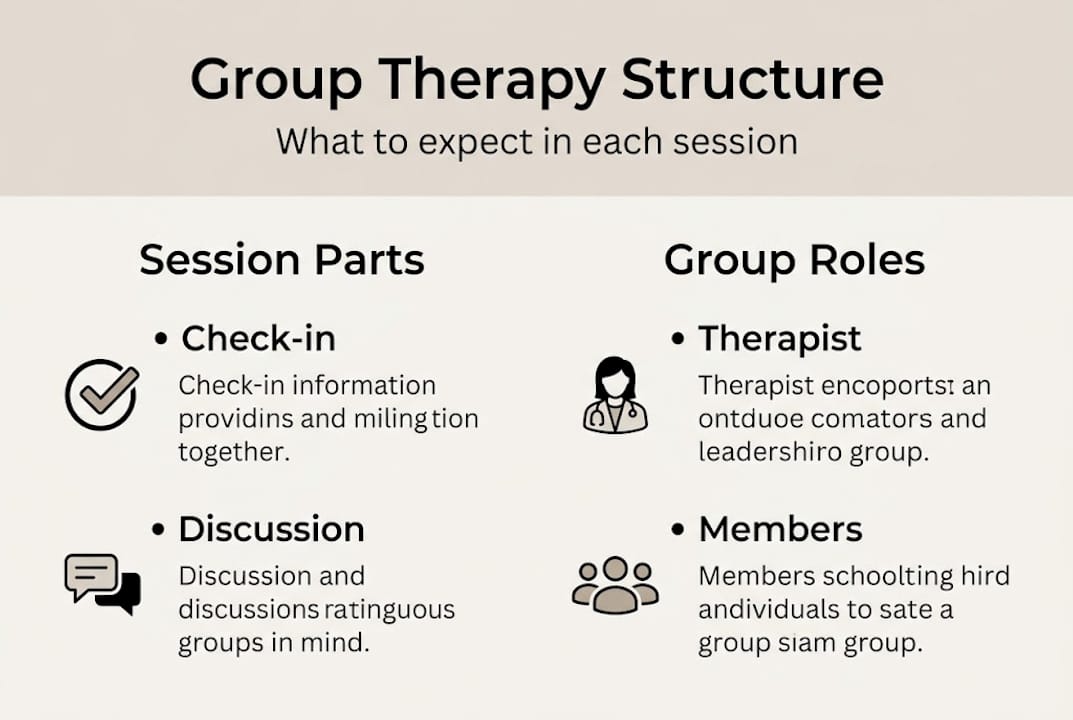
Understanding the group therapy session structure helps reduce anxiety about joining. A typical session begins with the therapist establishing group norms, reviewing confidentiality agreements, and inviting participation. Members are not forced to share, but the expectation is that everyone engages over time. Most groups meet weekly, and consistent attendance is important because trust builds incrementally.
Group therapy vs. support group vs. individual therapy
| Feature | Group therapy | Support group | Individual therapy |
|---|---|---|---|
| Leadership | Licensed therapist | Peer-led or volunteer | Licensed therapist |
| Clinical structure | Yes | No | Yes |
| Goal | Skill-building and healing | Shared experience | Personalized growth |
| Cost | Lower per session | Often free | Higher per session |
| Best for | Anxiety, depression, trauma, relationships | Grief, addiction, chronic illness | Complex or acute needs |
Here is what you can generally expect when joining a group:
- Confidentiality agreement: Everything shared in the room stays in the room
- Active participation: You are expected to contribute, though at your own pace
- Therapist as guide: The therapist facilitates but does not dominate the conversation
- Attendance commitment: Most groups ask for a minimum number of sessions
- Feedback culture: Members are encouraged to offer supportive, honest responses to one another
Types of group therapy: Approaches and methodologies
Not all group therapy looks the same, and that is actually a strength. Different frameworks exist because different people need different tools.
Group therapy can use dynamic or interactional, CBT, psychodynamic, interpersonal, DBT, skills-based, or psychoeducational methodologies, and therapists select the approach based on the group’s shared goals and needs.
Common group therapy types and their applications
| Therapy type | Main focus | Example techniques | Best for |
|---|---|---|---|
| CBT group | Thought patterns and behavior | Cognitive restructuring, homework | Anxiety, depression |
| DBT group | Emotional regulation and distress tolerance | TIPP skills, mindfulness | Borderline traits, self-harm |
| Psychodynamic | Unconscious patterns and relationships | Free association, reflection | Long-term relational issues |
| Interpersonal | Here-and-now relationships | Role-playing, feedback | Social anxiety, grief |
| Psychoeducational | Knowledge and coping skills | Lectures, worksheets | OCD, PTSD, chronic illness |
| Process/Interactional | Group dynamics as the therapeutic tool | In-the-moment interaction | General emotional growth |
California-based therapists offering therapy options in California will often blend frameworks depending on what emerges in the group. A CBT group for anxiety, for example, might also incorporate mindfulness or interpersonal work when the session calls for it.
When exploring which type fits you, consider asking:
- What specific goals do I want to work on in a group setting?
- Am I looking to build practical coping skills, or do I want to explore deeper patterns?
- How comfortable am I with feedback from peers right now?
- Do I have experience with individual therapy that has given me a foundation to build on?
- What are the therapist’s credentials and training in this specific group modality?
How effective is group therapy? Evidence and real outcomes
The research on group therapy is not just encouraging. It is compelling. Meta-analyses show group therapy is as effective as individual therapy for anxiety, depression, trauma, and PTSD, with effect sizes that demand attention.
For anxiety, the effect size is g=0.86. For depression, it is g=0.73. For PTSD, it reaches g=1.18, which is a large effect by any clinical standard. These numbers reflect real change in real people, not just marginal improvements.
“Group therapy is not simply a cost-effective alternative to individual treatment. For many patients, particularly those struggling with shame, isolation, and interpersonal problems, the group itself becomes the most powerful healing agent.” — Clinical Psychologist, APA Monitor
Learning how therapy benefits mental health overall helps put these numbers in perspective. The group format adds benefits that individual therapy cannot fully replicate, and mental health access in California continues to improve as more group options become available statewide.
Here are the top three benefits unique to group therapy:
- Peer validation: Hearing that others share your fears, shame, or struggles reduces isolation in a way no therapist alone can provide
- Real-time interpersonal feedback: You practice and receive feedback on how you relate to others in a safe, guided environment
- Sense of community: Belonging to a group reduces the loneliness that often makes anxiety and depression worse
Pro Tip: When selecting a group, prioritize therapist credentials and ask whether the format is evidence-based. An interactional or CBT-based group with a licensed clinician will consistently outperform loosely structured alternatives.
Who is group therapy for—and when is it not the best fit?
Group therapy works well for a wide range of people, but it is not universal. Understanding who benefits most helps you make a more confident decision.
People who tend to thrive in group therapy share certain characteristics:
- They are motivated to change and open to feedback
- They struggle with anxiety, depression, trauma, or relationship patterns
- They feel isolated and want genuine connection with others who understand
- They are stable enough to hear other people’s pain without destabilizing
- They have some capacity for self-reflection and curiosity about their patterns
- They are willing to commit to regular attendance over several weeks or months
Some situations are not a good fit, at least not immediately. Acute crisis, disruptive substance use, and poor motivation may not be suitable for group therapy, and screening with the Group Readiness Questionnaire (a brief clinical tool that evaluates a person’s interpersonal functioning and group readiness) is often recommended before placement.
Someone in the middle of an acute psychiatric episode, for example, needs stabilization first. Someone who struggles to tolerate emotional vulnerability may find the group format overwhelming before they have built individual coping skills.
If you are unsure where to start, learning how to find a therapist in California can connect you with a clinician who will assess your readiness honestly and match you to the right level of care.
Pro Tip: Combining individual and group therapy often produces the best outcomes. Individual sessions allow you to process group experiences privately, while the group amplifies your growth in ways solo work cannot.
The group therapy experience: Practical insights and what to expect
Knowing the theory is useful. Knowing what it actually feels like to walk into a group therapy room is something else entirely.

In your first session, the therapist will usually set group norms: no interrupting, no giving unsolicited advice, and full confidentiality. You will likely introduce yourself briefly and say something about what brought you here. You are not expected to open up fully on day one. Most therapists understand that trust takes time.
Group size impacts cohesion and outcomes, and skilled group therapists invest heavily in early trust-building, address conflict directly when it arises, and use structured feedback tools to keep the group productive. Cohesion, which is the sense of belonging and safety within the group, is one of the most reliable predictors of positive outcomes.
“The therapy group is a social microcosm. The way members interact in the group mirrors exactly how they interact in the rest of their lives—and that is precisely where the healing happens.” — Irvin Yalom, Psychiatrist and Group Therapy Pioneer
One concept worth knowing is “rupture repair.” Conflict or discomfort will sometimes arise in a group. A skilled therapist does not avoid this. They use it. Working through tension in a safe environment teaches people how to handle similar situations outside the group, which is one of the benefits of psychotherapy that makes lasting change possible.
Pro Tip: The members who get the most from group therapy are the ones who show up consistently and practice being honest, even when it feels uncomfortable. Growth lives just outside your comfort zone.
Why group therapy deserves more recognition in California
Here is an uncomfortable truth: group therapy is underutilized not because of lack of evidence, but because of stigma and training gaps, despite having parity with individual therapy. That is a problem we need to name directly.
We see this in our work at ReviveHealthTherapy. People come in expecting to be offered individual sessions as the gold standard, sometimes apologizing for “only” being in a group. That framing needs to change. Group therapy is not a gentle rinse when you can’t afford the power wash. It is a completely different tool that sometimes works better, especially when the core issue involves how a person connects with others.
California’s well-documented shortage of mental health providers also makes group therapy not just valuable, but necessary. More people can access care, costs are lower per session, and the peer experience often accelerates growth in ways that individual therapy takes longer to achieve.
For trauma recovery therapy options, group formats have specific advantages: shared experience reduces shame, and witnessing others’ progress creates hope. These are not minor benefits. They are often the turning point.
Group therapy should be considered a first-line option, not a last resort, for anxiety, depression, trauma, and relationship challenges.
Take your next step: Explore group therapy in California
Group therapy is evidence-based, effective, and often more accessible than individual therapy, especially here in California where mental health needs are high and provider availability is stretched.
At ReviveHealthTherapy, we offer trauma-informed, evidence-based therapy services across California, with in-person care in Walnut Creek and Oakland and telehealth available statewide. Whether you are exploring trauma-informed therapy benefits or ready to review evidence-based psychotherapy options that fit your life and budget, we are here to help. Sliding-scale fees and insurance, including HSA/FSA plans, make it easier than ever to start. Connect with a therapist today and find the right group for where you are right now.
Frequently asked questions
What conditions are best treated with group therapy?
Group therapy is highly effective for anxiety, depression, trauma, including PTSD, and relationship challenges, particularly when peer support and social skill-building are part of the healing process. Empirical data confirms strong outcomes across all of these conditions.
How many people are in a typical group therapy session?
Most group therapy sessions have between 5 and 10 participants, which is the optimal size for group cohesion, meaningful interaction, and positive outcomes.
Is group therapy as effective as individual therapy?
Yes. Research shows group therapy matches individual therapy in effectiveness for many conditions, and for issues involving interpersonal patterns and isolation, the group format can have a stronger impact.
What happens if a group member disrupts the session?
Therapists address disruptions directly to protect the group’s safety and trust. Interpersonal challenges are handled promptly in well-run groups, and careful screening before admission helps prevent serious disruptions.
How do I know if group therapy is the right choice for me?
A therapist will evaluate your current needs, stability, and goals, sometimes using a formal screening tool like the Group Readiness Questionnaire, to determine whether group therapy is a strong fit for where you are right now.
Recommended
- Therapy session structure: Evidence-based approaches explained – Revive Health Therapy
- Therapeutic modalities explained: 35% better outcomes in 2026 – ReviveHealthTherapy
- Explaining therapy goals: a clear guide for California adults – Revive Health Therapy
- How to Choose Therapy Type for Your Mental Health Needs – ReviveHealthTherapy