
When your teenager seems withdrawn, anxious, or persistently sad, it’s tempting to hope they’ll simply grow out of it. But anxiety and depression in adolescents are real, diagnosable conditions, not just phases. CBT for adolescents is a structured, time-limited psychotherapy that targets the connection between thoughts, feelings, and behaviors, and it’s proven effective for youth aged 7 to 18. In this article, you’ll learn exactly what CBT is, how sessions work, what the research says about outcomes, and how California families can access this support today.
Table of Contents
- What is CBT for adolescents?
- Core methods and session structure in CBT
- Effectiveness: What the research says about CBT outcomes
- Accessing CBT in California: Rights, options, and resources
- Tips for finding the right CBT provider and maximizing outcomes
- Connect your teen with effective CBT support
- Frequently asked questions
Key Takeaways
| Point | Details |
|---|---|
| CBT is proven effective | Cognitive Behavioral Therapy is backed by research for treating anxiety and depression in adolescents. |
| Accessible in California | Teens can access CBT through clinics, schools, and telehealth, with self-consent rights from age 12. |
| Family involvement helps | Including family sessions improves therapy outcomes for many teens. |
| Choose evidence-based providers | Seek out licensed therapists who use structured, research-supported CBT approaches. |
What is CBT for adolescents?
Cognitive Behavioral Therapy, or CBT, is built on one core idea: the way we think shapes the way we feel, and the way we feel shapes what we do. For teens struggling with anxiety or depression, this cycle can become a trap. CBT teaches them to recognize unhelpful thought patterns and replace them with more balanced, realistic ones.
This isn’t vague talk therapy. CBT is goal-oriented, structured, and time-limited, which means your teen works toward specific, measurable changes over a defined period. That structure is actually one of the reasons it works so well for adolescents, who often respond better to clear expectations and visible progress.
“CBT for adolescents is a structured, time-limited psychotherapy focusing on the interplay between thoughts, feelings, and behaviors, particularly effective for anxiety and depression in youth aged 7 to 18.”
The research backing is strong. CBT increases remission of primary anxiety diagnoses compared to waitlists, and for depression, combining CBT with medication like fluoxetine produces the best outcomes. School-based CBT programs have also shown meaningful reductions in depression symptoms.
Here’s what makes CBT especially well-suited for teens:
- It teaches practical, transferable skills teens can use outside of sessions
- It’s collaborative, meaning the therapist and teen work as a team
- It addresses both anxiety and depression, which often co-occur in adolescents
- It involves parents strategically, without making teens feel like they have no voice
- It’s backed by decades of research across diverse youth populations
If you’re exploring CBT for teen anxiety or looking into CBT for adolescent depression, understanding this foundation helps you ask better questions when choosing a provider.
Core methods and session structure in CBT
Knowing what actually happens inside a CBT session removes a lot of the mystery and helps your teen feel less anxious about starting. A typical course of CBT for adolescents spans 12 to 20 weekly sessions, each lasting 45 to 60 minutes. Sessions follow a logical progression.
| Phase | What happens |
|---|---|
| Assessment | Therapist identifies core concerns, triggers, and goals |
| Psychoeducation | Teen learns how thoughts, feelings, and behaviors connect |
| Skills practice | Core techniques are introduced and practiced in session |
| Homework | Teen applies skills between sessions in real-life situations |
| Review and consolidation | Progress is measured and skills are reinforced |
The methods used in CBT are practical and teachable. Here’s a breakdown of the most common ones:
- Cognitive restructuring — Identifying distorted thoughts (like “everyone hates me”) and replacing them with balanced ones
- Exposure therapy — Gradually facing feared situations to reduce avoidance and anxiety over time
- Behavioral activation — Scheduling enjoyable or meaningful activities to counter depression-driven withdrawal
- Relaxation techniques — Deep breathing, progressive muscle relaxation, and grounding exercises
- Homework assignments — Real-world practice that reinforces what’s learned in session
Parents often play a meaningful role in this process. CBT family sessions can help you understand what your teen is working on and how to support them at home without accidentally reinforcing avoidance. Research consistently shows that family involvement in teen CBT improves outcomes, especially for younger adolescents.
Pro Tip: Ask the therapist to share a brief summary of each session’s focus so you can reinforce skills at home without prying into your teen’s private disclosures.
Effectiveness: What the research says about CBT outcomes
Parents reasonably want to know: does this actually work? The short answer is yes, especially for anxiety. The longer answer involves some important nuance.

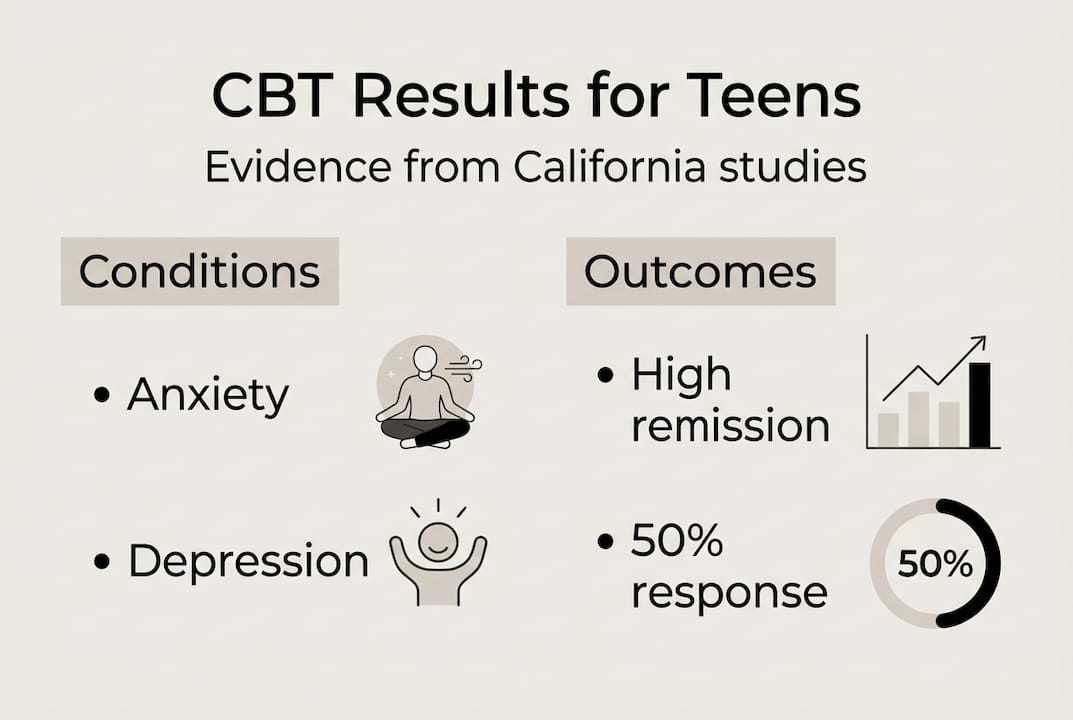
For anxiety disorders, the evidence is compelling. CBT increases remission with an odds ratio of 5.45 and a number needed to treat of just 3, meaning roughly 1 in 3 teens who complete CBT achieves full remission of their primary anxiety diagnosis. That’s a significant result.
| Condition | CBT alone | CBT + medication | Waitlist/no treatment |
|---|---|---|---|
| Anxiety | High remission rates | Comparable or better | Significantly worse |
| Mild to moderate depression | ~50% response rate | Best outcomes | Significantly worse |
| Severe depression | Less effective alone | Strongly recommended | Significantly worse |
For depression, about 50% of teens respond to CBT, and effects are often sustained at the six-month follow-up. However, CBT alone is less effective for severe or treatment-resistant depression. In those cases, combining CBT with medication produces meaningfully better outcomes.
School-based programs also show promise. CBT effectiveness in schools has been documented in multiple studies, making it a viable option for teens who can’t easily access private therapy.
Pro Tip: If your teen has been diagnosed with severe depression, ask the treating provider directly whether a combined approach with medication is appropriate. Don’t wait for them to bring it up.
Accessing CBT in California: Rights, options, and resources
California has some of the most teen-friendly mental health access laws in the country. Understanding them puts you in a much stronger position as a parent.
Under California law, minors aged 12 and older can consent to outpatient mental health services, including CBT, if a provider determines they are mature enough and that parental involvement would be inappropriate.
This doesn’t mean your teen will be shut out from your support. It means that if a teen is reluctant to seek help because they fear parental judgment, they still have a legal pathway to care. In practice, most providers encourage family involvement when the teen is comfortable with it.
Here’s a quick overview of where California teens can access CBT:
- Private practices — Licensed therapists in cities like Walnut Creek and Oakland offering individual and family CBT
- Medi-Cal — California’s Medicaid program covers mental health services for eligible teens at no cost
- School-based programs — Many California schools offer counseling and structured CBT-based groups
- Telehealth — Secure video sessions available statewide, removing geographic and transportation barriers
- Community mental health centers — Sliding-scale and low-cost options for families without insurance
CBT access for California families has expanded significantly with telehealth. If you’re unsure whether your family qualifies for covered services, reviewing therapy accessibility in California can clarify your options. Many families are surprised to learn that insurance and CBT coverage is broader than expected, and telehealth mental health options now make it possible to connect with a qualified CBT therapist from anywhere in the state.
Tips for finding the right CBT provider and maximizing outcomes
Not every therapist who mentions CBT is equally trained in it. Here’s how to find the right fit and set your teen up for success.
- Verify CBT-specific training — Ask whether the therapist has formal training or certification in CBT, not just general familiarity with the approach
- Check licensure — Look for licensed clinical social workers (LCSWs), licensed marriage and family therapists (LMFTs), or psychologists with adolescent experience
- Ask about session structure — A genuine CBT provider will describe a clear, phased approach with homework and measurable goals
- Consider family sessions — Evidence-based providers consistently recommend combining individual teen CBT with family sessions for better outcomes
- Evaluate digital options carefully — Online therapy choices for teens can be effective and convenient, but face-to-face therapy remains the gold standard for most adolescents
- Stay involved without hovering — Family therapy and CBT work best when parents are informed partners, not passive bystanders or overcontrolling managers
Progress in CBT is measurable. Ask the therapist what tools they use to track symptom changes, such as standardized questionnaires, so you have objective data alongside your teen’s self-report. If progress stalls after 8 to 10 sessions, it’s reasonable to ask whether the treatment plan needs adjustment.
Pro Tip: Before the first session, sit down with your teen and ask what they hope to feel or do differently in three months. Having a personal goal, in their own words, increases engagement and motivation throughout the process.
Connect your teen with effective CBT support
If this article has made one thing clear, it’s that anxiety and depression in teens are treatable, and CBT is one of the most well-researched tools available. The next step is finding a provider who delivers it well.
At Revive Health Therapy, we offer teen therapy grounded in evidence-based approaches including CBT, available both in-person in Walnut Creek and Oakland and via secure telehealth across California. Whether your teen is dealing with anxiety, depression, or both, our therapists tailor treatment to their specific needs and involve families in ways that strengthen, not complicate, the process. We also offer CBT for families to help the whole household navigate this together. If you’re still weighing whether therapy is the right move, exploring why seek psychotherapy can help you feel more confident in that decision. Reach out today to schedule a consultation.
Frequently asked questions
Can my teen start CBT without my consent in California?
Yes. Teens aged 12 and older can consent to outpatient mental health services, including CBT, if a provider determines they are mature enough and that parental involvement would not be appropriate.
How long does CBT for adolescents typically last?
Most CBT programs for teens involve 12 to 20 weekly sessions, each lasting 45 to 60 minutes, though the exact length depends on the teen’s specific needs and progress.
Is CBT effective for all teens with depression or anxiety?
CBT is highly effective for anxiety and helps roughly 50% of teens with depression. For severe or treatment-resistant depression, combining CBT with medication produces significantly better results.
Are online CBT options effective for California teens?
Digital CBT is promising and meaningfully increases access for teens in rural or underserved areas, but face-to-face therapy remains the gold standard for most adolescents.
What’s the difference between CBT and other types of therapy for teens?
CBT is structured and skills-focused, teaching teens specific tools to change thought and behavior patterns. Other therapies may emphasize insight or relationships more than practical skill-building, which suits some teens better depending on their needs.
Recommended
- Teen Therapy: Key Benefits for California Families – ReviveHealthTherapy
- Therapy for Teens: Key Approaches and Real Impact – ReviveHealthTherapy
- CBT for families: how therapy helps California families – Revive Health Therapy
- Start teen counseling in California: 2026 parent guide – ReviveHealthTherapy
3 Responses